Welcome back to the second installment of the 2018 Dancing with Noah NBA draft big board where we’ll dive into players 19 through 24: Aaron Holiday, Khyri Thomas, Mitchell Robinson, De’Anthony Melton, Anfernee Simons, and Melvin Frazier. There’s a weird glut of tough defensive guys (Thomas, Holiday in a way, Frazier though I’m suspicious of his shooting, Melton who’s more like a non-scoring young Dwyane Wade) and mysterious kids in Simons and Robinson who didn’t play college ball this past season. As a group of scouts (I use that extremely loosely), we had the greatest variation on Melton who had a standard deviation of 6.3 and the least on Simons at 2.3. In some ways, the lack of footage and up-to-date scouting makes it more difficult to develop strong perspectives on Robinson and Simons who both look like world beaters in their YouTube clips. The college guys, by contrast, have reams of tape which leave them vulnerable to having their weaknesses picked at until a narrative feedback loop develops. Try as we might to avoid these feedback loops, the truth is that they likely infiltrate in ways we’re not even aware.
Enough of our foibles, let’s get on with the future:
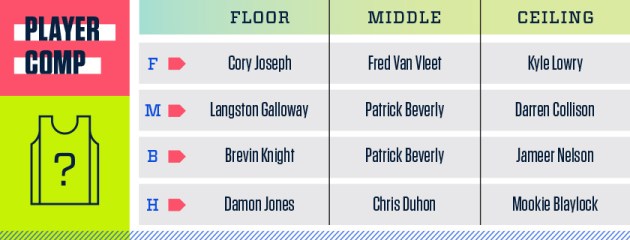 Hamilton: Aaron Holiday put up consistently solid numbers in his three years at UCLA proving himself a reliable shooter and scorer. He made over 40% of his threes in each season and wasn’t afraid to put them up there. He had an interesting tenure in Westwood, starting all 32 games as a freshman, then zero as a sophomore (behind Lonzo), and then all 33 his junior year. That’s a unique career arc and one that a lot of college players don’t follow. Holiday could have left the program when Lonzo and Big Baller Brand came in, but he stayed and proved he could still produce off the bench. Getting back into the starting lineup in his junior season helped propel him to the first 20ppg season at UCLA since Ed O’Bannon in 1995. He has a pro pedigree and a quick shot with plenty of range. He doesn’t elevate much on his threes but releases shots quickly – like a slightly smoother-looking Eric Gordon. He plays sort of like his older brother, Jrue, but he’s much smaller. And that’s probably going to be most limiting factor for Aaron Holiday. He’s only 6’1” and 185 pounds. On offense, he makes up for this with a good hesitation move and the ability to split defenders and knife through tight spaces with his dribble. He navigates pick and rolls situations pretty well and is comfortable pulling up from well beyond 22-feet. Defensively is where he could be in real trouble as teams go after players with physical limitations and hunt for switches. He’s likely a backup PG for the foreseeable future, and more likely, for his entire career. His sophomore year at UCLA provides evidence he’s comfortable in that role.


Bug: From the moment Khyri Thomas stepped on campus at Creighton, he was already a problem for opposing teams on the defensive end. Tazz, as he is affectionately known by friends and family, is the reigning two-time Big East Defensive Player of the Year and one of the premier perimeter defenders in this draft class. He’s a bit undersized for an NBA two-guard at 6’3”, but he more than makes up for his height with a 6’10” wingspan that will allow him to contest shots against bigger guards in the league. Although he doesn’t have the high steal numbers that you would expect from a DPOY, he plays a lockdown style of defense without gambling for steals and putting his teammates in a bad spot. Tazz is capable of guarding both backcourt positions and may be able to matchup with some small forwards in small ball lineups. His defensive accolades are well known, but it’s his steady improvement on the offensive side that has NBA circles buzzing. Khyri jumped his scoring up to 15ppg his junior season on only ten attempts-per-contest, while also shooting a 41% clip from three on 4.6 attempts-per-game (40% career from deep). Much like on the defensive end, Thomas is poised and smooth on offense, taking what the defense gives him. From a style of play and size standpoint, he compares favorably to Avery Bradley. He’s going to give everything he has on defense, while also being capable of knocking down the open shot or getting to the rim and finishing if he’s run off the three-point line. The thing impacting Khyri’s draft slot the most is his age. Already 22, Thomas spent a year in prep school before his three seasons at Creighton, making him the age of a college senior. That will raise questions about his ceiling, but he’s somewhat of a late bloomer who still has some room to grow. Creighton coach Greg McDermott refers to him as a “zero maintenance player” and overall, he’s one of the safest players in this draft. He’s ready to play immediately as a 3-and-D wing and has the potential to work his way into a starting role down the road if he finds the right fit on the right team. I’m projecting Thomas will go in the 20s, but I wouldn’t be surprised if a team falls in love with him in the late teens.
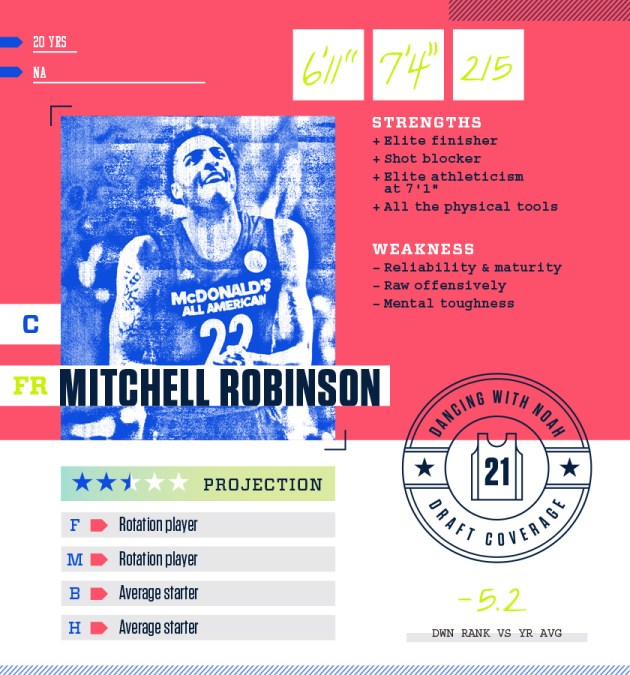
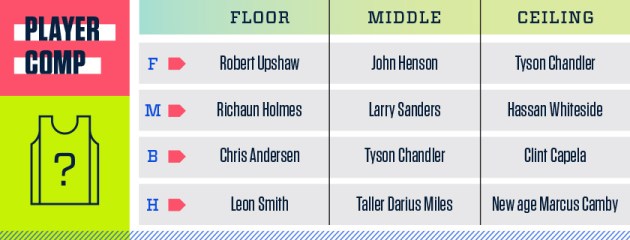
Bug: Almost every college basketball recruiting site in the country had Mitchell Robinson pegged as a five-star, top-10 recruit in the spring of 2017. Everything was going great for Robinson, who not only destroyed overmatched high school competition (25.7 points, 12.6 rebounds, and six blocked shots per contest), but he also shredded the Nike EYBL circuit as well. ESPN’s Jonathan Givony reported that Mitchell Robinson had the highest Nike EYBL player efficiency ranking (40.5) in the history of their database. Robinson was being mentioned in the same breath as Mo Bamba, Marvin Bagley, and Deandre Ayton as future NBA lottery picks, as well as being selected as a 2017 McDonald’s All-American. Everything took a turn when Robinson reported to campus at Western Kentucky the summer before his freshman year of college. Former UNC star Shammond Williams, who is also Robinson’s godfather, resigned from the Western Kentucky staff. Coach Williams was probably the sole reason Robinson went to WKU, so there was immediate tension that eventually led to Robinson asking for and being granted his release to transfer. Robinson decided to return to Western Kentucky, only to abandon his team a second time shortly after. Although Robinson has immense talent and potential, the way he handled the situation at WKU has really put a rain cloud over his draft stock and raised maturity concerns. Just when NBA execs thought they were going to get a look at how hard Robinson had been working while sitting out the entire season, he threw everyone another curveball by withdrawing from all NBA Combine activities the day the combine started. One thing NBA scouts do not like when investing millions of dollars into a player is flying blind on their evaluation. I’m assuming Robinson will hold his own private pro day, but the red flags have already been planted.
That said, I’ve had to resort to pouring over every YouTube highlight reel I could find to get a good read on Robinson’s game. After a few clips, it’s easy to see why college coaches and NBA scouts were salivating over him only a year ago. There are two things that really stand out as elite talents that Robinson possesses: 1) he can finish with authority on everything around the rim, and 2) he is an elite shot blocker. Robinson’s dunk and block radius around the rim are insane. Mo Bamba and Jaren Jackson are ranked at the top of the draft based on their defensive prowess, but this kid might be better than both of them on the defensive end. We see him step out and hit the occasional three, but that isn’t going to be his thing in the NBA. Robinson appears to be extremely raw when it comes to post moves and footwork, but there’s a role for him in today’s NBA as a defensive-minded rim-runner in the mold of Clint Capela or DeAndre Jordan. The dilemma for NBA execs is whether or not the talent outweighs the red flags. Robinson has the talent to be a lottery pick, but you can’t help but question whether he is playing the game because he is good at basketball or because he loves the game. I think there will be a team in the late lottery or just outside the lottery that is willing to take that gamble.

 Hamilton: Good players normally develop a lot between freshman and sophomore years. So De’Anthony Melton’s draft stock might very well be higher if he had played for USC this season. Unfortunately, Melton missed his potential breakout year after his name came up in the FBI’s investigation into NCAA basketball. The offensive numbers in his freshman year were average. Indeed, 28% from three and 70% FT is nothing to write home about. Eight-ppg is pedestrian too. It’s reasonable those numbers would have been better this year. How much better, we’ll never know. What you know for sure watching Melton is that he is all over the court and puts an imprint on games. On defense, he reads and reacts quickly as the ball moves getting his hands all over passes, loose balls, and rebounds. A 6’3”ish player getting seven rebounds and 2.8 steals per-40-minutes isn’t messing around. College players tend to gamble on defense and Melton isn’t an exception. But he is instinctual in his gambles and quick enough to recover when he guesses wrong. He loves to push the ball on steals or rebounds, and keeps his head and eyes up looking to attack the basket or pass ahead. He has good feet and balance which helps him attack on both ends. His shot itself doesn’t look bad and if he can become an average three-point shooter and better than 75% from FT, there’s a path to becoming a top guard in this class. Markelle Fultz had a disappointing rookie year, but during his lone NCAA season when he proved himself to be the top pick, Melton got 16 points, six rebounds, six assists, and six steals in a head-to-head matchup. If he can’t realize his full potential, some team picking in the mid-late first round is going to get good value and be really happy about it.
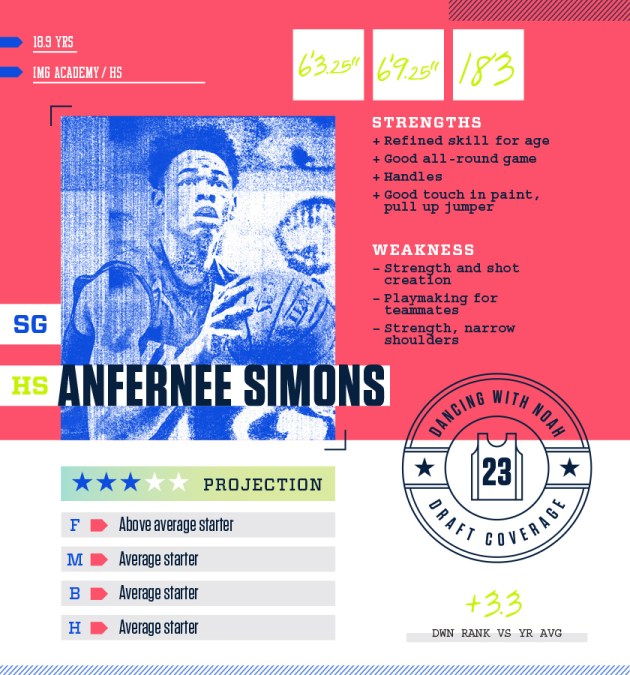
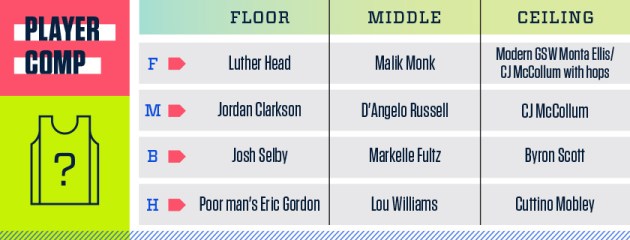
Fenrich: Anfernee Simons of the great state of Florida, home of the mighty Seminole and infamous stand your ground laws, will turn 19 in a couple weeks and he’ll be drafted into the NBA in about a month. He’s a 6’3” two-guard and pretty much every clip I’ve seen of him is scoring-related: he’s shooting deep threes with his feet wide apart, pulling up for jumpers off the dribble with a comfort and calm that makes you forget he can legally buy cigarettes, but not wine coolers. He dunks with ease off two feet or one foot, capable of gathering and going straight up through the rim which was supported by his 32” standing vertical and 41.5” max vertical at the Chicago combine. His handle is summer breeze cool even if he’s been a little right-hand heavy. At almost-19, he looks like a professional scorer, but he still looks 19 with a soft babyish face, high cheekbones, and a lean frame. The knock on Simons, and you don’t see this in his high school clips, is that he’s lacking strength and you can see it on that still-developing body. I’m a little less-concerned about his strength and probably more about his tweener size and the lack of playmaking I’ve seen from him. Simons spent the 2017-18 season at IMG Academy where he trained as a prep year without actually playing for the IMG team. This blind spot of an entire, development-heavy age-18 season is a big one. If and how he’s been able to develop any playmaking skills as an undersized off guard is going to impact his ability to see the court as a young player. Measurement-wise, he’s like a leaner Victor Oladipo or a shorter, more explosive D’Angelo Russell, but I don’t get the sense he has the playmaking skill of either of those guys which isn’t to say it can’t be developed. Oladipo’s made strides in his creation, so it can definitely be done. Malik Monk comes to mind as an undersized scoring guard who compares well, at least physically, to Simons though Simons has a bit more Brandon Roy whereas Monk had a bit more Monta Ellis or Kevin Johnson punch to his game. With his still-developing physique and youthful face, it seems like it’s easy to forget that Simons is in the same peer set age-wise as DeAndre Ayton, Luka Doncic, and Wendell Carter. What he’s lacking in stature though, he accounts for in skill and it’s not like he’s a Kyle Anderson-level athlete – his vertical is 41.5”! There’s a player here with a mega upside; one that only intensifies if he realizes the finer arts of defense and playmaking. Patience, as is often the case with our precocious savants (there I go again painting him as younger than he is), is the key and his landing spot is critical to his evolution and success.


It feels a little dehumanizing to refer to athletes as “freaks,” but in basketball parlance, Melvin Frazier is a freak. He’s a Jordanesque 6’6,” but has the wings of a predatory creature of flight at nearly 7’2”. At the combine, he registered a max vertical over 40”. Defense is Frazier’s meal ticket as his offense has been a work-in-progress since Tulane hired former NBA player and coach and the father of Mike Dunleavy Jr, Mike Dunleavy Sr, before Frazier’s sophomore season. Guarding the ball, he covers a ton of ground with his defensive slides and strong lateral movement. Even if his opponent is able to get a step, he’s long and quick enough with enough explosiveness to recover and at least harass the opposition. He reminds me a bit of Andre Iguodala in that he often keeps his hands down while playing defense. With the arms down, Frazier is frequently out of position on box outs. In Frazier’s case, this feels like a bad habit he’s been able to get away with in the American Athletic Conference. Despite his defensive impact (2.2 steals and nearly a block-per-game as a junior), he seems prone to defensive lapses. In limited tape I reviewed, he was beat off the dribble by a lesser attacker, gave up on a play after making an initial stop, and was beat backdoor because he wasn’t paying full attention. Multiple times he broke on a pass like he was playing defensive back, only to mistime the ball and leave his team at a disadvantage. Maybe more disconcerting, for me at least, was his critiquing a teammate on a miscommunication a switch. It’s minor, but his body language sometimes leaves a little to be desired (slumped shoulders and the teammate critique).
So how is a player with all these little defensive warts and an offensive game that, while showing flashes of feel (particularly on his court vision), has a long way to go being considered as a first round talent? His measurements, reflexes, and defensive instincts are pro level. With just a little discretion and accountability on the defensive side, Frazier could give quality minutes to an NBA team today. His shooting has significantly improved each year at Tulane with his true shooting going from 47% to 53% to 63% as a junior. This is all well and good, but the mechanics, both on his catch and shoot, and even more so on his pull up jumper, have a ways to go. Given that he has just 91 three-point attempts at the 38% clip versus 169 attempts (soph and frosh) as a 27% shooter, I’m not convinced that he’s fully turned the corner as a shooter, particularly as the range extends in the NBA. My issues with Frazier are primarily things you can teach: defensive habits, jump shot mechanics, interpersonal communication. The things you can’t teach like length and athleticism are already prevalent. If Frazier is willing to work and learn, he has the tools to be a long-time NBA player. But for every Kelly Oubre or Josh Howard (players who have comparable measurements to Frazier), there’s a lot more of the Lenny Cooke, Adonis Thomas, or Renaldo Balkmans; players who had the tools, but not the wherewithal to use them to the best of their ability.




 Dancing With Noah