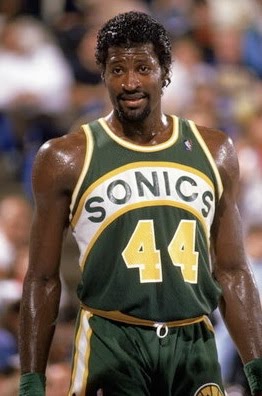
While the former should be the focus of this sketch, I can’t help but consider my memory of Cage’s dark skin glistening with sweat, strong stretching hands corralling yet another rebound, exhaling, sweat flying and that jheri curl resting intact, maybe bouncing ever so slightly as Cage throws an outlet pass and runs the floor. Cage’s best years were with the Clippers and Sonics and he wore the jheri until at least his Sonics days. It was sometime in the 90s that he retired that dying do, exchanging it for a more contemporary, more assimilated low fade. Cage adopted the fade sometime after the jheri was infamously mocked (and likely ruined for many) by Eriq LaSalle’s character in Coming to America.
But Cage was clearly more than a hairstyle. He was a rebounding champion (13rpg in 1988), a 6’9” power forward/center with a classically v-shaped frame prone to casual lefty dunks and an unflashy, functional style of play. The highlight video below is mostly uninspiring by today’s standards—with the exception of the last five seconds. From a purely statistical output perspective, Cage brings to mind Troy Murphy. The comparisons end there though as Murphy was an auburn-haired, pasty-colored distance shooting big while Cage was nicknamed “John Shaft.”
You remember Aaron McKie? You do. Combo guard, Philadelphia through and through. Through to the point that he was a Temple grad. Philly to the point that he went to Simon Gratz (I just learned this). City of Brotherly Love to the point that he was black like The Roots (all the way live from 2-1-5) with a goatee, but not a beard. He wasn’t drafted by the 76ers, but somehow, through some cosmic Andrew Toneyisms and Eric Snowdens, his qi guided him back home. McKie was a big-bodied, defensive minded, role playing guard. A physical presence to counterbalance the reckless litheness of Allen Iverson. McKie wasn’t much of a jump shooter and he cut against the grain of things by wearing number eight, but he was a lunch pail and hardhat guy in a blue collar, frill-free way that Philly can embrace. McKie embodied his hometown: Philly like a cold wind, Philly like booing an injured opponent, Philly like unfair expectations, Philly like Von Hayes.
For present-day comparisons, feel free to compare McKie to a more horizontal and technical, less athletic version of Tony Allen.
Dan Majerle was a 6’6” shooting guard with model good looks, a square jaw, a full head of brown hair, and a tan of Hasselhoffian proportions. “Thunder Dan” as he was known bombed threes before it became en vogue. In that sense, one could say he was ahead of his time. Sandwiched between a career spent in sunny Phoenix and on the sandy beaches of Miami was an out of context year in Cleveland which signaled the onset of his deterioration in which he possibly could’ve been referred to as “Cloudy Dan” by someone with a poor sense of humor. Majerle will forever be remembered for his role on the Barkley-led Suns teams and for being an object of the great Michael Jordan’s disdain in the 1993 Finals.
A three-time all-star, Majerle could oddly be considered a beiger, more pleasant version of Arron Afflalo or even a darker, more muscularly violent (in play only) version of Brent Barry.
In the commercial below, “Thunder Dan” can be heard asking for a stat that quantifies hustle (again, ahead of his time). While this may have been one of his calling cards, it’s not one with which I’m deeply familiar. If someone was bored, they could easily sub in Shane Battier footage with Majerle’s commentary.
Dino Radja was a 6’11”, somewhat sallow-colored offensive-minded front court player for the Boston Celtics in the early-to-mid 90s. His time with the Celtics was spent shedding defenders with his patented baseline spin move and deftly scoring in and around the hoop (he maxed out at ~20 and 10 in 1996) while assimilating into the Celtics culture by wearing bulky, bulging, inky black sneakers just as Bird, McHale, and Parrish had done before him. The black shoes these Celtics wore brought to mind something weighty like an anvil or some industrial-era workman’s footwear – not basketball shoes. Radja was also a member of the 1992 Croatian Olympic team; a group that featured Toni Kukoc, Drazen Petrovic and Zan Tabak and in another time and place, may have won gold. There’s certainly more to Radja’s story, but alas the NBA chapter is short as he appeared in just four seasons and played an average of 56 games/year. His tenure in the league, and more specifically the Celtics and then-coach Rick Pitino, ended disappointingly:
I went to Pitino and asked him if I fit into his plans. With a new coach, I obviously wanted to know what he thought of my game. I loved playing for Boston and just wanted to find out if there was any possibility I might be traded, because I had heard some rumors. Pitino looked me right in the eyes and said, ‘Dino, don’t worry. You’re going to be a big part of our offense. When we run a set play, the ball is going to go through you.’ I left the meeting feeling great. Five days later, I found out I was being traded to Philadelphia. I can’t tell you how much I felt betrayed. Either Pitino lied or something changed in a matter of a few days.
When I picture Sedale Threatt in my mind’s eye, he’s darker than he actually was, his head is so cleanly shaved that one might wonder if it even contains hair follicles, and his hands are like knives, slicing and stabbing away at the ball from absentminded ball-handlers and clumsy clods. Even in my minimal research, it turns out he was referred to as “The Thief.” Threatt was short for a combo guard (6’2”) and spent five of his 13 seasons in a Lakers uniform, but I also associate him with the Sonics where he spent four years. If you want to consider a modern-day Threatt, look to Mario Chalmers; another thieving point guard, but on less offensively aggressive by circumstance, but superior from the perimeter.
Additional Threatt research confirmed my suspicions that Threatt had some infamous off-court issues; namely that he may “have as many as 14” children and wasn’t paying child support.
I struggled about whether or not to include the reference to Threatt’s off-court issues, but ultimately decided on adding them as they make up part of my Threatt-related consciousness. In some cases, this can be problematic as certain athletes have their on-court/on-field personas unfairly overshadowed by off-field activities. As I move through these sketches, I will likely address legal or personal issues on a case-by-case basis and strive to be unbiased.
There’s so little I know about Mark West. He was an undersized (6’10”) starting center on a series of competitive Suns teams. He wore number 41 and was black with black moustache. He always shot well from the field (research shows he’s fourth all-time in career FG%). On first glance, without the benefit of seeing or knowing his height, he could’ve been anything, worked any job in any business or trade. Picture Mark West in a hard hat or a suit and tie and it’s the same; a trooper, a worker bee, a brick in the wall. This isn’t a slight on West by any means as the majority of us move through life as relative bricks in relative walls.
But Mark West was tall and while he may have been average by NBA standards, he had enough ability to stick for 17 seasons. Those Suns seasons when many of us probably remember him were spent in a supporting role to bigger and brighter stars and personalities like Kevin Johnson, Xavier McDaniel, Chuck Barkley, Dan Majerle, Jeff Hornacek and was even outshone by coach Paul Westphal. West also attended Old Dominion University and is profiled in a video below during his ODU days. A fair comparison in terms of present-day ability is a lesser version of Emeka Okafor – an undersized defensive center clearly attuned to his role within the team dynamic.
Mark West on left sharing a laugh with current Suns coach Jeff Hornacek
Tom Chambers was an ultra-athletic white guy who played power forward for 16 seasons in the NBA and was known primarily for his time with the Suns and Sonics. At 6’10”, he used a combination of size, skill, and athleticism most effectively on the offensive side of the ball where he was a career 18ppg scorer and maxed out with seasons of 25 and 27ppg. He struggled to get notoriety against the bigger and bolder bodies of work of Barkley and Karl Malone, but make no mistake, this one-time all-star MVP was like a more fluid, less violent version of Amare Stoudemire.
My strongest memories of Chambers are dunk-related. As a kid, I played the shit out of some Sega Genesis and the pixelated Tom Chambers looked like some kind of tanned surfer-turned-basketball player with an array of dunks so unfathomable as to appear as if he sprouted from the imagination of a panel of dunk gods insistent on challenging existing dunker archetypes. In truth, his pixelated doppelganger was likely inspired by his legendary dunk on Mark Jackson in which he caught the ball on a break and used the chest of the 6’3” Jackson as a springboard to reach heights that wouldn’t be realized until the Blake Griffin/LeBron James era of dunkers.

 Dancing With Noah