You can lose all sorts of things. There’s Nas’s “Lost Tapes,” the Lost Boys and the Lost Boyz. People lose themselves, lose their keys, lose games. Lost lives, lost loves. You can lose anything tangible or intangible. Then there’s the four-plus seasons Magic Johnson lost to a lack of understanding around the human immunodeficiency virus (HIV). Losing a few seasons wasn’t life or death, it exceeded basketball in the sense that it challenged misconceptions around HIV/AIDS and continues to do so today – over 22 years later. When I write about “lost years” here, I’m referring specifically to an on-court context as Magic’s contracting HIV had a broader, further reach than anything he could’ve done a on basketball court. To that point, the power of Magic’s very public relationship with HIV has been covered more in depth and with more consideration than I can hope to, but what I remain curious about is what would’ve happened from 1991 to 1996 when a post-prime Magic still would’ve been gliding up the court, knees braced, fingers wrapped in tape, freezing indecisive defenders will telegenic lookaways, gold jersey with big purple 3-2 shadowed in white, pumping out stats so rare that he has no statistical comparison. What would’ve been?
It was last week I stumbled across a piece on Deadspin titled “The Beautiful Infographics of Ted Williams’s The Science of Hitting.” I emailed the story to a couple friends and we exchanged a few back and forths about Teddy Ballgame and the three seasons he lost in his prime to WWII service. Williams somehow won the Triple Crown both before and after his military sabbatical and, like Magic, doesn’t need any extra stats to pad his legendary résumé, but you still wonder about those three seasons and 450+ games he missed out on.

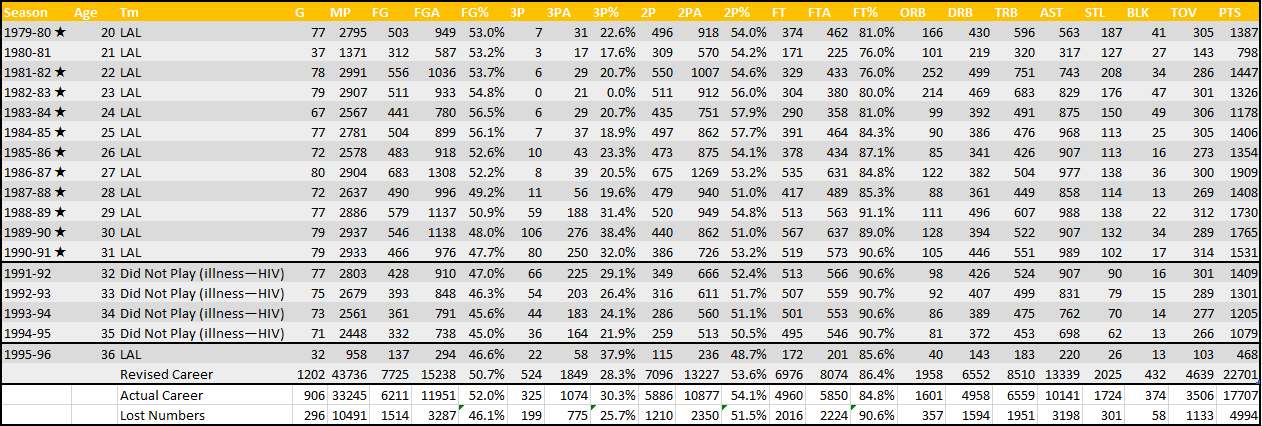
After referencing Magic in one of my email exchanges, I meandered over to Magic’s basketball-reference page and took a look at his outputs during his short return to the Lakers as a 36-year-old PF/PG: 14.6ppg, 5.7rpg and 6.9apg. The numbers on their own aren’t eye-poppingly revolutionary. 67 other times, NBA players have accomplished this line or better, but no player 36 or older has ever done it and no one else who’s posted these numbers did it while playing under 30-minutes/game like Magic did. It took most players at least 36-minutes/night to generate these well-balanced numbers.

I reached out to some of the stat guys at Hickory-High and chatted with Jacob Frankel about age-based regression statistics. Jacob explained to me that “players generally decline in everything except shooting and rebounding after 28,” but also cautioned that Magic might be a completely different animal. He offered to crunch the numbers for me using his own methodology and I was kind of excited when I heard back from Jacob a day later with the following: “I think Magic breaks the system … the system is based on similar players and Magic was so unique that it’s misfiring.”
I’m tempted to write something silly like “Magic breaks math,” but he’s just so much different from any other player that it’s difficult to systematically project his impact during those lost years. Where just a handful of players have been able to put up at least 14, 5 and 6.5 over the course of a season, Magic did it in every one of his 13 NBA seasons and the last one in 1995-96 was done after spending four full seasons away from the game and playing a career-low in minutes. His per-36 minutes that final season showed a slight decline against his career averages which is to be expected when comparing a 36-year-old with rust to a 31-year-old All-NBA first teamer who carried his team to the finals in 1991. Some other things to keep in mind: Magic split time between power forward and point guard on Del Harris’s 95-96 team. Despite playing in an unfamiliar position, he still exceeded his career average usage rate with 22.7%.
When I finally arrived at some oddball projections that wouldn’t pass muster in an elementary stats class, I found myself sort of empty. The numbers decline uniformly because my regressions are unimaginative, but the sum of what we missed out on amounts to a couple thousand rebounds, a few thousand more assists (he’d still be behind John Stockton), almost 5,000 points and a little over 10,000 more minutes. There would’ve been more memories and intrigues, battles with MJ and playoff triple doubles, but the extra codas these years would’ve added to his narrative are so significantly outweighed by his response to his own reality that I walk away from this piece with both a sense of failure at articulating any statistical intrigue and a greater sense of appreciation for the impact of the post-HIV Magic.

[POSTSCRIPT: It was eye-opening that as I sat down to write this, what is intentionally a piece focused on stats, I quickly became aware of how miniscule these thoughts are in relation to the impact of Magic’s announcement 22 years ago. What happened since then has been nothing short of world changing. In terms of bringing HIV/AIDS awareness to a mass audience and challenging stereotypes, Magic’s story is profoundly positive. In addition, his bottomless vaults of money and resources, his access to the best doctors and drugs, have cast a different-shaded light on what should be a problematic question of access and affordability of life-saving drugs. What I will continue to take away from Magic Johnson and HIV is that basketball created a platform with a massive, but relatively (on a global scale) limited audience. HIV offered a direct connection to millions of people in the same way cancer allowed Lance Armstrong to connect with people who never gave a damn about the Tour de France.
No matter how big they are, Magic’s trophy cases are overflowing with the awards and accomplishments from a life on the court. He’s on imaginary Mount Rushmores, is considered the greatest point guard to ever play the game, has the stats and hardware to back it all up. And no matter how great he was on the court, his impact off it has been infinitely more valuable to our species. Everything above, as curiosity-piquing as it may sometimes seem, is little droplets of salt water in the sprawling ocean of Magic’s life.]

 Dancing With Noah