The Golden State Warriors didn’t make any significant roster changes between 2014-15 and 2015-16 and yet they’ve come into the season a better version of themselves, most notably embodied by Stephen Curry and Draymond Green. Draymond’s been amazing and deserves his own writing which can be found on other parts of the internet, but I keep going back to Steph and trying to understand how a 27-year-old can experience such a statistical explosion.
Contextually speaking, we’ve only seen one (maybe two, but I’ll get to that) scorers go from good to great the way Curry’s done this year. I took a look at every player in NBA history who has qualified for minutes played and averaged over 30 points for an entire season, then looked at their previous season to identify the greatest leaps season-over-season – essentially players going from good scorers to great scorers, or great to greater in some cases.
The outliers were players that experienced massive leaps between their rookie and second seasons as no baseline of performance had been set. Three of the four greatest season-over-season increases in points-per-game were from players in this outlier set:
Jerry West: 17.6ppg as a rookie to 30.8ppg in year two (+13.2)
BoB McAdoo: 18ppg as a rookie to 30.6ppg in year two (+12.6)
Rick Barry: 25.7ppg as a rookie to 35.6ppg in year two (+9.9)
Then there’s Michael Jordan’s second season which I threw out because he appeared in just 18 games and played 25 minutes/game. So instead of comparing Jordan’s year two average (22.7ppg) to his year three (37.1ppg), I used his first season as a baseline (28.2ppg) which gave him an increase of 8.9ppg. I tossed this out as well.
Once we clear out the noise, we’re left with a sample size of 57 occurrences of players averaging 30 or more – 43 of which saw a season-over-season increase, 14 had a decrease. The greatest non-rookie-to-second season leap ever was Wilt Chamberlain in 1961-62 when he set the league record with what is still a confounding 50.4ppg which was a 12-point increase over the previous year when he scored a paltry 38.4.
Next on the list is our subject, young Mr. Curry. At 32.3ppg (as of Saturday night), Curry’s a robust 8.5ppg more than he scored last year. That makes for a 26% season-over-season growth which is the highest percentage growth of the entire sample of 57 30-point seasons (with outliers removed). I don’t care or know who the best scorer is on this list, but through 25 games in 2015, Curry’s experiencing an unprecedented growth rate. If we want to get deeper on how silly his season’s become, he’s averaging the lowest minutes/game of any player to ever score 30ppg at 34.9. George Gervin is second at 35.7, then Michael Jordan in 1991 at 37mpg. And maybe it’s not fair to compare percentages from the three-point era to the pre-three-point era, but by any measure that includes weighting the three-point shot (TS% and eFG%), Curry has the all-time highest accuracy rates – 68.8% TS and 64% eFG – of any players to score 30 or more. Adrian Dantley circa 1983-84 is second in TS at 65.2% and Kareem Abdul-Jabbar is second in eFG at 57.7% — a full 6.3% behind Curry. But why stop there when Curry also has the highest 2-pt% of anyone on this list at 58.4%.
This feels awfully Bill Simmonsy to write, but re-read that last paragraph. Within the context of volume scorers in league history, no one’s ever done it anywhere remotely similar to Curry this season.
Which leads to the question: Just what on god’s green earth is happening to Steph this season? I did some work on this in early November when Curry was averaging 37ppg and some of the trends from then still hold up now: Curry’s opportunities are up year-over-year in terms of FGA/game, 3PA/game, and FTA/game while his accuracy for each is at or above his career-bests – only his free throw percentage is below career-best and he’s still making 90% of them.
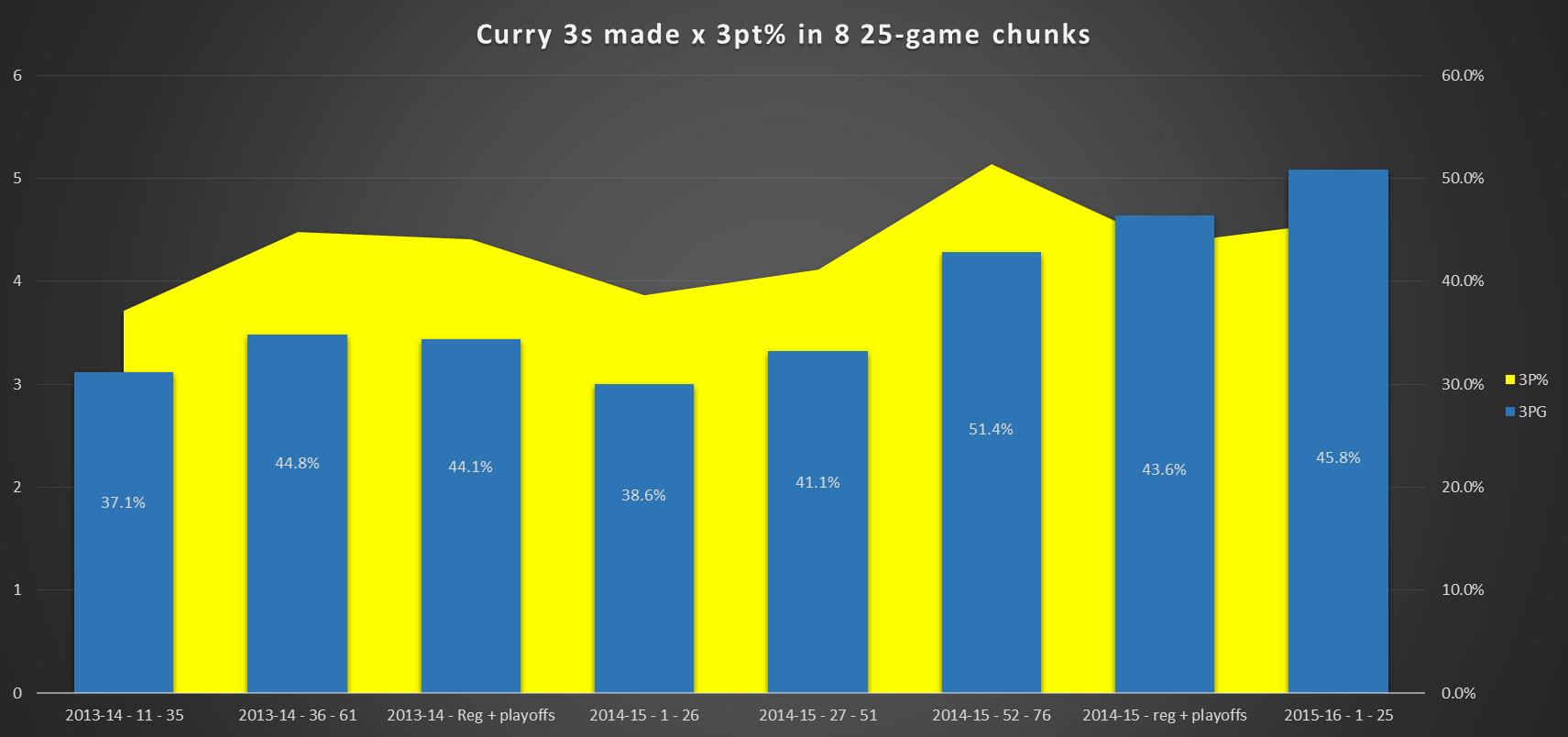
But I don’t feel satisfied just saying volume and efficiency have risen even if those things are true. There are notions and theories at play here that I feel compelled to explore. I went back to the start of 2013-14 (starting with game 11 of that season – the reasoning will become clearer) and broke out Steph’s ensuing 201 games into 25-game chunks that include regular season and playoffs. The patterns are intriguing in that we’re able to see sporadic trends during Mark Jackson’s final year with the team when Curry’s three chunks of 25 games saw his minutes fluctuate between an average of nearly 40 in games 11-35 down to just under 36 in games 36-61. When he was playing nearly 40mpg, his FG% and 3p% were the worst of this 8-set sample, as were his turnovers/game – nearly 5.
stats courtesy basketball-reference.com
As Kerr came on in 2014-15, there’s an immediate shift in Curry’s minutes down to a much-more-manageable 32-34/night with a steady rise in his three-point accuracy and a slight dip in total points. During that first regular season under Kerr, he took less field goal attempts, averaged less assists, and turned the ball over than he did under Jackson the previous year. It’s necessary to call out that Kerr taking over as coach led to a lot more changes than Curry’s role in the Warriors offense, but for the sake of this post and your time, we’ll focus on how Curry responded.
Last year’s playoff run is where we get a preview of what’s to come for Curry. Where he shot around eight threes/game in the regular season, it spiked up to 10.6 in 21 playoff games and final four games of the regular season. His three-point percentage stayed right at his average of this 201-game sample size – 43.6% during playoffs/reg season vs. 43.5% overall.
It’s that rise in the three-ball volume that appears to have carried over to 2015-16. Beginning in the sixth chunk of 25 games – game 52 to 76 of 2014-15 – Curry experienced his most accurate stretch of three point shooting: 107 of 208 – a 51.4% clip which accounted for 54.1% of his total points. For context, his average percentage of points from the three over this entire sample was 39.4%. From that block of games forward, his volume of three-pointers attempted has only increased. Curry was a great shooter before this stretch, but let’s look at the previous 126 games (start of 2013-14 thru game 51 of last season) against the most recent 75 games (game 52 of 2014-15 to present):
126 game stretch: 412 threes made on 1003 attempts, 3.3 threes/game, 41% accuracy, threes account for 41% total points
75 game stretch: 350 threes made on 751 attempts, 4.6 threes/game, 46% accuracy, threes account for 50% total points
25 game stretch in 2015-16: 127 threes made on 277 attempts, 5.1 threes/game, 46% accuracy, threes account for 47% total points
What we’re seeing now is like late-career Barry Bonds crushing all MLB walk records. In 2001, Bonds set the record with 177 walks, then bested it in 2002 by 21, and in 2004 put an exclamation point on his own theater of absurd by walking 232 times. This is Steph with threes – minus the weird head enlargement and freakish physical metamorphosis. Curry is taking a truly great skill (he already holds the top-two single season marks for threes made) and building upon it, but in a way that appears to be a collectively conscious extension of last season’s second half run. It’s not just that he’s taking and making more threes, but that his range is extending – or it was always there and his confidence and the team’s confidence in him taking deeper shots has grown (per stats.nba.com):
2013-14: 5.1 3PAs/game from 25-29ft
2014-15: 5.5 3PAs/game from 25-29ft
2015-16: 7.2 3PAs/game from 25-29ft
He’s already hit as many threes from 30-34 feet (three) as he did all of last season (regular season and playoffs combined) and more than he did in 2013-14 (playoffs and reg. combined). The impact of extending his range out further isn’t lost on his two-point game (again, he’s shooting 58.4% on twos) or his teammates who experience a wider, more open floor. Harrison Barnes approves.
Whatever Golden State saw in last year’s playoffs has carried over into this new season. The volume, the freedom, the carte blanche to shoot from anywhere at any time is open. We’re seeing Curry’s Davidson days replicated at the highest level of basketball in the known universe (when NCAA opponents decided they’d rather lose than have Curry go off on them, they were essentially waving a white flag in the same way MLB pitchers did when they intentionally walked Bonds all those hundreds of times). But what’s most fascinating to me is how Golden State appears to have tapped into an optimal playing time balance for Curry and the rest of the team. As I mentioned earlier when comparing Steph to other 30-point scorers, we’ve never had another 30-point scorer play this few minutes. Last year Curry won the MVP with the fewest minutes ever for a winner at 32.7. This isn’t just happenstance, but occurs when your margin of victory is somewhere between 10-13 points/night and your lead at the end of the third is 20-30 so your starters can kick back and rest during the final period.
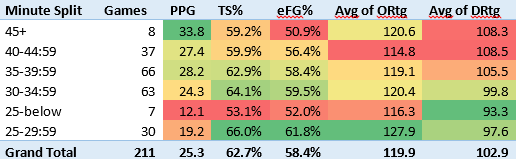
If we break out his efficiency and scoring output across five-minute splits, we can see a sweet spot in the 30-40 minute range. The sample below is from 2013-14 to present with playoffs included. It makes sense that in closer games where Curry struggles individually or the Warriors struggle collectively, Curry would play more minutes and see his efficiency dip and indeed his TS and eFG for games where he plays over 40 minutes are below averages in this sample set. What’s interesting though is that Curry’s output is greater in games where he plays 35-40 minutes than 40-45. For some players on that 30-ppg list, there’s a straight forward line between volume (minutes played and shot attempts) and points. For Curry, more doesn’t always equal more and Golden State appears to grasp that.
My suggestion that Golden State may have landed at an optimal spot in terms of Curry’s usage and minutes/game is the last area we’ll touch on. Last year they won 67 games in the regular season and went 16-5 in the post-season. This year, the playmaking responsibilities are increasingly falling in Draymond’s hands and the results are indisputable to-date. I’m curious about how far this envelope can be pushed though. We already see that Curry’s efficiency and even output in some cases takes a hit the more he plays, so pushing the envelope is finding ways to get more shots. It’s easy to look at what this team is doing and suggest that if ain’t broke, don’t break it, but they’ve made changes from last season with nothing but positive outcomes. Steph’s already stolen about two shots/game from Klay and two from somewhere else (David Lee?). Are there two more to go round? Is two more three-point attempts from Steph per game a better use of possessions than a shot each from Bogut and Draymond? Man, I don’t know and I’m not convinced it even matters, but while they’re here they may as well push it to the limit.
“Just let ‘em go.” With that simple message, Kobe Bryant cracked the hard-assed algorithm of Byron Scott’s face palming rotations. “Let ‘em go,” he told the coach in regards to the Lakers future, embodied by true rookie D’Angelo Russell and red shirt rookie Julius Randle. Both kids played all of the fourth quarter and overtime in a game the Lakers would lose to the T-Wolves with Russell hitting the contested drive to send the game into an extra period. The loss did little to dampen the unanimous feeling that this was the Lakers best game of the season – and almost exclusively because Scott’s arms-crossed drill sergeant act was defused by Kobe.
Rookies can oscillate between futuristic revelations and immature mistakes on a single possession. There’s no playbook for coaches detailing how and when to appropriately develop 19 and 20-year-old basketball players. Should they be given 30+ minutes and allowed to succeed or fail with high volume opportunity? Or should they be given nothing, forced to earn everything, and kowtow to vets by carrying chinchilla coats and fetching donuts while wearing Hello Kitty backpacks? The Lakers are caught in the center of this question with Kobe’s farewell tour adding a contentious element to an already-imprecise process.
Russell was the second overall pick in the draft. Scott’s currently playing him about 5.5 minutes/4th quarter which is 10th overall in his rookie class, wedged between Jerian Grant (19th overall, 5.7 minutes/4th) and Frank Kaminsky (9th, 5 minutes/4th). The Lakers are 3-21 right now, losing by more than 10 points/game and prior to Kobe stepping in and disrupting Byron’s rotation schemes, Russell still couldn’t get court time. But in 4th quarters, Russell’s inefficiencies get worse. His TS% drops from 48% to 44% while his O and DRtg’s (per stats.nba.com) also get worse in the last period.
Meanwhile in Miami, Justise Winslow is leading all rookies in 4th quarter minutes played at 9.2/game. The Heat are 13-9, yielding the 2nd least points to opponents with the 4th best defensive rating. He appears in all (5-man, 4-man, 3-man, 2-man) of Miami’s best lineups based on point differential and is defining himself as an updated mold of fellow Duke player Shane Battier as an indispensable defender whose impact exists beyond two-dimensional statistical measures. The only Heat player getting more 4th quarter minutes is perennial all-star, Chris Bosh. While Winslow’s NetRtg comes in at +6.8 (best of any Heat player getting at least 20 minutes/game), that number jumps up to +14.2 in the 4th. For all players appearing in at least nine minutes/4th quarter, Winslow ranks second to LeBron James (+23.4) in NetRtg.
Erik Spoelstra uniquely deploys Winslow in almost an inverse of how Scott uses Russell. Where the Lakers point guard has started 22 of 24 games, he gets the bulk of minutes (~7/quarter) during the first three quarters of the game before Byron’s thousand yard stare narrows and his moustache tightens and he relegates Russell to the bench in favor of some combination of Kobe, Jordan Clarkson, and Lou Williams. Winslow hasn’t started a single game, yet sees his highest volume of minutes come in the 4th quarter.
Winslow is the exception and not the rule for rookies. Number one overall pick Karl-Anthony Towns sees his NetRtg boost from -1.4 overall to +5.7 for 4th quarters, but still only sees six minutes/4th – much to the consternation of Wolves Twitter. Emmanuel Mudiay is second in mpg for rookies (29.9), but ranks fifth in 4th quarter minutes at 6.3 where his NetRtg drops from bad (-8.9) to worse (-9.5). Philly’s top choice Jahlil Okafor is getting 32 minutes/game and typically saves his best for last. In the final quarter, he averages his highest points while shooting 60% TS – up 11% from his overall TS. And any rookie conversation would be incomplete without the Lativian Gang Banger, Kristaps Porzingis. The Knicks are 11-14 and only one player on the roster with any impactful playing time has a positive NetRtg: the Zinger at +0.1.
A quarter of the way into a rookie’s inaugural season is probably too early to start seeking out trajectory-threatening trends. Teams, coaches, and players walk a developmental balance with their young players that become interpreted by media, writers, and passionate fans. What works for Towns with Sam Mitchell and Kevin Garnett isn’t likely to be replicable with Russell and Byron and Kobe. What Spoelstra does with Winslow in Miami can’t be copied by Derek Fisher and Phil Jackson in New York. What we can see in the numbers above and when we vainly try to read between the lines of coach-to-media communications are trends and then attempt to draw conclusions from those trends, but lacking a clearly-defined intent, even that can become confusing and noisy. What’s left but to (over) analyze and project and wonder in amazement at the rising arcs and sleeping valleys of kids not even old enough to legally consume alcohol.
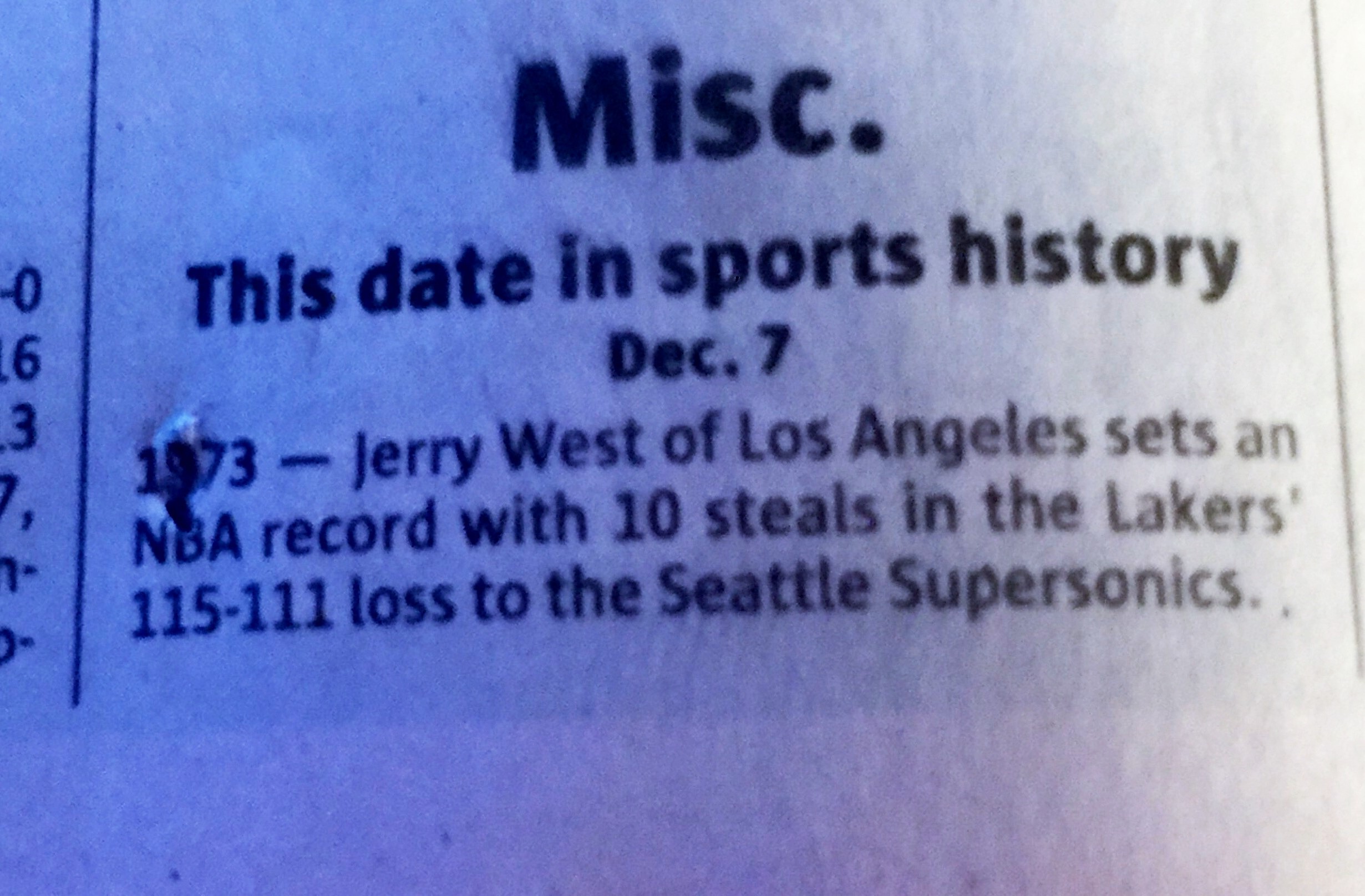
On December 7th, 1973, the Los Angeles Lakers hosted a Bill Russell-coached Seattle Supersonics team in Los Angeles. The game was and should be mostly lost to history with the emphasis of post-game narratives on the Sonics finally catching a win in LA.
As Gil Lyons of the Seattle Times wrote:
The Sonics scrambled and clawed to a 115-111 success, ending a string of 20 frustrating appearances in Jack Kent Cooke’s sports palace. The win also snapped a 13-game Laker domination of Seattle and ended the Sonics’ own six-game string of losses.
For me the game would’ve remained resigned to the minutia of NBA history, a single pixel in an infinitely-sized NBA logo were it not for today’s sport page. Tucked away on the back page beneath the WHL standings and next to the upcoming NFL lines was the “This date in sports history” feature: On December 7th, 1973 Jerry West recorded a then-NBA record 10 steals against the Sonics. If it would’ve been Alvin Robertson setting the record in 1987, I would’ve batted an eyelash but nothing more.
I knew the tracking of steals came along a little later than the standard points, rebounds, and assists, but didn’t realize the stat was tracked as early as 1973-74; which happened to be the first season the league kept track of thefts. For historical context, West’s 10 steals is still good enough for second-most steals all-time in a game. Larry Kenon (1976) and Kendall Gill (1999) each had 11-steal games.
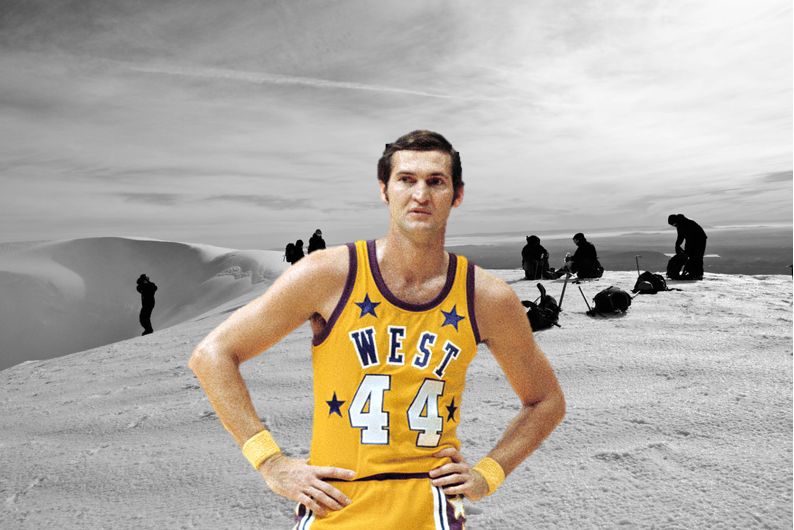
On the night of all those steals back in December of 1973, Jerry West, whose silhouette would eventually be immortalized as the NBA’s logo, was a 35-year-old combo guard in the final season his illustrious career. He only appeared in 31 games that season due to a groin injury, but still averaged over 20ppg, 6apg, and nearly 4rpg. Most interesting in his stat line though was the 2.6 steals he averaged.
It’s fair to assume the 35-year-old West had lost a step by 1973. While still a quality guard with good play left in the tank, his averages and efficiency were down across the board. He appeared in a career-low minutes and games while averaging the lowest points since his rookie season – and still put up 20/game. His combined playoff and regular season minutes were nearly 43,000 and it’s clear to point to age as a contributing factor to his season-limiting injury.
This is where I reveal my ignorance in that I haven’t watched West’s clips nearly as much as I wish I had. I have his autobiography, West by West, sitting on a bookshelf, unread and while I can rattle off West anecdotes, I’ve never gone deep on his defensive capabilities. The league started awarding All-Defensive honors in 1968-69 when West was nearing the end of his prime. In the six years he was eligible for defensive awards, he made the second team once and the first team four times – all past the age of 30. While his nickname was Mr. Clutch and damn near any highlight you’ll find of him will be of a steady downpour of jumpers, he had a reputation for being strong defender and reportedly had an 81-inch wingspan which is the same as Rajon Rondo. All this mixed with the hard evidence of 2.6 steals/game as a 35-year-old and anecdotal evidence of his intense approach to defense point a player who should be considered one of the greatest back court defenders in league history.
That game 42 years ago could act as a microcosm for the tortured dissatisfaction that plagued much of West’s life and pro basketball career. The Lakers turned the ball over 30 times and four of their players fouled out. West was masterful in defeat though with 27 points on 15 shots, five rebounds, five assists and of course 10 steals. That’s a line that’s been achieved just four other times in league history. And not to belabor the point, but West was 35 when he did it. West knew he was a great player, but did it give him any measure of satisfaction? I have no idea, but tracing his defensive prowess beyond the threshold of a 10-steal game 42 years ago has given me an even greater sense of appreciation for the Logo.
It’s December now and the new season is nearly a quarter of the way done with the Golden State’s Warriors stealing the show then having their own show improbably stolen by power-mad Kobe Bryant enabled and emboldened by an out-of-touch cuckoo coach. Everything else except the Zinger is on the NBA periphery, except that it’s not. I take it all back except the part about Kobe; shit’s gone mad and he’s basking in the madness dropping fortune cookie knowledge in post-game pressers. Let’s peel back the layers of the headlines though and see what kind of historic non-headline-snatching are blessing this early season (all stats thru 11/30):
Andre Drummond: 305 total rebounds and 105 offensive boards through his first 18 games. We haven’t seen this type of boarding destruction since Dennis Rodman back in 93-94. For context, Drummond has 70 more boards than his closest competitor, DeAndre Jordan and is snatching 25% of all rebounds and 36% of defensive rebounds.
James Harden and Russell Westbrook: At least 85 turnovers thru 18 games. One is reckless, the other unfocused or complacent. Both are averaging at or near five turnovers/game becoming just the sixth and seventh players since 85-86 to do this. Most notable on the short list is a 23-year-old Charles Barkley. In 1986-87, the Round Mound of Barkley was averaging nearly six turnovers/game through his first 18. He was also averaging 24ppg, 14rpg, 6apg while shooting 63% from the field. This reads like a bigger, beefier, but more rampaging Westbrook.
Steph Curry: 94 3s and 600 points thru 19 games. Every volume record associated with the three-point shot will be attached to Curry’s name sooner than later. Thru 19 undefeated games this season, he’s made 94 3s (nearly 5/game) which is 22 more than the next closest shooter in the same amount of games since 85-86: Antoine Walker with 72 in 2001-02. Steph’s also scored 600 points, becoming just the 22nd player to score 600 (31.5/game) this fast and the first since Allen Iverson in 2005-06. For historical context: MJ averaged 38.9 thru 19 in 86-87 and Wilt averaged 40 in 64-65.
Draymond Green: 130 assists and 150 rebounds thru 19 games. I’ve watched a lot of Warriors basketball this season because I’m desperate to be there when they lose so I’m familiar with Draymond’s increasing role as a playmaking facilitator on this team, but I didn’t realize he was averaging over seven assists. The 130/150 has been done nine other times to open a season – nearly all of whom are Hall-of-Famers: LeBron (12-13 and 11-12), Jason Kidd (twice), Scottie Pippen, Larry Bird (twice), Fat Lever, and Magic Johnson.
Blake Griffin: 450 points, 150 rebounds, and 80 assists in 18 games. Blake’s game has developed into something borderline unstoppable and it’s showing in the stats he’s putting up thru 18 games. His PER is over four full points greater than his best season and he’s averaging a career-high in points. The 450-150-80 hasn’t been accomplished since Bron in 2012-13 and before that it was Kobe in 02-03 when he started the season with 28/8.5rpg/6.5apg. The Mailman, Barkley, and Bird (twice each for Larry and Charles) are the other admissions.
Paul George: At least eight rebounds and three 3s/game thru 16 games. The increasing emphasis on the three-ball means we’ll continue to see the game evolve as bigger guys are encouraged to add distance to their arsenal. Per basketball-reference, prior to this season Paul George had appeared at power forward for about 2% of his total on-court time. In 2015-16, that number has swelled to 57%. That hasn’t stopped him from drifting outside and spreading the court where he’s hitting over three 3s/game on 45% shooting. Counting Curry and CJ Miles this season, three 3s/game has been reached 13 times since 85-86. Of those three point shooters, PG13 is the only one to ever average over eight rebounds/game, or seven, or six. His combination of rebounding and threes is something we’ve never come close to seeing.
Nearly 20 games into the season, we’re finally free from the “small sample size” qualifier that comes attached to early season wonders. We’ll still see what’s likely to be regression to the mean like Dirk’s three-point percentage sliding from 53% to 46% over a five-game span. But the trends above are worth monitoring and at the end of each month I’ll check back in to see how these guys (and others) are progressing relative to history. Onward to the winter, you kings.






 Dancing With Noah