In the fervor of the moment, three different players have been anointed best player in the world over these playoffs. It’s a fascination we collectively, even the smartest, most well-informed of us, can’t possibly avoid. I’m speaking about San Antonio coach Gregg Popovich who, during the first round of the playoffs, couldn’t help it and said, “Kawhi Leonard, is in my opinion, the best player in the league right now.” Paul Pierce, from maybe a more provocative motivation, said Kevin Durant, “may be the best player in the world today.” And of course, the LeBron James versus Michael Jordan discussion rages on out of boredom, fear, loyalty, and even rational thought.
As it has always been, this is a fluid conversation; one that will be answered today only to be debunked tomorrow. There’s a king of the mountain component to the conversation where the last man atop the hill, at the end of the season, assuming he’s in the conversation and proves himself, can seize the title – at least for the summer.
During the playoffs last year, after the hand wringing about whether James or the league’s first-ever unanimous MVP, Stephen Curry was the best, Bron demonstratively grabbed the title. Violently, sneeringly, shit talkingly. It was definitive to the point that he rode it into the 2016-17 season and all the way through to the finals where, in the dead week leading up to tip-off, the MJ/Bron debate peaked.
Now though, the Jordan/Bron debate is shelved, and quicker than a KD dunk smash, Pierce’s volley into the national TV consciousness that KD just might be the best player in the world is the topic du jour.
What actually is doesn’t even matter as much as what someone says is. If we’ve learned anything from the spectacle of Donald Trump’s ugly ascension to President of the US, it’s that reality is malleable and just because someone says something, that’s enough to make it worthy of discussion. I’m not here though, to debate who is the best basketball player on the planet.
Regardless of who you think it is, these playoffs, and the finals in particular, have become the tunnel through which the KD bullet train speeds towards inevitability in the form of a finals MVP and a first career title.
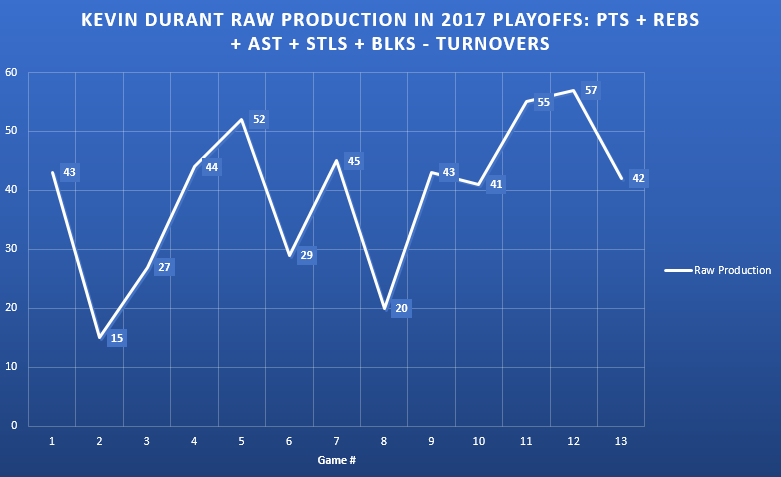
Despite amazing performances from Curry and desperate all out efforts from James, it’s KD who’s seized the media’s imagination in saving his best for last. At no point throughout his first season with the Warriors had KD scored 30-or-more points in three consecutive games and yet in these three finals, he’s gone for 38-33-31 including a game-stealing three in game three.
Unencumbered from the historic model of a single star carrying an out-sized responsibility for production, the beauty of Durant’s game has flourished. He’s not forced to hunt shots or isolate. Rather, he’s liberated to exploit mismatches and fluidly find opportunities within a balanced offensive flow. Playing aside another superstar in Curry has created a parting of the defensive seas whereby KD has encountered soft paths of undefended space free for his long-striding forays into one-handed dunks. In game one of the series, seven of his 14 made shots were dunks.
Life isn’t easy just because Cleveland’s defense is poor and they lack a rim defender. Life is easy because the Warriors pack the court with deadly attacking players. KD’s first dunk of the series was a lob made possible by three primary strengths:
KD’s own range which requires that Bron play him tight
Steph’s range which forces the defense to attempt to anticipate a downscreen from Curry onto KD’s man
Draymond Green’s recognition and passing ability which pull the beautiful read together
Bonus: Bron gets roasted on this back cut
His next bucket came off a Curry screen, the following two off Curry passes and strong Durant drives against Bron. And the fast break dunk after that was probably the most clear example of the Cavs caught somewhere between miscommunication and questionable defensive strategy and, again, the presence of Curry acting as a magnet attracting both Bron and Kyrie Irving towards him while KD flies downhill for his fourth dunk of the first half.
That’s five buckets, all assisted directly or indirectly, by Curry. This is luxury, for the rich and famous. This is the rich getting richer, the basketball equivalent of a tax break for the ultra-wealthy. KD didn’t need the game to be easier, but in its ease, we’ve been able to witness a full range of his game that’s rarely uncovered in this league due to circumstance, team construction, and all the other wonky shit that holds back NBA players and teams. The ideal scenario for any of us is the opportunity to achieve our potential, whatever that may be, and playing for the Warriors has allowed Durant to ascend in ways that most players don’t experience.
We know KD can do it on his own. He won his first scoring title at 21, his first MVP at 24. His finals performances have been less a surprise and a more a Cinderella-in-the-glass slipper moment whereby the most perfect player possible for the Warriors team schemes has slipped into the most perfect offense for his skills.
As Tristan Thompson has struggled through the series and the Cavs have no rim protector on the roster, Durant is often the tallest and longest player on the court. When the Warriors stretch the floor with their shooters, Durant as a ball handler is able to attack with multiple options. He shot four of eight from three in game two and the threat of that jumper keeps the defense perpetually off-balance. Defenders can’t give him space, but if you crowd him he can beat even elite defenders off the dribble and the Cavs aren’t exactly flush with elite defenders. When he puts the ball on the floor, he beats opponents with varying attacks. There’s the slaloming dunk shots, the one-legged off-balance kisses off the glass, and the pull-up jumpers. He’s too long for most any NBA defender, but particularly for a Cavs defense that lacks length.
If game one was a chance for KD and Golden State to show just how easy it can be, for KD at least, game two came with slightly increased degrees of difficulty as he had a stretch of play where he shot 14-straight jumpers from all over the court. Pull-up jumpers, step back threes, one-legged horse shots, fadeaways … it didn’t matter. He had a true shooting of 71% in game two. And when he wasn’t carving up Cleveland’s defenders from the perimeter, he joined Curry on the same backdoor cut off screen motion that he opened the series with. Again, Green with the pass, Curry with the screen attempt, and KD with the cut:
For the finals in the restricted area, Durant is shooting 16-21. He’s at 11-21 from three. I can only imagine Daryl Morey of MoreyBall fame watching this games salivating, fantasizing at the obscene efficiency and concocting crazy schemes to acquire the man. My focus here hasn’t even been his defense (two blocks and over a steal-per-game), rebounding (10-per-game), or passing (six assists-per-game). Despite his ability to both assimilate into the fun-loving Golden State infrastructure while still standing out with his precedent-setting combination of length, size, and skill; despite the fluidity of the socialist democratic team approach of these Warriors, Durant has been a one-man avalanche living in a new world with cool new friends, but doing the same old things and suddenly, somehow viewed differently because of it.
Jordan was a me-first ball hog before he won his rings. LeBron a choker who had to team up with other superstars to win (this narrative still pervades). Curry a gimmicky player who couldn’t possibly have survived the rough and rugged NBA of the 80s. The long list of denigrations and narratives are pre-packaged, ready to be consumed and spewed out at anyone who has the audacity to try and be the best. (How dare you?) But KD was always this guy, his head has always been shaped to wear this metaphorical crown. Between the boos and the cheers, between KD and Russ blowing a 3-1 lead last year and being on the verge of a playoff-sweep this year. Between it all, KD the player has remained steadfastly deadly; a Frankenstein amalgam of Tracy McGrady and Dirk Nowtizki. That he is or isn’t the best doesn’t matter, for a moment of some immeasurable transience in the summer of 2017, the crown is his.
Two games into these NBA Finals of this year of our lord, 2017, and most of the familiar faces are the same, but the game itself, its tone and long-built drama, are from another time, three years past.
In the first two games of last year’s finals, the Cavs lost by 15 and then 33 for an average margin of defeat a cringe-inducing 24-points. A year later, they’ve lost by 19 and 22, or 20.5-points-per-game. Yet somehow, with the presence of seven-foot giant basketball scorer machine man, Kevin Durant, it all feels different. Feel is one of those real stinking human traits that is often debunked by science and data. But it does, it feels different. It’s born out in the data too where the Warriors are over seven points-per-100-possessions better than last year’s playoffs while holding opponents to five points-per-100 less than last season. They’re healthy, they’re better, and there’s Durant.
But it’s still more about the feel for me; the data just conveniently backs that up I guess. Things felt different right at the start of game one during the pre-game inspection of game balls. Stephen Curry and LeBron James stood across from each other, pounding and slapping and squeezing the prospective game ball to test its readiness and durability. Their Hall-of-Fame hands and fingertips likely more qualified than any system or gauge to get a sense of whether or not the ball felt right. Then there was a dap or a nod or something, something agreeable without any mutual dislike or disdain. Not that those things are necessary for competitive basketball, but for all the buildup and the sub-tweet sniping between these teams, I hoped for a hint of the tense edge, but it was absent.
Then there was a brief exchange between Bron and Draymond Green in game one when their bodies tangled, and opportunity arose for conflict. Instead of sneering or pushing or shit talking, there were pats. “We’re good.” We’re friends. I don’t write this and I don’t over-examine the pre-game ball check to advocate for something other than sportsmanship. Rather, a healthy dislike can often create an edge. If you’re pulling on a steel mask of impenetrability and your opponent goes in for the hug, which you reject, suddenly there’s a wedge and disagreement. One man says, “it’s just a game, let’s compete.” The other says, “I’m not here for games.” These are the most minute of psychological edges, but possible edges nonetheless. (Or, possibly petty displays of machismo.)
After game one’s 22-point defeat, Bron’s podium tone was something that had the appearance of honesty. For a man who’s been sitting in front of camera lenses, cell phones, and microphones for the past 14 years, he has the ability to turn on a poker face, to deliver messages, and be deliberate in his word choice, and while some of that was at play after game one, it appeared to be genuine and thoughtful.
When asked if “there was one thing that stands out tonight,” without thinking, without blinking, with even a matter-of-fact expression and tone, he said, “KD.”
This was one small piece of a seven-minute podium appearance. It’s simple, two letters, one man, but in all its simplicity, I can’t help but wonder if losing to KD is somehow more than losing to Steph. Alternately, it’s entirely possible that it’s just easier to accept defeat when the deck is stacked so high against you – and the rest of your league-mates.
Game two, while a completely different complexion with Golden State committing 20 turnovers and Klay Thompson finally finding his rhythm, ended in a 19-point Warriors victory. The details were different, but the outcome was largely the same.
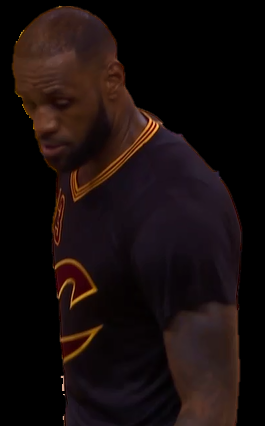
The Cavs cut the lead to four points with just under six minutes left in the third quarter, only to see that four-point deficit mushroom to 14 at the end of the quarter, and 22 midway into the final period. Somewhere in this blitzkrieg, Bron, whose face bore the appearance of fatigue late in the third, suddenly looked like it was all sinking in; that while he may be the best player on the planet, capable of putting forth bruising, forceful efforts enhanced by that beautiful basketball mind, could not beat this version of Golden State. There was too much firepower and his own teammates weren’t capable of making plays with the frequency required to win.
I’ve seen this face from LeBron James before. Back in 2014 when the Spurs met Bron’s Heat in the finals and played what David Thorpe has referred to as the greatest basketball he’s ever seen. Back then, there were moments where it was obvious that Bron was on one level and his teammates another. He shot 57% from the field, 52% from three, 79% from the line with a true shooting of 68% while putting up 28-8-4. His running mate, Dwyane Wade, had never looked older as he shot 44-33-69 with 15-4-2. The Spurs, in all their socialistic team play, were collectively on another plane. Bron knew this and as Wade and the rest of his teammates were torched, the grim awareness was drawn nakedly across his face, visible for the whole world to see. Fast forward to 2017 and through two games, James is averaging 28-13-11 with 63% TS and that ice-cold realization that defeat is inevitable is back again.
Standing shirtless and conducting an interview in the locker room after game two, Bron’s tone wasn’t one of defeat. He answered the questions as they were asked (even if the focus has been his impatient, frustrated answer to a single question) and provided his own team-centric analysis. He took accountability and didn’t point any fingers. But in the midst of it, the KD theme popped up again as he reiterated, “They’re a different team… you guys asked me ‘what was the difference’ and I told you so, they’re a different team.”
A few days ago, Marcus Thompson of the Mercury News and author of Golden: The Miraculous Rise of Steph Curryappeared on ESPN’s The Basketball Analogy podcast with Kevin Arnovitz. One of the topics they touched on was how race and class both impact how Curry is viewed in the league. At around the 15:40 mark, Arnovitz raises the issue which Thompson immediately seizes.
Arnovitz: “Is he culturally different from the rest of the league?”
Thompson: “That was the most fun part to write about; those cultural implications … especially for the current player and previous generation, their paradigm is based on the ruggedness of blacktop, and playing with hardened type (of) hood people and that’s how you gain that credibility … Steph doesn’t get the inherent credibility of being a tough guy.”
Arnovitz: “More than toughness … I don’t want to say resentment, but, look, we gravitate towards people, and we endow people with respect, who can relate to us; who we’ve shared that experience with. Is he seen at a distance from the rest of the NBA?”
Thompson: “I think only because he rose to a certain level and become part of an exclusive club … the issue with Steph is that he has risen to a level and he doesn’t share in their similar story and background … When he’s been put in that class … because now he’s up there with LeBron and them and there’s that question, ‘did you earn this?’”
Arnovitz: “An NBA veteran suggested to me that his skin tone had something to do with it.”
Thompson: “Yes. I agree one thousand percent. Color is a longstanding thing in the black community, this is not something new … The embrace, the rampant and widespread embrace of Steph Curry is partially attributed to the fact that he’s light-skinned which means that he’s more digestible to the white media and white masses.”
If we accept Thompson’s idea that class and skin color are, in some part at least, at play in how Cleveland, and LeBron specifically, compete against Golden State, then the presence of KD as the centralized figure within the Warriors’ dominance begins to take on a different appearance. Going back to last year’s finals, there was a visible tension between Bron and Curry and emanated primarily from James. The same tension is nowhere to be found between James and KD. Yeah, Bron and KD are friends, but to take it back to Thompson’s point; they share similar single-parent and cultural backgrounds. Bron’s comments on KD in these finals deviate from anything he’s said about Curry. With Durant, James has gone out of his way in post-game interviews to pinpoint him as the key differentiator despite what has been elite play from Curry. He’s averaging 30-8-10.5 with five threes made-per-game and 66% TS. Comparatively, he averaged 22-5-4 in last year’s finals on 58% TS. Curry is clearly a different player from the ’16 finals.
But, maybe it’s just more palatable to lose to KD. Maybe KD, in looking the part of what we’ve come to expect from our superstars, is less threatening and challenging than Curry. Wrapped up in all of this are subconscious allusions to masculinity and losing to a darker, taller, more traditional star is just easier to accept than losing to a shorter, scrawnier, lighter-skinned non-traditional star. This isn’t limited to James though. In his interview with Arnovitz, Thompson mentions that there’s a notion that players can stop Curry whenever they want; a sentiment echoed notably by TNT’s Charles Barkley and Shaquille O’Neal who have long advocated for a more physical approach to Curry. As Thompson says during his comments on skin color, the perspective of many darker players is that “he’s not built like us.”
None of the above is to imply that the Cavs have mailed in this series or that James has acquiesced to Golden State’s dominance. And after last year’s finals, it would be strange to write-off the Cavs when facing a 2-0 deficit. It’s also not to discount the absolutely torrid play of Durant as something that’s happening due to him looking the part. The Warriors are, by any measure, one of the most dominant teams in NBA history; a fact that’s made possible by the overwhelming skills of Durant, Klay, Steph, and Draymond. Much of my approach here has been to probe at what I noticed early on in this series as somewhat of a thawing and I believe that varying degrees of all of the above (collection of overwhelming basketball ability, color, class, culture, relationships, perceptions) are at play in these finals. Even in spectacular defeat, the nakedness of vulnerability, that moment late in the fourth quarter when LeBron looked like he wanted to skip the bench and walk straight back to the locker room, will always be a bridge to something we can feel.
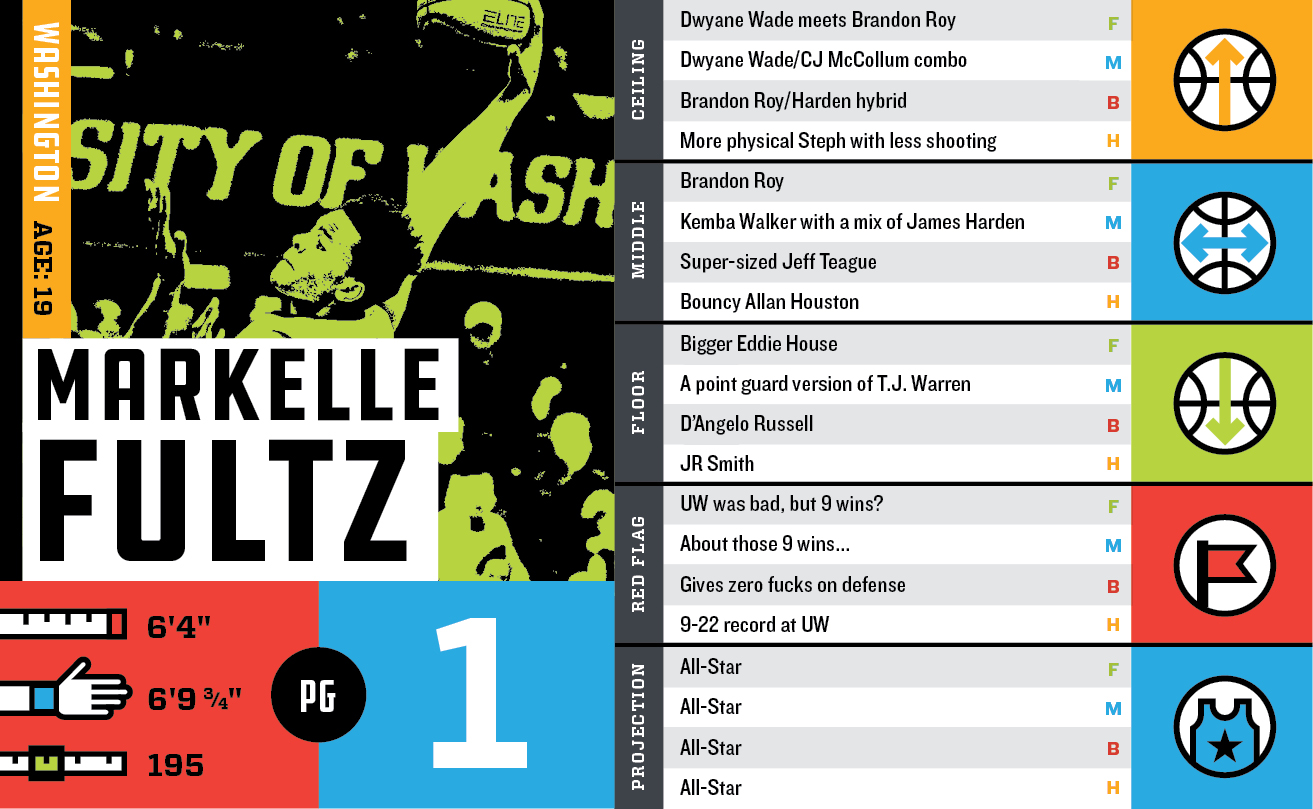
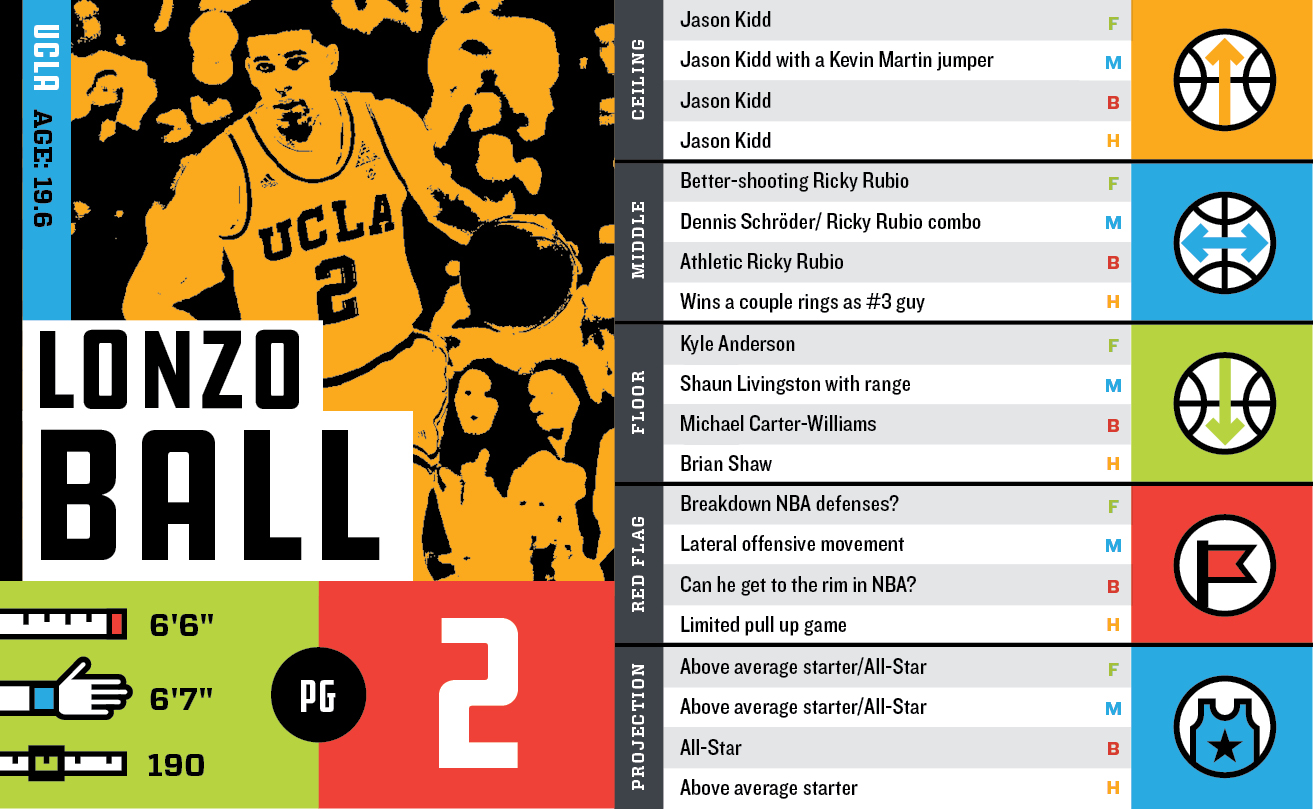
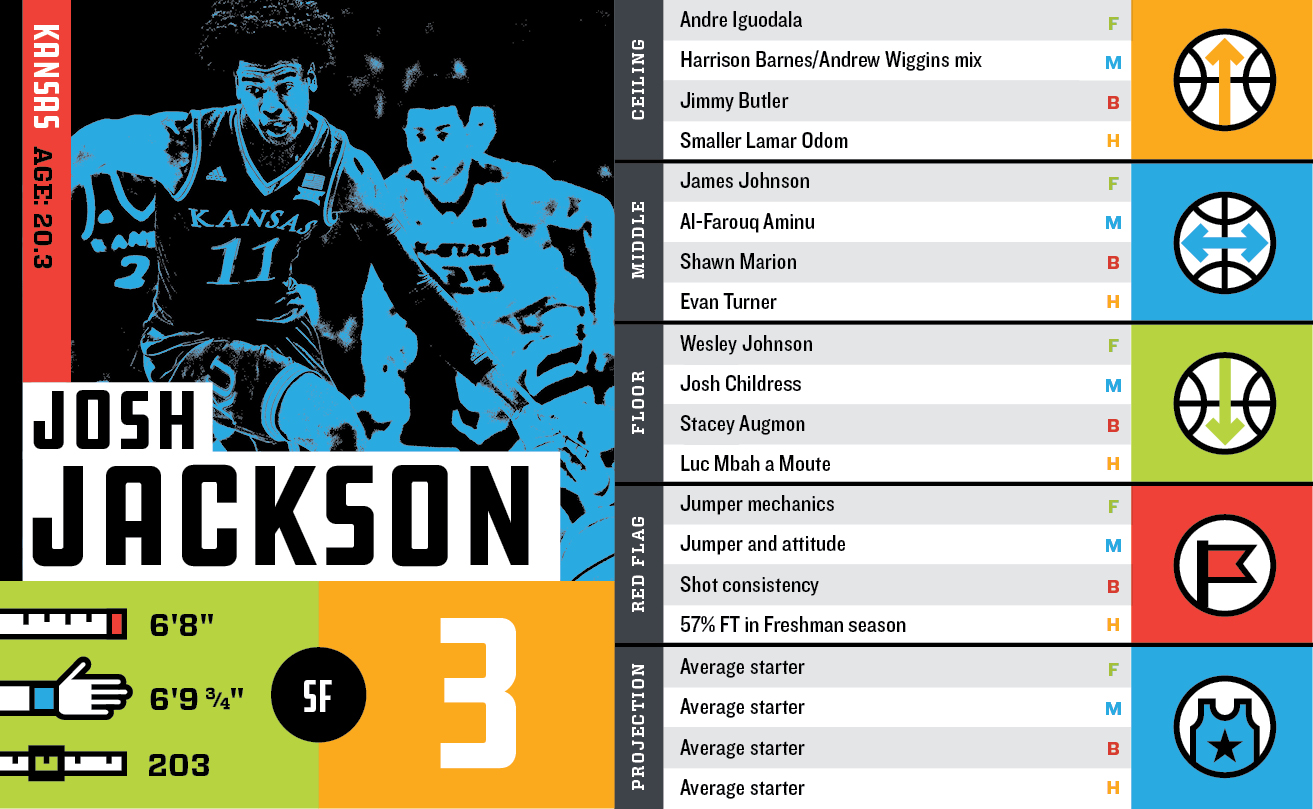
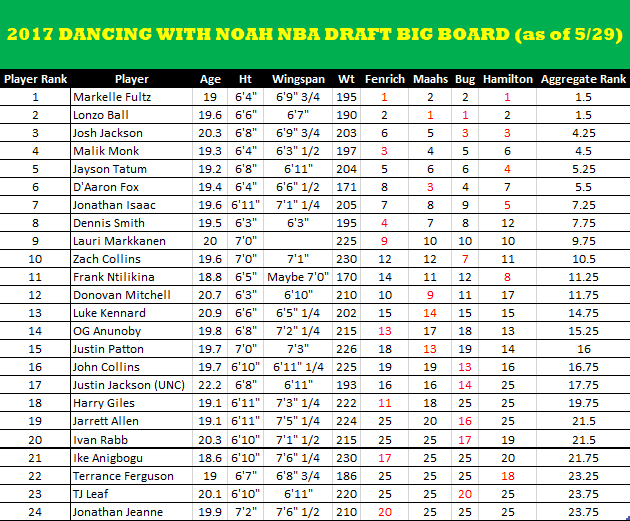
The charts below are pretty straightforward to read with each prospect’s ceiling, middle ground, floor, red flag and player type projection (all-timer, HOF, all-star, above average starter, average starter, below average starter, rotation player, and bench player) ranked my me (Fenrich), Andrew Maahs (also the creator of the fine graphics below), Bug Foster, and Hamilton. This is the second in a series of 2017 draft-related posts. The first of which is a top-20 big board with an explanation on how woefully incomplete a top-20 big board is in the modern NBA; it can be found here.
Fenrich: My Markelle Fultz relationship feels more complex than it needs to be and I can blame myself, Don MacLean and my buddy Matt for that. Myself, for not trudging a couple miles from my apartment to UW’s Hec Ed Pavilion to see Fultz play in-person. MacLean, for going overboard questioning Fultz’s intensity in some random game against an Arizona-based opponent and doing it in that oh-so-MacLean tone. And Matt, a Huskies season-ticket holder, for banging the Fultz drum in my ear all season. As I’ve gone through this Big Boarding process, the combination of warts on other players and the relatively unblemished game of Fultz has created a widening gap. The kid just turned 19 a few days ago and his measurements (6’4″ with a nearly 6’10” wingspan) make me think Dwyane Wade (measured nearly 6’5″ in shoes with a nearly 6’11” wingspan back in his pre-draft camp) as another big guard predisposed to scoring, but more than proficient in the ways of playmaking. That said, his game is nothing like the strength and force-fueled attack of Wade. His measured unfolding is more Brandon Roy or James Harden, more languid, deliberate, and paced. That he’s just 19 with an already advanced understanding of timing, great length, and a three-point accuracy north of 40%, and Fultz, for me, is the most NBA ready prospect in this class with a higher ceiling than any of his peers.
Bug: I’m a believer in the theory the great Isiah Thomas put forth in Bill Simmons’s Book of Basketball, “the secret to basketball is that it’s not about basketball.” The secret to Lonzo Ball’s game is not about the stats, it’s about being a floor general that puts his team in the best position to be successful. Zo doesn’t have stats that jump off the page, but his presence on the court instantly transformed a floundering UCLA program into an offensive juggernaut. It’s easy to get lost in the buffoonery of his father, Lavar Ball, but the talent of the kid is undeniable. Yes, he has an ugly shot, but if it goes in (41% from 3 on 194 attempts at UCLA), who cares? Everyone immediately thinks of Jason Kidd when watching Lonzo: big guard, great decision making, makes everyone around him better. In addition to the Kidd-like qualities, Zo can also go up and finish above the rim with ease. There is much debate about who should be the #1 pick in this year’s draft, but for me, I’m taking the point guard with the infectious style of play that uplifts an entire team. It’s not just about basketball, this kid will impact the entire culture of the organization that drafts him.
Bug: With the way the NBA is evolving to a smaller, up-tempo game, Josh Jackson seems to be a perfect for today’s game. When you watch him play, the thing that stands out is the variety of ways he can impact the game. He is able to do a bit of everything on the court, both offensively and defensively. The way Kansas used him ranged from post ups to slashing to running the break and giving the ball up to teammates for easy finishes. Mr. Jackson also shot a respectable 37.8% from 3 during his freshman season on one of best teams in the nation. While his offensive game has a good foundation and room for growth, the thing that has many scounts salivating is the equally tantilizing potential on defense. The kid flat out gets after it on the defensive end (1.7 spg & over a block a game), while also possessing the ability to guard 2-3 positions. The lackluster FT shooting (57% at KU) and unconventional shot mechanics could hold him back early in his career, but his impact in other facets of the game will get him a fair share of floor time as a rookie. Versatility is the name of the game for the modern NBA wing, and Jackson has it in spades.
Hamilton: Playing on national TV twice-a-week made it easy to catch Malik Monk in action. There was plenty to watch too. On a typically loaded team Monk routinely stood out. His incendiary offensive outbursts were certainly attention-grabbing (30 pts in 2nd half points vs Florida; 47 vs UNC on 16-28 FG). This wasn’t lost on many folks as he was named 1st team All-SEC. He plays with a sense of timing and understands when his team needs the offensive lift he’s always happy to provide. While his measurements aren’t great for a SG (6’3, 6’6 wingspan) he makes up for it with a quick release and legit NBA leaping ability. The release on his shot is consistent while the rotation and arc of the ball give most of his attempts a chance. This is evident in his 40% from 3 on 8 attempts per game. As most modern small-ish guards, he showed nice touch on his floater and uses a quick deciesive first step to get to the paint and get it off. Looks to get all the way to the rim for the dunk when he can do it off one or two dribbles. Whether he can do that against NBA defense with his slighter build remains to be seen. That quick first step from a standstill allows him to create space for pull up jump shots off the dribble. As most right-handed players, he’s more comfortable going to his left when shooting, but he’s very capable pulling up going right. He showed the range to shoot off the bounce from deep and should be able to eventually be a very reliable NBA 3 point shooter. Has a decent amount of what I like to call slickness. Slickness is a spectrum with Harry Barnes on the low end, while Jamal Crawford is the slickest. Monk leans toward JC at this point, which is a good thing. This is an area I would expect him to spend significant time on by developing more compex dribble moves and attacking tight gaps going toward the basket … Doesn’t strike me as much of a combo guard at this point, and I have my doubts he ever will be one. He’s far more comfortable coming off screens or attacking off a catch than running high pick and roll or finding open guys on his drive. WIth a great shot and relentlessness on the attack, Monk should be a good pro. How good may be very situational. Playing alongside the right PG may matter, which isn’t necessarily a knock on him. In other words, I’m not sure how he’d fair in Philly during the Ben Simmons PG experiment. But a John Wall or Mike Conley type would set Monk up nicely (to be fair those guys would set me up nicely). He seems to really enjoy playing baskebtall and competing, which will serve him well in development. It may take a couple years for Monk to figure out how to use his skills effectively in the NBA but I suspect he will do that and have a nice career.
Fenrich: I have so much confusion about Jayson Tatum. He has a ton of offensive skill and a game that’s well-developed beyond his 19 years. He’s comfortable in the post with a turn-and-face game and pretty much dogged out college defenders there. His range extends out to NBA three-point distances, even if the consistency isn’t there yet — he shot just 34% from deep on four attempts-per-game. The mechanics on his jumper look good and his form doesn’t breakdown much. Tatum looks the part of an NBA wing with his size, length, and athleticism. And maybe that’s part of the problem. His game reminds one almost immediately of Rudy Gay though Gay’s longer (7’3″ vs. 6’11” wingspan) with more bounce. There are hints of a Carmelo Anthony-type attacker which is seen in that post and face-up game. Tatum doesn’t have nearly the strength of a young Melo, but the refinement is there. JZ Mazlish of Wingspan Addicts did a great job of identifying the crux of the Tatum conundrum of the problem with scouting Tatum. It is a break in the value placed by traditional scouting approaches against the progressive approach of a numbers/analytics based community. If Tatum spent a decent chunk of his time at Duke playing power forward where he was able to abuse slower defenders, it doesn’t appear something that will translate against NBA fours. So if he’s a natural three, can he guard starting wings on a nightly basis or even score against them? At a first glance, the answer seems to be no. He looks like he’ll be better-suited as a rotation forward who can play the four in some small ball lineups. The skill is there, but the ceiling looks low and if I re-did my big board rankings, he’d likely drop down a bit. For some reason, the more I see and think about him, the more he becomes the wing version of fellow Dukie, Jahlil Okafor — a talented offensive player who probably would’ve been better-suited for the NBA of the 1990s.
Malcolm Brogdon, Josh Richardson, Norman Powell, Jordan Clarkson, Nikola Jokic, Draymond Green, Khris Middleton, Jae Crowder. Since the 2012 draft, the previous players have been taken in the second round, well behind players who are less effective as NBA pros. The draft isn’t a crap shoot, but with a crush of 19-year-old freshmen leaving college every season (11 of the top prospects in 2017 are freshmen, five of the top eight were freshmen in 2016, 11 of the top 13 in 2015, six of the top seven in 2014), the sample size to scout these players against top competition in a competitive setting is small.
Against that backdrop, I’ve teamed up with a few friends (Bug, Hamilton, and Maahs) to create a Big Board of the top-20 prospects in this year’s draft and over the next four weeks, scout these players in a series of posts. I lay out the above premise, that projecting NBA prospects has become an exercise that runs 90-players deep, to show the depth to which the league goes now in finding productivity and value. In the 2016-17 season, 88 different players who saw time on an NBA court were classified as rookies. The number was 73 in ’16, 82 in ’15, 78 in ’14, 78 in ’13. The draft is just 60-picks so what we’re seeing is close to an entire round worth of new players coming into the league each season.
The introduction of G-League-to-NBA team affiliations is up to 22 for 2016-17 and will rise to 28 by 2019. Combine that with two-way contracts (creates two additional roster spots and adds both team and player benefits that allow G-League players to make more money while giving the team flexiblity in bringing a player up to the NBA team without having to commit to an NBA salary until after 45 days – stipulations apply) that were created with the latest CBA agreement and there are more domestic pro basketball opportunities available.
All of the above means that the 20-player big board we’ve put together below is not comprehensive. We’re four people, three of us have children, and we’re all gainfully employed. Effective scouting, even with the copious tools that Draft Express puts out, isn’t just about identifying talent. The combination of team and scheme, opportunity, chemistry, player commitment and discipline – it’s a complex equation with few, if any, guarantees. And even if a team lands on a player and tries to cultivate him through the G-League, there’s still no guarantee they’ll figure out how to best tap that player’s potential in their particular system. Hassan Whiteside and Seth Curry are examples of players who were both late NBA bloomers and squandered by NBA teams. Whiteside was drafted 33rd in 2010, found himself out of the league in 2013 and is arguably a top-five player from his draft class. Curry wasn’t even drafted and played on four teams before latching on in Dallas as a productive member of NBA society this past season.
Caveats and qualifications aside, at the aggregate level, there’s not much variation from Draft Express or The Ringer’s big boards. This isn’t to say there’s not individual deviation, but collectively that our views converge with status quo. As we get into deeper analysis over the next few weeks, we’ll go into more player-specific detail. And because a cap of 20 prospects is woefully inadequate, where time and life allow, we’ll explore deeper cuts like DJ Wilson, Jawun Evans, Semi Ojeleye, Kobi Simmons, Sindarius Thornwell, Monte Morris and others.
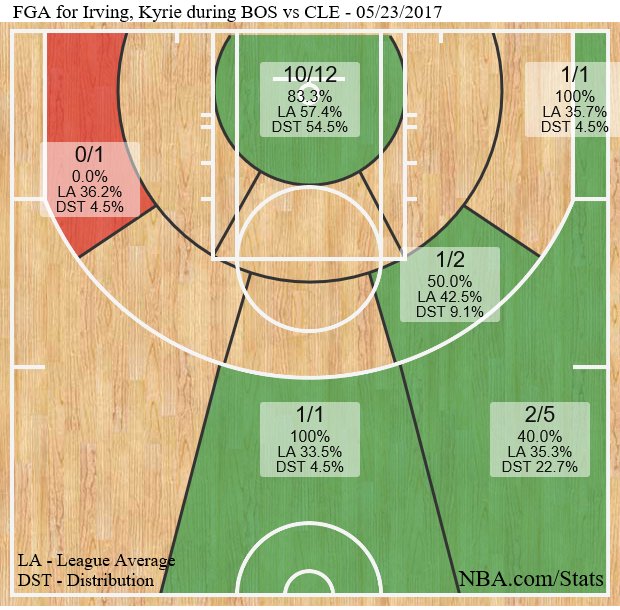
On May 23rd, Kyrie Irving’s delightful basketball art was once again on full display. The 25-year-old Cavs guard saw an opportunity when reigning GOAT-candidate and teammate, LeBron James, sat midway through the second quarter with his fourth foul and to paraphrase Steve Winwood, he saw a chance and took it.
His final line: 15-22 from the field, 4-7 from three, 8-9 from the free-throw line, a career playoff-high 42 points with 81% true shooting, and the type of third quarter performance that makes you want to support the National Endowment for the Kyries to cultivate this type of genius in all fields of expression. It was the kind of joy and declaration that simultaneously uplifts the audience to new levels of consciousness and reduces us to slack-jawed holy incantations in the same breath.
Take the third quarter which the Cavs went into with a ten-point deficit. Kyrie scored 21 points on ten shots. There was the buzzer beater three that dotted Terry Rozier’s eye. There was the scary rolled ankle that made guts bubble up and cringes rise in basketball fans across the globe. But, there was Kyrie nearly outscoring Boston for the entire quarter (he lost 23-21) with a series of improvisational acrobatic slaloms into the clutches of a green-hued opponent. I say improvisational because there’s so much reading and reacting, but there’s a choreographic element to Irving’s slicing drives almost as if it’s all premeditated. And there he was exploiting mismatches like Tyler Zeller and Kelly Olynyk (very poor souls, how I relate! How I empathize!) for layups. But these Kyrie layups aren’t your dad’s layups. It’s not Earl Monroe or Tiny Archibald or Rod Strickland, Isiah Thomas, Tim Hardaway, Steve Nash or anyone else. They’re elegant, funambulist, time-stopping. It’s beauty. For Kyrie, when it’s cooking like it was on this Tuesday night in May, it feels magnetic. You could cover the man’s eyes with a thick black cloak of midnight and he could sniff out the basket with the right amount of English and some preternatural understanding of geometry.
The crescendo really began at the 4:48 mark in the third when Cleveland was down 69-66. JR Smith found Kyrie in transition for a contested layup against Avery Bradley to pull the Cavs within one point at 69-68.
On the next possession, Kyrie was isolated above the corner against Olynyk, of Kelly Oubre-infamy, who he tortured with jab step threats before calmly sinking three. Score: 72-72, Kyrie at 25.
A minute later he caught Zeller on a pick-and-roll switch going downhill for a layup. Score: Cavs, 75-72, Kyrie at 27.
Less than a minute later, he caught a transition pass from LeBron and easily laid it in. Cavs, 77-72, Kyrie at 29. That’s four straight makes.
Off the ball moments later, he caught Rozier napping for slightest of moments, got just a hair behind him and used his underrated size advantage for a backdoor lob-into-a-layup. 79-74, 31 for Kyrie and five straight makes in about three minutes.
As if to prove he can do more than score in transition or against slow-footed sacrificial lambs, he then found himself on the right wing (his preferred area of operation – he took just one shot from the left side all night) against badass Bradley. Again, with the same fake jabs he used on Olynyk in the corner, he feints baseline and Bradley shifts his stance. In these split seconds of shifting and countering the counters, Kyrie gets over the defender’s top foot, has him beat, and careens downhill where Zeller awaits. Kyrie anticipates, adjusts, re-balances, makes the shot and draws the foul. Cavs, 82-76, Kyrie up to 34 and six straight.
Isolated again on the right wing, this time against the game, but overmatched Rozier, Irving does the exact same thing he just did to Avery: fake right, catch the defender off-guard because the defense must respect the dribble drive and in this case, Rozier nearly trips over his own feet, go left to the center. This time it’s Al Horford waiting and Kyrie casually leaps, brings the ball down and scoops it from a lower angle over Horford’s outstretched hand. And does it all at top speed with grace. Cavs, 84-78, 36 for Kyrie and he’s now hit seven straight.
Finally, the icing on the cake. The cherry on top. The gravy on the mashed potatoes. Whatever you want to call it, young Rozier was stuck all alone on Kyrie yet again with the quarter winding down. The previous slice and dice fresh in his mind, Rozier’s too reactionary on the balls of his feet jumping back nearly three to four feet when Kyrie fakes a dribble attack. At the same time Rozier backs up, Kyrie calmly, cool as you will, steps back creating a good six-plus feet between them. The shot is up, the shot is good and Cleveland goes into the fourth up 87-80 as the buzzer sounds.
Over the final four minutes and forty-eight seconds of the third period, Kyrie scored 19 points and hit eight straight shots.
And as I finish this, what I think I’ve realized is that Kyrie captured a moment, captured the crowd, and captivated us all. It reminds me of a section Jack Kerouac’s On the Road when his main characters Dean and Sal end up at a jazz club in San Francisco and end up under the spell of a tenorman who captured “IT.” As Dean explains it:
Now, man, that alto man last night had IT—he held it once he found it…. Up to him to put down what’s on everybody’s mind. He starts the first chorus, then lines up his ideas…. And then he rises to his fate and has to blow equal to it. All of a sudden in the middle of the chorus he gets it—everybody looks up and knows; they listen; he picks it up and carries. Time stops. He’s filling empty space with the substance of our lives…. He has to blow across bridges and come and do it with such infinite feeling soul-exploratory for the tune of the moment that everybody knows it’s not the tune that counts but IT
For all of basketball’s team-sport ethos, these moments of individual greatness can tilt thousands of people sitting in an arena towards palpable frenzy. You can imagine, or at least I can imagine, a crowd rising to riot levels in these moments. The rising giddiness, the euphoria, the open-ended question imploringly asked: how far can we go? How far will he take us? To which only Kyrie can answer. He owned the time and the moment. For that blissful stretch of the third, he had IT.
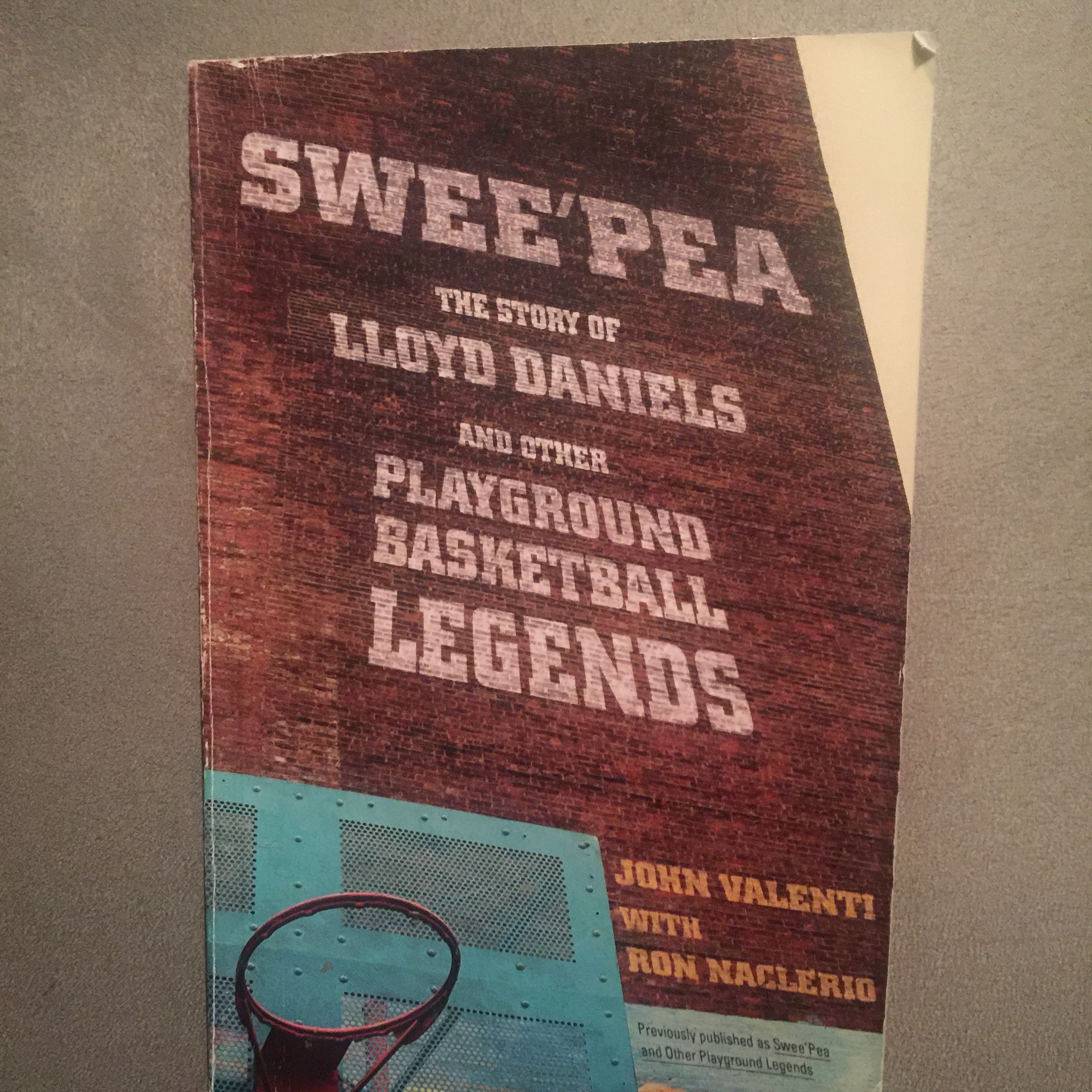
Lloyd Daniels entered my consciousness sometime in the early nineties. I don’t know if it was in 1992 when he made his NBA debut with the San Antonio Spurs as a 25-year-old rookie or if it was sometime before when he flirted with NCAA eligibility and Jerry Tarkanian’s UNLV program. As a 12-year-old, I was perplexed about why there was this hoopla around a guy who averaged under ten points and hadn’t played on any college team I knew of. Whenever I first heard of Daniels, it was absent awareness of John Valenti’s 1991 book (co-written by Ron Naclerio), originally titled Swee’Pea and Other Playground Legends: Tales of Drugs, Violence and Basketball; later republished as Swee’pea: The Story of Lloyd Daniels and Other Playground Basketball Legends.
It’s a not a radical title makeover, but it’s enough to raise an eyebrow as the original title and the content within Valenti’s book is flush with the drug abuse and violence that rolled like an avalanche through American cities in the 1980s in the form of crack. Not immune from the drug game and its accompanying violence were New York City basketball players from Earl “the Goat” Manigault in the 1960s to Len Bias and Lloyd Daniels in the 80s.
Valenti and Naclerio are perfectly qualified to tell Lloyd’s story. Valenti, a nine-time Pulitzer Prize-nominated reporter and Naclerio, one of the most decorated coaches in New York’s famed Public School Athletic League with over 700 wins, have the requisite skills and firsthand knowledge (Naclerio had been a Daniels confidant and supporter since the early-80s) to tell Lloyd’s tragic story.
It’s a story that is as much a sociological study of the impact of drugs on the inner-city boroughs of New York as it is an exploration into the city’s playground basketball legends. Unfortunately, the two have been tragically intertwined. In my reading, I wanted more basketball, more stories, more myths, more descriptions. But the narrative we want isn’t usually the one that was lived. And in the 18-to-20 hours each day that Lloyd Daniels wasn’t aweing basketball coaches or fans from Brooklyn to Mount SAC, from a young age, he was skipping school, sleeping in and getting high. That reality wasn’t unique to Daniels and it’s the story Valenti tells here which is why the title shift feels disingenuous.
Daniels was a 6’7” wing player born in 1967 so he came up around the same time as future NBA players J.R. Reid, LaBradford Smith, and Dennis Scott. His mother died at a young age, and his father wasn’t in the picture, so Daniels was passed back and forth between grandmothers. By age seven, he could navigate the city’s boroughs by public transit and by ten he was selling coke and weed and toking up daily. Ten-years-old, no mother, no father, unable to read with undiagnosed dyslexia, a well-developed con necessary just for survival. That same boy who was failed by the education system and failed by his family, was sneaking out night to play basketball in the dark. As Valenti writes,
He taught himself how to dribble on those darkened, glass-strewn courts. Taught himself how to pass, bouncing the ball off the chain-link fences. Taught himself to shoot jumpers in the park, which had no lights, banking them home in the dark. He said it developed not only his eye for the basket, but his feel for it. He’d take a hundred shots. After a while, despite the darkness, he could make 98, 99.
This balance, the drug hustle and basketball, is the delicate tightrope Daniels kept falling off throughout his life and is the backbone along which the content of the book strides. From the time he’s a young kid, barely a teenager, Daniels is swarmed by hangers-on, people who genuinely care for him, but are also pulled in by his prodigious talents. They let him get away with on and off-court crap because he’s just so freakishly talented. This extremely human conflict, a self-vested interest, is a recurring theme in Lloyd’s life where we see these older, typically well-off white men constantly drawn to Daniels’s talent, his likability, and they develop genuine relationships with the young star. Simultaneously, Daniels picked up pretty early that he was a hot commodity because he was good at basketball and developed terrible habits. He used people to get what he needed and into his 20s, had a teenager’s inability to take accountability for his actions.
Original photo posted by twitter.com/JoeMcKinzie here and partial photo here. That’s Lloyd wearing the hat and former-NBA player Rod Strickland is 3rd from left. Lou d’Almeida, a controversial Lloyd benefactor is the lone white guy.
People don’t take interest unless you’re one hell of a player and that’s what makes Lloyd’s story so damn compelling. This is a player who, as a junior in high school, averaged 31-points, 12-rebounds, ten assists, and five blocks per-game and was named to the 1986 Parade All-American team. He was regularly compared to Magic Johnson and George Gervin because his feel for the game was so natural, the execution so smooth. Just watching this clip from 1996 when Lloyd was 29 and had beaten his body up with years of drug and alcohol abuse and survived a drug-related shooting that nearly killed him, you can see the fluidity and talent that were so magnetizing when he was a teeThat there is so little video of Daniels playing ball is part beauty, part tragedy. Beauty in the sense that myths and legends are food for the imagination. You can choose to believe or not and even among those who saw Daniels as a teenager and then saw him in his mid-20s when he was well-past his basketball-playing prime have waffled on how good of a talent he really was. It’s tragedy in that a talent so vast and unique was underutilized to the point that, despite the availability of video equipment, a relatively small number of people were able to appreciate his gifts. His greatest lives on via oral tradition or in the locked-up memories of those who saw him when. Valenti, via high school recruiting expert and Daniels aficionado, Tom Konchalski captures this fleeting essence in religious tones:
Stories of Lloyd Daniels and his immense and immeasurable talent, remain like those of apparitions of the Virgin Mother at Lourdes and La Salette, at Fatima and Our Lady of Guadalupe and even Syracuse. That is, that most nonbelievers don’t believe those apparitions existed. But for those who were there, who saw with their own eyes, well … they believe, because they know in their hearts and in their minds what they saw. Truly saw.
Valenti uses a colorful cast of New York ball players to show that, however talented he may have been, Daniels being failed by family and schools and succumbing to temptations was not the exception, but the rule. He uses Tony Bruin III to show that even young men who grew up with a strong family presence and made it to college were still vulnerable to the pull of drugs. There’s the Goat, Richie Adams, Fly Williams, and how many other players who traded the ball for the rock.
On the flip side, there’s Lefrak City’s Kenny Anderson whose uncle was a well-regarded ballplayer caught up in the streets and killed at 27. Anderson’s older brother Ricky, another ballplayer who made a name for himself, but quit in exchange for “other interests.” Anderson is a background character in the broader story, but serves a purpose as a contrast to Daniels. From before he entered high school, Anderson was surrounded by a support team that included Kenny Smith’s brother Vincent, and Archbishop Molloy’s legendary head coach Jack Curran who helped insulate Kenny from all the shit swirling around. It wasn’t different from Daniels having Naclerio, Konchalski, Lou d’Almedia or Arnie Hershkowitz trying to help steer him to places like Oak Hill or Laurinburg; places where, in theory, Lloyd could thrive with discipline and a break from the temptations of the city.
It’s hard to point specifically to what made Anderson and Lloyd different though Valenti, through the stories of Mark Jackson and John Salley, repeatedly points out the steady and influencing role of family that helped some players avoid the street temptations. But it’s not that simple as the Tony Bruin case shows. There’s not always an explanation to why some people succeed and others fail. What makes Lloyd’s story so compelling, and this is no doubt part of the problem, was his rare talent. In July of 1989, just after he had been shot, Lloyd attended the Mike Tyson-Carl Williams fight in Atlantic City and was the toast of the celebrity-filled afterparty. He’s buddy-buddy with Mike Tyson, cool with Rick Pitino and even artist Leroy Neiman, friendly with Charles Barkley and Charles Oakley. He was a defacto celebrity without ever having played in the NBA or the NCAA – that’s how prodigious his talent was.
Swee’Pea is a sociological survey. It’s also a basketball story. It’s a study of human psychology and power dynamics as the substance abusing Lloyd, who was let down by his family and the New York schools, who can’t read, can’t be relied upon for work, can’t commit to putting forth consistent effort, can’t do the basic shit all of us try to do just to get by, is gifted chance after chance at redemption because he has a set of skills that can be packaged up and sold for millions of dollars. On its surface, that’s a miserable, transparent, and heartless exchange. But what makes Swee’Pea worth reading is that it’s not as simple as a heartless exchange. Administration and bureaucracy lead to cold, unfeeling exchanges and on the outer rims of high level basketball, you’re not finding much in the way of administration. It’s not just Jerry Tarkanian using Lloyd to try and better his program or Lloyd conning the owner of his CBA team who took him into his house.
Beyond the brutal zero-sum game of drugs and high caliber basketball are humans worth giving a damn about. That they’re engaged in the endless pursuit of self-interest doesn’t make them different from the rest of us. It makes them more relatable; just sitting at a different table with different stakes, playing games we can all relate to in one way or another.
Last season I had a monthly post to look at how players were pacing against random historical statistical achievements and now that we’re now roughly a quarter of the way into the NBA season, I’m revisiting the concept. It’s no longer the “young” NBA season, but we’ve escaped the doldrums of “small sample-size theater” and can look at trends as markers of potential sustainability like Russell Westbrook preposterously averaging a triple double. The audacity! Let’s dive in and embrace the stats instead of telling the kids to get off our lawn while we spit shine our shrines to Oscar Robertson and Michael Jordan because goddamn it, yesterday wasn’t better than today and today isn’t better than yesterday. New frontiers await, let’s go!
Special thanks to Basketball-Reference for ALL stats
You want efficiency, here’s your damn efficiency: Kevin Durant scoring 27ppg on 17 or less FGA/gm. Since 1946-47, Basketball-Reference (BBR) tells us the only player with comparable volume and efficiency was Charles Barkley in 1987-88 when he averaged 28.3-points on 16 FGA/gm. Everyone said it would be easier in for KD in Golden State and so far it’s been historically easy.
For just the 3rd time in league history, at least 10 players are averaging 25 or more points/game. Last happened in 2005-06 after a rule change. Additionally, a whopping 28 players are averaging 20 points or higher.
Seems like everyone has strong opinions these days on how many threes big men should or shouldn’t be shooting. I may or may not be one of these people, but it doesn’t change the fact that players listed at 6’11” or taller are taking and making more threes than ever before. Prior to 2016-17, big guys had hit 1.5 or more threes/game 18 different times and it been accomplished by just seven players including the king of big man threes, Dirk Nowitzki who did it five times. But the throne is being challenged in 16-17 as six bigs are making at least 1.5 3s/game including Channing Frye who, if he keeps up his current pace, will tie Dirk for most appearances on the list. Also worth noting is that Frye’s on pace to set big man records for most threes made and highest 3pt-percentage.
With advanced stats like individual defensive-rating, defensive plus-minus, and opponent shooting percentage, we have more and deeper ways to measure defensive impact. This is good, but there’s still some traditional measures that help identify the havoc players are wreaking on that end of the floor and steals and blocks do a decent job. Since 1973-74 when steals and blocks started being tracked, just two players (David Robinson once and Hakeem Olajuwon four times) have accomplished full-season averages of 2-plus steals and 2-plus blocks. A quarter of the way into 16-17 and the dashing young Grecian prince Giannis Antetokounmpo is making a bid to join these Hall-of-Fame legends with his averages of 2.2 in both categories. Fellow basketball savant Anthony Davis isn’t far behind at 2.7-blocks and 1.8-steals. Do these youngsters dare to jointly pull off a feat not seen since 1992? Dare they may!
In all our years, we’ve only seen the greatest of the great reach the all-around statistical lines so indicative of great versatility as a 22-point, 8-rebound, 6-assist per-game average. These are players like Oscar Robertson (5x), Wilt Chamberlain (2x), John Havlicek (2x), Larry Bird (6x), Michael Jordan, Kevin Garnett, and Lebron James. But legends must make room for new jacks and those include Russell Westbrook (31-10-11) and the aforementioned Giannis (22-8-6). Russ is the headliner, but at 22, Giannis and Oscar (in 1960-61) are the youngest ever to stack these stats.
From the world of the weird, since the advent of this great game only a single player has averaged at least 25-points while making 8-or-less field goals/game. That lightning rod of making a lot out of a little is James Harden who reached the over-25/under-8 marker thrice is being threatened with new company this season as argyle-sock-puppet-loving Jimmy Butler throws his hat into the ring of mondo-efficiency with 25.6-points on just 7.8-field goals/game.
Joel Embiid doesn’t currently qualify for league leaders due to his lack of minutes which is a result of nightly restrictions and not playing back-to-backs, but for rookies, he’s embarking on some strange records:
Usage rate: He’s currently at 37.6% which would easily eclipse Ben Gordon’s record of 30.4% back in 2004-05. NBA usage rates are tracked back to 1977-78.
Blocks & Threes: With all these unicorns like Embiid, Giannis, and Porzingis galloping around NBA cities, new frontiers are being explored with frequency. Since 1983-84, only one other player (not limited to rookies) has as many blocks (29) and threes (18) made through his team’s first 13 games and that’s Wilson Chandler in 2010-11.
28-points-10-rebounds-1.5 3s had never been reached before this season and now we’ve got two players breaking on through to the other side (interestingly enough, a montage of Westbrook drives, dives, and boards could easily be set to The Doors tune) of NBA statistics: Westbrook (31-10-1.8) and DeMarcus Cousins (29-10-1.7). There’s a lot of similarity in how these guys play so while positionally (not a word, but we’ll go with it) and physically they couldn’t be much more dissimilar, they’re both emotionally volatile players fueled by something deep in their guts and chest cavities. They’re wrecking balls with immense responsibilities riding on their shoulders and their carnage is leaving bulk stats and fragile records in their wakes from Sacramento to Oklahoma City.
A usage rate over 30% will typically land a player in the top-10 in the league in overall usage. But 30% usage and under two turnovers/game? That’s rare. So rare that prior to this season, it’s been accomplished just three times: by Kobe Bryant last year (more a result of his bullish shot jacking), LaMarcus Aldridge in 14-15 (30.2, 1.7), and Dirk in 08-09 (30.3, 1.9). Joining this rare combination of usage and efficiency are Kawhi Leonard (30.6, 1.9) and Zach Randolph (30.9, 1.3). Though I haven’t seen as much Z-Bo as I would like, I’m assuming there’s a lot of catching and shooting with little dribbling and not much playmaking. Kawhi, by contrast, has more assists/game than anyone else on this list.
Blocking shots and scoring the basketball at an elite level are the domains of Kareem, Hakeem, the Admiral and Pat Ewing, right? I mean those are the first names that come to mind when I think of that joint skillset, but prior to this season, only a single player had ever average 30-points and greater than 2.5-blocks for an entire season. Can you guess who it is? Think, think, guess, guess, don’t skip ahead. This year, Anthony Davis (31.5, 2.7) is flirting with joining Buffalo Brave great Bob McAdoo (30.6, 3.3) in this exclusive club of tall, lean basketball pros.
After tonight, the Brow of unibrow fame is already up to six 35-point, 15-rebound games. Since 1983-84, the most a player has had in a single season was Charles Barkley with 12 in 87-88. We know the Brow’s susceptible to missing games to aches, pains, strains, sprains and the like, but this is a fun one to watch.
50-40-90 club but with 48-38-88 thresholds so we can see who’s sniffing around. 20 games into the season and we’ve got four candidates: Stephen Curry (49-42-92), Patty Mills (51-45-96), Terrence Ross (50-44-94), and J.J. Redick (49-46-90). Only once since we’ve been threes came into the game have we seen more than one player reach this dead-eye shooting summit: 2007-08 when Jose Calderon and Steve Nash landed there together.
We’re a quarter of the way in, but this has the making of a legendary season for statistical achievements, driven by those former three Thunders rolling roughshod through the league in their own tradition-defying ways. Usage rates at the individual level are rising in line with individual scoring and the range expansion of big men means more of the court is open to new batches of players which means the entire ecosystem of stats is undergoing historical change. This is fun, it’s unseen, let’s get our sunscreen (I’ll make sure your neck is covered) and venture off into worlds unknown with Boogie and Russ and the Brow. Godspeed!
Aside from being wholly arbitrary and comforting with its round numbers, the 30-point, 10-assist, 0-turnover game is an indelible mark of pro basketball efficiency. Its achievers clearly shoulder the weight of an entire offense, acting as both elite scorer and distributor while taking care to not give away precious possessions. At this early time in the 2016-17 season, James Harden is trekking towards NBA infamy with a turnover-per-game ratio north of 5 which makes his induction into the 30-10-0 club on November 19th, 2016 all the more unexpected, but also all the more possible given his nightly responsibility.
Major League Baseball has an informal mark of master class in starting pitching referred to as “The Maddux,” in honor of Hall-of-Famer Greg Maddux who was known for his ultra-efficiency on the mound. The Maddux is a complete game shutout while throwing under 100 pitches. Not surprisingly, Maddux was the master of The Maddux. He accumulated 13 such performances over 740 career starts – just under 2% of all starts. The next closest pitcher is Zane Smith with 7 Madduxes. Since 1988 when pitch counts were regularly tracked, blogger/writer Jason Lukehart writes that there have been over 300 Madduxes thrown by 190 different pitchers – or roughly 11-per-season.
While it’s nothing near an apples-to-apples comparison, the 30-10-0 club has the feel of a Maddux in its combination of efficiency mixed with excellence. Our dear Player Index resource over at Basketball-Reference tells us that since the 1983-84 season, the 30-10-0 has been accomplished 46 times by 39 different players; or less than 1.5 times-per-season. Given the time constraints and lack of turnover numbers available for historical players, it’s safe to assume 30-10 luminaries like Nate Archibald and Oscar Robertson are grandfathers of the stat, but we’ll just have to move forward with our Reagan-era players.
So if the great Greg Maddux is the godfather of the Maddux, then we’re all inevitably asking, “Who’s the godfather of the 30-10-0? Whose illustrious name shall represent the ultimate in scoring and assisting efficiency?”
My own guesses went the way of Chris Paul, or Magic Johnson, Larry Bird, or Steve Nash. I wasn’t prepared for Stephon Marbury. Maybe it shouldn’t be a shock as the Coney Island Starchild had a 7-season stretch where he averaged roughly 22-points and 8-assists with 3-turnovers, but I was shocked anyway. Here are the top 30-10-0s:
The Godfather of the 30-10-0 Club honored with a statue for having 4 such games
Zero turnovers isn’t some ultimate mark of perfection in basketball anymore than differentiating between 99 pitches and 100 pitches is in baseball, but it’s a hell of a benchmark. Coupled with the points and assists, it’s also a good indicator of team success. In the 46 games we’ve seen the 30-10-0, teams featuring said players are 40-6, winning 87% of their games.
There’s no great takeaway other than acknowledging that something extremely rare and unlikely occurred this past Saturday. History is full of these little untold truths that lie waiting to be discovered through the accomplishments of the present. Alex English going for 46-10-0 while shooting 76% from the field? Larry Bird hanging 46-10-0 on the Magic as a hobbled 33-year-old? Or even Baron Davis’s 33-14rebound-10-0 effort in the playoffs back in 2002? These are masterpieces trapped in the memories of fans and beneath the dust of the archives. If Zane Smith can be Greg Maddux for a night, then even Stephen Jackson can be Larry Bird.
It’s a bit of Captain Obviousness at his most obvious, but after this latest weekend of norm-crushing outputs, it’s still worth acknowledging the statistical rampages on which Russell Westbrook and James Harden are presently embarking.
Harden’s latest salvo was fired across the electorally-commentating Gregg Popovich’s snout to the tune of 25-points, 11-rebounds, and 13-assists which marked back-to-back triple doubles and the third consecutive game of at least 24-points and 13-assists. The last guy to go three straight 24-13s was the Canadian maestroSteve Nash.
Russ responded in kind with an even nervier performance on Sunday (the day of my birth and the day after his own birth so thanks for the bday entertainment) when he unloaded for 41-points, 12-rebounds, and 16-assists while turning the ball over just twice and shooting 67% from the field. That OKC lost to the ever-struggling Magic is just details in the micro, but worrisome in the macro where there’s a collective evidence that disallows celebrating the individual performance in basketball unless there’s a corresponding team success. Aside from the tiresome debates of our day about winning, stats, and the individual in modern basketball, you can be reassured that Russell’s performance was of a most rarefied air. Since 1983-84 which is as far back as Basketball-Reference’s game logs go, only one other player has posted the 40-10-15 triple double and that was three-time NBA champion and ghost chasing coverboy, LeBron James – though Bron needed a full 47 minutes while Russ needed a mere 38. (As an aside, the night Bron executed the 40-10-15, the Cavs lost to Denver in a classic Carmelo-Bron duel where Anthony put up 40 in a game his Nuggets won in overtime. Can we get this on some NBA OnDemand platform? Please? Or is that too much to ask given that we can’t even get a workable version of League Pass?)
We’re a mere 10% into this new season, but inching further away from the small sample size theater and into some world of sustainability. These gaudy stats (32-9-10 with 5 turnovers and a 41% usage for Russ, 30-8-13 with 6 turnovers and 34% usage for Harden) would seem to taper off at some point and yet that assumption is driven by two notions: 1) neither player is physically capable of keeping up these torrid paces, 2) a single player carrying a disproportionate load eventually becomes an impediment to team success.
Physically speaking, Russ has proven his Wolverine-type resiliency over the years as he hadn’t missed a single game through the first five seasons of his career until Patrick Beverley notoriously dove into his leg during the playoffs. This is a man who had his skull dented and continued to play. He appears capable of carrying anything and has the second-highest usage rating in league history at 38.4% in 14-15 which he achieved over 67 games in a season when Kevin Durant was frequently absent with foot injuries.
Harden is a case in stylistic contrast, but has proven himself to be a player with a single-minded emphasis on forward progress. He’s in the midst of a stretch of over 300 games dating back to 2013 where he’s averaging right at 10 free throw attempts-per-game. Despite a bruising style that results in him getting hacked as much or more than any player not named LeBron, his only missed game since the 14-15 season happened in March of 2015 when he was suspended. He’s led the league in minutes played the past two seasons and appears more than physically capable of doing it again year. Iron Man, Iron Beard? So what, get your minutes Harden.
If you’ve seen OKC during one of its 14-minute stretches each game when Russ sits, then you’ve seen a train wreck of a directionless offense flying off the tracks, careening into the fiery depths of basketball hell. They have just one 5-man lineup that doesn’t include Westbrook and has a positive point differential and that lineup has seen just 4-minutes this season. Westbrook leads the league in both box score plus/minus and VORP (value over replacement player) and his on-off difference is a whopping +25.7. Whether you watch or study the data or just close your eyes and imagine, in any scenario, by any measure, OKC needs Russ like the winter needs the spring.
But if you think a +25.7 on-off is nice, Harden’s with the Rockets is +38.6. Like Westbrook, he appears in Houston’s most productive lineups and has become the singular point of propulsion for this potent offensive attack. Maybe the return of the knee-crushing Beverley does something to reduce Harden’s burden, but he’s never been a traditional point guard/playmaker either, so while his return may assuage some of the wear and tear, it’s not likely to limit the role of the bearded one.
By all visual and statistical appearances, these team’s hopes weigh disproportionately on the shoulders of these native Los Angelinos. It may not meet the aesthetic that some have of basketball, but it does create a space for insanity to reign and for us to plumb the depths of man’s ability to mythologize in a most John Henry (or early MJ) way.
Is it sustainable though? Russ is shooting a career-best 35% from three on a career-high 6 three-point-attempts per-game. Harden is averaging over 40% more than his best assists-per-game average. And both guys are rebounding at career-best levels.
Without Durant, OKC is playing the fastest pace of Westbrook’s career which is resulting in around three more possessions-per-game than at any other time in his career. Harden, conversely, is playing slightly slower than last season, but in line with 14-15. The big flip for Harden is that, per BBR, he’s seeing 98% of his minutes at the point guard position versus 1-2% the previous three seasons. He’s surrounded by glorious shooters like Ryan Anderson, Eric Gordon, Trevor Ariza and even a blossoming Sam Dekker. The variables are in place for both guys to continue churning out offense at gluttonous levels.
Points and assists are so much more in the player’s control than rebounding and while the scoring/assist combinations are the stuff that Oscar Robertson and Nate Archibald can relate to, it’s the rebounding as lead guards that make these players so unique and dangerous. Like LeBron or Magic, both guys can retrieve the defensive board and catch a vulnerable, unset defensive off-balance. As of 11/14, Westbrook leads the league in transition possessions and Harden is tied for 5th. Neither player is exceptionally efficient, which, given the volume of their breaks doesn’t diminish from the overall impact.
All that defensive rebounding-leading-to-breaks aside, Harden maintaining 8-rebounds-per-game or Westbrook at 9 are the most likely stats to fall off.
To put these lines into perspective though, only one player in NBA history has maintained the 30-8-10 line for an entire season. Yep, Mr. Triple-Double himself, Oscar Robertson pulled off the feat three separate seasons: 61-62, 63-64, and 64-65.
Stats courtesy of the great basketball-reference.com – a great website
Like my presumption of Russ and Harden’s toughest counting stat being rebounding, the Big O’s greatest volatility was on the boards where he dropped from 12.5/game as a 23-year-old to a mere 9-10 in subsequent seasons. What makes the Robertson comparison interesting and what makes Russ and Harden’s outputs so damn ridiculous is the difference in pace between the mid-60s and today. Below I’ve included the same table, but with team pace included at the far right:
The numbers are frighteningly similar despite the massive gaps in both minutes played and pace. None of this should take away from the Big O who averaged a triple-double over his first six seasons in the league which spanned 460 games and a 30-10-10 stat line. But it feels almost like Miguel Cabrera winning the Triple Crown a few years back. There are hallowed numbers that feel out of reach, until the savants of today show up with their beards and fringe fashion statements and make you think the impossible is possible. Dinosaurs can walk again – but can they do it for 82 games? Shit man, you’re asking the wrong guy.
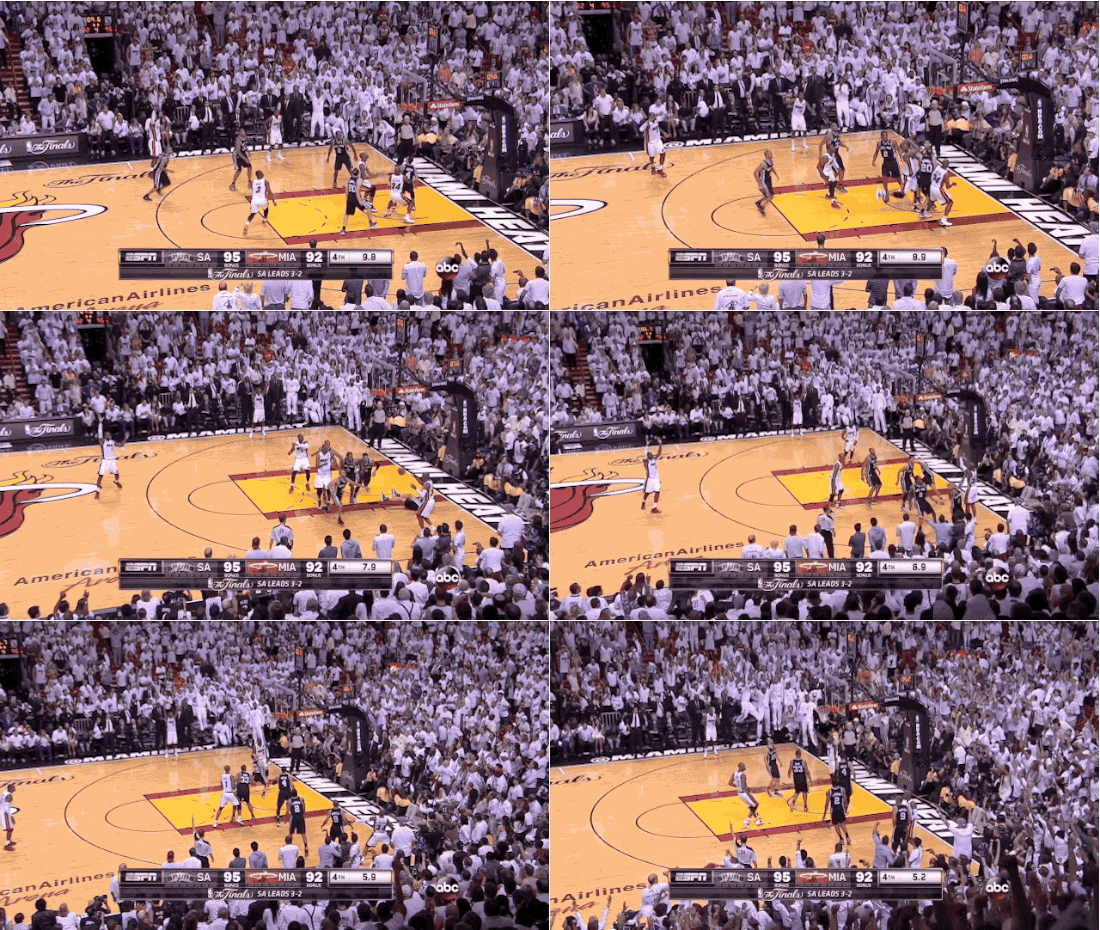
On November 1st, 2016, Ray Allen announced his retirement from the National Basketball Association, but way back in June of 2013 when I was a wee lad of 32, I was in my living room watching game six of the Finals with my guy Zach, an unabashed LeBron James non-fan. We both claimed indifference to the outcome, but as the series progressed, it became evident that I was outwardly pro-Heat, and he was low-key pro-Spurs – or maybe just anti-Heat. I think our lines of division were cut primarily along a Lebron-drawn border and of course it was the King who lost his headband and went HAM, but it was Ray Allen in his most particular attention to detail who attempted the improbable, impossible, iconic corner three while backpedaling, squaring his feet, catching, rising, and with a posture and form that has always been the envy of jump shooters around the world, actually made one of the greatest shots in pro basketball history.
If I remember nothing else of Ray Allen, that shot will forever be seared in the part of my memory that houses basketball. It’s up there with MJ’s shot against the Jazz and Dave Newman’s shot against Valley High School in 1998 as my trinity of greatest shots of all time experienced live in the moment. (This list is subject to change at the author’s own whims and as memory affords.)
In as much as Ray’s basketball excellence can be boiled down to a single shot that articulates and expresses everything about his basketball greatness, the breadth and depth of his career is vast.
My own personal relationship with Allen dates back to his Big East days where I have recollections (and maybe even a VHS recording) of UCONN battling Allen Iverson’s Georgetown squad and Ray going by the nickname The Candyman which, whenever I’m reminded of this, I hear the refrain from the song, “The candyman can because he mixes it with love that makes the world taste good,” which is fraught with awkwardness. This is back when I was 14 or 15 which means I’ve been conscious and aware of the being called Ray Allen for over half my life.
While his Milwaukee and early Seattle years established him as top-tier and probably the top shooter in the league, my own fondness for Allen developed when I moved to Seattle in August of 2004. Up to that point, I’d never lived in a city with an NBA team. The Sonics were gone four seasons after my arrival, but in my time here they were an ok-to-good team with Allen and Rashard Lewis as their go-to guys and took the eventual champion Spurs to six games in 2005. The game three atmosphere in Key Arena was beautiful, moving enough that my mom, always good for an emotional release, had recently become a US citizen and cried through the rousing national anthem. It’s strange, but my memories of Allen are not profound and certainly not as moving as my mom’s experience during that playoff game. During the three years I watched him at Key Arena (attending roughly 5-10 games/season in-person), he experienced his statistical peak with a three-season average of 25-points, over 4 rebounds, nearly 4 assists, with 3 threes-made-per game and made the All-NBA Second team in 04-05.
There was something rote or maybe even boring to his excellence. That’s not to imply there’s something less valuable about a versatile two-guard with a well-rounded game and the prettiest jump shot of all-time and an incomprehensibly quick release. It’s not to discount the nuance of his footwork curling around a screen and lining his feet up perfectly while catching and shooting in one motion. There was something almost in the vein of Floyd Mayweather; the technical genius who is indisputably great, but semi-predictable and at worst taken for granted. I enjoyed his game most of all when he was acting as a playmaker as he was capable of expanding his game beyond the shooting and attacking style he was known for up to that time. His handle and playmaking ability were given short shrift, but I always wondered what type of ceiling lay lurking beneath that jump shot.
Stylistics aside, my strongest memories of Allen in a Sonics jersey are conflict and performance-related. First there was the long-simmering beef with Kobe Bryant, encapsulated so beautifully by Kobe reportedly calling Ray-Ray before a pre-season game to notify him of a pending ass busting and then telling reporters, “Don’t even put me and dude in the same breath.” How could I forget that kind of old school inter-positional shit talking? Allen was always a yin to Kobe’s yang; an ultra-talented player, athlete and shooter, but all business which isn’t to say without ego. Where Kobe couldn’t coexist with Shaq or be a part of a big three, Allen just went about his craft scoring 20-25-points while setting NBA 3-point records and eventually filling roles on championship teams in exchange for his own individual stats and accolades. Even to the end, Kobe couldn’t share the spotlight with anyone else while Ray was more than comfortable receding without fanfare. One isn’t better than the other, but their contrasting styles and personalities create a natural rivalry that Kobe, for his part, seemed comfortable exploring.
On a winter night in January of 2006, the Sonics hosted the Orlando Magic with reserve combo-guard Keyon Dooling. I was somewhere up high in the rafters of Key Arena watching with my wife. Early in the second quarter, Dooling smashed into Allen with an intentional forearm shiver. From my vantage point, all I saw was the aftermath which was the flurry of activity that accompanies a fight. Allen lifted Keyon and drove him into the front row and from my seat so many hundreds of feet away, I still had that prickly hair-on-end feeling that accompanies live, physical violence. As someone who’s attended 30-some-odd NBA games in person, it’s strange to me that the one fight I’ve witnessed included Ray Allen.
On the performance side, the evening of Sunday, January 22nd will always belong to Kobe and his 81-point game, but it was a game in Phoenix that’s often added as a footnote to that day in NBA history and is my Ray Allen ideal. In a double-overtime contest, Allen led the Sonics with 42 points and 67% true shooting. The final score was a ridiculous 152-149, but Allen was quintessential Ray-Ray late in the game. Maybe it was exploiting the occasional mismatch with Steve Nash or maybe he just put the team on his back like Greg Jennings. Whatever the case, Allen scored 10 through three quarters and went bonkers in the 4th with 21 points on 6-6 shooting including 5-5 from 3. If you watch the clip below, the threes are contested, but Allen, in all his obsessive compulsive nuance, maintains the same form, same footwork, and alignment on every shot. His ability to run in a straight line at full speed or go full speed, curl around a screen, situate his feet just behind the line and catch and shoot with defenders rushing at him like barbarians at the gates is makes him a stylistic father to Klay and Steph. It’s the kind of skill that requires its own targeted defense. The broadcast is comedically highlighted by one of the announcers (Craig Ehlo?) saying, “You know what his mama always told us? ‘Don’t worry about Ray, he’ll get his shots.’”
As if his flawless fourth quarter and a 138-138 tie through four periods and one overtime wasn’t enough, the Suns had the audacity to lose Allen on the final play of the game. Tied up at 149 with 2.5 seconds on the clock, he caught the ball probably 40-feet from the hoop, took a big dribble and stepped in a game-winning shot from somewhere around 30-feet out, nothing but net just for good measure.
Raja Bellsummed it up nicely, “How do you explain a guy knocking down a 30-some footer to win a game? It’s not really luck, but it’s a tough thing to explain. It just happens.” Meanwhile, announcer Kevin Calabro held it together, but somehow got stuck repeating, “Break on through to the otherside!”
Through a combination of national exposure, NBA championships, the evolution of the internet and a vociferous online basketball-loving community, Allen’s peak popularity came after his peak as a player. The Boston Big Three was a collection of first-ballot Hall of Famers on a mission – and they delivered. I hated this Celtics team with a passion I’ve reserved for Curry’s Warriors and the “if it ain’t rough it ain’t right” Pistons. Kevin Garnett had evolved into a bully with Kendrick Perkins as his henchman. Paul Pierce was a shit-talking heel. Rajon Rondo was sullen, too big for his britches or something. And they embraced it all! How dare they! But then there was Ray Allen, a steady Eddie if ever there was one. And even though his temperament was the calm day to KG’s tempestuous night, he was perfect for the Celtics model. Unlike KG, he wasn’t angry or demonstrative. He assimilated into the Boston culture without nonsense, without pretense or personality sacrifice. By being his uncontroversial self, he differentiated from his bombastic teammates which also speaks to why Allen’s departure from Boston was met with acrimony by KG and Pierce. Ray went about his business, KG caught feelings.
We finish where we began, in Miami, in his late-30s as a reserve, comfortably and quietly in the background as LeBron, Wade, and Bosh absorbed all the attention. Ray Allen spent his career as a constant, always conforming to roles his team required; be it as an evolving young star with the Bucks, face of the franchise with the Sonics, critical component of Boston’s Big Three, or floor stretching reserve with Miami. His conformity to role and commitment to regiment is the gateway through which his greatest individual play as a basketball player passed. At 37, with any hope for any NBA championship resting on his ability to place a basketball in a rim while opponents distract him, Ray Allen did what he’s done more than any player in NBA history: he made a three. The rest is just epilogue.







 Dancing With Noah