“Why does shit like this always happen to my rotten ass?” – R.L.H.
The man who said the words above probably didn’t realize he was speaking for the downtrodden and hard luck of the world when he spoke those words of frustration and exasperation. Nor did he realize I’d be using his words to describe a sentiment shared by Portland Trail Blazers fans from sea to shining sea, but here we are…
The Blazers’ injury and draft-related woes have been re-told as a cautionary tale to would-be GMs for years like some kind of pro basketball boogeyman creeping in the knees and joints of promising Portland players, just waiting to strike when the time is worst. Brandon Roy and Greg Oden are the latest victims of said boogeyman, but Darius Miles, Sam Bowie (different circumstance) and Bill Walton find themselves associated with some variety of Rose City fever. To be fair, Bowie and Oden had the misfortune of preceding Michael Jordan and Kevin Durant in the draft; a sin so egregious that both men’s names will be forever intertwined with the Hall of Famers who came after them.
As much as I fantasize about an encyclopedic-length Choose Your Own Adventure novel based on NBA scenarios that could’ve, but didn’t happen (guarantee I’ll revisit this idea multiple times in the future), reality still looms with its cold hands and dark mornings. Despite the Roy/Oden apocalypse, the Blazers’ 2011-12 reality is much more comfortable than the unforgiving steel of a coroner’s cold table—which is where Roy’s career sadly resides. Mourning is a necessary part of the grieving process, but let’s not lose sight of the potentially exciting group Portland’s pieced together beginning with a man who’s blossomed over his five-year career: Mr. LaMarcus Aldridge. Prior to last season, I never liked his game and considered him soft by NBA standards. At 6’11” with broad shoulders, athleticism, balance and coordination, he was far too talented to get seven boards a night over his first three seasons. In Roy’s absence last season, Aldridge matured and seemed to become tougher, smarter and more polished at the same time. If I’m holding him to the All-NBA standards he’s achieved, the only thing I can ask is for him to continue improving his rebounding. 8.8 boards per game still seems like an underachievement. The other area of concern is that Aldridge just had the second heart surgery of his career for a condition called Wolff-Parkinson-White Syndrome. From all reports and internets, it’s not a life or career-threatening issue, but damn … can a Blazer fan go through an anxiety-free season?
It’s a fun cast of characters with Aldridge. Raymond Felton’s back it with the weight issues and while it’s easy to make jokes about fat NBA players, Felton’s Ricky Hatton-esque off-season weight gain habit hasn’t prevented him from steadily improving as a pro point guard. He’ll be spelled by recent signing, the 50-point mercenary, Jamal Crawford who returns to the Northwest in a homecoming of sorts (he’s a Seattle product). Crawford has always been a mesmerizing player on the offensive side of the ball based on his lean, lanky physique and heat check-ability. His limbs are made of rubber which allows him to make cuts and do things with the ball that other humans are physically unable to do (except for Rajon Rondo, who seems to be from a similar planet). In another era (like the 70s), I feel like the Big JC would’ve been adored for the effectiveness of his on-the-court trickery and competed with Earl Monroe or George Gervin for icon status. Yep, I like me some Jamal Crawford and hope to someday write an e-book about him that uses Youtube clips for footnotes and celebrates his underrated contributions to physical creativity, artistry and inventiveness.
The Gerald Wallace/Nicolas Batum tag team isn’t quite as fresh as Jamal, but Crash and Batum should provide ample highlights. Batum’s one of those players who’s always overrated by video game developers and thus gets overrated by some percentage of video game-playing NBA fans simply because he’s good on a video game. The reason the pixelated version of Batum is nice is because two of his best skills translate perfectly to the gaming realm: Dunking and shooting threes. Is this the year the real-life version (just turned 23 and already has three years of experience in the NBA) lives up to the promise foretold by NBA 2K11? Or will he have to play second fiddle to Wallace’s maniacal efforts?
There are other Blazers of intrigue like Wes Matthews, Marcus Camby and the Rhino, Curt Smith and owner Paul Allen, who happens to be a bit stranger than I realized. Unfortunately, it’s the absences of Brandon Roy and a hobbling Greg Oden that continue to attract the headlines. Even if this group of players is able to make the playoffs and advance out of the first round for the first time since 2000, we’ll all witness it under the burning question … what if they had a healthy B. Roy and Oden? And what that happens, just look back to the quote at the beginning of this post.
Milton pitching in to cover the Warriors and the crew Don Nelson left them with.
For the roughly 20 years I’ve been a basketball fan with any level of cognitive awareness, the Golden State Warriors have been an intriguing franchise. From Run TMC, to the infancy of Chris Webber’s career to Sprewell vs. Carlisemo there has been no shortage of topics to dissect and debate. For 11 of the last 23 years Don Nelson coached this franchise. Those 11 years were not in succession – Nelson’s tours with GSW were from 88-95 and 06-10 – but the influence of his alchemy appears to have been so prevalent that no other coach could find success. As if Nellie poisoned the East Bay waters, the 12 other seasons GSW was coached by another man were all sub .500 finishes. Nellie wasn’t without his own poor seasons (34-48 in 93, 26-56 in 2010) but he led GSW to .500 or better in 6 of 11 years at the helm.
In 2007 the 8th seeded Warriors pulled off the improbable by knocking off MVP Dirk Nowitzki and his vaunted, 67-15 Mavericks. That GSW group was full of perimeter players who created mismatches on offense and utilized toughness to bang with bigger guys defensively. The outcome was viewed by some as affirmation that Nellie’s mad scientist approach can bring to life a contender. The reality is they got hot at the right time and Stephen Jackson scared the crap out of Dirk.
Since then GSW has tried desperately to get that swagger back. Cap’n Jack, Jason Richardson and Baron Davis are long gone. In their place, Nellie acquired the likes of Matt Barnes, Al Harrington and Corey Maggette and things haven’t been the same since. Monta Ellis might be the fastest player in the NBA but he gives up so much defensively that the overall impact of his speed is negligible. Stephen Curry’s playmaking and defensive abilities have surprised me; however he appears better suited to play the two. His best skill is his jumper and his instinct tells him to shoot first and ask questions later. Andris Biedrins had one solid year and has since been injured or disengaged. How can you blame him for losing focus when Nellie didn’t even suit the same players up on a nightly basis from 08-10?
Near the end of Nellie’s second tenure with GSW, stories began to emerge about his affinity for liquor. Whether true or not, things had gone so awry in GSW that I often pictured Nellie wobbling drunkenly into the locker room on game nights like Jimmy Dugan in A League of Their Own. The end was near and everyone knew it. But after a long night of drinking comes the inevitable hangover.
Keith Smart coached the Warriors last year and the results were mixed, but mostly disappointing. The final tally was 36 wins and 46 losses but what do we really know about Smart as a coach? Not much. How can we judge him? He tried to play a more conventional style with a team of Nellie ballers.
Two key additions to last year’s squad who didn’t endure the bizarre Nellie experience, David Lee and Dorell Wright, provided solid production. Wright contended for Most Improved Player and Lee bounced back from a freakish tooth-in-the-elbow injury to average nearly a double-double (16.8, 9.8 reb). Lee and Wright are above average players but it’s hard to fit in with a Nellie roster if you’re not a Nellie player. Klay Thompson was selected with a lottery pick and is expected to contribute immediately. He’s got the pedigree (former Laker Mychal Thompson is his father) and can shoot the ball. Ekpe Udohis long and has potential but looks more like Thabeet than Mutombo.
Smart didn’t make it to a second year. An ownership change may have necessitated a move at head coach but the hire is still perplexing. Mark Jacksonhas never coached in the NBA as an assistant or a head coach. He was one of the finer players at his position in his era (and a mediocre announcer). The challenge for Jackson will be to combine the Nellie players (Monta, Biedrins, Udoh and to a lesser extent Steph Curry) with non-Nellie players (Lee, Wright, Thompson, Brandon Rush) to find a suitable team identity. It won’t be easy … certainly not for a coach with no experience. And word is he wants this team to focus on defense.
Nellie hosted an enjoyable party with booze aplenty, but for Golden State’s loyal and basketball wise fans, the hangover still lingers. The challenge for this great fan base is to keep downing the Advil and Gatorade and hope the headache slowly goes away. Another trip to the lottery is likely in the works.
I remember the first and only time I stepped foot in the Bradley Center like it happened seven or eight years ago. It was a cold Milwaukee night in November and I was with a few college buddies making the trek from Iowa City up north. The police officers took jaywalking seriously and made some threats which we took seriously. Then we made it inside and my recollections get fuzzy. I remember the 23-year-old version of me being impressed by the dinginess of this NBA arena that seemed sepia-toned like I was watching the game through the lens of an old photo. The Kobe/Shaq Lakers beat the Bucks in what was a mostly forgettable game, but memories drift to the lower end of indifference … similar to how I felt when I sat down to write this preview.
The 2011-12 version of the Bucks are a most uninteresting collection of interesting individuals. Their owner is long-time Wisconsin Senator, Herb Kohl. I don’t know much about Kohl except a story I heard once from a friend who occasionally travels to DC for work. Kohl’s worth hundreds of millions of dollars, but piddles around the nation’s capital in a model of simplicity—a Ford Taurus. I realize there are plenty of thrifty millionaires, but given that Kohl owns an NBA team, this contrast found a way to stay stuck in my mind and I’ve always had an appreciation of Kohl since. (I hope the story’s true.)
Moving down the ladder a few rungs, we find Coach Scott Skiles who, from afar and second-hand accounts, appears to be possessed with a deep, unquenchable intensity. The kind of intensity that overrides any logic and convinces engage your teammate in physical battle … even if he’s 7’1”, 300+ pound Shaquille O’Neal and you’re 6’1”, 180lbs Scott Skiles. This temperament underlining a point guard’s skill set and vision is the primary genesis of the 2011-12 Bucks’ theories and strategies. I’ve always been curious about how the 47-year-old drill instructor of a coach gets along with his swag-heavy 22-year-old point guard, Brandon Jennings.
We know some of Jennings’s story: the preps to Euro-pros move, the 55-point game as a rookie, the streaking quickness and an Under Armour sponsorship that won’t quit. If you don’t have League Pass or NBA TV, there’s a good chance you’ve seen Jennings’s unorthodox (for a basketball player) workouts in commercials (Bosu planks and pushups, exercises to strengthen the core and improve balance, jumping and touching the ball against the backboard over and over, etc) more than you’ve actually seen him in a Bucks uniform. The workouts, like much of what Jennings does, are designed and promoted as new, fresh, ahead of the game which he’s always presented himself as: from the high-top fade at the McDonald’s All-American game to skipping college to make some money and play in Europe to the faux hawk to signing an endorsement deal with a non-basketball traditional shoe company to his gritty, sweat-drenched, highly marketed workouts—Brandon embraces the new. But his coach embodies the old; he was emblematic of the old even when he was a younger player—short shorts, receding hairline, Indiana roots. Having played the same position and the point guard being a natural extension of the coach makes this a fascinating relationship that happens to be part of the role dynamics of the NBA and pro sports; it’s just that stylistically, Jennings and Skiles couldn’t be much more of a study in contrasts.
Sticking with Jennings; we also know he’s capable of nuclear scoring outbursts like the 55 he droped … in his seventh game … as a rookie. No rookie since Earl the Pearl Monroe (aka, Black Jesus) scored 56 in 1968 has done better than Jennings. If his nickname was Black Jesus, what’s that make Jennings? In one 48-minute stretch, Jennings expanded the possibilities of his own personal stratosphere and simultaneously raised the expectations of the pro basketball public. That was 2009 and it’s his most definable moment and will be tough to overcome since we all only have one rookie season for each career we choose. It will always be a special marker of the Brandon Jennings narrative, but the progression of his career will determine its prominence.
The Bradley Center might be a big warehouse with some seats and a couple baskets, but Andrew Bogut’s raucous group of fans called Squad 6, the Fear the Deer campaign and now Stephen Jackson’s inclusion have filled the arena and its Euro-style fans with some fun and hopefully a few more wins. On the fun (or worrisome) side of things, Jackson’s a wild card and Bogut’s known for being outspoken and averse to biting his tongue. Jennings and Skiles have co-existed through two seasons, but Skiles has a way of wearing teams down with his intense approach. For Milwaukee beat reporters, there should at least be plenty of quality post-game quotes.
Among others, these are the first questions that come to mind when I think about the potential of this team:
Has Andrew Bogut’s elbow finally healed? The man shot 44% from the free throw line last year. Bucks fans can only hope this was an injury-related 44%.
Will Brandon Jennings’s video-documented workouts make him a better player? He claims the weight work is preceding a style change that will include more penetrating and less three-chucking (over two years, he’s shot 4.8 threes/game—bad enough for 15th most 3pa/game and the worst 3p% of any of the players who shot more than him).
Has Carlos Delfino recovered from his post-concussion symptoms from last season? We’ve seen Justin Morneau in baseball, Sidney Crosby in hockey, Delfino in the NBA and who can possibly count the number of NFL-related head injuries. It’s spooky to think about how little we knew about concussions 10, 20, or 30 years ago.
Stephen Jackson?
The more time I spend contemplating this Bucks team, the more I find myself being drawn into the complex players, relationships and talents that make up the group. I don’t know what to expect on the floor, but it hinges on a combination of the questions above and the chemistry that does or doesn’t develop in the locker room. I’m not quite ready to Fear the Deer, but I’ll proceed with necessary caution.
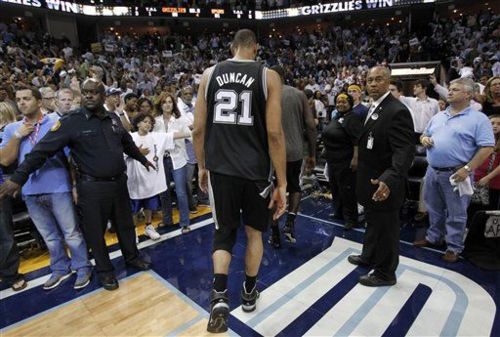
The first post I ever wrote here was about the indefensible mugging the Spurs were receiving at the hands of a young, hungry, relentless Memphis Grizzlies team. After finishing the regular season with the West’s best record, the thousands of minutes and hundreds of games spanned over more than a decade worth of pro basketball had caught up with the great Tim Duncan and his associates. Now heading into another season at age 35, how should we feel about the present version of this all-time forward/center and the men who have flanked him in battle all these years?
As a sport consuming culture, we’ve become accustomed to watching our heroes transition from immortality (21pts, 20rebs, 10asts and 8blks—in a game six Finals clinching win) to flesh and bones mortals (6pts, 7rebs—against the Grizzlies in the playoffs last year—on his birthday!) on a gradual, measured decline with little reminders of previous greatness coming with less and less frequency. There’s nothing to be sad about here unless we fail to recall the past individual and team glories and with the ever-living online archive, this shouldn’t be a problem. Growing old and decaying is part of the deal; we just watch our athletes play out this sequence on the digitized, highly defined stages of ABC, TNT and ESPN while we experience our own in relative privacy.
What the fuck does any of this have to do with the San Antonio Spurs besides the fact that Tim Duncan has inevitably aged? (speaking of inevitably aging, if there was one player to make a deal with the devil or maybe one of the devil’s representatives, who would it be? I know the easy answer is Kobe, but I wouldn’t be surprised if it was Durant or Dwight… for completely different reasons—another post for another day) The Spurs as a collective have aged. Manu Ginobili is suddenly 34, Tony Parker 29, Antonio McDyess (if he returns) 37, DeJuan Blair’s knees alone are over 40. The youth movement that began with George Hill and ended with George Hill has been swapped out for an even younger player who has hands big enough to palm three basketballs at once … while texting with the other hand at the same time! Kawhi Leonard’s hands are freakishly large, but he’s more than a set of huge mitts. He’ll likely challenge Richard Jefferson for playing time at the three. So there’s at least an eye to the future, but in San Antonio, it’s difficult to catch a clear view of the horizon over the receding shoulders of an exiting Duncan.
Among the living legends roaming the streets of San Antonio is the most ancient of all: Gregg Popovich, the Garry Kasparovof NBA coaches. The fact his name has two ‘Gs’ only adds to the mystique. Pop’s success with an aging roster playing an updated style is indicative of his powers both as a visionary and a manager. 2011 proved the old wizard still had the magic; he just didn’t have the tools. What does 2012 have in store?
What’s so different about the Spurs’ decline and that of the Suns? I asked myself this while I was walking home earlier and while the differences were numerous, the Suns had romance and dreams on their side while the Spurs were coldly analytical and capable of merely living out their dreams. Mike D’Antoni’s constant middle finger pointed in the direction of convention and the Lakers won the Suns fans far beyond Arizona’s borders. The Spurs were real, practical and boring as hell to the average basketball fan. They played defense and made mid-range bank shots and gave quality minutes to the Matt Bonners and Bruce Bowens of the pro basketball world. The only Spur who designed outside the lines was and still is Manu and even his rejection of conventional American-style basketball somewhat seemed to fit in with the Spurs. Controlled improvisation? Practiced spontaneity? Who could be so confident as to say? There were and are drastic differences between these two clubs and in the end it mostly had to do with what could’ve happened versus what did happen.
If you want immortality, set a record. The flesh tears and bones break. Immortality is for numbers and ideas. The Spurs have done a masterful job with this group and extended the shelf life and entertainment value further than it probably should’ve gone, but I’m unsure, uncertain what happens next or what needs to happen next. There’s the simple answer: It’s a business. Then there’s the reality of it: We’re humans, the Spurs front office is filled with humans and its arena is filled with humans who’ve adopted Duncan and Friends like travelers on a shared road with a shared destination. I don’t know what will happen, but I’d be happy to supply the booze and pull up a chair for a chat with Popovich and RC Buford and hear their honest, unspun, unfiltered, unabbreviated, unabridged thoughts on the future of these San Antonio Spurs.
Around the same time the Great Recession hit Detroit, something happened to what felt the Midas Touch (Darko aside) Detroit Pistons General Manager Joe Dumars possessed. The Recession crippled Detroit as bad as any city in the country. City Mayor and former Pistons guard, Dave Bing resorted to bulldozing buildings and vacant houses, downsizing a city once that once stood for the blue collar industriousness of an entire nation. Across the way in Auburn Hills, a team built on the same ethos as its city, right down to their gritty slogan, “If it ain’t rough, it ain’t right,” paralleled the city’s decline. Sport imitating life?
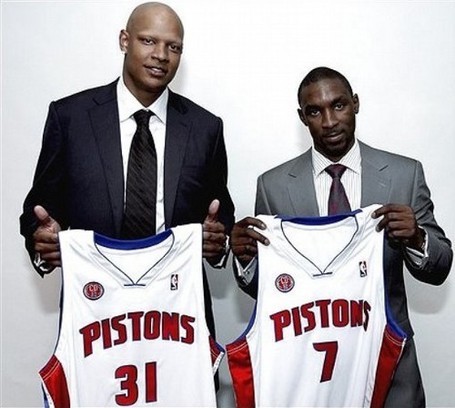
It was a swift fall from NBA grace (59 wins in 2007-08 to 39 wins in 08-09 to 27 wins in 09-10) for the Eastern Conference’s standard bearer of the mid-2000s, but the team changed for the worse, just like its home city. For Detroit, it appears to be a surface-level change. The auto industry might be smarter, leaner and more efficient, but the labor force still drives the final product. The Pistons? Dumars? Not so sure Charlie Villanueva for over $35 mill and Ben Gordon for $58 million is smart, lean or efficient.
I’ve read and heard Joe’s supporter’s claims that his hands have been tied over the past few years while Pistons’ ownership was in limbo. It’s hard to believe that line when Dumars is on the hook for the above amnesty-worthy contracts or the severely flawed, 54-game Allen Iverson experiment. Did Joe just get lucky with Billups, Rip Hamilton, Tayshaun Prince, the Wallaces and Larry Brown? Or is he a savvy GM chomping at the bit to build one more winner?
For the here and now, the Pistons are about as exciting as bread sandwiches. They’re a mix of young and old with two ties to the championship squad of 2004 remaining: Prince and Big Ben Wallace. Rip Hamilton and his mask have finally departed, leaving the two-guard spot to the aforementioned Gordon; a 6’3” guard whose style and physique recall the Microwave, Vinnie Johnson. In Detroit, Gordon’s efficiency has taken a slight dip to his pre-Pistons career, but his opportunities have dried up—minutes/game (down 15%), shots/game (down 30%)—and impacted his productivity. At point guard, Rodney Stuckey may or may not return, but what impact does this 50 Cent doppelganger really have? Is there a drastic drop-off from Stuckey to Will the Thrill Bynum or rookie guard, Brandon Knight? The lineup data at 82games.com says yes as Stuckey consistently appeared in the Pistons most productive lineups. The backcourt isn’t depressing unless you’re in search of the next Isaiah/Dumars or Billups/Hamilton. If you’re cool with an average-to-slightly-above-average backcourt, then you’ll love Detroit’s backcourt.
Nine of out of ten basketball fans agree the chief (no Parish) reason they tune into Pistons games is to see Greg Monroe. The remaining one of ten is player’s families and Jonas Jerebko fans (don’t sleep on Jerebko). In his first season in Detroit, Monroe showed a keen and practical basketball mind. Imagine a bespectacled Monroe reading the channels and dimples of a basketball. This is the guy I see. At 6’11”, Monroe’s smooth and comfortable passing out of the high or low posts, provides coverage on the boards and proved capable of scoring—although we didn’t see him presented with too many scoring opportunities as a rookie. New coach Lawrence Frank has referred to him as a “hub” on offense. I like it, but I’m not sure if it’s more of a compliment to Monroe’s versatility or an indication of the rest of the Pistons’ offensive woes.
After the toxic stench that permeated last year’s locker room and nearly led to a mutiny; a new owner and coach probably make the early season feel like one long Sunny Sunday morning. Rip, T-Mac and Kuester have all left the building, leaving Dumars and Frank to work overtime to rebuild this team. Success won’t happen overnight and it’ll take some creativity to escape the Gordon/Villanueva mistakes, but as the architect of the only NBA champion of the past 20 years to not revolve around the gravity of at least one superstar, Joe’s proven capable of being successful by taking a different route.
I never intended to write about the league’s two worst teams over the past five years in back-to-back posts, it just came together this way and now we’re taking a trip down I-5 to the capital of Cali and home to one of its four NBA teams: Sacramento. Since the breakup of the Chris Webber Kings, a pall has been cast over the Kings-crazy fans of Sacto. Webber was traded on February 3rd, 2005 and while the Kings managed to remain afloat in the Western Conference for a couple years after, things officially bottomed out in the 2008-09 season when they won a franchise low 17 games. It’s been off ever since with the franchise building a young team around strong draft picks who, while entertaining, have proven to be success-challenged—this of course depends on your definition of success.
The reams of losing over the past three seasons haven’t stopped Sacramento fans from showing up and supporting their team in what almost feels like an endearing manner. How else could you love this motley crew that doesn’t get more motley than their 21-year-old center, DeMarcus Cousins; a headband-wearing giant ball of emotion and talent. Watching the young Cousins, it doesn’t take long to see he has a feel for the game that far exceeds his level of experience. It’s one thing when we see a young point guard like Omar Cook whip passes into spaces that only a fraction of the basketball-playing population could recognize, it’s something altogether different and refreshing to see the rare rookie center make passes and plays that defy the unoriginal standards and expectations we place on positions and ages. Then there’s the dark side to DeMarcus, an internal fury that feels Vesuvianly intense and is indiscriminate in choosing targets—the opposition, teammates, refs, coaches, me, you?
The Kings are more than their moody big man. They’re a collection of redundancy which is also referred to as depth. Francisco Garcia, John Salmons (picked up in the off-season) and Donte Greene seem as interchangeable as different brands of socks. Garcia adds more defensively, Salmons possesses a greater scorer’s mentality, but may have an inflated sense of his skills and Greene’s the youngest which means someone, somewhere is still waiting for him. In the backcourt, Tyreke Evans, Marcus Thornton and now Jimmer Fredette and even the last pick in the draft, Isaiah Thomas, each brings a shoot-first mentality—they clearly bring more dimensions than shooting, but none of these guards are renowned for their passing. Being on the west coast, I’ve seen quite a few Kings’ games over the past two years and have seen in Evans a talented player who makes awful decisions; particularly in crunch time. When you’re the best and most talented player on your team at 20-22-years-old, there are going to be growing pains, but Evans, and the Kings by extension, could benefit from a true point guard. The data at 82games.com indicates the Kings’ best lineups last year consistently included Beno Udrih who functioned primarily at the point. This truth makes me scratch my head at Sacramento re-signing Thornton and trading for Fredette. By another token, last year’s squad (24 wins) wasn’t exactly making people forget about Webber’s Kings.
JJ Hickson (acquired in a summer trade for Omri Casspi), Chuck Hayes (just signed) and Jason Thompson join Cousins on the front lines for Sacramento. It’s a serviceable, workmanlike crew that isn’t likely win any beauty contests, but collectively knows its role. In terms of intrigue, I rank these guys Cousins, then Hickson.
In what could be the final season for the Kings in Sacramento, the small similarities between the Kings and Sonics situations are just enough to revisit old scars: Ailing franchise coming up on the shoulders of future stars, franchise one foot out the door over some antiquated arena bullshit and a group fans who will suffer the most. The Kings belong in Sacramento and hopefully Kevin Johnson and crew can figure out a way to keep them there.
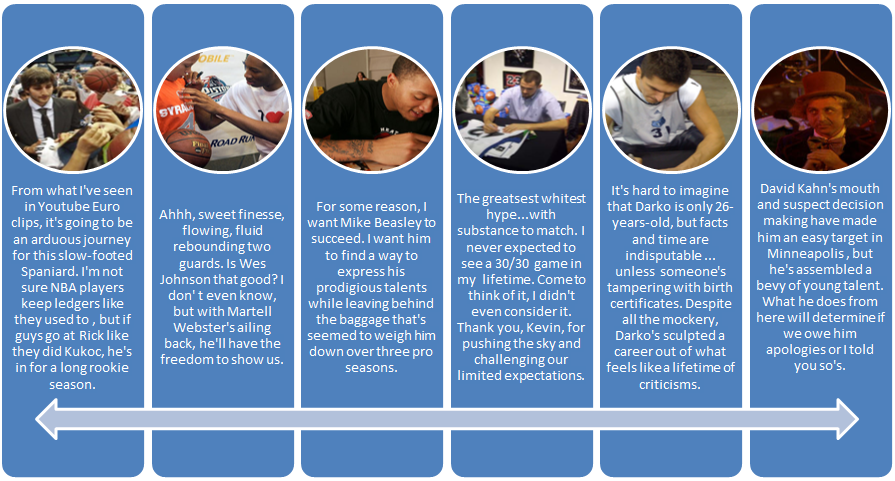
Did you know that Wesley Johnson (24), a rookie last year, is older than Kevin Love (23) and Michael Beasley (22)? Or that Beasley’s older than Ricky Rubio (21) and Derrick Williams (20)? The T’Wolves’ core is filled with youth, dreams and ceilings that reach beyond the firmament. To realize Kevin Love’s 30-30 game is to tip-toe into our past and dance with Moses Malone. To load up on youthful assets like David Kahn has done is put to faith in the future and bank on the development of at least one of Beasley, Johnson, Rubio, Anthony Randolph or Williams to partner with Love’s already historic body of work.
Being so bad for so long (last year, six teams had more wins (57 or more) than the Wolves have had over their past three years combined (56 total)), has helped Minnesota stockpile players who are barely old enough to drink. The front line is already established with a diverse threesome who can produce stats, but have struggled to generate wins. The backcourt, mostly point guard, is more mysterious. It’s not quite as confusing as crop circles, but Jonny Flynn, Luke Ridnour and Ricky Rubio give new Coach Rick Adelman options at the point. I picture a training camp where point guard front runners rotate on a daily basis like Republican Presidential candidates jockeying for position. With any luck, Kahn will throw the whole situation into chaos by drafting Marquis Teague to compete for the position in 2012.
Beyond the potential starters, Minnesota has elements of intrigue coming off the bench. Randolph perennially inspires stargazers to grab hold of isolated visions of potential and extrapolate them into 82-game projections punctuated by big, bold IFs. While the performances across his first three years as a pro have been marked by more valleys than peaks, it feels like we often forget this kid is just 22.
Then there’s Derrick Williams—Minnesota’s reward for being a terrible team yet again in 2011. Williams is an explosive combo forward; a strong rebounder with a slow, but accurate jump shot. Sometimes we see guys devour inferior competition in college, then get to the pros and look ordinary when faced with the world’s finest. Derrick is better than ordinary, but is he quick enough to guard Nicolas Batum? Is he beefy enough to bang with Serge Ibaka? Fortunately, Minnesota can ease him into these questions and peers like Love and Beasley can help provide the answers he seeks.
When winning’s not an option, an exciting underdog with a white hero to latch onto, a quadruple double threat and a previously post-hype Spanish point guard becomes an acceptable substitute. T’Wolves fans won’t have a lot of team success to celebrate this year, but the individual will be at the forefront many times over.
I know we’re all angry and upset by the league’s despicable handling of the Chris Paul trade today, but like AC Green taught us on his way to setting the NBA’s record for consecutive games played streak (1,192 straight), sometimes we have to swallow our salty tears, put a little activator in our hair and play the damn game. So tonight, in honor a man who never took a game off (except those three games he missed in his second season), I’m going to write about the Phoenix Suns; AC’s team when he broke the record.
The Phoenix Suns have had books written about them, been adored by media and fans, introduced fast break basketball to a generation who grew up with the 90s Knicks and Heat and thought bullying and intimidation was a part of the winning process; their doctors prolonged careers and their cast of characters and fan-friendly style developed something that started as a cult following but grew into full-fledged fandom. We’re all familiar with their legend and the hopes that accompanied their title runs from 2005-07. It was exciting and refreshing, beautiful and fantastic to watch Steve Nash speeding up (not down, he was and still is a one-way player) the court and shattering defensive schemes that had been designed to neutralize him … yet consistently failed. We loved it and witnessed its descent into harsh reality, wilting under the weight of time, strategic ingenuity and bad stinking luck.
But all that’s in the past and we’ve got to talk about where we are now and what the hell we’re doing here. The Suns will likely wave good-bye to a couple of aging wings in Grant Hill (New York-bound?) and Vince Carter (free agency), and probably add Shannon Brown. Barring (league approved) trades, the Suns will keep the majority of last year’s 40-42 team intact. It can’t be a time for optimism in Phoenix. Steve Nash turns 38 in February and despite the sorcery of the Suns physicians, no matter how far and fast Nash can run, time will hunt him down the way it does all of us. Nash is a free agent and at this point, he’s probably worth more to the Suns if he’s wearing a different uniform. It’s time for both parties to embrace or give a stern handshake (I get the feeling Nash is more of a hug guy though) and part ways.
Carter and Hill combined to account for just under 25% of Phoenix’s scoring last year. With Nash acting as a dribbling bodhisattva, life is easier for everyone. If Nash wills you to have points, you will have them, so I don’t anticipate scoring being a huge issue for this team. But again, here I am writing about the Suns and I’m continually drawn back to Nash. His presence as a Phoenix Sun is all encompassing.
OK, I’ll escape the Nash-vortex and acknowledge that the Suns do have a full roster. Marcin Gortat may have been the best value in the mega-player trade last December that sent Turkoglu, Jason Richardson, and Earl Clark to Orlando for Carter, Mickael Pietrus and Gortat. He gives the Suns someone sturdy and rugged to man the paint and he can hold down the fort while Robin Lopez continues to develop. I don’t have any complaints about Pietrus or Jared Dudley. They’re both nice players in the Shane Battier mode in that they can knock down the three, both play strong defense and possess a value structure that’s appropriate for team sports as evidenced by their acceptance of roles outside the spotlight.
And then there’s Channing Frye whose career has refused to follow a predictable path: from All-NBA rookie team in 2006 to an invisible player in Portland in 2009 to potential harnessed in 2011 with Phoenix. I find this interesting mostly because of its implications for all of our lives. Maybe Frye was written off by Portland or maybe it was just a bad fit for everyone (even though Channing loved the city itself). Regardless of the cause of his departure, he joined Phoenix in the summer of 2009 and has experienced his best two seasons as a three-point shooting big man who creates matchup problems. Channing Frye’s Phoenix resurgence (Steve Nash fueled or not) reminds me to keep being inquisitive and continue to try and find congruence between ability and opportunity.
Those are all nice pieces, but they’re all complementary stylists. None of the non-Nash players I just mentioned are capable of elevating this team to anything better than the middle of the pack. Yet somehow the Suns still have nearly $50million on their payroll. Unlike the Hawks who give off a vibe of contentment, I get the feeling that people in Phoenix desperately want to be successful, they’re just not sure if they want to spend the money to do it.
That’s the Suns; still living in the inescapable shadow of a radiant past. And they’ll continue to do so until there’s a willingness from the Suns and Nash to just let go.
I can’t quite put a finger or a thumb on it, but I feel like this year’s Philadelphia 76ers are going to improve on last year’s 41-41 record and 7th seed in the playoffs. If I had big ol’, Elton Brand mitts, I bet I could get a better grasp on it, but as it stands, I just have a few ideas sketched out below. These ideas are subject to refutation by fans of the Pacers, Bucks, Knicks, Bobcats or anyone else who stands to gain from Philly failure.
Where to begin with the squad housed in the City of Brotherly Love, the home of the (Legendary) Roots Crew and formerly the greatest court in league history? Let’s start with Coach Doug Collinswho’s played, coached and commentated on the league since 1973. I was aware of Doug’s reputation as somewhat of a fixer-upper of a coach, but didn’t realize how serious it was until I took a look at his career performance as a coach:
Coach
Season
Team
W
L
Win Change
Stan Albeck
1985-86
Bulls
30
52
N/A
Doug Collins
1986-87
Bulls
40
42
+10
Doug Collins
1987-88
Bulls
50
32
+10
Don Chaney
1994-95
Pistons
28
52
N/A
Doug Collins
1995-96
Pistons
46
36
+18
Doug Collins
1996-97
Pistons
54
28
+8
Leonard Hamilton
2000-01
Wizards
19
63
N/A
Doug Collins
2001-02
Wizards
37
45
+18
Doug Collins
2002-03
Wizards
37
45
0
Eddie Jordan
2009-10
Sixers
27
55
N/A
Doug Collins
2010-11
Sixers
41
41
+14
Doug Collins
2011-12
Sixers
?
?
?
How great would it be to see Doug Collins host an NBA version of This Old House where he takes a poorly managed or neglected roster and walks us through the remodeling job? I’d watch for sure. Back to the straight dope…I’d be intentionally deceiving you if I didn’t recognize injuries and acquisitions played a role in Collins’s ability to turn a loser into a winner. The cynic might say he’s just savvy at accepting the right jobs at the right time (kind of like Red Auerbach trying to poo poo Phil Jackson’s rings) and that may be the case. But given his nearly 40 years of experience in the NBA and irrefutable successes, I would passionately disagree with those cynics.
Collins runs his team like a basketball communal. Eight players played between 21 and 37 minutes per night and six of those eight averaged double digit points with Brand leading the way at 15. Everyone contributed and did so at different positions which added to their versatility. If Evan Turner is able to develop his offensive skills and maturity and start at the two, they’ll have a pair of strong ball-handling, multi-dimensional wings to play alongside the most captivating player on the team and the primary reason I expect the Doug Collins magic to continue: Jrue Holiday: A 6’3” point guard who’s only 21, rebounds well for his position, started all 82 games last year, consistently funked up defenders with a compact spin move and has tremendous feel for the game. Part of me thinks it’s a shame that the majority of casual or local NBA fans live in the darkness when it comes to the ways of the Jrue. But then I think about it a little more and in a world where we’re saturated to the center of our beings with nonstop information to the point that we’re stressed out, anxious and distracted, I’m thankful for the truths that have yet to be mass-marketed, consumed, regurgitated and then demanded a trade…I’m thankful for Jrue Holiday.
With the natural blends of youth (Holiday, Turner, Lou Williams and maybe Thad Young and Spencer Hawes), experience (Andre Iguodala) and wisdom (Brand and Collins), and a core group that includes six to eight of their top producers from last year, Philly’s ready for organic growth and progression.
*The following was contributed by the homie Milton
When I think of the New York Knicks, the word that first comes to mind is trying. There’s been a lot of trying going on in New York for years but very little to show for it.
Sure, they’ve got two of the biggest names in the NBA under contract and fans are willing to pay admission to see them put up gaudy offensive stats and brutalize opposing defenders from 16 feet and closer, but where has this all really gotten them? In order to go forward with this team, we need to review how they got here.
When the Knicks landed Amare Stoudemire as a consolation prize in free agency 2010, the NBA was abuzz with the upcoming Stoudemire/Mike D’Antoni reunion. Amare did his part early in the 2010 season by putting up MVP numbers – 30 points in nine consecutive games is impressive. What matters more perhaps is that eight of those nine games were Knick wins and in the 9th (a home loss to Boston) Amare’s just-a-split-second-too-late-3 from the top of the key would have been the game winner. Stoudemire has never been known for his rebounding, but he was doing plenty of that early last year reaching double-digit boards in 16 of 32 games and 8+ in six more.
The cast around Amare was playing well too. Danilo Gallinari emerged as a guy that can’t be left open. Notorious fat kid and crybaby Raymond Felton was enjoying a career year. Lightly-sought-after rookie Landry Fields (Isaiah’s apologetic olive branch to NYK?) looked like a legit ROY candidate and Wilson Chandler did what he does – play good basketball and keep his mouth shut. It all seemed too good to be true. And it was.
One thing was clear from the beginning with this team: They weren’t supposed to be good yet. James Dolan’s vision of the Knicks’ return to Eastern Conference supremacy needed two things: more time and more money spent.
Carmelo Anthony made it very clear he wanted a trade to the Knicks and would only sign an extension with them. Denver, not wanting to get left with nothing in return, found itself in a bad spot. No team would give them meaningful pieces to rent Melo for the remainder of the season but Denver wasn’t going to just give him away either. For weeks the back and forth went on, the speculation in the media clearly bothered Denver and George Karl. When the deal was finally done on Feb 22nd, the Knicks gave up three key pieces (Felton, Chandler and Timofey Mozgov) for Melo, Chauncey Billups’s ball and chain of a contract, and a few other players. The Minnesota T-Wolves were involved in the deal as well, but giving David Kahn any space in this post would be wasteful, so we’ll just move on.
The results for the Knicks were nothing spectacular. The pre trade 5-man starting unit of Felton-Fields-Chandler-Gallinari-Stoudemire won 62.8% of its games while the 5-man unit of Billups-Fields-Anthony-Stoudemire-Turiaf won 50% of its games. In fact, no 5-man unit post Melo trade won more 55% of its games and each unit had a positive net turnover percentage (giving up more TOs than taking from the opposition). The Knicks made the playoffs and were promptly swept by an aging Celtics team that showed little fight in a 2nd round smothering at the hands of Lebron and D Wade. That’s all fine with Dolan and D’Antoni. 2011 was never supposed to be the Knicks’ year. This was just another season of trying because incremental improvement can be sold to fans.
As for the 2011-12 season, there’s really not too much to say about this group. They drafted Iman Shumpert from Georgia Tech – a player who rocketed up the draft board the way freak athletes do following absurd NFL combine performances but doesn’t have a true position. They’re still largely the same team that Boston swept in Round 1: Chauncey Billups is a year older. Landry Fields should be better and in my opinion is the most interesting player on this team. Melo and Amar’e will get buckets and thrill the crowd, but won’t guard anyone. And it won’t matter because Mike D’Antoni doesn’t care if they guard people. He’s been trying to win with an ill-suited system for several years. 7 Seconds or Less sounds like fun to play in but, in my view, it won’t win any rings. As constructed, I don’t think this is even a playoff team and I’ve got them penciled in for #3 in the Atlantic behind Boston and Philly.
The Knicks want Chris Paul. CP3 wants the Knicks too, in the worst of ways. If you spend any time online, you’re aware of this. If you follow the NBA, you know the Knicks don’t have the hustle to get it done. Stoudemire ($16.4 mil), Melo ($17.1 mil) and Billups ($13.1 mil) make up the vast majority of the payroll – there’s just one other player under contract set to make more than $4 million and that’s Ronny Turiaf. Zeke mortgaged their future to get guys like Eddy Curry and Jerome James so they have no picks to throw in. The only way CP ends up in a Knick uniform this year is if a third team is willing to get involved. If that’s to happen you can bet a lot of real shitty contracts will be on the move … Or CP3 can wait until next year and sign with them for dirt cheap. Not likely.
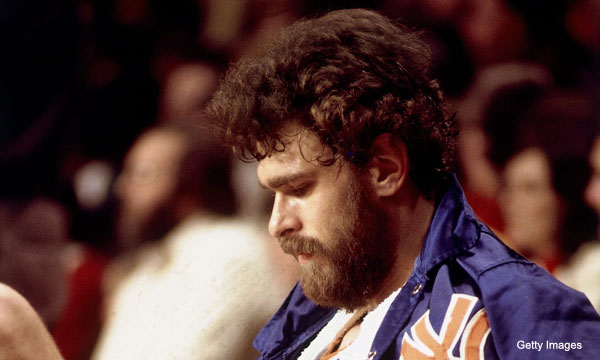
If Dolan can find a way to keep building without giving up too much of the future, the only chance they have to compete for titles is to find a coach that values both ends of the floor and all aspects of the game including developing a bench (D’Antoni is known for playing his starters heavy minutes – even in blowouts). Maybe the Knicks’ endgame is luring a highly successful, recently-retired coach back to the franchise he helped to win titles with as a player…

 Dancing With Noah