Like millions of basketball fans on Saturday night, I sat on my couch watching Oklahoma City’s lead squirt out of their hands like a slippery fish refusing to comply with a hungry human stomach or sportsman. And on the other end of that wriggling was Stephen Curry just waiting to create an iconic moment in the form of a 38-foot game-winning three that, to my understanding, everyone expected to go in. The supreme in athletics is when everyone knows what will happen and is powerless to stop it and this is what Steph created on Saturday.
In the process, he set the NBA single season record for threes made – even though he’s appeared in just 56 games of an 82-game season. But big deal, because it became clear sometime in late November that he had about as much regard for his own three-point record as I do for olives. He’s pacing to make more threes this season that Magic Johnson did his entire career and in the past week has hit nearly as many threes at the Chicago Bulls entire team. His wake is littered with discarded adjectives and comparisons, but it’s mathematically evident that there is no precedent for his season, which is the natural segue to asking what’s next?
Back in December I explored how Curry was experiencing such an explosion and concluded that a mix of increased volume and accuracy were the primary drivers and this continues to be the case as Curry’s FGAs and 3PAs/game are both at career highs while his FG%, 3p% and 2p% are all significantly above his career-bests. (It’s not that simple in the sense that ball movement, Draymond Green acting as primary playmaker, collectively elite passing, lineup versatility, etc are contributing.)
That’s how we got here and while those factors will continue feeding into what Steph does next, I started thinking this morning that his recent road trip could be indicative of what’s next to come.
For reference, over the seven-game trip he averaged 36-points while shooting 56% from the field and making 48 of 85 threes for a 56.5% clip and seemed to have reached some perpetual zone over the final three games of the trip when he shot 28 of 43 from three (65%) and averaged 46ppg. That’s a 9 of 14 average from three and somehow, in the same way that everyone expected him to sink that 38-footer to kill off OKC on Saturday night, in some way it doesn’t feel unsustainable. This isn’t at all to say that it will happen, but to explore whether it, or something like it, could happen.
When I wrote back in December, I operated under an assumption that the Warriors had achieved some sort of perfect balance between minutes and usage for Curry. I thought that 11 or 12 3-point attempts in 35 or less minutes was ideal. What this road trip has revealed is that maybe there’s room to bump up the three-point attempts so I started looking at two pieces of information:
Curry performances in high-volume shooting games
Shooting distance
Using basketball-reference’s handy dandy player game finder, I took a look at all games in regular season history where a player has taken at least 15 threes. It’s happened 129 times and includes everyone from Steph to Jeff Green to Gerald Green to Nick Van Exel. Not surprisingly, Steph appears on the list 16 times – seven more than J.R. Smith who’s second and ten more than George McCloud at third. In 11 of those 16 games, Steph shot over 50% and if we really want to find a reason to cock an eyebrow, he’s never shot over 16 threes in a game. For all the “that’s a bad shot for anyone other than Steph” comments out there, a sober man could counter that he should be taking more of any shot he can get.
Now let’s push the hypothesis a bit more. Of Steph’s 16 games with 15 or more attempts, 11 have occurred this season. This lines up nicely with the increase in volume, but what makes it more impressive is the accuracy. In these 11 games in 2015-16, he’s shooting 48% from deep on 300 attempts which is a full percentage point above his season average which is also his career-best. While it’s fair to assume a player who’s shooting well will shoot more, this 11-game sample shows that Steph still has room to increase volume without potentially sacrificing any of that accuracy. For historical comparison, only one other player who’s taken at least 15 threes in more than one game has a higher percentage and that’s his teammate Klay Thompson who’s shooting 56.4% on three career high-volume 3PA games. Steph’s is 53.2%.
But how do you get more attempts if defenses are playing you smarter? Oklahoma City switched on all screens that involved Steph and did a surprisingly decent job of it. Occasionally it left Steven Adams or Enes Kanter defending Curry, but more often than not, OKC was able to contain Curry from deep. There was a concerted effort to defend the arc and yet he still got off 16 threes and tied the record with 12 makes. (Quick aside, has a single game NBA record ever felt more vulnerable than the 12 threes made in a game record does now?) His quick release and ability to exploit the slightest defensive lapse created windows of daylight that few basketball players in the history of the game could exploit. And finally, just the threat of the deep three, the 28-foot and deeper bomb creates opportunities.
The expanded range is gaudy in the same way his fat 3PM/game is fat. It’s freakish and obvious in the way booming homeruns and knockouts are and has the appearance of being indicative of both an exploration and evolution of his game. An evolution in the sense that, year-over-year, he’s taking and making deeper threes. An exploration in the increased volume by distance. February and January accounted for 11 of his 22 +30-foot attempts. Is he getting bolder?
Less than 4% of Curry’s threes this season have been from 30-feet or deeper. That number is super small, but it’s also more attempts than five of his nearest peers in terms of deep shooting. Thompson, Damian Lillard, James Harden, Kobe Bryant, and J.J. Redick are a combined 3-20 from beyond 30-feet this season while Curry’s hit 11 of his 22 attempts. He’s shooting 50% to his peers’ 15%. It’s unfair and borderline useless to keep making these comparisons, but contextualizing something abnormal remains necessary.
But it wasn’t always this way for Curry. Last year he was 3-16 (19%) beyond 30-feet and that was the best season of his career; prior to that he was an underwhelming 5-53 for his career. That type of inaccuracy is enough to make a coach or your teammates ask you in what the devil’s going on in your thick skull, but nope. In 2016, he’s still bombing with low frequency, but frequently enough to be relatively prolific. It’s one thing to rain area code jumpers in warmups when children are crying like the Beatles are about to perform, but it’s something altogether different when an above average NBA defender is guarding you, thousands of fans are shrieking cacophonously in your ears and the damn game is on the line. Hitting that shot? What is that? In game for Steph, it’s a 50% shot.
So what’s next? Is he pushing the envelope, taking opportunities the defense gives? In a world of vulgar, offensive certainty, not knowing what’s next creates a magnetic sense of anticipation. We knew that game-winner was going in, but really who hits a game-winner like that? The crystallization of our hopes and fears lands us somewhere between numb and elated at the improbable inevitability of it all. I was going for Oklahoma City and Russ and Durant and even Enes Kanter. The last thing I wanted to see was a season-defining from a player in the midst of a historic run and yet here I am sucked into the vortex, levelheaded and whole with all my bearings making sense of that which makes no sense and wondering, with mixed emotions, what in the Land of Chamberlain comes next.
Almost 25 years ago to the day, a perturbed Karl Malone nursing hurt feelings and a bruised ego stepped onto the Salt Palace court as the Jazz hosted the Milwaukee Bucks. What ensued was something akin to a pissed off Andre the Giant going off script at a Royal Rumble and tossing all comers out of the ring so quick that the pay-per-view ends two hours early and no one is quite certain what just happened. The game itself was a bloodbath and Malone scored a career-high 61 points on 21-26 shooting while snatching 18 rebounds in just 33 minutes of game play.
The only reason I found this game was thanks to modern-day efficiency king Stephen Curry’s precision in Washington D.C. less than a week ago when he scored 51 in 36 minutes in a road victory over the Wizards while shooting 19-28 from the field and 11-16 from deep. It was peak Curry and peak Warriors in that the reigning MVP needed just 36 minutes to fill it up. In the nationally televised game, he opened the bidding with a 25-point first quarter on 7-8 from three and playing all 12 minutes. In what (as of this writing) Sacramento Kings Coach George Karl refers to as a “California cool” style, Golden State relaxed, turned the ball 15 times through the following three quarters and was outscored over that same period. But the game was close enough that Curry put up his second most shot attempts of the season, tied his most three-point attempts, and exceeded his average minutes/game.
Wizards point guard John Wall described the performance:
It’s like Kobe (Bryant) when he had 81. He couldn’t miss. You keep defending the best way you can. We challenged some shots. He didn’t have too many open looks. He just made them.
Scoring 51 in 36 or less has been accomplished just 12 times since the 1983-84 season with Curry now owning the two most recent occasions. The only other player to appear on the list more than once is Kobe Bryant at four times. What’s unique and I guess predictable is that in all 12 games, the team with the +51-point scorer won. The big scorers are hyper efficient from the field (except Tracy McGrady in 2003) and get to the at least 10 times (except Curry last week who made it to the line just three times).
For me, the most memorable on this list was Kobe’s 62 points on Dallas during his Chamberlain-esque scoring binge of 2005-06 when he had single handedly outscored Dallas through three quarters (62-61). (As a side note, ESPN’s Baxter Holmes reported then-Dallas Assistant Coach Del Harris was the primary motivator for Kobe’s 62-point outburst as Harris had been Kobe’s coach as a rookie and he still held a desire for revenge for Harris “driving him crazy” as a rookie. The unlucky coincidence (for Harris at least) is that Harris was present as the Bucks head coach the night Malone scored his 61. To my knowledge, Del Harris was in no way affiliated with the Wizards during Curry’s performance.)
The anatomy of 51 in 36 is one thing whereas motivation is something altogether different and in some cases less discernible.
After his single-handed destruction of Washington, Curry described what we most frequently refer to as the zone. There was no other apparent motivation, no driving force, just “some of the shots that you’re like ‘Oh that’s off,’ they end up going in. It’s a fun feeling, and you want to ride that until you can’t anymore.”
But for other players, the motivations are clearer for various reasons:
Kobe, by contrast, has often appeared to tap into anger or feelings of being slighted, as he did during his 62-point game where, in addition to retroactively pointing to Harris as a source of motivation, at the time of the 62 in three quarters, it was a recent loss that fueled him: “I was very angry, I felt like I wanted to come out and send a message, that we’re going to dominate at home. We’re going to hit you, we’re going to bring it to you. I wanted to send that message.”
Kobe’s first-such game was again fueled by anger and emotion when he lit up the Grizzlies for 56 in 34 minutes in 2002: “It was a combination of emotions. I was upset because we lost in Chicago, and two in a row. I was upset that Shaq was suspended.”
A 22-year-old Shaquille O’Neal went for 53 and 18 in 36 minutes back in 1994 as he (and his Magic teammates) went all in trying to get him the scoring title which would ultimately land with David Robinson who scored 71 points in a season finale. Shaq, in his most Shaqness, was also partly inspired by visit from Michael Jackson.
(Note: For a thorough reading on athletes and vengeance, Bill Simmons’ Vengeance Scale from ~2004 (?) still holds up pretty well with an exceptionally robust rating scale.)
But no one on this list can reach the grating disrespect the Mailman felt back in 1990 after the results of the All-Star Game fan vote (hat-tip to Danny Hazan for putting me onto this storyline). It was January 26th, 1990 when Malone, the defending ASG MVP, found out the fans had selected the Lakers’ A.C. Green to start the game. Green edged him out by all of 1,226 votes – less than 1% of the total votes Malone received. At the time, the Mailman was an MVP candidate putting up 30.5ppg on 58% with nearly 11 rebounds and three assists/game. His lividity was so great that Kurt Kragthorpe of The Deseret News wrote: “Before the game, Karl Malone called the NBA office to complain about the voting results and told teammates he would boycott the All-Star Game.”
Teammate John Stockton and the aforementioned fan-selected starter Green were less confounded, both offering more contextual responses. Stockton said,
I don’t know that being selected this way (by fan vote) is any better than being selected the other way (by coaches). It’s tough to be thrilled about a selection process when an absolute shoo-in doesn’t make it. That amazes me.
And Green:
I’m surprised to be on the team. I never knew my position in the balloting, and it’s really out of the players’ control who the fans vote for. Neither one of us did any campaigning. On paper, you’d think (Malone) would be on the team. I mean, he does it night in, night out. That’s what you have to do to be an All-Star.
But on a first glance that didn’t matter to Malone. And so the following day on the 27th of January, he came out with bad intentions, powered forth by the conviction that he had been wronged in the most egregious fashion. He scorched and burned the Bucks big men in the paint and around the rim. All of his points have been wrapped nicely into a single 12-minute Youtube post (below) and a couple things are powerfully evident: of his 21 made field goals, just two came outside the paint and the topic of the All-Star snubbery was hot all night evidenced by the condensed clips where the announcers mention it three separate times including references to “that message was sent airmail, special delivery!”
The way this drama unfolded is fascinating in the sense that Malone was enraged by the fan vote which is something we’ve come to accept 25 years later as a completely uninformed popularity contest. Stockton and Green seemed to grasp that from different perspectives and maybe it’s all the Yao voting or some of the oddities we’ve seen over the years have reinforced the notion that it’s all about popularity, but clearly players in 1990 understood that. And on some level Malone did too, which I’ll explore, but the announcers repeatedly stating that he was “sending a message to voters” is revealing of the most MJ manner of allowing a slight (however significant) to become an all-consuming obsession and that obsession isn’t just accepted by the community, it becomes a rallying point.
Malone’s approach to this game – constant post-ups on the right block, relentlessness on the offensive glass (he had nine offensive boards), and tearing up the court like a demonic man-tank on amphetamines – are indicative of a sustained fixation. All that anger not just harnessed by Malone, but reinforced by who? Reinforced by the local media, teammates, coaches? In The Deseret News the day after the 61-point game, there was a paragraph and anecdote from Stockton that provides some of the insight into the kind of mind that propelled Malone forward:
So who said Malone was overrated this time? In Charlotte last month, teammate John Stockton planted a fake story that the Hornets’ Armon Gilliam had downgraded Malone in a TV interview and the Mailman went out and scored 52. Stockton claimed innocence Saturday, smiling and saying, “Who knows what can lurk in his mind?”
Reviewing the story from the Gilliam game in December of 1989, it sounds like Stockton definitely planted the seed that got Malone going and speaks to the power of security and insecurity, respect and disrespect, succeeding and failure, and fiction versus reality in addition to Stockton’s ability to know which buttons to push and how hard to push them. For the Mailman, just the suggestion that Armon Gilliam or some fans misunderstood his proper place as one of, if not the preeminent power forward in the NBA simultaneously sent him off the rails and pushed him to new heights.
On the one hand, being overlooked by the fan vote feels insignificant. Malone was so obviously at the peak of the game that it seems like it shouldn’t have mattered. The other angle to take is that having achieved so much already (ASG MVP, All-NBA first team, playoffs, top power forward status) and being accepted by his peers, the only audience left to convert was the fans. Where Jordan had his Nike contract and Magic his smile and Larry the faithful of the Boston Garden, Malone was still – at least based on the voting – an unknown. What more did he need to do? What more could he do? Losing out to a clearly lesser player in Green had to be discouragingly Sisyphean and unfair. It had to hurt.
Within this intrusive exploration into the mind of Karl Malone is a glimpse into how that mind works which is what I find so intriguing. If we look at the drama of early 1990 linearly, there’s a nice a smooth narrative arc: the release of the ASG voting which shakes Malone and results in him going as far as reportedly calling the league office. Then there’s the response, the attempt to “send a message to the voters” as if they were a singular mind, as if the vote was indicative of his standing relative to Green’s even though Malone at his most rational had to know how little it implied. The 61 points was intentionally symbolic, but most likely sent to an audience the majority of whom weren’t even listening and the people who were listening already knew Malone’s standing. Even before the eruption, his tone was somewhat more revealing:
“The first couple of days, it hurts, but after a while you have to take a little time and think about things.”
From the AP via Seattle Times: `When you get put into the situation that I’m in, it’s hard. You get hurt. Everyone has a sense of pride, but I’ve had time to think about it and I think I will go if I’m asked.’
They’re both variations of the same quote and the same theme of having his pride and feelings hurt. Most of us can relate to being stung – whether it’s being disrespected, not being appreciated, being rejected – and responding first with anger expressed through lashing out – or calling the NBA’s front office and saying we’re not going to participate in the ASG. But what we do next is where people’s individual processes vary. Sometimes when I’m angry, I have an immediate outlet and it’s rarely competitive sports. Maybe I dive into work or writing or I’m unfairly being a jackass to my wife. But whether I channel that anger with or without intention, it doesn’t result in anything resembling 61-point games. Other times I’m able to easily identify that what I’m feeling isn’t even anger, but hurt or sadness and I can skip the anger-manifested-as-fill-in-the-blank step and resolve the damn thing in the immediate.
Where it would seem our species can walk fine lines is in how much these real or imagined slights grow and fester. For the pro basketball community, Michael Jordan is the standard bearer who leveraged slights and insults as well as any basketball player in history. For anyone who saw Jordan’s Hall of Fame speech, there was a sad bitterness at how MJ articulated his motivations dating back his high school years (sorry Leroy Smith) and carrying through his entire career. I don’t have any desire or intent to judge MJ’s vindictiveness or the benefits or risks of using that mentality as a value principle for succeeding in life other than to observe that it looks fucking exhausting.
What followed Malone’s seeming acceptance and resolution was no less interesting. On January 31st he was chosen as a reserve for the ASG, but awkwardly stated: “Maybe somebody would say, ‘He doesn’t really want to go.’ After all the attention, I don’t think it would have been a big disappointment not to be selected by the coaches.”
He still wasn’t comfortable with having missed out on the fan vote (again, by a ridiculously narrow margin) and it’s not crazy to at least ask if that frustration factored into his comments on February 6th when he said he would retire in five years – after the 1994-95 season when he’d still be 31.
I won’t go deep on the retirement comment other than to say the timing raises an eyebrow if nothing else. The last piece of this particular Malone-driven drama is what actually ended up happening at the All-Star Game in Miami. Malone didn’t end up playing and cited an injury as the reason. This would be one of two games Malone missed between 1989 and 1997 including regular season, playoffs and ASGs. I have no issue with players sitting out the mid-season games, but sitting this game coupled with the retirement talk are at least anecdotal evidence that this enormous chip that helped him achieve so much (like an insane 61-point game) had the power to impede progress.
These two weeks in the winter of 1990 serve as a dramatic microcosm of Malone’s psyche. Always well-respected, but long labeled a choker, Malone was truly a great player, but a great player who on occasion struggled with the mental aspects of the game. In this way, he’s infinitely relatable. Who among us hasn’t struggled with some mental hurdle that seems pre-loaded into our psyches? And who hasn’t accomplished some thing by some inborn flame which is as old as our individual history? Malone in greatness and bitterness is still just a man – who happens to be 6’9”, 270lbs capable of scoring 61 points and grabbing 18 rebounds in 33 minutes of a pro basketball game.
The media and Dwight Howard have always positioned the Houston big man as some kind of heir to Shaquille O’Neal in the same way it was en vogue for years to saddle two-guards with the dreaded “Next MJ” tag. It was wrong with Dwight in the same way it was wrong with Vince Carter and MJ. The closest thing we have to Shaq is in Sacramento in big barrel chested DeMarcus Cousins. And for the sake of perpetuity, we must not forget what Cousins did over a pair of games in late January 2016.
It was a Saturday night, January 23rd to be exact. The Kings were hosting the run and gun (?) Indiana Pacers of Paul George fame. Boogie, as the big man is known, had already been enjoying a pleasant new month of the new year, posting and toasting all comers to the tune of 31ppg. The Pacers were without defensive stalwart, starting center and possible Francophile Ian Mahinmi. Journeyman Jordan Hill, rotation player Lavoy Allen, and young upstart Myles Turner (fresh off a 31-point game against Golden State) manned the ramparts in his absence. And like any Jaws in any sea, Boogie smelled blood in that water.
Cousins is listed at 6’11”, 270lbs, but I swear to shit this man weighs more than 270lbs. His upper body defies NBA body types. It’s broad with massive shoulders, filled out in the way someone who chops down trees and carries stumps around all day would be with big, tattoo-covered arms. But where he deviates is in his trunk. Many NBA players have the classic v-shape with broad shoulders and narrow waists, but Cousins doesn’t thin out like Dwight. He’s thick all the way through and uses his body in the most Shaq-like of ways to create space and room to breathe to get up little jump hooks and lay-ins.
But life as a Boogie Cousins isn’t about playing the traditional back-to-the basket game. Against the Pacers, Cousins more frequently caught the ball on the wing, which is anti-Shaq/Dwight/tradition. In 2015-16, he has three-point range, which is like Paul Bunyan having the domestic sensibilities of Martha Stewart. Cousins catches on the wing, throws in a couple fakes and the defenders – be it Hill, Allen, or Turner – have to respect it. While taller players like Dirk Nowitzki and Kristaps Porzingis are rewriting concepts about what 7-footers can and can’t do, traditional centers shooting threes are still an evolving species. Defending those players is no easy task for semi-mobile 7-footers and so Cousins making over a three/game has opened up dribble driving attacks that maybe weren’t there earlier in his career. (Prior to this season, Cousins’ had taken 69 threes in his career. This year, in 37 games he’s taken 129 and made four times as many threes than in his entire career.) These defenders have to offer a cushion in defense, but Boogie’s handle is good enough to attack which he loves to do. Throughout the game against Indiana, Cousins repeatedly put the ball on the floor and penetrated. He was often off-balance, had his shots blocked from ending up in terrible position under the hoop, but he was still effective. He drew fouls and made at least six of his 17 field goals on these dribble drives.
Cousins has a sure-footedness you may expect in a giant amateur ballerina. He’s not the most graceful, but in addition to attacking defenders off the dribble, he’ll occasionally hit them with spin moves that leave defenders grasping at air where Cousins used to be. Against the Pacers, on three separate possessions, he found different ways to leverage the spin into buckets. In the second quarter, he caught it in the post, set up Lavoy Allen to overplay to the middle of the lane, took a couple dribbles and with his left shoulder pushed the defender deeper out of position, and once space had been established, pulled a quick spin for a dunk. This spin reminded me of Shaq in all the glory of his power and quickness.
Later the spin accompanied one of his many dribble drives and resulted in a lefty layup make. And finally, feeling Allen overplaying on a post-up, he spun baseline for an unmolested catch and score.
The final tally was a career-high 48 points on 29 shots, a single three, 13-20 from the line a team-best +18, and the Kings fifth straight win.
Two nights later on the Monday when most everyone in the NBA solar system was focusing their undivided attentions on the Spurs at Warriors main event, Sacramento decided to host the Charlotte Hornets. Like the Pacers, these Hornets were shorter than normal and short-handed. Perennial double double Al Jefferson was out with knee surgery and his backup Cody Zeller sat with a shoulder injury. Crying MJ’s Hornets went to battle with a front court that included native Pacific Northwesterners Spencer Hawes and Marvin Williams bolstered by Frank Kaminsky and Tyler Hansbrough off the bench. As Shaq so delightfully enjoys exclaiming: Barbeque Chicken!
And while Warriors-Spurs descended into the East Bay Evisceration, the undermanned Hornets and Kings of Cousins ratcheted up intensities with competitive basketballing. With a banged up crew, the Hornets decided to front Cousins if Williams or Hansbrough guarded him with Hawes or another defender helping on the backside. If Hawes was on Cousins, he’d play behind him. This strategy and the overwhelming physical advantage the Kings had allowed for a different exploitation than what Cousins showed against the Mahinmi-less Pacers. With a weakened frontline, the Hornets were like Goldilocks and Cousins was all three of the bears happy to maul his all-too-human opponents. No less than six times the Hornets ended up fronting Cousins and the Kings, particularly with Rondo recognizing the opportunity, took advantage. Even if Hawes was able to help over, Cousins was too big, too quick, too skilled scored easily.
This time it’s not even Hawes able to help out, but 6’4” Troy Daniels who’s maybe slightly more effective than I would be at pestering Cousins (course I’m 6’3″ 250 and run a 4.5 forty):
But later we see Hawes as the help man and even though he anticipates the post entry, he’s powerless and gets caught with his hand in the cookie jar, and-1 DeMarcus:
As the game unfolded, it had the feeling of some kind of lopsided battle royal playing out on the basketball court. Cousins and his teammates continued to pound the ball inside, almost growing with greed. A mix of jump hooks, dunks, layups and free throws were there for the picking. But all that post work is exhausting for a man carrying what Cousins has. The catches and fouls, scoring with 240lb-men draped over your shoulders can wear on the biggest ox. As the game shifted into overtime, it felt like a battle of attrition and I wondered who would collapse first: Big Cuz or the entire Hornets front line? Williams fouled after Cousins dunked on him on a lob, then it was Hawes and finally Hansbrough went to the bench with his sixth which left the relatively slight rookie Kaminsky to defend the most dominant post scorer in the league. A bully mentality is a great asset to any big man, but that wasn’t enough for Cousins against Frank the (tiny) Tank. He had the audacity to mix in a hesitation dribble on a drive the likes of which I can only assume Kaminsky never saw in the Big 10.
But mercy was on the side of Kaminsky and the Hornets. In the second OT when the world of basketball was firmly united in cheering Cousins towards his 60th point and the team’s sixth straight win, a referee named Zach Zarba bailed out Kaminsky by whistling Cousins for his sixth. In the league’s official review of all calls that occur in the final two minutes or OT, they deemed Zarba had made the correct call, but as any of us who watched the game can attest, it was not the correct call in the sense that Cousins was essentially penalized for being bigger and stronger than his opponent. And what a way to wrap up a night in which a man has appeared to be truly Shaqtastic – by being penalized in a way in which Shaq was oh so familiar.
Final tally was a new career-high 56 points on 30 shots, a single three, 13-16 from the line, a team-best +13, and a Kings loss.
The following night a bedraggled Kings team headed north to take on the Blazers in Portland. They were soundly thrashed, losing every quarter of the game. Our hero Boogie fell back to earth with a thud scoring 17 points while shooting 4-21 from the field. But who reserves space in their memory banks for the second games of back-to-backs? Who has time for such letdowns when we’re given 104 points over a two-game span? Cousins might not be Shaq, but in an evolving NBA where skilled back-to-the-basket big men appear to be a slowly dying breed, Cousins is without peer when it comes to dominant big man. While he may make head scratch-inducing decisions and have the occasional poor judgment on the court, enjoy him while we can and let’s not forget the time he scored 104 points in back-to-back games.
Final two-night tally: 104 points on 38-59 shooting (64%), 2-5 from three, 26-36 from the line (72%), 25 rebounds, 10 fouls, 12 turnovers, 84 minutes, 1-1 record
The Golden State Warriors didn’t make any significant roster changes between 2014-15 and 2015-16 and yet they’ve come into the season a better version of themselves, most notably embodied by Stephen Curry and Draymond Green. Draymond’s been amazing and deserves his own writing which can be found on other parts of the internet, but I keep going back to Steph and trying to understand how a 27-year-old can experience such a statistical explosion.
Contextually speaking, we’ve only seen one (maybe two, but I’ll get to that) scorers go from good to great the way Curry’s done this year. I took a look at every player in NBA history who has qualified for minutes played and averaged over 30 points for an entire season, then looked at their previous season to identify the greatest leaps season-over-season – essentially players going from good scorers to great scorers, or great to greater in some cases.
The outliers were players that experienced massive leaps between their rookie and second seasons as no baseline of performance had been set. Three of the four greatest season-over-season increases in points-per-game were from players in this outlier set:
Jerry West: 17.6ppg as a rookie to 30.8ppg in year two (+13.2)
BoB McAdoo: 18ppg as a rookie to 30.6ppg in year two (+12.6)
Rick Barry: 25.7ppg as a rookie to 35.6ppg in year two (+9.9)
Then there’s Michael Jordan’s second season which I threw out because he appeared in just 18 games and played 25 minutes/game. So instead of comparing Jordan’s year two average (22.7ppg) to his year three (37.1ppg), I used his first season as a baseline (28.2ppg) which gave him an increase of 8.9ppg. I tossed this out as well.
Once we clear out the noise, we’re left with a sample size of 57 occurrences of players averaging 30 or more – 43 of which saw a season-over-season increase, 14 had a decrease. The greatest non-rookie-to-second season leap ever was Wilt Chamberlain in 1961-62 when he set the league record with what is still a confounding 50.4ppg which was a 12-point increase over the previous year when he scored a paltry 38.4.
Next on the list is our subject, young Mr. Curry. At 32.3ppg (as of Saturday night), Curry’s a robust 8.5ppg more than he scored last year. That makes for a 26% season-over-season growth which is the highest percentage growth of the entire sample of 57 30-point seasons (with outliers removed). I don’t care or know who the best scorer is on this list, but through 25 games in 2015, Curry’s experiencing an unprecedented growth rate. If we want to get deeper on how silly his season’s become, he’s averaging the lowest minutes/game of any player to ever score 30ppg at 34.9. George Gervin is second at 35.7, then Michael Jordan in 1991 at 37mpg. And maybe it’s not fair to compare percentages from the three-point era to the pre-three-point era, but by any measure that includes weighting the three-point shot (TS% and eFG%), Curry has the all-time highest accuracy rates – 68.8% TS and 64% eFG – of any players to score 30 or more. Adrian Dantley circa 1983-84 is second in TS at 65.2% and Kareem Abdul-Jabbar is second in eFG at 57.7% — a full 6.3% behind Curry. But why stop there when Curry also has the highest 2-pt% of anyone on this list at 58.4%.
This feels awfully Bill Simmonsy to write, but re-read that last paragraph. Within the context of volume scorers in league history, no one’s ever done it anywhere remotely similar to Curry this season.
Which leads to the question: Just what on god’s green earth is happening to Steph this season? I did some work on this in early November when Curry was averaging 37ppg and some of the trends from then still hold up now: Curry’s opportunities are up year-over-year in terms of FGA/game, 3PA/game, and FTA/game while his accuracy for each is at or above his career-bests – only his free throw percentage is below career-best and he’s still making 90% of them.
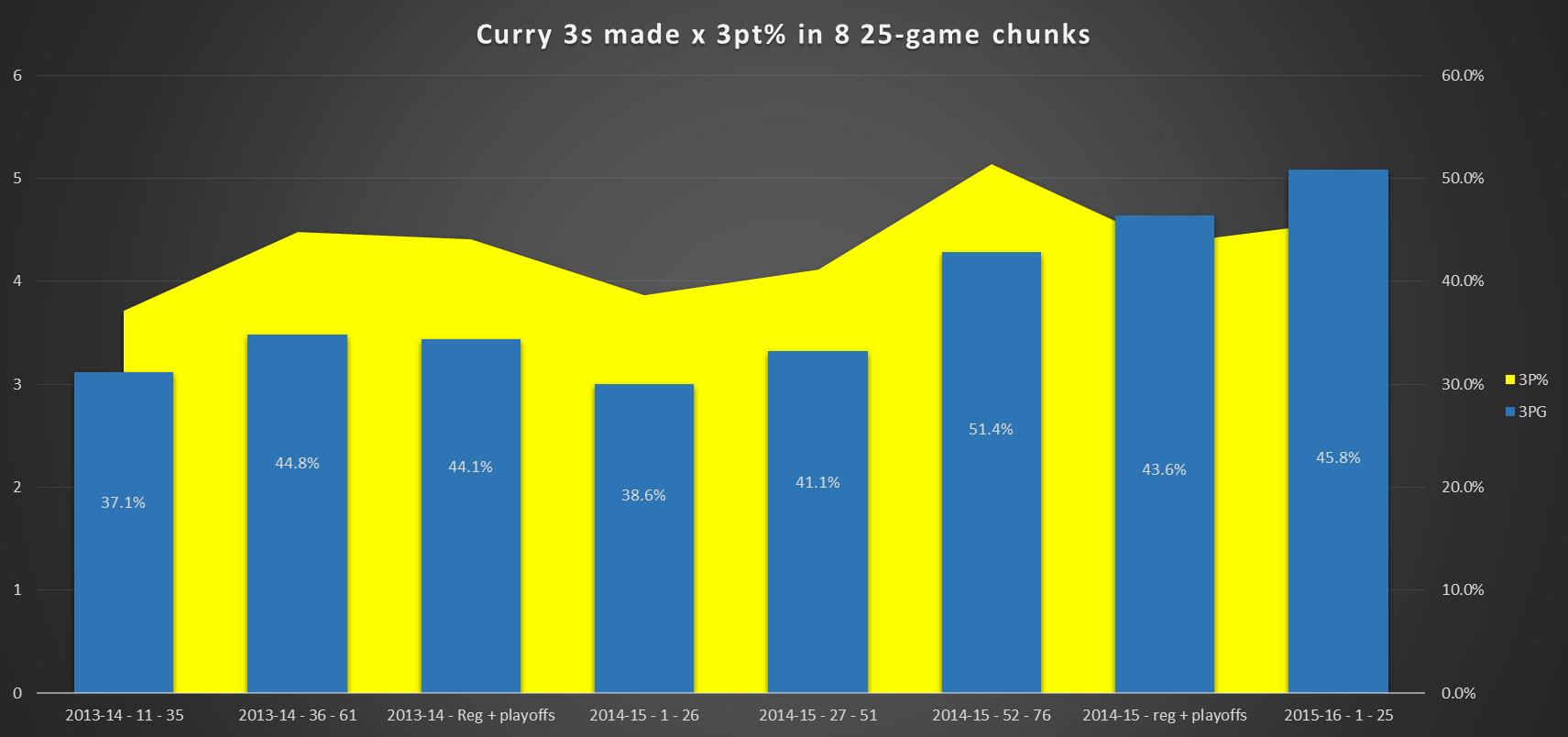
But I don’t feel satisfied just saying volume and efficiency have risen even if those things are true. There are notions and theories at play here that I feel compelled to explore. I went back to the start of 2013-14 (starting with game 11 of that season – the reasoning will become clearer) and broke out Steph’s ensuing 201 games into 25-game chunks that include regular season and playoffs. The patterns are intriguing in that we’re able to see sporadic trends during Mark Jackson’s final year with the team when Curry’s three chunks of 25 games saw his minutes fluctuate between an average of nearly 40 in games 11-35 down to just under 36 in games 36-61. When he was playing nearly 40mpg, his FG% and 3p% were the worst of this 8-set sample, as were his turnovers/game – nearly 5.
stats courtesy basketball-reference.com
As Kerr came on in 2014-15, there’s an immediate shift in Curry’s minutes down to a much-more-manageable 32-34/night with a steady rise in his three-point accuracy and a slight dip in total points. During that first regular season under Kerr, he took less field goal attempts, averaged less assists, and turned the ball over than he did under Jackson the previous year. It’s necessary to call out that Kerr taking over as coach led to a lot more changes than Curry’s role in the Warriors offense, but for the sake of this post and your time, we’ll focus on how Curry responded.
Last year’s playoff run is where we get a preview of what’s to come for Curry. Where he shot around eight threes/game in the regular season, it spiked up to 10.6 in 21 playoff games and final four games of the regular season. His three-point percentage stayed right at his average of this 201-game sample size – 43.6% during playoffs/reg season vs. 43.5% overall.
It’s that rise in the three-ball volume that appears to have carried over to 2015-16. Beginning in the sixth chunk of 25 games – game 52 to 76 of 2014-15 – Curry experienced his most accurate stretch of three point shooting: 107 of 208 – a 51.4% clip which accounted for 54.1% of his total points. For context, his average percentage of points from the three over this entire sample was 39.4%. From that block of games forward, his volume of three-pointers attempted has only increased. Curry was a great shooter before this stretch, but let’s look at the previous 126 games (start of 2013-14 thru game 51 of last season) against the most recent 75 games (game 52 of 2014-15 to present):
126 game stretch: 412 threes made on 1003 attempts, 3.3 threes/game, 41% accuracy, threes account for 41% total points
75 game stretch: 350 threes made on 751 attempts, 4.6 threes/game, 46% accuracy, threes account for 50% total points
25 game stretch in 2015-16: 127 threes made on 277 attempts, 5.1 threes/game, 46% accuracy, threes account for 47% total points
What we’re seeing now is like late-career Barry Bonds crushing all MLB walk records. In 2001, Bonds set the record with 177 walks, then bested it in 2002 by 21, and in 2004 put an exclamation point on his own theater of absurd by walking 232 times. This is Steph with threes – minus the weird head enlargement and freakish physical metamorphosis. Curry is taking a truly great skill (he already holds the top-two single season marks for threes made) and building upon it, but in a way that appears to be a collectively conscious extension of last season’s second half run. It’s not just that he’s taking and making more threes, but that his range is extending – or it was always there and his confidence and the team’s confidence in him taking deeper shots has grown (per stats.nba.com):
2013-14: 5.1 3PAs/game from 25-29ft
2014-15: 5.5 3PAs/game from 25-29ft
2015-16: 7.2 3PAs/game from 25-29ft
He’s already hit as many threes from 30-34 feet (three) as he did all of last season (regular season and playoffs combined) and more than he did in 2013-14 (playoffs and reg. combined). The impact of extending his range out further isn’t lost on his two-point game (again, he’s shooting 58.4% on twos) or his teammates who experience a wider, more open floor. Harrison Barnes approves.
Whatever Golden State saw in last year’s playoffs has carried over into this new season. The volume, the freedom, the carte blanche to shoot from anywhere at any time is open. We’re seeing Curry’s Davidson days replicated at the highest level of basketball in the known universe (when NCAA opponents decided they’d rather lose than have Curry go off on them, they were essentially waving a white flag in the same way MLB pitchers did when they intentionally walked Bonds all those hundreds of times). But what’s most fascinating to me is how Golden State appears to have tapped into an optimal playing time balance for Curry and the rest of the team. As I mentioned earlier when comparing Steph to other 30-point scorers, we’ve never had another 30-point scorer play this few minutes. Last year Curry won the MVP with the fewest minutes ever for a winner at 32.7. This isn’t just happenstance, but occurs when your margin of victory is somewhere between 10-13 points/night and your lead at the end of the third is 20-30 so your starters can kick back and rest during the final period.
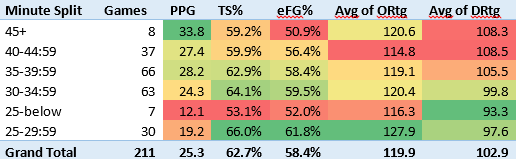
If we break out his efficiency and scoring output across five-minute splits, we can see a sweet spot in the 30-40 minute range. The sample below is from 2013-14 to present with playoffs included. It makes sense that in closer games where Curry struggles individually or the Warriors struggle collectively, Curry would play more minutes and see his efficiency dip and indeed his TS and eFG for games where he plays over 40 minutes are below averages in this sample set. What’s interesting though is that Curry’s output is greater in games where he plays 35-40 minutes than 40-45. For some players on that 30-ppg list, there’s a straight forward line between volume (minutes played and shot attempts) and points. For Curry, more doesn’t always equal more and Golden State appears to grasp that.
My suggestion that Golden State may have landed at an optimal spot in terms of Curry’s usage and minutes/game is the last area we’ll touch on. Last year they won 67 games in the regular season and went 16-5 in the post-season. This year, the playmaking responsibilities are increasingly falling in Draymond’s hands and the results are indisputable to-date. I’m curious about how far this envelope can be pushed though. We already see that Curry’s efficiency and even output in some cases takes a hit the more he plays, so pushing the envelope is finding ways to get more shots. It’s easy to look at what this team is doing and suggest that if ain’t broke, don’t break it, but they’ve made changes from last season with nothing but positive outcomes. Steph’s already stolen about two shots/game from Klay and two from somewhere else (David Lee?). Are there two more to go round? Is two more three-point attempts from Steph per game a better use of possessions than a shot each from Bogut and Draymond? Man, I don’t know and I’m not convinced it even matters, but while they’re here they may as well push it to the limit.
On December 7th, 1973, the Los Angeles Lakers hosted a Bill Russell-coached Seattle Supersonics team in Los Angeles. The game was and should be mostly lost to history with the emphasis of post-game narratives on the Sonics finally catching a win in LA.
As Gil Lyons of the Seattle Times wrote:
The Sonics scrambled and clawed to a 115-111 success, ending a string of 20 frustrating appearances in Jack Kent Cooke’s sports palace. The win also snapped a 13-game Laker domination of Seattle and ended the Sonics’ own six-game string of losses.
For me the game would’ve remained resigned to the minutia of NBA history, a single pixel in an infinitely-sized NBA logo were it not for today’s sport page. Tucked away on the back page beneath the WHL standings and next to the upcoming NFL lines was the “This date in sports history” feature: On December 7th, 1973 Jerry West recorded a then-NBA record 10 steals against the Sonics. If it would’ve been Alvin Robertson setting the record in 1987, I would’ve batted an eyelash but nothing more.
I knew the tracking of steals came along a little later than the standard points, rebounds, and assists, but didn’t realize the stat was tracked as early as 1973-74; which happened to be the first season the league kept track of thefts. For historical context, West’s 10 steals is still good enough for second-most steals all-time in a game. Larry Kenon (1976) and Kendall Gill (1999) each had 11-steal games.
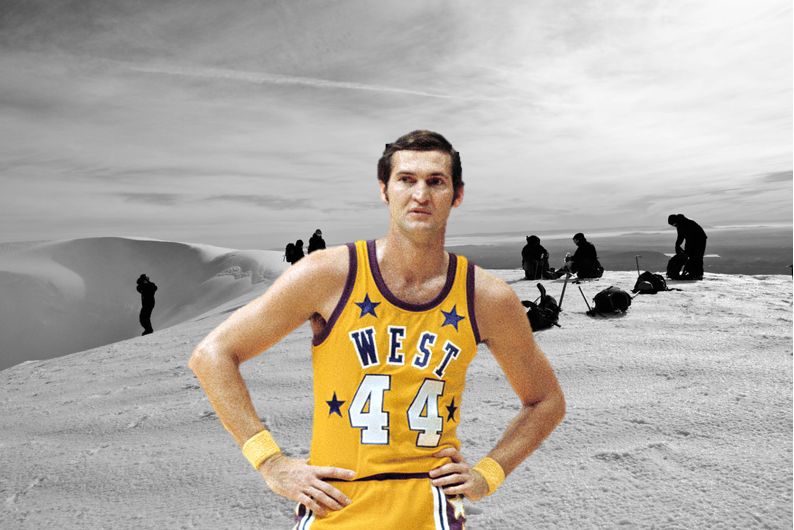
On the night of all those steals back in December of 1973, Jerry West, whose silhouette would eventually be immortalized as the NBA’s logo, was a 35-year-old combo guard in the final season his illustrious career. He only appeared in 31 games that season due to a groin injury, but still averaged over 20ppg, 6apg, and nearly 4rpg. Most interesting in his stat line though was the 2.6 steals he averaged.
It’s fair to assume the 35-year-old West had lost a step by 1973. While still a quality guard with good play left in the tank, his averages and efficiency were down across the board. He appeared in a career-low minutes and games while averaging the lowest points since his rookie season – and still put up 20/game. His combined playoff and regular season minutes were nearly 43,000 and it’s clear to point to age as a contributing factor to his season-limiting injury.
This is where I reveal my ignorance in that I haven’t watched West’s clips nearly as much as I wish I had. I have his autobiography, West by West, sitting on a bookshelf, unread and while I can rattle off West anecdotes, I’ve never gone deep on his defensive capabilities. The league started awarding All-Defensive honors in 1968-69 when West was nearing the end of his prime. In the six years he was eligible for defensive awards, he made the second team once and the first team four times – all past the age of 30. While his nickname was Mr. Clutch and damn near any highlight you’ll find of him will be of a steady downpour of jumpers, he had a reputation for being strong defender and reportedly had an 81-inch wingspan which is the same as Rajon Rondo. All this mixed with the hard evidence of 2.6 steals/game as a 35-year-old and anecdotal evidence of his intense approach to defense point a player who should be considered one of the greatest back court defenders in league history.
That game 42 years ago could act as a microcosm for the tortured dissatisfaction that plagued much of West’s life and pro basketball career. The Lakers turned the ball over 30 times and four of their players fouled out. West was masterful in defeat though with 27 points on 15 shots, five rebounds, five assists and of course 10 steals. That’s a line that’s been achieved just four other times in league history. And not to belabor the point, but West was 35 when he did it. West knew he was a great player, but did it give him any measure of satisfaction? I have no idea, but tracing his defensive prowess beyond the threshold of a 10-steal game 42 years ago has given me an even greater sense of appreciation for the Logo.
Black Friday, a time for some consumers to pit their deal-stalking prowess against the masses, a post-holiday competitive consuming dessert. For the NBA, a day to get back on track after one of the few league-wide off days. For some, strange cornucopias like chocolate drizzled on turkey manifested themselves on this Friday.
The criteria:
50 or more points
Nine or more turnovers
Two of my favorite storylines this year in the NBA sense of soap opera are Philadelphia and Houston. Black Friday was a chance to see these train wrecks on the same court navigating through their own personal debris in efforts to find some stable safety. But there can only ever be one winner in the NBA and for Houston (they won 116-114 at home knocking to Philly to 0-17 and extending their losing streak to 27 games) it took every particle of James Harden’s basketball being to achieve the victory. Harden hoisted the hodge podge Rockets on his back for the following line:
Harden, 11/27/15: 50pts on 12-28 from field, 6-12 from 3, 16-20 from the line, 9rebs, 8asts and 9 turnovers
This is right in line with the season he’s having where’s now averaging a career best 30 points/game alongside a career worst five turnovers/game. As I’ve written though, the only time the Rockets seem capable of competing is when James is dominating – efficiency be damned – and his inability to control the ball didn’t prevent a Rockets win. It does put him in some rare company though. As we see below, just two other players in the past 30 seasons have pieced together such uneven lines:
Allen Iverson, 4/12/97: 50pts on 17-32 shooting, 5-9 from 3, and nine TOs. He was just 21 at the time.
Hakeem Olajuwon, 4/19/90: 52pts on 21-34 shooting, 18rebs, 3stls, 3blks, 11 TOs while fouling out
Harden wasn’t the only big leaguer to struggle taking care of the ball on this evening. Up north in Oklahoma City, Mountain Dew pitchman Russell Westbrook bing bang bobbled his way into 11 turnovers in just 29 minutes of play (he fouled out) against the Pistons and former teammate Reggie Jackson. His TOs covered a broad swath of ball un-control:
Dribbled off his foot
Forced a pass
Charge
Bad pass
Bad pass
Stripped
Stepped out of bounds
Charge (bad call as Ilyasova pushed into Russ as he drove)
Dribbled off his foot
Unforced lost ball on drive
Charge (tried to draw contact jumping into defender)
The criteria:
11 or more turnovers
30 minutes or less
Unlike James and his friends Allen and Hakeem, Russ is all alone on this one. Since 1985-86, we’ve never had another guy turn the ball over this much in as limited playing time. It’s entirely possible that someone turned the ball over 12 times in 24 minutes of play, then proceeded to play another 10 minutes of TO-free basketball, but that’s not the criteria.
This is probably Russ’s worst game of the season. On top of the sloppy ball control, he shot 5-14 from the field and fouled out for just the ninth time in nearly 600 career games (playoffs and reg season). His already league-leading turnovers/game went from 4.9 to 5.2 in what’s suddenly become a race to the bottom between him and Harden to see who can turn the ball over most. Like Harden and the Rockets, OKC was still able to win and by double digits despite Russ’s off night. So instead of this being a costly headache, it’s the flipside consequence of a player that exceeds all speed limits and handling guidelines and occasionally goes off the rails as a result.
Not everyone can grace us with the ball protection and calm of a Chris Paul assist-to-turnover ratio. Harden and Westbrook are two of our most dynamic guards, centerpieces of a New NBA with an unstated philosophy that to make the perfect omelet, many, many eggs must be broken. On the same night, pro basketball wunderkind Stephen Curry dropped 41 points while turning the ball over six times and raising his career-worst turnovers/game up to 3.8. It’s like Tyler Durden told us in Fight Club, “even the Mona Lisa’s falling apart.”
In the midst of the decay of Kobe Bryant, Paul Pierce, and Kevin Garnett, Dirk Nowitzki has become the late 90s perimeter version of Tim Duncan: the elder statesman that ages, but evolves with something beyond grace, something both practical and creative. At age 37 and in his 18th season, Dirk isn’t so much reinventing his great game as re-purposing and fine tuning it.
Forever known as an all-time shooter, Dirk’s career averages are 51.4% eFG and 38.4% from three. Through 12 games in November of 2015-16, he’s scoffing at those numbers with a career-best 60.8% eFG and 53.3% from three. He’s taking less shots and getting to the line less than at any other point in his career, but at 37 the 9-5 surprise Mavs are happy to trade a bit of volume for unnatural efficiency.
Basketball-Reference stats as of 11.22
Bill Simmons of Bill Simmons fame created the 50-40-90 club as a statistical marker that takes into account quality shooting from three measures: FG% (50%), three-point accuracy (40%), and free throws (90%). Prior to this season, just eight players (including Dirk) had achieved the informal milestone: Kevin Durant, Steve Nash (four times), Jose Calderon, Steve Kerr, Reggie Miller, Mark Price, and Larry Bird. In early 2015-16, three players are trying to join that company: Utah’s Joe Ingles with his 13 minutes and three FGAs/game, Steph Curry and his transcendent season (51.5%, 44.1%, 93.8%), and a 37-year-old power forward named Dirk.
Where’s this coming from after a 2014-15 appeared to be the beginning of the inevitable downward slope of Nowitzki’s career? Last season his eFG and three-point shooting were both below career averages. The team as a whole struggled to find an identity after acquiring Rajon Rondo in December. Of their top-20 five-man lineups in 2014-15, Rondo appeared in just two of the top-ten based on point differential per 100 possessions. Four of the bottom-five lineups featured Rondo.
It’s not all about Rondo though as the Mavs made significant off-season changes including acquiring Deron Williams, Wes Matthews, and Zaza Pachulia (three of the top-four minutes/game players on the new roster). A healthy Ray Felton and Chandler Parsons are helping as well. To communicate the lack of continuity from last season, the guy who assisted most of Dirk’s baskets was Monta Ellis with 84 assists in 77 games in which Dirk appeared. He was just a hair over one assist-to-Dirk per game. In 2015-16, Deron Williams is already close to two assists/game to Dirk which is a decent indication Williams is adopting the Rick Carlisle offense in ways that Rondo didn’t and the Mavs are benefiting by getting the big man better looks.
Even though his three-point numbers are most staggering, it’s his work inside the arc that’s equally deadly. From three-to-16 feet, he’s getting over 35% of his total field goal attempts and from those spots he’s shooting either career-best (10-16ft) or near-best (3-10ft). These are remarkable stats of the Barry Bonds variety – as in, Hall-of-Fame player gets older and somehow keeps getting better, but Dirk’s head and neck haven’t grown in comical ways and in place of Balco it’s just his shooting coach Holger. Just your normal German tandem shot genius and savant pupil.
So while it’s easiest to compare Dirk to peers of his own age, comparing him to this season’s most dominant player does a better job of conveying how deadly he’s been. In terms of volume, Nowitzki at his finest couldn’t touch the Curry we’re seeing this year with his five threes made/game on nearly 12 attempts/night. Where a conversation can be had though is around accuracy. Anything that’s weighted towards threes rightly skews in Curry’s favor as he’s massacring our notions of what a volume three-point shooter looks like. For Dirk to be shooting 53% from deep while taking nearly four threes/game is unprecedented. No player in the league has ever hit two threes/game while shooting over 50%. With 68 games on deck, it’s entirely likely that a combination of opponent adjustments and wear and tear bring Dirk closer to his career averages, but at this snapshot in time he’s shot the ball as well as anyone in the league and done it at 37-years-old.
Michael Jordan, Kareem Abdul-Jabbar, Karl Malone have each had more prolific post-age 37 seasons than what Dirk’s doing this year. They shouldered great loads on good (or bad) teams, but with the exception of Kareem’s timelessness, Malone and Jordan rightly struggled to remain efficient as they aged. Nowitzki’s early season has the makings of a masterpiece. He doesn’t need to be compared to the senior division as he’s still good enough to compete seamlessly with world beaters ten years his junior. He’s truly a master of his craft in his execution and adaptation. His fadeaway and the high arc are romantically iconic. The sun’s going to set on him like it does all of us, but for now he’s traveling through space in a stasis of sorts where time doesn’t seem can’t seem to touch him.
Rainy Saturday nights in November against the lowly Brooklyn Nets. Quiet, tired Tuesday evenings when the wind is whipping outside and the Toronto Raptors are in town. We’re 12 games into the 2015-16 season and every game the Golden State Warriors play has become an event.
I don’t mean this in the Bill Simmons sense that that they’re so good they’re can’t miss TV though I also understand approach. I mean it in the Floyd Mayweather sense. (I considered titling this piece The Floyd Mayweatherization of the Golden State Warriors, but opted not to because the click baitishness of it all, but really this post is about a type of Mayweatherization.) I don’t know why people tuned into Floyd’s fights, just that the top-three buys for Pay-Per-View fights are owned by Mayweather. Most people either tune in to see him keep winning or hope tonight’s the night he finally loses. With his unblemished record and bombastic embrace of the villain role, he created an atmosphere where at his peak, each and every one of his fights became a mega event – though one can legitimately counter that his swan song against overmatched Andre Berto failed to meet the can’t-miss-TV status of his previous fights. And he’s managed to do it with unlikable, non-fan-friendly style.
Over a short three weeks, these Warriors have amplified the magnitude of their games from entertaining basketball games to high powered events. It’s not just that they’re 12-0 and threatening both the best opening record in NBA history (15-0) or that they’re a realistic possibility to reach 70 games. It’s that their margin of victory is over 15 points/game. They haven’t just adopted the NBA’s love of the three ball, but have mastered it through a blend of style and personnel. If that weren’t enough, the magnetic dichotomy of the best baby-faced player on the planet in Stephen Curry with the cockily confident/confidently cocky Draymond Green has offered up something for fans or non-fans of various stripes.
Much like a Floyd fight, the beginning of every game starts out with an iota of hopeful anticipation. For the Warrior supporter, a relaxed expectation that they will witness greatness yet again, further cementing a growing confidence of both fan and team. Where this begins to coincide with the Floyd fan is the zero in the loss tally. Over 82 games, perfection appears to be unattainable, but our species can’t help but rise and fall within the moment and as long as they’re 11-0, 12-0, 13-0, 14-0, the weight of each game will elevate. And if/when the Warriors finally lose and creep and climb through the winter and spring months, the emphasis will shift towards 70 wins and the weight will come back – probably soft and slow, like a small earthquake (hat tip Neil Diamond). For the Warrior opponent, the hopeful iotas are aimed at an opposite result – the Warrior loss. The non-fan views Warrior wins through the lens of the give-away. The Kings, the Nets, the Raptors had their chances and they gave it away. But they/we will tune in and hold on waiting for the knockout punch and pending desperate, satisfying catharsis.
And what of the connoisseur? The objective critic of Mayweather or Golden State is hard-pressed to find fault in the execution. The results speak for themselves. Championship rings, championship belts, flawless records. My Twitter timeline lights up with gushy excitement when the Warriors ride the improvised waves of basketball circumstances. Steph catches an intended receiver napping and finishes a righty layup in traffic. Floyd rolls his shoulders back, his opponent’s goal (a brutal headshot) less than an inch away but may as well be in Turkmenistan and he counters with a peppering jab to remind the hopeless that the goal, the purpose is and will remain unattainable. The analyzing fan and writers smile in appreciation.
Even the space is part of the event. Oracle Arena tucked along a random highway in Oakland, a strange neighbor to industry, nothing close to a theater of dreams, but a house of worship nonetheless. Despite an ever-growing disparate fan base split between expensive courtside seats and less expensive upper-level seats, the attendees rise and fall in harmonious agreement. As I resided comfortably in my climate-controlled apartment watching the opening of Golden State-Toronto, I was inspired by the moment and the moment finally resonated (after the pre-game Ernie/Webber/Anthony chatter and the post-east coast games) when I recognized the fans. From the opening tip there was a palpability to the game and it started with the fans grasping the sense of the moment and raising their energy accordingly. Some have said that the real Warrior fans are being priced out by the fair weather Silicon Valley crowd and that may be the truest of the trues, but these past couple games where the undefeated start is at stake has produced May-level excitement from Warrior fans regardless of economic status.
This is peak Warriors. Steph Curry is at his other worldly best and Draymond Green is the clear cut second best player on the team. Andrew Bogut is leaner and bouncier. The team can play better, but they can’t be anymore 12-0 than they are 12-0 today. And as long as that zero sits in the loss column and as long as 70-73 wins is in place, every Golden State game will be an event in the Mayweather sense of things.
James Harden’s 2014-15 season ended with a splat. If you remember, Harden bumbled and stumbled his way into a 2-11 shooting night with a reckless 12 turnovers and a game score of one. Houston was bounced from the playoffs and Harden had the summer to vanquish whatever demons crept through his pores on that late May day.
That was nearly six months ago, plenty of time to recalibrate and find the touch that made Harden’s 2014-15 campaign one of Houstonian bliss. Ten games into the new season though and whatever oddities plagued Harden at the end of the playoffs have hardened into a crust. He’s a career 44% shooter from the field with a 51% mark at eFG (adjusted to account for threes being worth one more point than a normal field goal). Since his days as a 20-point scorer began, he averages just under four turnovers/game. Through ten games of the 2015-16 season, Harden’s efficiency has nosedived to 37% from the field with 4.9 turnovers/game.
Comparing Harden to players other than Harden doesn’t offer a much more favorable view. Since 1985-86, just six other players have managed 210 shot attempts with sub-40% from the field over their first ten games. Except for Kobe’s banged up/shot slinging 2014-15, each player below saw some degree of improvement from their early struggles to their end season stats. (As an aside, what in the hell happened in the Atlantic division in 2002-03 that three players began the season so ineptly inefficient?)
data courtesy of basketball-reference.com
It’s not that the list above is filled with bad company, rather it’s an ugly snapshot in time of otherwise talented players.
Much of Harden’s woes from the field can be traced to a combination of increased fascination with the three-ball and significantly decreased accuracy from that spot. His current approach to the three is enough to make Antoine Walker un-shimmy. After putting up between six to seven threes/game over the past three seasons, he’s jacking nearly ten/game in 2015. For context, prior to this season, no player in league history had ever averaged nine three-point attempts/game. Stephen Curry’s shooting 11.5/game this year, but he’s also making a whopping 45% of them. By contrast, Harden’s ten attempts/game are coming with a 24% efficiency. There’s no reason to suspect that his accuracy won’t creep back up to the 36-37% rate he’s maintained his entire career, but it’s also hard to envision him maintaining the current volume.
While Houston has plenty of issues that have contributed to a 4-6 record with a pair of three-game losing streaks (most notably a defense giving up 107.8ppg [27th out of 30th] with a DRtg of 108.9 [29th out of 30]), the chart below highlights the Rockets early-season dependence on Harden’s offensive efficiency for success. In wins, he has an eFG% of nearly 54 while in losses that number drops to under 32%. As a reminder, his career average is 51%.
There’s such a paradoxical element to Harden’s young 2015-16. He’s averaging a career-high in points at 28.4ppg bolstered by nearly 12 free throw attempts/night while sinking 86% of those attempts, but that’s countered by a career-low in ORtg (estimate of points created per 100 possessions). He’s getting more rebounds than at any point in his career, but that’s driven by him seeing more minutes than ever at small forward as Houston’s been forced to go small due to injuries. And CBS Sports’ Matt Moore pointed out that even those numbers come with caveats:
The NBA’s SportVU data has Harden logged for the second-most defensive rebound chances on the team, at 10.8 per game. He’s grabbing just 5.5, with only 1.4 contested. That is a horrendous rate, which is fine if he’s not being asked to do that, but with the Rockets going small, the guards have to rebound, and they’re not.
Speaking of said injuries, through ten games, Houston’s dilly dallied with five different starting lineups to accommodate the health of Dwight Howard and dings to Terrence Jones. Reserve guard Patrick Beverley has spent the season banged up and the assimilation of Ty Lawson appears to be confounding the entire populace of Houston – Lawson’s to-date performance as a Rocket makes Harden’s struggles feel like sunbeams and smart vacation. There’s a continuity issue here reflected in their streaky play (three-game losing streak followed by four straight wins then another three-game losing streak) and need for total domination by Harden to win. In wins he’s averaging 38ppg with a near-38% usage rate while losses 22ppg and 32% usage and a despicable 15% from three on 53 attempts.
We have three-plus seasons of video and statistical evidence that defines a true Harden identity. While he’s been historically bad over ten games, history tells us he’ll progress to the mean at some point and we’ve already seen it happen in a few Houston games this season. The question for coach Kevin McHale and Harden are more of a when than an if. But like Alexander’s mother tells him in the book which this post takes its name from: “Some games are like that. Even in Australia.”
Once upon a time in the pre-presidential Obama days of the NBA, young Mr. Michael Jordan showed up for a game in Indianapolis against the Pacers and their funny two-guard, Reggie Miller. Jordan’s Bulls lost by four points, but it was due in no part to Jordan who crapped all over the Pacers for a sizzling 47 points, 11 rebounds, 13 assists, four steals and two blocks while shooting 57% from the field and 13-14 from the line. Egads!
Of course Michael Jordan, he of “commerce over conscience” infamy, is the modern-day NBA (defined as 1985-86 which is the first season basketball-reference offers certain box score stats) pioneer of the 43-13 club; aka 43-points and 13-assists, a truly dominant offensive game mixed of equal parts attack and distribution, but all attack.
So how’d we arrive here? James Harden delivered us to this moment on a Friday night in Sacramento in November with his vintage Hardenesque performance: 43 points on 23 shots with 16 FTAs and 13 assists. Harden was a rock or ogre or something irrepressible. And it was kind of fitting that in a league where all two guards are measured by their ability or inability to emulate his Airness, that the two-guard with the most un-MJish game would be the latest in a short line of NBA greats to repeat his feat from 1989.
James Harden considering Mars
Here’s the criteria:
43 points or more
13 assists or more
The inductees:
Michael Jordan, 26-years-old in 1989: 47pts, 11rebs, 13asts, 4stls
LeBron James, 25 in 2010: 43pts, 13rebs, 15asts, 4blks, 1-9 from 3
James Harden, 26 in 2015: 43pts, 13asts, 7 TOs
It’s an illustriously exclusive crowd Harden’s just joined, but fitting given the versatility of his game. Long a playmaker and dynamic scorer, the Beard is one of just 12 players in league history to average 27ppg and 7apg over the course of a single season. Where our eyelashes barely bat at the inclusion of MJ, Bird or LeBron, Kenny Anderson and Antoine Walker are more surprising. Anderson’s game was necessitated by an injury to Derrick Coleman while Walker’s was an outmatched team on the road where he caught fire.
Context for games like these matters. In Harden’s case, it was his sixth game of the year, the first three of which had all resulted in 20-point losses with last season’s MVP runner-up shooting a combined 12-54 (22%) from the field and 3-32 (9%) from three. His team has been ravaged by early injuries and the challenge of integrating speedy playmaker Ty Lawson into the attack. On this Friday night, there was no Dwight Howard, no Terrence Jones, Donatas Motiejunas, or Patrick Beverley. So against an undermanned (no DeMarcus Cousins) Kings team, Harden seized the reigns and torched the Kings. It was without peer as his best game of the new season with the Rockets largest margin of victory and his own highest usage and ORtg.
Which takes us to the final noteworthy relationship of the 43-13 club; the relationship between usage and Ortg. The 43-13 club means you’re accounting for no less than 60 of your team’s points. A player becomes the catalyzing engine driving the offensive attack from multiple planes much to the defense’s helplessness. I expected higher usage rates which isn’t to say the rates aren’t high, but below we see a consistent relationship: mid-30s usage, mid-130s Ortg – with a couple of truly unique outliers. Allen Iverson’s 44 and 15 on 16-22 shooting stands out as a model of harnessed efficiency which, given his career-long struggles with efficiency becomes the greatest outlier and a likely topic for a future edition.
Stats courtesy of the great Basketball-Reference.com.








 Dancing With Noah