Dancing With Noah

Just messing around, getting triple doubles

Tag Archives: basketball

Pain: Defining our Future one Injury at a Time

I definitely have multiple fascinations and mini obsessions in my life. In this space here and in the space residing in the smooth casing of my skull I like to imagine how the NBA could be different and by different I mean in a plausible sense. I don’t mean I want to see how Dwight Howard would compete in a league with Hakeem, Ewing, David Robinson, Shaq, Alonzo Mourning, Mutombo, etc; although if my mind’s in the right place, I do like to imagine how players would overlap generations. But alas, today is about plausibility, disaster, fragility and mortality—but not in the literal sense on that last piece, more in a basketball sense.

A month or so ago, I explored the ongoing agonies of number one overall picks; a pick that’s had to endure what seems like an abnormal amount of injuries relative to the rest of the pro basketball playing universe. When injuries happen, it’s not just the players and the organization that suffer; but rather it’s a massive boulder being tossed in a kiddie pool and me and you, the fans and writers and hoop heads are the little kids sitting around in our swim trunks, wondering what we’re going to do now since the water’s all gone and that boulder simply can’t be moved—because we can’t, with all of our will power and technological advances, make Greg Oden get well soon. This business about number one overall picks having health issues is nothing more than a sad coincidence, but when the wheels in my mind start spinning, I begin to obsess, little by little, with possibilities, alternate realities, the what could’ve been and that’s how I arrived at the post today. My mini obsessions take hold in daily emails to friends of hoop, take root in my mind, are validated through Basketball-reference.com’s encyclopedia of NBA information and finally flushed out here in some polished format … or not depending on your definition of “polish.”

Today, I’m exploring the impact bad luck or bad genes (it’s something bad) have had on all of us as basketball fans and the course of the league as a whole. I’m not making a case for butterfly effect theory on an NBA level, but rather investigating the massive ripples stemming from the painful belly flop of a few of our brighter, yet possibly cursed, stars:

Pain In words, numbers and images

Besides being ridiculously cluttered, the image above is somewhat functional. It tells the story of six men, six men blessed with unique combinations of size and athleticism who proved, at varying degrees, that they not only belonged in the NBA, but could actually thrive (and some may still thrive) as faces of franchises. These are all stars and guys who could’ve given induction speeches in Springfield in some kind of strange future, but instead they’ve danced with pain and lost. Some have given up, while others keep at it with mixed motivations of love, need, pride and stubbornness. No one’s here to judge the reasons of the retired or the motivations of the mad, but just to stroke our wise basketball beards and wonder what could’ve been, what we lost:

Andrew Bynum: Bynum, like Eric Gordon, is less tragic than the other members of the All Pain team because he’s younger. But his youth doesn’t take away from his injury-prone lower body which has been plagued by floating kneecaps, dislocations, surgeries, injections and probably crueler fates that we haven’t heard about (alien dissections, anyone?). Bynum’s highly decorated with rings, All NBA (2nd team) honors and an all-star appearance, but descriptions of his NBA existence or his immense potential are prefaced with references to his oft-injured body and missed games; a preface Philly fans likely precede with a “See, told ya so.” The Atlantic Division with Boston, the new-look Knicks and Nets and a Bynum-led Sixers squad should’ve been one of the more competitive divisions in the NBA this season; instead it’s all about New York and Brooklyn while the other three teams bore us with their flat storylines (no offense as in I didn’t mean to offend, not a reference to basketball scoring ability). And the tragedy here doesn’t end at the city limits of Philadelphia. It stretches across the country to Los Angeles where Jim Buss is likely still shedding tears over Bynum’s departure. It looms like an afro-wearing shroud over a league bereft of talented big men. What does health mean to Andrew Bynum? Would he still be in LA? Would he be dominating an Eastern Conference that has no answer for his 22 points/game and 12 rebounds/game? Will we ever know or will we all be swallowed in Bynum-less lament?

Bynum Dreams:

  • Do the Lakers trade a healthy Bynum? If no, then this Lakers team looks the same, but with Bynum instead of Howard. Not sure that solves their problems though.
  • No Dwight in Los Angeles means the dominoes fall in a different direction; one that I can’t possibly be expected to imagine since four franchises were involved.
  • And of course, Doug Collins agrees Bynum’s healthy presence would change things in Philadelphia, the Atlantic and the East.

Brandon Roy: I remember watching Roy at the University of Washington. He patiently waited his turn while more extroverted personalities like Nate Robinson’s shaped the team. But he waited and in his senior year, I recall seeing a kid possessed of absolute control, both physical and mental, whose game flowed like water, contorting himself to whatever the situation required, coolly flowing in waves or droplets—depending what look the opposition presented. He arrived as a pro in Portland with the same composure and pace. He spoke softly and was capable of the always-enjoyable “quiet” 35-40 point night. Genetics or fates weren’t having it though and young Roy’s knees began to deteriorate, or perhaps disintegrate is a more appropriate term (or perhaps someone injected his knees with cartilage-corroding acid), at the tender age of 24-25 and eventually resulted in retirement at 27 only to attempt a comeback this year at 28—a comeback with Minnesota that’s sadly been marred by more knee issues. But what could’ve been in Portland if Roy had been gifted with health instead of chronic pain? Stretch your imagination like one of those physical therapy rubber bands … pull it, stretch it and think of a Portland team starting Roy at the two (and don’t forget, he was a three-time all-star by age 25), Batum at three, Aldridge at four and a defensive anchor in Oden (more on him below) at five. Alas, my tears are dripping on the keyboard and it’s not because I have a Pacific Northwestern loyalty to the Blazers, but because as an NBA fan, I want a chance to witness what should be and what should be is the team I just described; instead it’s LaMarcus running with Wes Matthews and JJ Hickson.

Roy Dreams:

  • A title-contending nightmare in Portland with Oden, Aldridge and Batum
  • No Damian Lillard in the Rose Garden—because of course they never end up with that pick; unless the Nets are feeling generous all over again.
  • A Pacific coast rivalry with the Lakers: Roy vs. Kobe, Oden vs. Bynum

Eric Gordon: He’s back and since I built out the graphic a couple weeks ago, it doesn’t accurately reflect the fact that Gordon has actually appeared in games this season after curious rumors about microfracture surgery never came to fruition. He’s never made an all-star game or the playoffs, but he’s undeniably talented. At 6’3”, 220lbs, he’s the NBA’s answer to Earl Campbell; a battering ram of a two-guard with a smooth stroke that looks like it was crafted by the basketball gods of the Hoosier State. Three years into the league and the 23-year-old Indiana native was scoring 22/game and well on his way to something exciting, something special, some kind of explosive basketball device tucked in a compact package of muscle and talent. Of course, that was until he started breaking down with an assortment knee and wrist injuries. Gordon’s the youngest player on this list at 24-years-old which means he has the greatest opportunity to right any wrongs attributed to faulty genetics or mutations. In Gordon, New Orleans trusts and prays.

Gordon Dreams:

  • If he’s a healthy all-star guard, do the Clippers send him to New Orleans in 2011?
  • If the Clippers pass on the CP3 trade, then they move forward with Blake Griffin and Gordon at their core and Lob City becomes nothing more than the Lost City of Atlantis; an unverified utopia that gains beauty as time passes.
  • No Clippers-Hornets trade throws a wrench in the league’s attempts to sell the New Orleans franchise and puts David Stern in a tighter spot after he became inexplicably involved in the CP3-to-Lakers trade veto. Like the Dwight scenario above, there are too many possibilities to explore.
  • A healthy Gordon in 2011-12 (he played in just nine games) means the Hornets likely finish with a better record which means the Hornets don’t luck into Anthony Davis which means Davis likely ends up somewhere like Charlotte—a city desperate for a pro basketball savior. Instead they’re suddenly a tandem in New Orleans and David Stern is … well, I don’t know, but it feels like Stern’s name should be mentioned.

Gilbert Arenas:  Over a three-season span at what appeared to be extremely near his prime (or anyone’s prime), Arenas had point averages of 25.5, 29.3 and 28.4. Over that span he scored 6,489 points in the regular season and scored 34/game in the 2006 playoffs while playing 47 minutes/game in that first round series. At the peak (this is an assumed peak because after the injuries was downhill, but it’s OK to wonder if he could’ve gotten even better) of his career, his primary rival was LeBron, he scored 61 in LA against Kobe and was the king of all that is swag in the NBA. And then all the weight of those self-created expectations collapsed inward and took him with it, robbing Gilbert of his all-important swag and once that was gone, it was time to move on (to China). It started with a torn meniscus and ended with a gun suspension. For a player of Gilbert’s showman caliber, it’s not that big of a surprise that things devolved the way they did. He could only be a comet; never meant for longevity, but given his upward trend and relative youth at the time of his meniscus injury (25), it’s appropriate to wonder where Arenas could’ve taken the Wizards or his own career. Could he have been a 30-point-per-night scorer? Would he have had an existence comparable to Dominique Wilkins? Or would he have gone the other route and provoked Javaris Crittendon into killing him?

Arenas Dreams:

  • Five more years of oodles of points, threes, clutch buckets and quotes that beg for attention. If he played 70+ games/season, it’s likely we’d just now be entering the downward arc of his career—he just turned 31 two days ago! Please consider this when you see the Wizards leaning so heavily on Jordan Crawford and Bradley Beal (nice shot last night, kiddo).
  • No bad meniscus means no John Wall means John Wall’s somewhere else.
  • Of the nightmarish variety; with the cast of characters this Wizards team employed, it’s not hard to imagine a prank gone terribly wrong and resulting in death or dismemberment.
  • The course of the Eastern Conference might not be altered with a healthy Arenas, but it’s a hell of a lot more entertaining.

Greg Oden: It’s hard to dive as deeply into the pool of Oden’s potential and possibility as it is the rest of these players simply because he’s endured more physical challenges and his broken body of work as a professional is a fraction of theirs. I included him on this list because any discussion of injury-prone players of the past twenty years must include him. The ceiling was high: He played a total of 82 games in the two seasons he appeared in Blazer games and shot 57% from the field while averaging 15pts, 12rebs and 2 blocks per 36 minutes over that pain stained stretch. Assuming the worst, that we saw Oden peak as a 22-year-old (highly unlikely), if he can produce 15 and 12 and change games on the defensive side of the ball, he’s a more offensive version of Tyson Chandler. We all missed out on this career and it’s truly tragedy in the greater theater of basketball.

Oden Dreams:

  • I mentioned the Roy/Aldridge/Batum/Oden Blazers above; a lineup that would challenge any team in the Western Conference and would likely have ended a in similar situation to OKC in being forced to move one of their primary producers because the cost would’ve been too great.
  • The league would no longer have been dominated by a singular center and this would’ve been a good thing for Dwight for multiple reasons.
  • It’s easy to forget Oden is only 24-years-old. We’d just be entering the beginning of his prime. And at this point, I can’t help but drive down to the Columbia River which sits at the border of Washington and Oregon and toss a single rose into the rushing water and watch it sail away into the depths of the Pacific Ocean and take some kind of poetic comfort in its fleeting beauty.

Yao Ming: Yao’s tale is sadder than Oden’s, but less mysterious. He proved himself as a dominant post in the NBA with that massive backside and lower body and his elite skill around the rim. He had better touch than his peers and learned how to use his size as a great advantage. We knew what he was capable of; we just didn’t get the opportunity to see it all the way through. Over the course of his first five seasons, Yao improved statistically every season and then at age 25, his body (mostly his feet) began to break down. Those feet just weren’t made to support a frame that big running, jumping and pounding on a hardwood floor 35 minutes a night for hundreds of games and eventually the feet rebelled without mercy; the bones cracked and fractured and simply gave out. His last full season was 2008-09 when he averaged ~20, 10 and 2 blocks. This was casual for Yao, but only one player in the league has been able to equal this consistency since and that’s Howard.

Ming Dreams:

  • His last full season was 2008-09, so that’s three-plus years we’ve missed out on Yao delivering fits in the form of 30s and 10s to the rest of the Western Conference.
  • In this re-imagined West where bigs stalk the paint, demanding respect and instilling fear, the game is altered and while it’s still a guard’s league, the Lakers, Blazers and Rockets each has an oversized weapon with which to do battle.
  • If Yao’s healthy, Daryl Morey’s still going to be Daryl Morey which means he’s still going to make ballsy moves, moves that I can’t possibly predict, but it’s safe to say the Rockets would have a radically different roster today—no Jeremy Lin, James Harden or Royce White.
  • Thanks to the China voting bloc, Yao would’ve continued to represent the West in the All Star game; whether he earned it or not.

This entire post has been built in a combination of facts and speculation and assumptions on what could’ve been. There isn’t any extra effort here to apply advanced forecasting models to project what kind of numbers these players could’ve achieved or how many wins they could contribute over players who replaced them. I thought about including Jay Williams and a case can be made for Tracy McGrady, Grant Hill, Steve Francis, Penny Hardaway, but I decided Williams’s career was too short and not as impressive as Oden’s, McGrady wasn’t racked/cursed in the fashion of the players above, Hill and Penny came too early and I just thought about Francis while I’ve been writing. Additionally, it’s a creepy coincidence how some of these guys have played together and single franchises and fan bases have lived through the agonies right alongside the players (condolences go to Houston, Orlando and Portland)—and often felt the pain even more deeply than the men sustaining these future-ravaging injuries.

Injuries always have and always will be a course-altering part of sports. It’s a death of sorts for all athletes and one of the greatest obstacles preventing athletes from realizing potential. I’m not making a case to the AMA or the league’s doctors and trainers to do a better job of injury prevention, but rather taking this long moment to acknowledge the unfair impacts injuries have on the league while considering how our world of basketball could’ve (plausibly) been a different place.

Original photo by Richard P. Fennimore

Original photo by Richard P. Fennimore

Jarrett Jack: Author of Indispensability

It wasn’t always about Jarrett Jack, but for now at least it will be about him; this burly, hard-headed (in appearance) man with his brick wall frame, compact like a boxer’s, eyes locked in what appears to be a perpetual squint—in anger or humor—eyes given by mom or dad, eyes passed through the gene pool generations ago perhaps, a head that looks almost too big for its body; always cleanly shaven as if he calmly stands in front of the mirror before games and at halftime, straight razor in-hand, head covered with thick white shaving cream, slicing the hairs away from that immense rock-like brown dome with the same precision he’d cut open an adversary’s throat; a face and appearance (particularly in scowl mode) that draws comparisons to emcee Sticky Fingaz and could land him a spot in the aforementioned’s aggression-fueled hip hop group from the 90s, Onyx, with their furious black baldness, black hoodies, black pants, black boots. This is about Jack, who’s traveled the jet streams of the NBA; from and to teams I couldn’t even recall off the top of my head (completely blanked out on the long lost Pacers days). A journey begun back at Georgia Tech with BJ Elder and Paul Hewitt and moved on to Portland and Indiana and Toronto and New Orleans and now Oakland. Always steady, but never anyone’s first choice. Passed over in favor of Jose Calderon, traded for Jerryd Bayless not once, but twice, a multi-time trade casualty …

Typically in the background

Typically in the background

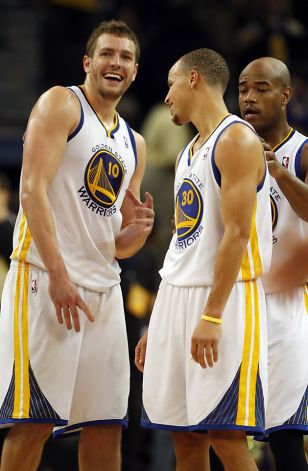
When I see Jack in 2012 playing with Steph Curry (as a replacement of sorts for Monta Ellis) I see indispensability and luxury. In terms of pure ability, it doesn’t matter how he compares to Monta, but in terms of the Golden State Warriors, he’s a flawless fit, pragmatic and versatile, complementary and embraceable. He’s glue, Velcro, a viscous player that appears in 83 games in an 82-game season, oblivious to any limitations. He’s the kind of dude every team needs even though they’re quick to send him on his way. Call him a liberator in that he can relieve Curry of his playmaking duties.

2012 isn’t the Year of Jarrett Jack, it’s just another in a career of underappreciated years. What’s so profound about Jack is that there’s nothing profound about him. He does what he’s called on to do and in a league of specialists and superstars, he’s easily taken for granted—just like the PJ Browns and James Poseys of the world. I’ve been thinking about this all season and now I’m expressing it in full, or maybe just in part because I’m fairly certain Jack will provide plenty more reasons to write and think and consider his uniquely simple place as a backup guard in a league gone mad with awards, titles (of the individual variety) and over-analysis.

(and no, this hasn’t turned into a Golden State Warriors fan blog)

16 Minutes or Less

I arrived home last night (12/14/12) after an evening of wrestling with tallboys of Rainier and eating massive slices of New York style pizza and promptly did what I often do: Scoured NBA box scores in search of anything out-of-the-ordinary. This exercise is typically futile which is why it’s out-of-the-ordinary, but on this Friday night, I noticed something in the Kings-Thunder box score that caught my eye:

Isaiah Thomas box score - 12-14-12.jpg

In the box score above, I highlighted the most intriguing stat of the night: Isaiah Thomas scored 26 points … in 16 minutes. This is no small feat; it’s prolific. It’s Reggie Miller prolific, Kobe Bryant prolific. I was curious to see if/when this had previously occurred and cross-referenced Basketball-Reference’s Player Game Finder which shows individual game data from 1985-86 to present. After plugging in the criteria (26 points in 16 minutes or less), I was pleased to get the following message:

No results

All of this leads to a few quick observations:

  • If Isaiah Thomas earned the starting spot last year and the team isn’t winning with Aaron Brooks running point … and IT’s stats are better across the board, why is Brooks still starting?
  • As a follow-up question to the first point, is it possible that the same reason Thomas dropped to the bottom of the draft in 2011 (his height—5’9”) is the same reason Kings coach Keith Smart insists on starting Brooks (6’0”)?
  • I can honestly say I didn’t see any of the game last night. And with that admission, there’s a good chance IT entered after the game was already out of hand and just gunned for the 16 minutes (15 minutes, 42 seconds to be precise) he was on the floor.
  • That’s a lot of points in a short amount of time whether you’re playing with grade schoolers or in a JV game or in summer league, but against pros who are paid millions to prevent you from scoring? It’s a hell of an accomplishment.

So for your efforts on Friday, December 14th, 2012, I award you, Isaiah Thomas, the first ever Dancing with Noah Extraordinary Performer of the Night (EPN) award. The opposite of this award would be given to Keith Smart for his complete inability to logically choose which players should be on the court and how much time said players should spend on the court.

What is this thing, hope? alternately: Drowning in our own hubris

Back in September, the odds makers in Vegas or Jersey City or Macau or wherever it is they reside set the odds of a Lakers championship at 9-4. For the sake of comparison, the defending champion Miami Heat also had 9-4 odds; which makes the Heat and the Lakers the odds-on-favorite to win the NBA crown … as of September. As I sat down to write this, the Lakers were 9-12 and a full two games outside of playoffs in the Western Conference. They were in the middle of a strange slap fight in Cleveland against the Cavs—a team that no doubt scraps and scrapes, but in terms of today’s talent, they’re many rungs lower than the Lakers on any imaginary talent ladder.

But for multiple reasons, I enjoy watching this Lakers team and it’s not because of any hatred I harbor for Kobe or the Lakers because I don’t hate the Lakers or Kobe. It’s not even the smoldering dislike I have for Dwight Howard—which I do have. It’s because there’s something beautiful in the struggle and I don’t mean beautiful struggle the way disenfranchised people struggle to find justice and equality in a prejudiced world. I mean it in the sense that there’s an awesome collection of talent on this Lakers team and, to some debatable degree, they’re trying to learn how to successfully coexist with each other. And in that struggle, I find them more intriguing than the team that won over 70% of their games the past five seasons because there are so many strange things going on with this team and their least interesting player is somehow Metta World Peace. And since I think lists are kind of gimmicky, but my brain moves in bullet points, I decided to lay out my feelings and views on the 2012-13 Lakers, an old team that could be hopeless or hopeful … or both:

  • The Lakers as imagined by a European soccer owner: The Lakers have always loved to make a big splash and collect talent and in that regard, they’re similar to those mega-spending Euro soccer clubs that build football foundations on cash and bricks of gold and hope that’s enough for success. Sometimes it works like Manchester City’s EPL title last year, but other times it ends up like Chelsea or Real Madrid—a pair of accomplished clubs that seem to be influx for perpetuity. Chelsea’s been through eight managers since 2008 and Real Madrid’s backups could compete for a UEFA crown on their own. It’s talent for days, but what’s that matter when it’s assembled without any sense of compatibility, cohesion, personality or style? Sound familiar?

    Lakers fans and their strange celebratory customs.

    Lakers fans and their strange celebratory customs.

  • Will Steve Nash even help this team? Mike D’Antoni loves to run the pick and roll, but how’s that going to work with Dwight and Kobe out there? How’s Nash feeling sitting on the bench and witnessing this avalanche of ineptitude? He looks sharp, has a nice new Tom Cruise-approved LA haircut and can be counted on to be a good soldier, but on the insides of the walls of his mind, in places we can’t penetrate; it’s likely a tumor filled with doubt and regret is growing.
  • Speaking of Steve Nash … how great is the Phoenix training staff? Anyone who follows the NBA is aware of the Suns’ magical powers of resuscitation and now we have the final proof, the absolute truth: Steve Nash and Grant Hill. Each of these aging (by NBA standards) players experienced mostly clean bills of health during their stays in Phoenix, but now that they’ve relocated to opposite ends of the Staples Center, they’ve appeared in a combined two of 42 games this season. Phoenix, we salute you.
  • How bad does it hurt to let your team down? Hack-a-Shaq has evolved into a hack-a-Dwight and Howard has predictably failed at the free throw line where he’s shooting a career-worst 48%. Too much pressure in LA? Too much pressure having to look Kobe in the eye after you miss another freebie? Eh, I’m not too concerned that Dwight’s missing these shots, but I’m curious about the psychological impact it has on him. Shaq couldn’t shoot throws to save his life and Wilt Chamberlain was worse than Shaq and Dwight. Each of these dominant giants has masked any insecurity they may have with blinding and deafening personas that divert and distract from pain, but somewhere deep in those psyches, behind the conquests, jokes and accomplishments lays shame and embarrassment at having stand in front of the world, naked and vulnerable, and be judged.
  • I alluded to this a bit in the second paragraph above, but part of the reason I want to keep watching this team is because something is going to happen. If the Lakers keep up like this, then the finger pointing, the blame game, the inability to trust … all of it is going to get to worse and while I don’t wish harm or anguish on these guys, it makes for an entertaining season and future and after all, sports exist for entertainment. The other reason, the preferable reason (depending on your allegiances) is the belief that the Lakers will figure things out, that Nash will come back, Pau will thrive in D’Antoni’s system, Dwight will get his legs and his back healthy and dominate defensively and of course Kobe will have the opportunity to explore the non-scoring facets of his game. This is the hope, but we have to find out if our basketball prayers (for better or worse) are answered.
  • Is this the longest winter of Mike D’Antoni’s life? That’s kind of tongue in cheek since the experiences life delivers us far exceed the game of basketball, but in professional terms, this has to be painful. And it leads to another question: Can Mike D’Antoni coach at this level? While the Seven Seconds Suns were delightfully pleasing to the eye and the box score, D’Antoni hasn’t proven capable of improving or innovating from that original style. Many fans and analysts saw his apparent disregard of defense as a cardinal sin he could never overcome and sadly he’s done nothing to prove otherwise. Instead, he’s bounced across the country in high profile jobs with his maverick mustache, laid back approach and lukewarm results. I have to give him leeway with this Lakers team that was strangely constructed and the short timeframe he’s had to turn things around, but if the struggles continue, Mike D’s head’s going to be on the chop block (figuratively speaking … I hope).
  • Phil Jackson can coach. It’s a natural segue from the previous questions about D’Antoni. I’m not saying the Lakers should’ve caved to the allegedly ridiculous demands made by the Zen Master, but to all the fans and anti-Phillipians out there who love to accuse Phil of riding the coattails of Jordan and Kobe, look at the nightly confusion that is the today’s Lakers and tell me that shit would fly with Phil sitting on the bench in that crazy special-made chair he had.
  • Was a curse attached to this trade and if so, did Rob Hennigan cast the spell? When I first read about the Dwight-Bynum-Iguodala trade this summer, I was least impressed with Orlando’s inability to get back any worthwhile assets (except for Aaron Afflalo, we all appreciate his contributions). But in the true, humbling nature of the universe, everyone in this deal appears to be struggling with their new acquisitions—except Orlando. Andrew Bynum’s combination of knee injuries and hairstyles has resulted in Moses Malone reconsidering his retirement (“for the good of Philadelphia,” he says). I thought Iguodala would blend in brilliantly in George Karl’s intense defensive approach to the game, but instead he’s playing about as poorly as he ever has as a pro. We’ve already discussed a few of the Lakers woes above. And that leaves Orlando; limping along at 8-12, but doing two things extremely well: Playing hard and playing together. And they’re facing some of the same challenges as the Lakers—new coach and new teammates. It’s a relative comparison since the Lakers are living below lofty expectations while the Magic are playing above the lowest expectations (they tied Charlotte with the worst odds to win the title: 1,000 to 1).
  • Dwightmare revisited? Of the possible dastardly outcomes of a Lakers collapse, the potential for a return of the Dwightmare is most concerning. Nothing gets the media’s attention like a juicy, sensational rumor; especially one that involves one of the league’s best players and signature franchises. And if the Lakers continue the current backslide, only time will stand between us and a litany of quotes from “unnamed sources.”

There’s a reason the sports books in Las Vegas are still accepting sports bets and haven’t gone out of business yet: They know more than we do. And they missed this early-season Lakers conflagration by a country mile and then some … just like the rest of us did. To say there’s anything certain attached to this Lakers team (other than them playing 82 games this season) is to actively participate in self-deception. So when your friends or your favorite bloggers or handicappers approach you with their foolproof theories and analysis of why this Lakers team will either sink into the abyss or triumph over the uncertainty of the day, kindly remind them, like the universe occasionally has to remind us, that we’re all walking through the darkness of today toward the light at the end of the tunnel of a tomorrow we’ll never reach.

Original photo by Richard P. Fennimore

Original photo by Richard P. Fennimore

Late Nights with Steph

Don’t get it twisted, this isn’t my foray into a new genre of basketball erotica and I am wearing (sweat) pants while I write this. It’s about me accepting the aesthetic of Stephen Curry’s game: a sweet, sensual convergence of college fundamentals with the boldness of Marvin Gaye on his classic I Want You.

I live on the west coast, so I get the great pleasure of watching west coast teams play at a reasonable time—at least reasonable based on my 32-year-old/married standards. The straight up west coast options we have: Lakers, Clippers, Kings, Blazers, Suns and Warriors. The Lakers are a comedy of errors, a team without a collective identity even though they have players with well-defined identities. The Kings have really disappointed; particularly because of their decision not to re-sign Terrence Williams. I don’t care for the Blazers, but I do like some Nicolas Batum and Young Mr. Damian Lillard is pure joy—regardless of how you feel about point guards. The Suns are another laughable comedy routine on a nightly basis. Shannon Brown as your get buckets guy? It takes a rare NBA roster architect to devise that scenario. Then there are the Clippers and the Warriors, a couple of teams that are entertaining for entirely different reasons. The Clippers are potential-in-the-process-of-being-realized and this kind of maturation is so magnetic because we’re eagerly anticipating their ongoing improvement. Once the ceiling is reached, we can get bored because we’re simple people with short spans of attention living in a world full of attention grabbing experts. As a group, the Clippers are more fun than Golden State and yes, Chris Paul is the PG archetype, but there’s nothing human about Paul single-handedly demoralizing and discouraging defenses or Jamal Crawford heat checks or Blake Griffin or even Los Angeles for that matter. But up in Oakland? Oh, up north it doesn’t get much more human than Bogutian tragedy, the erosion of Andris Biedrins’ confidence, Brandon Rush’s torn ACL, David Lee’s around-the-basket intuitiveness (it’s still underrated) or Steph Curry’s nightly flirtations with basketball death, a dreaded Grant Hill career arc.

The crowd in Oakland pleads a great case for watching the Warriors, but Lee’s interior aptitude and the development of Harrison Barnes are entertaining too. The primary reason to watch, the main event … that’s Curry.  There’s a reason he’s still the (baby) face of the Warriors despite missing nearly 25% of his team’s games through his first three seasons (of course, part of that reason is that they were never able to find a trade partner willing to take on those papier-mâché ankles). They’re still going to war every night with Curry as their lead guard because the kid (he’s still just 24) is disruptively good and can get better.

I’m not positive if the NCAA’s and ESPN’s and Dick Vitale’s infatuations with Curry during his Davidson days soured me on him or if I was too distracted following the explosions of Monta Ellis (fiery spectacle one night, snap pops the next), but I only studied Curry from afar for his first few years. His ankle(s—was it both?) turned last season into one long, depressing sputter. And if it was frustrating for fans, imagine how Curry felt riding that physical and emotional roller coaster: special shoes, protective boots, ice bags on ice bags in ice baths, multiple doctors, fear that something’s wrong, that maybe it’s somehow his fault … failure; letting down your teammates, fans, the people who pay you huge checks to be on the court performing. So when he rolled his ankle (again!) in the pre-season, I think there was a part of me that lightly erased Curry from the NBA panorama. He wasn’t a ghost yet, but he was fading.

This is a terribly unfair thing to do, particularly given the steadily impressive performances of Curry’s first two seasons in the league which compare better than favorably with Derrick Rose’s and Russell Westbrook’s:

Advanced stats on top, per game on bottom

Advanced stats on top, per game on bottom

Not too many people put Curry in the same echelon as Rose and Westbrook and there are a couple of obvious reasons why:

  • The Third Season: While Curry spent his third season on crutches, in walking boots and enduring a bombardment of tests on his ankle(s), Westbrook and Rose made a motherfucking leap in theirs. Remember how similar these three guys were through their first two seasons? The third seasons created a massive chasm:
Per game stats

Per game stats

  • Playoff Appearances: Rose was a black NBA version of Rocky Balboa as a rookie when he led the 8th seed Bulls to a memorable seven-game series against the defending champion Boston Celtics in the opening round. Westbrook made a name more violently for his volatility—eruptions of athleticism versus decision making follies and the unique ability to forget Kevin Durant was on his team (and in the damn game!). Where Russell made the playoffs three of four years and has Rose has advanced to the postseason every year, the ill-fated Curry is still awaiting his first appearance.

I didn’t set out to write a story about how Steph Curry does or doesn’t compare favorably to two of the best young point guards in the game, it just organically occurred this way and I’m happy with that. Beyond the inconclusive stats we have above, the Curry I’ve seen this year is a smooth ball handler with great court awareness, passing ability and a hyper fast shot release. His handle is so much better than I realized, but it looks like he’s still figuring out how to fully utilize this skill. You see Rose and Westbrook combine their ball handling with raw speed and quickness: Rose more lateral quickness with the ball in-hand and Westbrook more straight ahead speed. Steph’s handle is so often used on the perimeter to keep defenders at bay instead of attacking with it. If and when he improves that part of his game, he’ll be able to create more space and get to the rim more frequently than he already does which would make him close to indefensible. Of course, the more he penetrates, I feel like the odds of rolling an ankle increase (is that true?).

So while the rest of you east coast and Midwest fans are sleeping away the nights or blowing rails just to stay up for the west coast games, your brothers and sisters on the left are settling in on couches and recliners from San Diego to Blaine with beers and green teas while our spouses and partners and roommates flit in and out, oblivious to our fascinations with a guy named Steph…and even more oblivious the fingers we have discretely crossed under a pillow or blanket, vainly hoping those tender ankles hold up.

The Pain of Being Number One

Injuries are the bane of an athletic existence. When our favorite athletes (in any sport) get hurt, everyone loses: The players and teams lose out on money, investments and glory. The fans lose out on entertainment and glory and are forced to wonder what could’ve been which leads to wild speculation and imagination. And injuries come in all shapes and sizes: Shoulder strains and contusions, patella injuries, concussions, colds, flus, torn ACLs, torn Achilles tendons, hamstring injuries, slipped disks, back injuries, stress fractures, broken bones, HIV, chlamydia, gonorrhea, diarrhea, migraines, scratched corneas, stabbings, shootings, sprains, depression, anxiety, substance abuse and on and on. All players are vulnerable to injuries and the recent revelation that Andrew Bogut underwent the dreaded microfracture surgery in April opened my eyes to something I already knew: The top draft picks in the NBA haven’t had a great run of health over the past decade.

The injuries plaguing these young players run the gamut from freak (Bogut’s fall that led to a horrific broken wrist) to chronic (Yao Ming and Greg Oden) and have hit players of varying race, age and position. Injuries don’t give a fuck what God you pray to or what block you grew up on or how much pain you’ve already experienced in your life. Injuries are lurking … just ask the top picks from the past decade:

  • The table above looks at the percentage of games a player could have appeared in (% Possible = 100% for each player) and the percentage of games he missed (% Missed).
  • Graph doesn’t include playoff games.
  • A rookie like Anthony Davis is unfairly represented due to the small sample size.
  • Yao Ming appears twice. The first Yao Ming (without asterisk) represents his career pre-retirment. The starred Yao Ming* includes games he missed since he’s been retired with the assumption being that without injuries, Yao would still be with us today and the NBA would be a radically different place.
  • The total numbers for all players are: 6,147 possible games played, 4,455 games missed for a total of 27.5% missed.
  • If you remove the top (Dwight Howard, 2.9% missed) and bottom (Greg Oden, 80% missed), the percentage of missed games drops to 26.5%.
  • I’m uncertain about league averages for games played/missed, but my gut reaction is that missing 27.5% of possible games is on the high end. Additionally, teams drafting a player number one overall likely have the expectation that these players will be suiting up more frequently than the numbers here show.

Lastly, if anyone out there has access to injury data or DNP reasons, that additional information could add quite a bit of insight into the causes for the numbers above. As it stands, let’s all have a moment of silence for the careers of Greg Oden and Yao Ming.

November Observations: I’ll be watching you, Newton

We’re not even a full month into the season, so it’s not like there’s this deep well of meaningful observations on this toddler of a season, but given that I’ve spent so much time watching games in standard definition, questioning how League Pass chooses which games are shown in HD, watching multiple games on League Pass Broadband and reading/posting nonsensical NBA observations on Twitter, I decided to meditate on things I’ve actually seen or noticed. The following list isn’t in any order of significance, just some cold November observations of teams and players I’ve watched at some point this month:

  • Tim Duncan as Kareem. He’s 36 now and will be 37 by the end of the season and he’s plugging away with his best per/36 numbers since … since he was 28. I’m not naïve or knee-jerk enough to even halfway believe that 16% of a season (13 games out of 82) constitutes sustainability, but Duncan’s putting up a career highs in PER and win shares per 48 minutes. Despite his longevity, people still, after all these years, love to sleep on Duncan and the Spurs for being boring. Duncan fans respond with their own brand of godly hyperbole, but wherever you fall on the Timmy spectrum, do yourself a favor, put your prejudices aside and spend a couple hours one night just watching Duncan; he’s still (somehow, even at 36) an underappreciated NBA treasure and the best shot blocker/shot alterer I’ve ever seen.
  • The (re) emergence of Jamal Crawford. I’ve always had a soft spot for the Big JC and it makes sense since we have so much in common: We’re both 32, he’s from Seattle while I live in Seattle, we both went to Big 10 schools and both of us can play each guard position. Commonalities aside, Crawford’s always been a free-form, improvisationalizing chucker and it’s refreshing to see his game out-perform his reputation. Like Duncan, he’s easily putting up career bests in PER, TS% and eFG% and like Duncan, it’s likely unsustainable. But while it lasts, there’s not much more entertaining than putting on a late night Clips game and seeing JC’s silly putty limbs stretched to their limit with the ball and his defender at his mercy; a shake of the hips, his elastic joints casting spells and oops, there’s the quick-release jumper splashing through the net and of course, no follow-through. If a Keith Haring painting or drawing came to life as a basketball player, it would be Jamal Crawford.
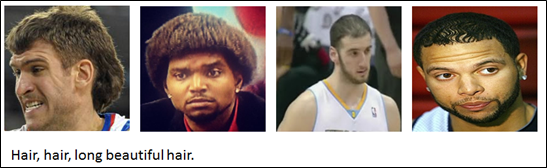
  • Hair. The second Free Darko book had an appropriately random section dedicated to the league’s eternal fascination with follicle fashions. And while they focused primarily on the 70s, just watching a month into the 2012-13 season, I’m like: DAMN, the hair game is back! Just a few guys who are uniquely expressing themselves through hair styles:
  • Spencer Hawes: Steady rocking the mullet in Philly.
  • Andrew Bynum: Hasn’t even played a game for the Sixers, but he’s already becoming notorious with a series of hairstyles we’ve never seen grace an NBA player’s head.
  • Kosta Koufos: Male pattern baldness isn’t anything to joke about; rather it’s something to make money off. Jokes aside, Koufos is just 23-years-old and getting pretty thin on top. The common solution for this is to snag the clippers and just take it off, but not Kosta. Nope, he grows it out and combs it forward. We’re not fooled though.
  • Anthony Davis & James Harden: The Brow and the Beard … these are kind of losing their intrigue.
  • Deron Williams: He’s been rocking the same look his entire career and it hasn’t gotten any better. Maybe shave that shit?

  • Harrison Barnes: No, I’m not including Barnes next just because his name is phonetically made up of “hair.” I’m including him because in just a few short weeks, he’s already shown more athleticism and aggression than he did in two years at Chapel Hill. Instead of settling for jab steps and jumpers, he’s attacking the rim with and without the ball. Oh, and in 14 games as a pro, he already has more double digit rebound games (three) than he did in his final year as a Tar Heel (two).
  • The Battle for Los Angeles is Real: It’s kind of an incestuous rivalry since Lamar Odom and Matt Barnes have been on both sides, but these teams don’t like each other and follow the lead of their uber-intense competitors: Kobe and CP3. Everyone keeps singing the same refrain about the Lakers: It’ll take time to gel (especially given the coaching change and Steve Nash missing in action), but meanwhile the Clippers are reveling in depth and developing their own chemistry. Despite a recent three-game losing streak, the Clips have improved from last year thanks to the development of Eric Bledsoe and DeAndre Jordan, the addition of Barnes, Crawford and (maybe) Odom. And they’re still waiting on the returns of vets Chauncey Billups and Grant Hill who may not have much left in terms of athleticism, but can definitely help LAC win free throw contests or knockout tournaments. While I’m part of the Lakers chorus, I’m also seeing a Clips team that can match up with the Lakers superstars and go a lot deeper than LAL. As for the coaching advantage? The jury’s still out for D’Antoni and Del Negro. Can we just have Kobe and CP3 as player/coaches?
  • Plateaus: DeMarcus Cousins, Javale McGee, Evan Turner (maybe not as much here), Blake Griffin, Ty Lawson. With the exception of Javale, I don’t believe these other kids have reached their ceilings, but in terms of the eye-test, none of these guys appear to have improved from last year. The stats (per game, per 36, and advanced) show declines for Cousins, McGee, Lawson and Blake (Blake’s statistical declines look like a result of the Clippers diversifying their attack, but that’s an investigation for another post). Just because the sun comes up every morning doesn’t mean it’s always going to be a beautiful day.
**As a sidebar, can you imagine how frustrating it would be to regress? Let’s say you work for a Senator or you’re a manager or you’re a salesperson, a teacher, a statistician, a firefighter, a writer, anything and all of your colleagues are high on you because you have a proven record of performance and then one day you show up and you’re unable to do your job as well as you’re used to.   Maybe there’s some external life events getting in the way or perhaps you’re just struggling to focus, but you know that everyone’s watching and wondering what happened. If you exponentially multiply the intensity of that lens, then you’ll start to have an idea of the struggles faced by the players listed here.
  • Falling Down: Josh Smith, Andrea Bargnani, Lamar Odom, Washington Wizards. Every time I’ve watched the aforementioned, I’ve ended up shaking my head in disappointment. Mid-range jumpers are to Smith what heroin was to William S. Burroughs—irresistible, enchanting, holding so much possibility. Bargnani and Odom are exceeding optimal weight limits and it’s preventing them from fulfilling roles their teams need. And the Wizards … oh, the poor, poor Wizards are the league’s only winless team at 0-11. I’m a John Wall fan, but in cleaning house of the Arenas-era characters, the Wiz have built a strange, slow-to-form supporting cast around their franchise player. If these downward trends continue, I’m going to start new series titled Essays in Exploration: Identifying the Early Signs of Decay.
  • Princes of the Fall: Brandon Jennings, DeMar DeRozan, Chandler Parsons, Damian Lillard, Kemba Walker: In the three-plus years I’ve been watching Jennings in the NBA, his biggest asset has consistently been his speed. So far in 2012, it looks like he’s found ways to harness said speed on the defensive end where he leads the league with an Alvin Robertsonian 3.5 steals/game … and yet Milwaukee didn’t extend him before the October 31st deadline. DeRozan, by contrast, was extended by the Raptors. It was kind of strange since he’s appeared to be a mostly one-dimensional scoring slasher without a reliable jumper, but in the Sunday day games and random weeknight games I’ve seen him in, he’s more aggressive, more confident, more purposeful. Whether it’s the addition of Kyle Lowry or the struggles of Bargnani, DeRozan’s a better, more mature player this year. Maybe I’m still on a high from seeing Parsons light up the Knicks the other night, but the Rockets are rewarding his versatility and he’s playing over 37 minutes/night and thriving as their starting small forward. After seeing him at Florida, I knew the kid was a strong ball handler and playmaker, especially for his size, but I didn’t believe it’d transfer over to the pro level. (I’m fairly confident this isn’t unique to me, but American-born white college players are difficult to project as pros … or maybe the smaller number of these players just makes it seem like they’re more difficult to project.) Anyhow, Damian Lillard’s not white. He’s a black point guard from Weber State who apparently learned the fine arts of the pick and roll during his undergrad studies and arrived in Portland with nothing more than basketball gear, online devices and gym clothes. He lives at the Blazers practice facility and is as NBA-ready as any point guard since … well … I guess Kyrie Irving.

Of course there are other observations from November, but these were top of mind. I haven’t seen all 30 teams and I’ve seen some teams I wish I hadn’t. We’ve already been subjected to surprises, pleasantries and disappointments and if this first month is any indication, we’ll be happily swimming a pool of confusion wondering how we got there come Christmas.

Let’s Meet at the Crossroads of LeBron and Russell Jones

It started off on the island, aka Shaolin…it was November 9th, 1993, almost 19 years to the day that the Wu-Tang Clan dropped their legendary Enter the Wu-Tang (36 Chambers) album and hip-hop was forever changed. While the Clan was busy blowing the minds of hip-hop heads across the globe with their Kung-Fu-inspired lyrics and pro-black mathematics, LeBron Raymone James was kicking it in Akron, Ohio with his mama, Gloria who was all of 24-years-old and raising the boy on her own. Even though there were mystical elements to the Clan (their formation (like Voltron), their lyrics and bizarre obsession with the ways of the East), it’s doubtful they realized the semi-prophetic links between their lyrics, their most infamous member and this fatherless 8-year-old from Akron.

“And and, then we got, then we got the Ol’ Dirty Bastard ‘cause there ain’t no father to his style.” – Method Man

When Meth spoke those words, he articulated everything we ever needed to know about ODB, aka Russell Jones (Also worth noting it was eight years ago today that ODB died—if Wu-Tang’s involved, we can’t over-emphasize the impact of numerology. And while we’re playing around with numbers, the 13th of November is also a birthdate shared by Metta World Peace and myself; so it’s clearly we’re all interconnected and I couldn’t not write this.). In a culture where fathers are far-too-often absent, ODB’s bastardness, when referenced by Meth, was a description of his style. And as any of us who heard his often unhinged roars and raps or followed his numerous incarcerations and impregnatings can attest: The man was (Ason) unique. There never could’ve been a father, a model or path previous feet had stepped (or stumbled).

And in the NBA, where we’re all obsessed with paternal lineage, with father figures, styles and history, obsessed to the point of books, blogs, TV shows and stack ranks; a player’s stylistic bloodline matters. In a marketing sense, Michael Jordan was one of a kind, but in the stylistic sense, he was a descendent of the line of Elgin Baylor, Julius Erving, David Thompson and he’s the father of Kobe Bryant, Vince Carter and Dwyane Wade—the high-flying, slashing, scoring shooting guards. Lines may vary; Shaquille O’Neal, for example, stems from a line that began with George Mikan, who begat Wilt Chamberlain, who begat Shaq and has (somewhat) begat Dwight Howard—physical monstrosities that the game’s rulers (read: Competition Committee) have no idea how to handle.

Shirts are for conformists and we are not conforming.

What of LeBron James? In his game and style, his physique and narrative, we see potential fathers: Karl Malone meets Magic Johnson, Magic Johnson meets Michael Jordan, Scottie Pippen meets Karl Malone meets Magic Johnson meets Michael Jordan meets Julius Erving (what?) or my favorite, Charles Barkley meets Scottie Pippen. We badly want our basketball history to evolve the way humans did…Neanderthals to Cro-Magnons to the beings we are today—crawlers, hunched over walkers, upright bipeds, jumpers, runners, dunkers. Oscar Robertson to Magic Johnson to Penny Hardaway to LeBron James to Shaun Livingston—wait, scratch that last one. This continuity is what we crave.

But as he has done for longer than he gets credit for, LeBron James continues to defy classification. In both a technical (if we’re being crude) and ODB-esque sense, LeBron James is a bastard; there is no father to his style. He’s not out there flagrantly breaking Federal or state laws like Dirty. He’s just out there leading the league in PER for the 6th consecutive season, winning MVPs, earning subjective titles like “most versatile defender in the NBA,” being inevitably added to the “potential to be better than Jordan?” conversation and continuing to redefine his fatherless style. This kind of original (both the literal and metaphorical senses) has its faults as we’ve all witnessed with LeBron over the past few years where he’s made mistakes and mishandled complex steps. His “decision” was the equivalent of ODB’s segment on MTV—a serious lack in judgment, an avoidable mistake, a stain that hopefully fades with time (we’re a forgiving, but far from forgetting culture). It’s a lot easier to fuck up like this when you don’t have a dad waiting for you at home with a question like, “What the fuck are you doing? I raised you better than that.”

Missteps aside, LeBron’s undefinability was on full display again in Houston on Monday night when he put Miami on his back and scored 32 second half points, including going 5-7 from three and vaguely referring to his own performance in mythical terms: “It’s the zone you hear about…” But it wasn’t just the “zone,” it was zero turnovers in 40 minutes, ten rebounds, six assists and an effort that Miami desperately needed in order to get the win. And he wasn’t incentivized the way the most cynical of us like to believe: It wasn’t a primetime TNT game on Thursday, it wasn’t even NBA TV, it was on League Pass and locally for Miami and Houston Residents. It wasn’t against Kobe or the Celtics or in front of Dan Gilbert. It was the Houston Rockets on a Monday night in November.

If we learned one thing from Ol’ Dirty’s far-too-short life, it’s that we need to enjoy our athletes and entertainers while we have the chance. Watch LeBron. You’ll be a better basketball fan for it.

Legends, Myths and Man: James Harden

Not so long ago a little black boy showed up at a mountain temple somewhere in Europe or South America. At the gates of this immaculately hidden temple, a giant stood guard. He wore a long robe that had once been pristinely white, but over time became a slushy gray. On his feet, the brown giant wore a pair of Nike Force 180 Pumps, casually untied. The giant looked down at the little black boy with his zip-up hoodie and duffel bag whose brown eyes peered upward towards the giant’s gaze. Their eyes met and the little boy didn’t blink or swallow or reveal any indication of nervousness.

The giant’s mouth opened, it was big enough to swallow the boy whole, but instead of cannibalizing the kid, words rained down on the boy like an avalanche of sound: “What do you call yourself, boy?”

The boy puffed his chest out with pride: “James Edward Harden.”

“Why are you at my gate?”

The boy puffed his chest out even more and rocked onto the balls of his feet, stretching to his maximum possible height and he recited the words that had become a part of him: “I’m here to learn the great game at the feet of the world’s greatest teachers…the disciples and descendants of Wooden, Auerbach, Naismith, Russell, West, Irving. And with all humbleness in my being, I ask for your acceptance.”

The giant stared back and began questioning James Edward Harden with a rapid fire assault of questions: “Who invented the game? What’s a diamond press breaker? Who is Black Jesus? Describe John Wooden’s pyramid of success. How many squares make up Boston’s parquet floor? What’s your personal definition of leadership? How do you respond to adversity?” It was an intense interview for a man of knowledge, let alone a pre-teen like James. But Harden, being a well-studied prodigy rattled off staccato answers: “Naismith, Earl Monroe, 112…”

The big man revealed a faint smile stretched across his giant’s lips: “Yesss…” the boy looked up at him, “Yes…YES!” the giant shouted and began to exhale a great embracing laugh that shook his whole body and scared James Harden more than it reassured him. He felt the sonic vibrations in his bird chest, the ground rumbled, the birds cried, the trees shook and the temple opened up to him. The giant stepped aside and James Harden crossed the threshold.

James Harden may or may not have perfected his ball-handling by dribbling up and down these stairs while being pressed and trapped by multiple defenders.

Boys and men in sandals and high tops, jerseys and robes moved throughout the temple and its surrounding gardens, all moving quickly, but without hurrying. There was a palpable sense of purpose inside these gates and James wanted to be a part of it. He slowly became acclimated with his surroundings and the tears that silently streaked down his cheeks at nightfall during the first few weeks eventually dried up and pain was replaced with peace; dreams of gyms full of basketballs; bouncing, soaring, nets splashing and swishing, floating down lazy rivers in rafts made of basketballs, men with round Spalding faces, faces he would caress and men he could trust. He would wander the temple grounds, in his oversized robe, thin ankles and wrists poking out, revealing his youth. The clouds hung low, the air was cold, but his robe warmed his body, his immense black beard protected his boyish face. The first few months, he didn’t touch a single ball and only occasionally did he glimpse one. He didn’t step foot on a court or hear the sound of nets or rims snapping. He walked calmly, exploring himself and his surroundings while the black beard grew into his skinny, hairless chest. He took a special interest in rocks, pebbles, stones and would drag his long, thin fingertips across the cool surfaces feeling the texture: Earth-worn, wind-washed, rain-rinsed. James preferred the smooth stones instead of rough or abrasive ones, round edges to sharp jagged ones. Fingers on both hands would explore these, reaching into an ancient geology through touch and sense. In particular moments of focus, he let his eyes relax, let the eyelids droop and trace the history of existence through the curves and indentations of the rocks. At night, he clutched them closely like pets or parents and fell asleep patiently awaiting his turn.

By the time he was introduced to a basketball for the first time, his hands explored it delicately, feeling the worn dimples, the weathered leather and his favorite part of the ball: the smooth black rubber channels that any hand naturally seeks out, but which James had an elevated appreciation. His first teacher was a dark, thin man with great white teeth, a mustachioed man with thinning short hair who would spin and pirouette with the ball and obsessively pounded basketballs in a complex manner: through the legs, behind the back, inside out, right-to-left-to-right in motion with impeccably timed spins and herky jerky fakes. Young bearded James would mimic his teacher, pounding basketballs until his arms and hands were fatigued, sweat pooling in his nest-like beard, sweat dripping, hanging from the tip of his nose, exhales blowing sweat through the air while he ran or spun bouncing balls with both hands baseline to baseline. But this was just the first of many teachers.

The ball became an extension, a new, more versatile version of the stones. His innate sense of touch allowed him to freely use both hands with equal dexterity; a trait he assumed all humans had…like walking with both feet or breathing through both nostrils. Once he began working with the architects, older men of all colors, men with thick, out-of-style glasses, men with silver hair, men who drew diagrams and repeated myriad theories; he was quickly identified and drilled more intensely due to his ability to identify a defense and its weaknesses. His sense of attacking and passing and when the situation called for one instead of the other was uncanny and quietly, out of earshot of little James, the silver-haired and bald men who were too stoic to express themselves with excitement and pride would overflow in awe; each attempting to outdo the others in praising the young boy with the old man’s beard.

In the hands of these master builders; players, coaches, Woodenites and Auerbachers, Harden’s prodigious talents were sculpted and groomed (his game, not his beard which became something of a black hair-covered elephant in the room; a beard so massive it was tied up in rubber bands or a net and collected burrs, thorns and leaves like animal fur would). With a largely diverse collection of styles and his obvious athleticism, Harden quickly developed a hybrid style built on the foundations of American street ball, collegiate fundamentals, European improvisation and timing; a game not predicated on speed, but on timing, deception, acceleration and deceleration with broad strokes of the mysterious South American style so influenced by the beautiful game of football with its passing, cutting and interwoven pieces. His teachers were legends and scholars; wise in the language of basketball…a game in which he became fluent in all styles.

James Harden glided over every hurdle they put in front of him with ease and grace. And it was decided, with James’s reluctant, but eventual agreement, that in order for him to achieve his true potential, he would have to return to the land of his birth and reveal a new style, a new to way to play—and although he took great joy in basketball, James never considered a game, but rather an expression of art, of self, of unity. So it was he accepted his eventual departure. To say goodbye to his second family, his world of extremely tall and talented fathers, a family of brothers, older and younger, was difficult, but necessary. He shaved his beard, packed up his meager possessions—basketball shoes, shorts, sweatpants and sweatshirts and a few of his favorite rocks—and set out on a journey to California to a high school called Artesia…fitting since in ancient dialects it translates to “Many will enter these doors, but James will be chosen.”

There are no known photos or even artwork of James Harden’s time at the mysterious (mythical?) temple, but if you close your eyes at night, you can almost conjure up the image of the young James Harden resting with his lean back and narrow shoulders against the trunk of a giant tree, his eyes soft with meditation, a smooth stoned cradled caringly in young hands with dirty fingernails.

*(The rest of the James Harden story is well-known and has been thoroughly documented by many sources. A simple web-search for “James Harden bio” will reveal multiple results—most of which contain mostly factual information.)

**The history above is in no way meant to indicate that James Harden arrived at Artesia High School with all of his skills intact, as a fully-developed, NBA-ready guard, but rather that the foundation of his game was created in the aforementioned idyllic setting. Additionally, the nuance and details of his style reflects numerous coaches and former players. The degree to which his style is more reflective of one player than another is a point that continues to be debated even by the men who raised him.

Conquistadors in California, alternately: Channeling Emotion into Effectiveness: A Contrast of Blake Griffin and DeMarcus Cousins

Two of the league’s youngest, shiniest, brightest and most volatile stars are residing in the same Sunshine State and we all get the luxury of watching these mountains of agility, power and skill square off four times this season. I’m not talking about Dwight Howard (not that bright), Pau Gasol (not that young), Andrew Bogut (not that volatile) or DeAndre Jordan (just not enough). Blake Griffin and DeMarcus Cousins are captivating for what they’ve done in two short years and maybe even more for what they haven’t done; which is reach their stratospheric potentials.

Last night, Monday night, these two giants competed; not against each other, but for my attention. Big Cuz did his thing in Sacramento and went bananas during a third quarter stretch where he seemed to galvanize himself, his team and fans. His emotion rises in pitches and can be tracked by events: A blocked shot on the defensive end leads to Cousins making a face, a scowl that takes place while the 22-year-old barrels down the court, sprinting to get to the offensive end where his excitement almost results in turnovers, but instead it’s a hustle play, a jumper that extends the Kings’ lead and it’s followed by more sprinting and obvious satisfaction. There are sequences like this throughout the game: Cousins makes a layup, gets a steal on the other end and never missing a play, he gets a dunk going back the other way. He’s uplifted, raised to the rafters by a combination of his own energy (barely harnessed) and the sounds of the crowd urging him on, lifting him higher.

Down I-5 in Los Angeles, I focused of my attention on the Cavs-Clips game, Chris Paul vs. Kyrie Irving; which somehow turned into the Dion Waiters show. Point guard and ball handling clinics aside, I kept an eye on Blake Griffin; one of the league’s most recent poster boys. His face is more recognizable than Arian Foster’s, maybe better known than Mitt Romney among the 25-and-under set. And tonight he’s just OK. He catches lobs from CP3 that have a similar impact on the crowd as Cousins’ antics. The big difference is where Cousins wears his heart on his sleeve, unable to contain even the faintest emotion; wearing the worst poker face in the NBA, Blake is cool, expectant, nonchalant. In a deadpan tone, “I ferociously dunked on that man’s face, put him on a poster, got seven million views on YouTube, so what? It’s what I do.” And the crowd reveres him for it—it’s LA, it’s Hollywood, it’s cold, emotionless, unfeeling, sunglasses at midnight—swaggalicious! But it’s not enough tonight, the 20 points, the dunks, the improved post game, the passes, the increased defensive activity; it’s not enough and he ends the game with the poorest plus/minus of any Clippers player. The stat’s not all-indicative or all-encompassing, but it does tell us that the Clips were outscored when Blake was on the court tonight. The above isn’t to say that Griffin is emotionless. Rather, his furies are selective; taken out on rims and refs. A man can’t dunk with the aggression of Griffin without having something built up, pent up, bottled up…waiting to explode.

Griffin’s an embraceable face, a marketable style, a chiseled athlete that Subway and Kia throw wads of cash at in attempts to lure him into promoting their products. He’s rugged and competitive; he’s the perfect athlete to place on a pedestal. But DeMarcus? Last season he demanded a trade and (in a roundabout way) got his coach fired. To casual fans, he’s known as much for his outbursts and tantrums as he is for his dominant play and potential. To the unknowing, he’s the enfant terrible. How much of is this fueled by anger compared to immature indiscretion is impossible to know, but it’s fair to assume both parts sources drive Cousins’ madness.

And of course these two young innocents have exchanged words and occasional elbows on the court. After a physical game last season, Cousins called Griffin an “actor” and said the NBA “babies” him. Griffin responded with some jokes and questioned Cousins’ reputation. It was a nice tit for tat that can link players together through the media while driving them apart as people and potential teammates (all-star games, Olympics).

Despite Griffin developing somewhat of a reputation as being one of the league’s golden children (especially from a marketing and advertising perspective), he’s simultaneously becoming known for his flopping and posturing. He’s prone to the extended stare after a big play, the glare after a hard foul; he can be seen as a tough guy who doesn’t back it up. If you’re a Clippers or Griffin fan, you see him getting under the skin of his opponents, helping his team win while maintaining his cool. His cool is part of his being, part of his on-court persona and skill set. Given his effort and physicality, it’s hard to make a case that his cool results in any on-court detachment. This is where the primary break with DeMarcus occurs. Where Griffin’s immaturity and petulance are merely annoying for fans and opponents, Demarcus’s antics and eruptions are distracting for him and his teammates. He’s battling the refs, battling opponents, battling coaches and worst of all, fighting himself.

At risk of delving into a wormhole of sociological speculation, I’ll only briefly touch on the drastic life differences these two young men endured growing up. Griffin was raised in a two-parent home in Oklahoma; one where he was homeschooled until eighth grade and played for his father in high school. Alternately, Cousins grew up in a single-family household, attended multiple high schools in Alabama and steadfastly refused to take any responsibility for his behavior. A fully fleshed-out essay could easily be built around the differences in their childhoods and the challenges they face today as a result, but other than this brief review, I’d rather stick to the men we’re dealing with today, not yesterday.

Literally speaking of yesterday, I watched Griffin and questioned whether or not he’d actually developed over his first couple seasons. While Cousins’ statistical arrow is pointed straight up, Griffin’s stats have been slightly, but steadily, dipping down. Looking at it from a purely statistical standpoint or even watching the games, you can see Griffin’s impact isn’t what it was when he was a rookie. Meanwhile, Cousins has become the heart, soul, tears and pulse of this Kings team. Instead of looking at this as Griffin already reaching his ceiling, it’s not as simple as that. Both players are filling a void on their respective teams. In Los Angeles, Chris Paul has revised the climate from the Blake Show to a CP3-led, guard-initiated attack. It begins and ends with Paul; an on-the-court general; one of the league’s most intense competitors who’s willing do whatever (ask Julius Hodge) it takes to win. The team (Blake included) has followed his lead. Griffin’s learned to play off of his PG, drifting towards the basket on CP’s defense-collapsing drives, hitting the offensive boards on CP misses or kick out misses, he takes advantage of slower fours by hitting what’s become an improved mid-range jumper. In Sacramento, as Tyreke Evans has either plateaued or regressed, Cousins has taken on the role of catalyst. When Paul Westphal was fired last season, it was evident there was a Westphal-Cousins conflict and new coach Keith Smart was wise to tap into the mercurial big man’s psyche and give him the confidence and latitude to succeed—which he clearly did last year: 4th overall in rebounds/game, only center to finish in the top-20 in steals/game, 3rd in TRB%, led all centers in usage rate. Cousins arrived with heavy footsteps and swinging limbs, announcing his arrival to anyone in earshot or sight.

None of this is to say one player is better than the other, but rather each player’s giving his team exactly what they need. CP3 might be the Clips’ version of Jean-Luc Picard, but Blake is the swag, the electricity, the vitality. And Cousins fulfills both of those roles in Sacramento…because that’s what he has to be for them to have any chance of success. These kids leave everything on the court every time they play. They play, they care, they’re upsettable, excitable, irritable, irrationally talented. And for all their differences (vertical vs. horizontal, NoCal vs. SoCal, one-parent vs. two-parent, stability vs. volatility), they have just as much in common, although both would probably puke if they had to admit it.

Tale of the Tape