Dancing With Noah

Just messing around, getting triple doubles

Tag Archives: basketball

Post All-Star All-Stars (and non-stars)

Since the All-Star snubbing of Damian Lillard, one of the more compelling roadshows of the league has been the Damian Lillard does-Kill Bill on the rest of the NBA. He’s averaging nearly 33 points, hitting nearly four threes/game with a TS% of 64% and a pair of +50-point-games to boot. In my worst Clyde Frazier parlance, he’s feasting and beasting on the rest of the league. And most important for the post-season coffers, the Blazers have gone 6-4 in that post All-Star stretch and played themselves into the 7th spot of a crowded Western Conference playoff race.

But alas, the world doesn’t revolve around Lillard. Other players, through transaction, renewed role, or just revitalized visualization, have accepted the challenge of the last leg of the season with vim and vigor.

The sample sizes are small, just 5-10 games, but the trends are intentional in some cases (Alex Len, Devin Booker, Jabari Parker). Less clear in others (Luol Deng, Draymond Green, James Harden).

Thank you to the creators of Excitebike for the time I spent playing your game as a child.

Thank you to the creators of Excitebike for the time I spent playing your game as a child.

I’m happy you dumped me, my new friends are great: The Hawks and the Jazz are often connected for some strange reason. Pistol Pete Maravich enjoyed success with both franchises, Dominique Wilkins was drafted by Utah then traded to Atlanta, Demarre Carroll and Paul Millsap both left Salt Lake City for the ATL, and now we can add Shelvin Mack to the great culture shock pipeline. In what Kevin Arnovitz described as the Hawks “doing (Mack) a solid,” the team sent the Butler point guard on his way on the trade deadline day. The Jazz might be 2-6 since acquiring their new guard, but Mack’s had a positive plus/minus in five of those games and has appeared in more minutes in every game with the Jazz than he did in any game with Atlanta. More John Stockton or more Raul Neto? Let’s move on.

Speaking of players reaping personal benefits of changing scenery, everyone’s favorite New Yorker nicknamed “Born Ready,” (Lance Stephenson for the uninitiated) has been enjoying a renaissance in Memphis where he was dealt (along with a 2019 first rounder) in exchange for Jeff Green. Stephenson’s appearing in seven more minutes/game with a 9% increase in usage rate (15% to 24%) while also seeing an improvement in TS% (from 57% to 59%). The Grizz are 5-3 since Lance joined and he’s no doubt tickled pink to be out of Doc Rivers’ doghouse once and for all. (Note: Memphis went into Cleveland as I wrote this and despite being painfully shorthanded, beat the Cavs as Stephenson scored 17 in 27 minutes though he did have the Grizz’s worst plus/minus.)

Just gimme a chance, I’m the right one for you: The Suns have descended into a crustiness where players are injured, the coach was fired, Earl Watson (he of very little coaching experience) has been given the keys to the car which he may or may not be able to drive and nothing seems to be going right (except they’ve won back-to-back games). But then there’s some glimpse of the future wrapped in the body of 7’1”, 22-year-old Ukrainian Alex Len. Now in his third year, Len has had these mini-spikes throughout his time in the league where he’s strung together double doubles and swatted shots with impunity. So what to make of his latest run? Post-ASB he’s averaging 11 more minute minutes/game, scoring 12 more points (19ppg), and has recorded as many double doubles (five) in eight games as he has all season. On the flipside his net-rating is -11.3 and his plus/minus is -6.1. His counting stats are up, but his rate stats are down or flat. Things are ultra-shitty in Phoenix right now though, so maybe the jury’s still deliberating on Len.

Speaking of youngsters, a few of last year’s rookies have been given green lights galore: Jabari Parker, Zach LaVine, and Aaron Gordon have had their collective training wheels removed and are being thrown into the wide world of Excitebike. Dunk contests hold some level of basketball cultural meaning, but at the same time, dunk contests don’t score points and defend the pick and roll. Maybe they build confidence though and for a trio of kids that are legally too young to drink, confidence is as critical as legs. Like Len, these youngsters have experienced sporadic successes, poor coaching, and injuries in their 1.75 seasons in the league, but this post-ASB has hints and hopes of something sustainable:

Pre-post ASB variance

Pre-post ASB variance

They’re all getting more playing time, scoring more and shooting better. None is more notable than the rest, but Parker’s becoming the scorer we thought/hoped he could be with running mate Giannis Antetokounmpo picking up triple doubles in a most Draymond Green manner. LaVine’s accuracy and shooting are seeing spikes as crackpot coach Sam Mitchell does the unthinkable and plays the evolutionary Gerald Green at off guard instead of point. LaVine’s usage is down 5%, but he’s shooting so much better – for once the armchair coaches were right! And All-Star weekend’s big winner in Aaron Gordon is seeing more minutes which is coinciding with a swing in NetRtg (per NBA.com) from -1.7 pre-ASB to +4.7 post-ASB alongside a -1.2 to +2.7 improvement in plus/minus. He’s able to defend multiple positons as well as take the defensive board and push the break himself. Oh the places you will go, Mr. Gordon.

Y’all must have forgot! (the Roy Jones Jr. version): Even though trainers and sports scientists need injuries and destructible human bodies in order to stay employed, injuries are no good. But the occasional silver lining that accompanies an injury is the return from said injury. Chandler Parsons muddled through an injury-riddled season in 2014-15 and struggled to find the form that earned him a three-year, $46-million deal in the summer of 2014. An off-season knee surgery (something described as “hybrid microfracture”) slowed his 2015-16 season with minute restrictions, but with an ASB to recharge (perhaps mentally as well as physically), Parsons has come out guns blazing. He’s taking and making more attempts with fat upticks in 3p% and TS%, but most impressive has been a jump in plus/minus from -1.3 pre-ASB to +17.2 post.

And sometimes it’s not just a player rediscovering his own motor or touch, it’s an injury-generated opening that creates circumstances where a formerly-injured pro seizes the opportunity. That’s what it feels like in Miami where Chris Bosh is unfortunately undergoing complications related to the same blood clots that knocked him out of last season, but meanwhile super-pro Luol Deng is stepping into a much-needed role. His post-ASB numbers show a beefy 5.3% increase in rebound percentage (nearly doubling his rpg from 4.7 to 9.3) and he’s getting to the line for three more attempts/game while scoring 17/game compared to under 11 previously. The Bosh-hole is huge and gaping, but Deng, along with Hassan Whiteside, Amare Stoudemire, and Josh McRoberts are finding ways to fill it as best they can. Miami’s 8-2 post-ASB.

Speaking of unfortunate blood clots, Mirza Teletovic has had better fortune with clots that ended his 2014-15 season than Bosh. And like Len, he’s a beneficiary of the Phoenix flop. It’s not enough to just have an opportunity, but those who shine on like crazy diamonds are the ones who grab the opportunity and Teletovic’s done that. Since the ASB, he’s making over three threes/game while pulling down nearly 6rpg. For context, there’s not a player in the league who’s averaging that combination.

I never dreamed my game would leave in spring: As much as it’s fun to celebrate success, it’s only fair to recognize the struggle because it’s real. Let’s start with Draymo Green who’s seen his post-ASB shooting touch flushed straight down some East Bay sewer. Post-ASB he’s 5-26 from three (19%). Anything scoring related is down – FG%, FT%, PPG, eFG%, TS%. Golden State keeps winning games, but as Draymo has struggled, so too has the team. For a player that appears to be powerfully driven by his own confidence, whatever it is that’s impeding his return to pre-ASB shooting would ideally be rediscovered prior to May.

Stats via basketball-reference.com.

Stats via basketball-reference.com.

Speaking of performances tied into coaching changes, all we heard in Cleveland was how Tyronn Lue was going to get the Cavs running and take full advantage of Kevin Love’s elite skill set. That hasn’t necessarily been the case though as Love’s post-ASB splits have taken some odd turns. He’s getting less three-point attempts/game (not necessarily a bad thing), but his accuracy has dipped from 37% to 23.5%. His rebound percentage is down over 5% resulting in a pedestrian 7.5rpg. The Cavs have lost four of 10 games and each loss results in internal reflection and LeBron admonishments. All is not well in The ‘Land.

It’s a small sample size, but every trend starts somewhere. Now if we can just follow Lillard’s lead, I suppose we’ll all end up in a decent place. Even you, Ty Lue.

Lords of February Town – volume 4

Except for October, February’s the leanest, lightest month in the NBA season. There’s the All-Star break, a short month, and the trade deadline throwing wrenches into players and their pursuits of historical nobility, but what applies to today’s players applied to the players of yesteryear and so the locomotive pushes forth down the tracks headed to the inevitability of an 82-game stopping point. Niceties aside, let’s get into the cold inflexibility of the numbers:

03-01-16 - Pyramids of Success

  1. Andre Drummond: 902 rebounds in 60 games: For a while it felt like maybe Drummond’s pace was slowing but that was back in the day, back in January when he averaged just 12.6rpg in 15 games. February was a new month and like the first buds sprouting on the branches of spring, Drummond’s arose with his consumption of 24.3% of all rebounds with a 15.2 average for the month. The last player to rebound like this was Kevin Love in 2010-11 and before that Dennis Rodman did it thrice and Kevin Willis once. Sadly, Drummond is the worst free throw shooter of the bunch.
  2. Hassan Whiteside: 195 blocks in 50 games: He’s not starting anymore, but he’s blocking more shots. February was Whiteside’s best shot blocking month since November as he swatted 37 shots in nine games while turning in a DRtg of 89 and his best plus/minus of the season at +3.1. Honestly, he was a beast across the board with season highs in TS%, ppg, and rpg all while playing his least minutes/game. Whiteside’s blocking the most shots since Marcus Camby back in 2007-08, but it doesn’t mean the enigma of his emotional volatility is any clearer. Someone’s rightly going to pay that man his money, but is this the guy you want as the defensive anchor for your team? I’m unconvinced, but I’ll listen.
  3. James Harden: 268 turnovers in 60 games: By some measures like points, rebounds, and assists, Harden’s having the most prolific season of his career. By other measures like turnovers, he’s having the worst. But one thing we can say for Harden is that he’s been steady Eddie when it comes to turning the ball over. He took a cool 4.42 TOV/game average into February, turned the ball over 47 times in 10 games and cranked that average up to 4.5 – the type of ball control messiness not seen since Allen Iverson in 2004-05. Before that it was Charles Barkley and Isiah Thomas in 1986-87. The Rockets went 4-6 over that stretch and Dwight Howard was not traded.
  4. Stephen Curry: 288 3s made in 58 games: I’m all Steph’d out. 288 threes in 58 games (he’s only played 56, but I’m handicapping his number by including his team’s total games) is 90 threes more than the next closest player – Ray Allen from 2005-06 when Seattle used to have a pro basketball team called the Sonics.
  5. Draymond Green: 551 rebounds and 421 assists in 58 games: Averaging nearly 10 rebounds and 7.5 assists, Draymo has no company on this list. (As a reminder, all stats are pulled from basketball-reference’s game finder tool which has games dating back to 1983-84). But if we want to explore his statistical peers, then we’re looking at guys who’ve averaged 13ppg, 9.5rpg, and 7apg. It’s a small list that includes Magic Johnson, Oscar Robertson (four times) and Wilt Chamberlain (twice). Draymo’s shooting went in the tank in February (18% from three), but that didn’t stop him from shaping the hell out of the outcomes with averages of ~10-10-8 for the month.
  6. Kristaps Porzingis: 67 3s and 116 blocks in 61 games: He’s no Karl-Anthony Towns, but big fucking deal. Not everyone can be the heir to Tim Duncan. Instead Porzingis is just a 7’3” kid making over a three/game while blocking nearly two shots/night. For a 20-year-old kid unaccustomed to the grind of an 82-game season with travel and living in a new country, the Zinger’s been impressively consistent. Last month he had four peers within this stat set, but this time around it’s just three; the most recent Serge Ibaka last season.

03-01-16 - Hoop

  1. Paul George: 161 3s made and 423 rebounds in 60 games: Maybe more impressive than George being the third player since 83-84 to average 7+ rebounds while making over 2.5 3s/game through 60 games is that he hasn’t missed a single game in his first full year returning from injury. All season long it’s been George and Antoine Walker holding down the fort for this club, but a steady month-over-month decline in 3PM/game has opened the door to the inclusion of Ryan Anderson (2011-12) of stretch four trade rumor fame.
  2. Kawhi Leonard: 51% FG, 48.8% 3pt, 88.2% FT in 59 games: With the Spurs getting their asses kicked a couple times in the past month or so, some of the clamor around Leonard quieted a bit, but in the meanwhile (aka, February), he had a 65% TS on the strength of 50% from three and 54% from the field. Through 59 games (the number of games his team has played – Kawhi’s played just 54), the only other player that has shot as well (51-48-88) is Fred Hoiberg back in 2004-05 when he went for the remarkable 52-53-88 through 59 games.
  3. Karl-Anthony Towns: 615 rebounds and 106 blocks in 60 games: The best rookie in nearly 20 years, Towns is proving Duncan-esque in his consistency and that’s appropriate since Tim Duncan’s the last rookie to rebound and blocks shots as well as Towns. But if we want to get super exclusive, we could just expand the criteria to include Towns’s 20 made threes and we’ll filter out Duncan, Shaq, Hakeem, etc. That feels unfair though since the game is entering a period of evolution so let’s add free throw accuracy to the mix instead. If we set the FT% at 80% (Towns shoots 82%), Karl-Anthony will be singing “one is the loneliest number” all by his damn self. Karl-Anthony Towns: Only rookie since 83-84 (and possibly ever) to average 10rpg, nearly 2bpg while shooting over 80% from the line. You sweet bastard, you.
  4. Kobe Bryant: 288 FGs on 822 FGAs (35%) in 49 games: Every month this one stings just a bit as Kobe’s the only player (since 83-84) who has needed 822 shots to make just 288. He had his best TS month of the season at a paltry 48%, driven by a season-best 32% from three, but even his best this year is well below average. (Note: At this moment on March 1st, Kobe has made as many FGs as Steph has 3s.) Old Kobe is grossly inefficient, but he’s still a human so let’s just move on.
  5. Ricky Rubio: 149 FGs on 411 FGAs (36%) in 54 games: Rubio’s game couldn’t be much more different from Kobe’s which makes the fact that the 2016 versions of each both shoot like shit a weird kind of coincidence, but it’s still true. If you want to find silver linings in Rubio’s shooting, you need to look at his free throws (shooting career-best 83%) because everything else is bad or sporadic. While we’re grasping for straws, it’s worth mentioning that in 11 February games, Rubio had his best FG%, FT%, and TS% of the season while averaging a season-high points for a month with a 124 ORtg – also a season high. Maybe some of that can be traced to the addition of Zach LaVine to the starting lineup or maybe it’s just part of Rollercoaster Rubio’s peaks and valleys. The last guy to shoot this bad through 54 games was Eddie House in 2003-04.
  6. Tony Parker: 285 FGs on 553 FGs (51.5%) in 54 games: The only other guard to make 285 or more shots on 553 or less attempts is John Stockton; a player probably as steady as any in history though Tim Duncan and Karl Malone may have bones to pick with that idea. Whatever, Parker’s shooting his eyeballs out this season. He’s extra-selective in his shot selection as evidenced by his taking less than a three/game, but making 47% of them including 57% in February on 14 attempts. I still don’t see him being a significant contributor in a Spurs/Warriors series, but there’s a reason I’m here writing this and not giving snarky answers to sideline reporters in between quarters of NBA games.
  7. Russell Westbrook: 1458 points and 619 assists in 60 games: Since 83-84, the only other player to go for at least 24-10 was little Michael Adams, but this is all about Russ (sorry, Michael). In addition to the rare 24-10, Russ is leading the league in steals and averaging nearly 8rpg. He’s second in the league in triple doubles (has 9 to Draymo’s 10) and has somehow found a way to be the Russ the pundits always wanted him to be while doing it his own way – and no, I’m not referencing his pre-game fashion eccentricities though that is an implicit part of the package. But two thoughts on Russ: I’ve always considered him a modern version of Barkley in his violently raw athleticism that allows him to impact every part of the game at a high level. And now I’m wondering if, like Barkley with MJ, Russ is doomed to the shadow of Steph. It’s too early for this kind of talk though, the future is a doorway to tomorrow in the shape of a question mark. After you, my friend. I insist.
  8. James Harden: 614 FTA and 417 assists in 60 games: Speaking of the great unknown, it shouldn’t be a surprise to see Harden pop up twice. Harden’s one of our most skilled players and because of that he’s in select company with LeBron James and Iverson as the only three players since 83-84 to average at least 7apg while shooting 10 FTA/game. These are true attackers of the basket, a rare breed of player that batters defenses with body shots instead of the one-punch KOs of Curry/Pacquiao. Also worth noting, 2015-16 Harden and 2004-05 Iverson both averaged over 4.5 TOV/gm along with their 7apg and 10 FTA/gm.
  9. Draymo, Russ and Triple Doubles: This is a new addition to the list. Draymo and Russ have combined for 19 triple doubles this season and with a quarter of the season remaining, NBA players have already registered the most triple doubles (47) since 1996-97 when players combined for 50; led by Grant Hill’s 13. For context, the most in a season since 83-84 was 88-89 when players put up 78. Magic had 17, MJ 15, and Fat Lever 9.

03-01-16 - triple doubles

When do we normalize? (Alternately, Steph from the Abyss)

Like millions of basketball fans on Saturday night, I sat on my couch watching Oklahoma City’s lead squirt out of their hands like a slippery fish refusing to comply with a hungry human stomach or sportsman. And on the other end of that wriggling was Stephen Curry just waiting to create an iconic moment in the form of a 38-foot game-winning three that, to my understanding, everyone expected to go in. The supreme in athletics is when everyone knows what will happen and is powerless to stop it and this is what Steph created on Saturday.

In the process, he set the NBA single season record for threes made – even though he’s appeared in just 56 games of an 82-game season. But big deal, because it became clear sometime in late November that he had about as much regard for his own three-point record as I do for olives. He’s pacing to make more threes this season that Magic Johnson did his entire career and in the past week has hit nearly as many threes at the Chicago Bulls entire team. His wake is littered with discarded adjectives and comparisons, but it’s mathematically evident that there is no precedent for his season, which is the natural segue to asking what’s next?

02-29-16 - Guru Steph

Back in December I explored how Curry was experiencing such an explosion and concluded that a mix of increased volume and accuracy were the primary drivers and this continues to be the case as Curry’s FGAs and 3PAs/game are both at career highs while his FG%, 3p% and 2p% are all significantly above his career-bests. (It’s not that simple in the sense that ball movement, Draymond Green acting as primary playmaker, collectively elite passing, lineup versatility, etc are contributing.)

That’s how we got here and while those factors will continue feeding into what Steph does next, I started thinking this morning that his recent road trip could be indicative of what’s next to come.

For reference, over the seven-game trip he averaged 36-points while shooting 56% from the field and making 48 of 85 threes for a 56.5% clip and seemed to have reached some perpetual zone over the final three games of the trip when he shot 28 of 43 from three (65%) and averaged 46ppg. That’s a 9 of 14 average from three and somehow, in the same way that everyone expected him to sink that 38-footer to kill off OKC on Saturday night, in some way it doesn’t feel unsustainable. This isn’t at all to say that it will happen, but to explore whether it, or something like it, could happen.

When I wrote back in December, I operated under an assumption that the Warriors had achieved some sort of perfect balance between minutes and usage for Curry. I thought that 11 or 12 3-point attempts in 35 or less minutes was ideal. What this road trip has revealed is that maybe there’s room to bump up the three-point attempts so I started looking at two pieces of information:

  1. Curry performances in high-volume shooting games
  2. Shooting distance

Using basketball-reference’s handy dandy player game finder, I took a look at all games in regular season history where a player has taken at least 15 threes. It’s happened 129 times and includes everyone from Steph to Jeff Green to Gerald Green to Nick Van Exel. Not surprisingly, Steph appears on the list 16 times – seven more than J.R. Smith who’s second and ten more than George McCloud at third. In 11 of those 16 games, Steph shot over 50% and if we really want to find a reason to cock an eyebrow, he’s never shot over 16 threes in a game. For all the “that’s a bad shot for anyone other than Steph” comments out there, a sober man could counter that he should be taking more of any shot he can get.

Now let’s push the hypothesis a bit more. Of Steph’s 16 games with 15 or more attempts, 11 have occurred this season. This lines up nicely with the increase in volume, but what makes it more impressive is the accuracy. In these 11 games in 2015-16, he’s shooting 48% from deep on 300 attempts which is a full percentage point above his season average which is also his career-best. While it’s fair to assume a player who’s shooting well will shoot more, this 11-game sample shows that Steph still has room to increase volume without potentially sacrificing any of that accuracy. For historical comparison, only one other player who’s taken at least 15 threes in more than one game has a higher percentage and that’s his teammate Klay Thompson who’s shooting 56.4% on three career high-volume 3PA games. Steph’s is 53.2%.

But how do you get more attempts if defenses are playing you smarter? Oklahoma City switched on all screens that involved Steph and did a surprisingly decent job of it. Occasionally it left Steven Adams or Enes Kanter defending Curry, but more often than not, OKC was able to contain Curry from deep. There was a concerted effort to defend the arc and yet he still got off 16 threes and tied the record with 12 makes. (Quick aside, has a single game NBA record ever felt more vulnerable than the 12 threes made in a game record does now?) His quick release and ability to exploit the slightest defensive lapse created windows of daylight that few basketball players in the history of the game could exploit. And finally, just the threat of the deep three, the 28-foot and deeper bomb creates opportunities.

The expanded range is gaudy in the same way his fat 3PM/game is fat. It’s freakish and obvious in the way booming homeruns and knockouts are and has the appearance of being indicative of both an exploration and evolution of his game. An evolution in the sense that, year-over-year, he’s taking and making deeper threes. An exploration in the increased volume by distance. February and January accounted for 11 of his 22 +30-foot attempts. Is he getting bolder?

Less than 4% of Curry’s threes this season have been from 30-feet or deeper. That number is super small, but it’s also more attempts than five of his nearest peers in terms of deep shooting. Thompson, Damian Lillard, James Harden, Kobe Bryant, and J.J. Redick are a combined 3-20 from beyond 30-feet this season while Curry’s hit 11 of his 22 attempts. He’s shooting 50% to his peers’ 15%. It’s unfair and borderline useless to keep making these comparisons, but contextualizing something abnormal remains necessary.

But it wasn’t always this way for Curry. Last year he was 3-16 (19%) beyond 30-feet and that was the best season of his career; prior to that he was an underwhelming 5-53 for his career. That type of inaccuracy is enough to make a coach or your teammates ask you in what the devil’s going on in your thick skull, but nope. In 2016, he’s still bombing with low frequency, but frequently enough to be relatively prolific. It’s one thing to rain area code jumpers in warmups when children are crying like the Beatles are about to perform, but it’s something altogether different when an above average NBA defender is guarding you, thousands of fans are shrieking cacophonously in your ears and the damn game is on the line. Hitting that shot? What is that? In game for Steph, it’s a 50% shot.

So what’s next? Is he pushing the envelope, taking opportunities the defense gives? In a world of vulgar, offensive certainty, not knowing what’s next creates a magnetic sense of anticipation. We knew that game-winner was going in, but really who hits a game-winner like that? The crystallization of our hopes and fears lands us somewhere between numb and elated at the improbable inevitability of it all. I was going for Oklahoma City and Russ and Durant and even Enes Kanter. The last thing I wanted to see was a season-defining from a player in the midst of a historic run and yet here I am sucked into the vortex, levelheaded and whole with all my bearings making sense of that which makes no sense and wondering, with mixed emotions, what in the Land of Chamberlain comes next.

Pacing against the record books – volume 3

We’re in the thick of things now. Iowa caucuses are dominating the Twitter and cable periphery. Hell, the caucuses and nauseating Presidential politics are dominating everything, but still the NBA game goes on like the little men and women at the center of the Earth pushing the giant gears that keep this frightening globe spinning. And as long as the NBA goes on, we’ll have stats and contexts and histories to thumb through – which is exactly what we prefer to do here. So damn the elections, let’s check in with the NBA, 2016 style:

[NOTE: All stat comparisons use www.basketball-reference.com’s Player Index Finder which cross-references data going back to the 1983-84 season. Anything that occurred pre-83-84 is not included.}

02-02-16 - Pacing pictures

  1. Andre Drummond: 720 rebounds in 48 games. When we last checked in with Drummond, he was averaging over 16rpg. Through January and 48 games, the Middleman in Motor City has dropped to 15rpg, but he’s still semi-prolific. We haven’t seen a player board like this since Kevin Love in 2010-11 and Drummond is just the fourth player in this +30-year data set. His new friends include Love, Dennis Rodman (seven times!), and Kevin Willis.
  2. Hassan Whiteside: 158 blocks in 41 games. After averaging over 4 blocks/game for the first 31 games of the season, Whiteside’s subsequent 10 games have dropped to just a shade over 3/game. It’s nothing to sneeze at and I’m unfamiliar with analysis including sneezes so let’s get away from that. Whiteside’s been dinged up with injuries and appears to get a bit sensitive on Instagram when he’s criticizedwhich is often. Dramas aside, no one’s blocked shots as frequently as Whiteside since Marcus Camby back in 2007-08.
  3. James Harden: 221 turnovers in 50 games. The Rockets have been a hot mess this year and some chunk of the responsibility for their suffering falls on the bearded shoulders of Harden. His stats have been gaudy as he’s averaging ~28ppg, 6rpg, and 7apg, but the most consistent element to his play has been turnovers. So many turnovers. If I told you his TOs/game had decreased since early January, maybe you’d nod in approval. But if I told you his average dropped from 4.47/game to 4.42, maybe you’d shake your head in disgust. The last player to mishandle this much through this many games was that ode to anti-efficiency measures, Allen Iverson back in 1996-97. At least that AI was a rookie with mistakes to make and lessons to learn. Harden is … not a rookie. He shouldn’t be making this many mistakes.
  4. Steph Curry: 221 3s made in 46 games. This stat is a video game. Side note, back when I was in college I had NBA 2k-something on Dreamcast. I added classic players (Wilt, Jordan, Russell, Dominique, etc) to all the rosters, then did a draft. I was in college and had a ton of time on my hands, don’t ask. I’d play games with every team and was a bit of a stickler for having at least somewhat realistic stats. My roommates would sometimes play my season when I wasn’t there – I didn’t care much because I was playing games with every But one day I come back and am looking at the records and see my roommate went nuclear with Jerry West and scored 122 points in a single game. The next most threes any player has made through 46 games is also Steph with 154 two seasons ago. His 221 threes so far this season would’ve led the league as recently as 2010-11. Steph is the Jerry West of my Dreamcast 2k. He is Barry Bonds. He is Tom Brady. He is Tiger Woods.
  5. Draymond Green: 445 rebounds and 343 assists in 47 games. These numbers translate into 9.5rpg and 7.3apg which are both improvements on his thru-December averages from last post. Using basketball-references’s game finder to adjust for number of games played, no player since 83-84 has reached these numbers. But if we open the filter to look at entire seasons, Green gets company in the forms of Larry Bird (89-90), Magic Johnson (81-82), Wilt (twice), and Oscar (four times). We know Draymo’s elevated himself to that next, but sweet mother of triple doubles that’s a historic wrecking crew.

02-02-16 - 3s company

  1. Kristaps Porzingis: 54 3s and 93 blocks in 49 games. It seemed in late December or early January like maybe the Zinger had hit the wall, but he bounced back a 7’3” piece of laffy taffy in January when he played his most minutes, scored his most points, and had his highest true shooting percentage month of any month in his young career. Quite possibly the most popular Latvian man in America, the Zinger’s 54 3s and 93 blocks in 49 games make him one of just five players since 83-84 to put up these stats. The most recent was Serge Ibaka who accomplished the feat as a six-year vet. Porzingis isn’t even 21 yet.
  2. Paul George: 131 3s and 335 rebounds in 47 games. George makes just the third player since 83-84 to average over 2.3 3s/game and over 7rpg and the first since current New Orleans Hornet and trade rumor hot topic Ryan Anderson pulled it off in 2011-12. The other is the king of the shimmy, Antoine Walker with Boston back in 01-02. This has the feel of a replicable line for George and could we see him become the honorary chairman of the 2.5/7 club sometime?
  3. Kawhi Leonard: 48% from three, 88% from FT, 50% from FG in 45 games. As long as we add a filter for minutes played, this is a list of elite players known primarily for their marksmanship. Kyle Korver accomplished it last year and before that it was Steve Nash in 07-08. Then there’s Chris Mullin and Kiki Vandeweghe along with Dana Barros and Jason Kapono. As I mentioned last month, Leonard’s game in no way resembles this company. That’s part of his mystique, his charm, his Spurish magnetism. And a gentle hat tip to David Thorpe for this, but Leonard’s percentages over two years in college were 45% from FG, 25% from three, and 74% from the line.
  4. Karl-Anthony Towns: 485 rebounds and 88 blocks in 49 games. Towns turned 20 two and a half months ago. The last rookie to put up a similar 10 rebounds and 2 blocks/game was a 21-year-old Spur named Tim Duncan. Towns isn’t Duncan, but comparing their rookie per/36 numbers looks uncomfortably similar and Towns is about 20 months younger than Duncan was during his rookie season. Towns is oh so good and I’m happy to admit I had no idea he’d be this good.
  5. Kobe Bryant: 637 field goal attempts and 222 field goals in 40 games. Since 83-84, Kobe’s the only person to make so few shots while attempting so many. It’s shitty and not always fun to watch, but at least we’ve all (Kobe included) settled into an acceptance of what this year is and will be.
  6. Ricky Rubio: 336 FGAs and 118 FGs in 43 games. Kind of like Kobe, there’s a sense of acceptance with Rubio. The guy can’t shoot. He’s in his fifth year and you have to scoot around his percentages to find signs of improvement: His TS is matching his career-high (49%), but his FG% (35%) is at a career-low. His FT% is a career-high (82%) while his eFG% (39%) is below his career average. The last player to shoot this poorly on as many shots was Sebastian Telfair back in 08-09. Rubio’s no Telfair, but they share an affinity for crappy shooting.
  7. Tony Parker: 430 FGAs and 225 FGs in 43 games. It’s kind of amazing that at 33 and in his 15th season, Parker is having one of the most efficient shooting seasons of his career, but that’s what’s happening. Seeing Kawhi on this list and knowing how well Duncan has aged, it’s easy to want to praise the Spurs system and they deserve it, but these players have to be working as hard as anyone in the game to do what they do when they do – IE, putting up ultra-efficient seasons well after their athletic primes have been reached. Dwight Howard and Marcin Gortat were able to shoot as efficiently in the same amount of games last season, but it’s not as impressive a feat for the big man to do it. The only other guards to make as many shots while attempting so few are John Stockton and Maurice Cheeks.
  8. Russell Westbrook: 1181 points and 485 assists in 49 games. Relatively speaking, Westbrook had a down January. His points, minutes, steals and shooting stats were all down from previous months, but he compensated by bumping emphasizing his rebounding and assists. At this point, we all know Westbrook is a heatsinking missile with bad intentions and with the addition of a new Euro-step, he’s even more Westbrookian. It’s popping in the stats too as he’s joined by little Michael Adams as the only players since 83-84 averaging roughly 24 and 10 through 49 games. If Westbrook can make it to the end of the season with these benchmarks, he’ll join Adams, Tiny Archibald (72-73) and Oscar Robertson (five times) as the only players to do so.
  9. James Harden: 507 FTA and 348 assists in 50 games: Sure, Harden’s sloppy with the turnovers, but with all those possessions a lot of good things happen. He’s getting to the line more than 10 times/game while distributing just a hair under 7 assists/game. He’s the first player with these numbers this deep into the season since LeBron back in 07-08.

The All-Star game and trade deadline are coming soon so February’s a light month for the best basketball league in the world, but the games keep coming. It’s the stretch before the last stretch, a time when people can and do fall off as the playoff picture crystallizes, soft tissues strain and tear and NBA Cinderellas turn into pumpkins late at night – is that you Pumpkin Cousins? The onslaughts will continue so let’s rendezvous here in two fortnights with finger sandwiches and refreshments.

Remembering that time DeMarcus Cousins Scored 104 Points in Two Games

The media and Dwight Howard have always positioned the Houston big man as some kind of heir to Shaquille O’Neal in the same way it was en vogue for years to saddle two-guards with the dreaded “Next MJ” tag. It was wrong with Dwight in the same way it was wrong with Vince Carter and MJ. The closest thing we have to Shaq is in Sacramento in big barrel chested DeMarcus Cousins. And for the sake of perpetuity, we must not forget what Cousins did over a pair of games in late January 2016.

01-28-16

It was a Saturday night, January 23rd to be exact. The Kings were hosting the run and gun (?) Indiana Pacers of Paul George fame. Boogie, as the big man is known, had already been enjoying a pleasant new month of the new year, posting and toasting all comers to the tune of 31ppg. The Pacers were without defensive stalwart, starting center and possible Francophile Ian Mahinmi. Journeyman Jordan Hill, rotation player Lavoy Allen, and young upstart Myles Turner (fresh off a 31-point game against Golden State) manned the ramparts in his absence. And like any Jaws in any sea, Boogie smelled blood in that water.

Cousins is listed at 6’11”, 270lbs, but I swear to shit this man weighs more than 270lbs. His upper body defies NBA body types. It’s broad with massive shoulders, filled out in the way someone who chops down trees and carries stumps around all day would be with big, tattoo-covered arms. But where he deviates is in his trunk. Many NBA players have the classic v-shape with broad shoulders and narrow waists, but Cousins doesn’t thin out like Dwight. He’s thick all the way through and uses his body in the most Shaq-like of ways to create space and room to breathe to get up little jump hooks and lay-ins.

But life as a Boogie Cousins isn’t about playing the traditional back-to-the basket game. Against the Pacers, Cousins more frequently caught the ball on the wing, which is anti-Shaq/Dwight/tradition. In 2015-16, he has three-point range, which is like Paul Bunyan having the domestic sensibilities of Martha Stewart. Cousins catches on the wing, throws in a couple fakes and the defenders – be it Hill, Allen, or Turner – have to respect it. While taller players like Dirk Nowitzki and Kristaps Porzingis are rewriting concepts about what 7-footers can and can’t do, traditional centers shooting threes are still an evolving species. Defending those players is no easy task for semi-mobile 7-footers and so Cousins making over a three/game has opened up dribble driving attacks that maybe weren’t there earlier in his career. (Prior to this season, Cousins’ had taken 69 threes in his career. This year, in 37 games he’s taken 129 and made four times as many threes than in his entire career.) These defenders have to offer a cushion in defense, but Boogie’s handle is good enough to attack which he loves to do. Throughout the game against Indiana, Cousins repeatedly put the ball on the floor and penetrated. He was often off-balance, had his shots blocked from ending up in terrible position under the hoop, but he was still effective. He drew fouls and made at least six of his 17 field goals on these dribble drives.

Cousins has a sure-footedness you may expect in a giant amateur ballerina. He’s not the most graceful, but in addition to attacking defenders off the dribble, he’ll occasionally hit them with spin moves that leave defenders grasping at air where Cousins used to be. Against the Pacers, on three separate possessions, he found different ways to leverage the spin into buckets. In the second quarter, he caught it in the post, set up Lavoy Allen to overplay to the middle of the lane, took a couple dribbles and with his left shoulder pushed the defender deeper out of position, and once space had been established, pulled a quick spin for a dunk. This spin reminded me of Shaq in all the glory of his power and quickness.

Later the spin accompanied one of his many dribble drives and resulted in a lefty layup make. And finally, feeling Allen overplaying on a post-up, he spun baseline for an unmolested catch and score.

The final tally was a career-high 48 points on 29 shots, a single three, 13-20 from the line a team-best +18, and the Kings fifth straight win.

Two nights later on the Monday when most everyone in the NBA solar system was focusing their undivided attentions on the Spurs at Warriors main event, Sacramento decided to host the Charlotte Hornets. Like the Pacers, these Hornets were shorter than normal and short-handed. Perennial double double Al Jefferson was out with knee surgery and his backup Cody Zeller sat with a shoulder injury. Crying MJ’s Hornets went to battle with a front court that included native Pacific Northwesterners Spencer Hawes and Marvin Williams bolstered by Frank Kaminsky and Tyler Hansbrough off the bench. As Shaq so delightfully enjoys exclaiming: Barbeque Chicken!

And while Warriors-Spurs descended into the East Bay Evisceration, the undermanned Hornets and Kings of Cousins ratcheted up intensities with competitive basketballing. With a banged up crew, the Hornets decided to front Cousins if Williams or Hansbrough guarded him with Hawes or another defender helping on the backside. If Hawes was on Cousins, he’d play behind him. This strategy and the overwhelming physical advantage the Kings had allowed for a different exploitation than what Cousins showed against the Mahinmi-less Pacers. With a weakened frontline, the Hornets were like Goldilocks and Cousins was all three of the bears happy to maul his all-too-human opponents. No less than six times the Hornets ended up fronting Cousins and the Kings, particularly with Rondo recognizing the opportunity, took advantage. Even if Hawes was able to help over, Cousins was too big, too quick, too skilled scored easily.

This time it’s not even Hawes able to help out, but 6’4” Troy Daniels who’s maybe slightly more effective than I would be at pestering Cousins (course I’m 6’3″ 250 and run a 4.5 forty):

But later we see Hawes as the help man and even though he anticipates the post entry, he’s powerless and gets caught with his hand in the cookie jar, and-1 DeMarcus:

As the game unfolded, it had the feeling of some kind of lopsided battle royal playing out on the basketball court. Cousins and his teammates continued to pound the ball inside, almost growing with greed. A mix of jump hooks, dunks, layups and free throws were there for the picking. But all that post work is exhausting for a man carrying what Cousins has. The catches and fouls, scoring with 240lb-men draped over your shoulders can wear on the biggest ox. As the game shifted into overtime, it felt like a battle of attrition and I wondered who would collapse first: Big Cuz or the entire Hornets front line? Williams fouled after Cousins dunked on him on a lob, then it was Hawes and finally Hansbrough went to the bench with his sixth which left the relatively slight rookie Kaminsky to defend the most dominant post scorer in the league. A bully mentality is a great asset to any big man, but that wasn’t enough for Cousins against Frank the (tiny) Tank. He had the audacity to mix in a hesitation dribble on a drive the likes of which I can only assume Kaminsky never saw in the Big 10.

But mercy was on the side of Kaminsky and the Hornets. In the second OT when the world of basketball was firmly united in cheering Cousins towards his 60th point and the team’s sixth straight win, a referee named Zach Zarba bailed out Kaminsky by whistling Cousins for his sixth. In the league’s official review of all calls that occur in the final two minutes or OT, they deemed Zarba had made the correct call, but as any of us who watched the game can attest, it was not the correct call in the sense that Cousins was essentially penalized for being bigger and stronger than his opponent. And what a way to wrap up a night in which a man has appeared to be truly Shaqtastic – by being penalized in a way in which Shaq was oh so familiar.

Final tally was a new career-high 56 points on 30 shots, a single three, 13-16 from the line, a team-best +13, and a Kings loss.

The following night a bedraggled Kings team headed north to take on the Blazers in Portland. They were soundly thrashed, losing every quarter of the game. Our hero Boogie fell back to earth with a thud scoring 17 points while shooting 4-21 from the field. But who reserves space in their memory banks for the second games of back-to-backs? Who has time for such letdowns when we’re given 104 points over a two-game span? Cousins might not be Shaq, but in an evolving NBA where skilled back-to-the-basket big men appear to be a slowly dying breed, Cousins is without peer when it comes to dominant big man. While he may make head scratch-inducing decisions and have the occasional poor judgment on the court, enjoy him while we can and let’s not forget the time he scored 104 points in back-to-back games.

Final two-night tally: 104 points on 38-59 shooting (64%), 2-5 from three, 26-36 from the line (72%), 25 rebounds, 10 fouls, 12 turnovers, 84 minutes, 1-1 record

The Fireballs of Winter

Happy New Years, friends. Back in early December, I slogged through a handful of season-to-date performances to see who was performing at historical levels and now we’re here again to revisit those players, their performances and add a few more to the list:

  1. Andre Drummond 531 rebounds in 33 games. Back in December, his company included Dennis Rodman (twice) and Kevin Willis once. In January, it’s four Rodmans and still one Willis. Drummond’s still dominating the glass, but his November/December splits show a two rebound/game dip in production. That’s accompanied by an increase in plus/minus from +2.7 to +6.8 so all’s fair in Drummond and rebounding. For those keeping score, Drummond is 22.
  2. Hassan Whiteside 125 blocks in 31 games. When we last checked in with Whiteside he was averaging 4.7 blocks/game. That’s down to four/game which invites a lot more company than we saw at the end of November. The last player to block at least 125 shots in 31 games was Alonzo Mourning in 1999-00 when he averaged 4.5 bpg through 31 games. The most on record through 31? David Robinson back in 1991-92 averaged 5.2/game. Blah blah blah, this is the Mr. Robinson’s neighborhood.
  3. James Harden 152 turnovers in 34 games. Since 1985-86, just four players in the league have committed more turnovers than Harden has through 34 games. Not too surprisingly, Allen Iverson appears on the list twice along with Charles Barkley, Isiah Thomas, and, oddly, Gary Grant who marshalled moribund Clippers teams back in the early 90s. His monthly splits show a slight decrease in TOs in December, but this is a season that’s been pockmarked with team and individual struggles. I have no idea where Harden goes from here.
  4. Steph Curry 140 threes made thru 32 possible games and 916 points thru 30 games played. Just because I’m not a Curry fan doesn’t mean that he hasn’t put together one of the best openings to a season in recent memory. His 140 threes made thru 32 possible games (he’s sat two, but I handicapped the criteria just because he’s so far ahead of his historical peers) is 29 more made threes than the next closest player: Ray Allen with 111 in 2001-02. At the end of November he was averaging 31.5. That’s fallen a full point and where he was 22nd all-time on total points thru 19 games, he’s dropped to 30th all-time thru 30 games. Injuries, massive margins of victory, and what should be a desire to keep their most valuable player healthy into June make me think this number will continue to drop.
  5. Draymond Green 230 assists and 290 rebounds thru 32 games. When we looked at Draymo’s 130 assists and 150 rebounds thru November, he had a lot of company – LeBron, Bird, Pippen, Magic, Kidd, and Fat Lever. Nice company, ay? A month and 13 games later and Draymo has no company. In 32 games, no other player has ever picked up as many assists and rebounds – 7.2apg and 9rpg. He’s also averaging nearly 1.5 steals and blocks/game. Green’s versatility reminds me most of Jason Kidd and he’s taken the Swiss Army Knife metaphor to some kind of Texas Chainsaw Massacre levels where the knife has motorized blades that hack flesh without discrimination. He’s a nightmare.
  6. Kristaps Porzingis 30 threes made and 67 blocks in 33 games. The Zinger may have hit some sort of rookie wall, but his combination of range and rim protection (looking at you, Jeff Teague) have become even rarer over the past month. Sure, Serge Ibaka accomplished similar stats last season, but before that it was Eddie Griffin (RIP) in 2002-03, then Lamar Odom and Raef LaFrentz (twice) before that. Strange bedfellows indeed.
  7. Paul George 98 threes made and 240 rebounds in 32 games. George’s November vs. December splits reveal some Jekyll & Hyde-lite disparities, but with over three threes and seven rebounds/game, he’s still in lonely historical company with Antoine Walker circa 2001-02.
Stats courtesy of www.basketball-reference.com, a great website.

Stats courtesy of http://www.basketball-reference.com, a great website. NOTE: all non-points stats are 1985-86 to present.

The remaining players are new additions to the list:

  1. Kawhi Leonard shooting 48% from three, 88% from FT, 50% from field in 32 games. One of the more intriguing lists in that it’s made up of guys that were always known as shooters: Kiki Vandeweghe, Steve Nash, Mark Price, Drazen Petrovic, Kyle Korver. Then there’s Kawhi, whose reputation is probably best known as a defender with giant hands and cornrows, but who’s expanded his game into the realm of shooters. The all-enveloping nature of Kawhi’s game is reflected in the steals and block totals on this list where Leonard exceeds every other historical peer thru 32 games and features second in total rebounds to Detlef Schrempf. Kawhi is a diamond with cornrows.
  2. Karl-Anthony Towns 311 rebounds and 62 blocks in 33 games. Towns is the most polished rookie I can recall seeing in some time. His game and athleticism have a refinement that shouldn’t be prevalent in a 20-year-old kid. The last time we saw a rookie put up this many rebounds and blocks thru 33 games, the year was 1997-98 and the rookie was Tim Duncan. The other guys on the list? Zo, Shaq, Mutombo, the Admiral, and Patrick Ewing. For further reading, explore Shaq’s rookie season. In his first 33 games, he was averaging nearly 15 rebounds, over four blocks, and 23 points/game.
  3. Kobe Bryant 499 field goal attempts and 170 makes in 29 games. Kobe’s November-to-December splits show much-needed improvement in field goal shooting, but it doesn’t change the fact that since 1985-86, Kobe’s the only player to take at least 499 shots and hit so few. In 08-09, Baron Davis shot 36% on 501 attempts and 03-04, Quentin Richardson shot 40% on 499 FGAs. Those are both extremely bad and still preferable to Kobe’s 34% thru the end of December.
  4. Ricky Rubio 218 field goal attempts and 73 makes in 27 games. Speaking of horrific shooting, Ricky Rubio’s somehow shooting worse than Kobe from the field although he’s taken less than half as many shots so the impact is significantly reduced. Kobe comparisons aside, we haven’t seen someone shoot as poorly as Rubio on as many shots since Toney Douglas cursed us all back in 11-12 when he shot 32% thru 27 games. The most interesting inclusion this list of sub-standard shooters is everyone’s favorite Canadian back-to-back MVP winner, Steve Nash who spent the first 27 games of 98-99 languishing in shooter’s hell where he shot 36% from the field in his first year as a Dallas Maverick.
  5. Tony Parker 320 field goal attempts and 173 makes in 33 games. I thought Tony Parker was washed up, but like John Matrix in Commando, I thought wrong. Parker’s 173 makes on 320 or less attempts isn’t too rare. Drummond did similar last season and J.J. Hickson the year before, and Nikola Pekovic the season prior. What is interesting though is that Parker’s the only point guard on the list. You have to scroll back to 91-92 (Blue Edwards) and 90-91 (Kevin Gamble) to see perimeter players pop up on this list. How does this happen? Kawhi and LaMarcus Aldridge likely help.
  6. Russell Westbrook 800 points and 300 assists in 33 games. Thru 33 games, Russ put up 854 points and 310 assists. No player since 85-86 has put up those numbers. The only way we can find company for the Oklahoman hero is to open the filter to the nice, rounded 800/300 club and doing so pulls in the little leg-pumping jumper Michael Adams, who back in 90-91 averaged 25 points and nearly 12 assists/game to start the season.
  7. James Harden 358 free throw attempts and 232 assists in 34 games. It stands to reason that Harden appears on this list twice. Once in a positive context and another in a negative. With a game that is the anchor of an entire offense, Harden constantly has the ball in his hands. He takes and makes more free throws than anyone in the league and as part of that attacking barrage, he frequently turns the ball over. Whether charging into defenders, getting stripped or making errant passes, the same tree that yields all those free throw attempts and open looks for teammates contributes to the messiness of nearly five turnovers/game. The Beard giveth, and the Beard taketh, my Houstonian friends.

Meet me back in here February where we’ll compare notes on historical Valentine’s Day performances and see who’s falling off and who’s still going strong.

Steph Curry in 25-game Chunks (plus historical comparisons)

The Golden State Warriors didn’t make any significant roster changes between 2014-15 and 2015-16 and yet they’ve come into the season a better version of themselves, most notably embodied by Stephen Curry and Draymond Green. Draymond’s been amazing and deserves his own writing which can be found on other parts of the internet, but I keep going back to Steph and trying to understand how a 27-year-old can experience such a statistical explosion.

Contextually speaking, we’ve only seen one (maybe two, but I’ll get to that) scorers go from good to great the way Curry’s done this year. I took a look at every player in NBA history who has qualified for minutes played and averaged over 30 points for an entire season, then looked at their previous season to identify the greatest leaps season-over-season – essentially players going from good scorers to great scorers, or great to greater in some cases.

5 30ppg scorers in 1 place

5 30ppg scorers in 1 place

There are a handful of outliers that were thrown out and three players (Wilt Chamberlain, Walt Bellamy, Oscar Robertson) that averaged 30/game as rookies.

The outliers were players that experienced massive leaps between their rookie and second seasons as no baseline of performance had been set. Three of the four greatest season-over-season increases in points-per-game were from players in this outlier set:

  • Jerry West: 17.6ppg as a rookie to 30.8ppg in year two (+13.2)
  • BoB McAdoo: 18ppg as a rookie to 30.6ppg in year two (+12.6)
  • Rick Barry: 25.7ppg as a rookie to 35.6ppg in year two (+9.9)

Then there’s Michael Jordan’s second season which I threw out because he appeared in just 18 games and played 25 minutes/game. So instead of comparing Jordan’s year two average (22.7ppg) to his year three (37.1ppg), I used his first season as a baseline (28.2ppg) which gave him an increase of 8.9ppg. I tossed this out as well.

Once we clear out the noise, we’re left with a sample size of 57 occurrences of players averaging 30 or more – 43 of which saw a season-over-season increase, 14 had a decrease. The greatest non-rookie-to-second season leap ever was Wilt Chamberlain in 1961-62 when he set the league record with what is still a confounding 50.4ppg which was a 12-point increase over the previous year when he scored a paltry 38.4.

Next on the list is our subject, young Mr. Curry. At 32.3ppg (as of Saturday night), Curry’s a robust 8.5ppg more than he scored last year. That makes for a 26% season-over-season growth which is the highest percentage growth of the entire sample of 57 30-point seasons (with outliers removed). I don’t care or know who the best scorer is on this list, but through 25 games in 2015, Curry’s experiencing an unprecedented growth rate. If we want to get deeper on how silly his season’s become, he’s averaging the lowest minutes/game of any player to ever score 30ppg at 34.9. George Gervin is second at 35.7, then Michael Jordan in 1991 at 37mpg. And maybe it’s not fair to compare percentages from the three-point era to the pre-three-point era, but by any measure that includes weighting the three-point shot (TS% and eFG%), Curry has the all-time highest accuracy rates – 68.8% TS and 64% eFG – of any players to score 30 or more. Adrian Dantley circa 1983-84 is second in TS at 65.2% and Kareem Abdul-Jabbar is second in eFG at 57.7% — a full 6.3% behind Curry. But why stop there when Curry also has the highest 2-pt% of anyone on this list at 58.4%.

This feels awfully Bill Simmonsy to write, but re-read that last paragraph. Within the context of volume scorers in league history, no one’s ever done it anywhere remotely similar to Curry this season.

12-16 - 1108_FEA_Curry_opener(1)

Which leads to the question: Just what on god’s green earth is happening to Steph this season? I did some work on this in early November when Curry was averaging 37ppg and some of the trends from then still hold up now: Curry’s opportunities are up year-over-year in terms of FGA/game, 3PA/game, and FTA/game while his accuracy for each is at or above his career-bests – only his free throw percentage is below career-best and he’s still making 90% of them.

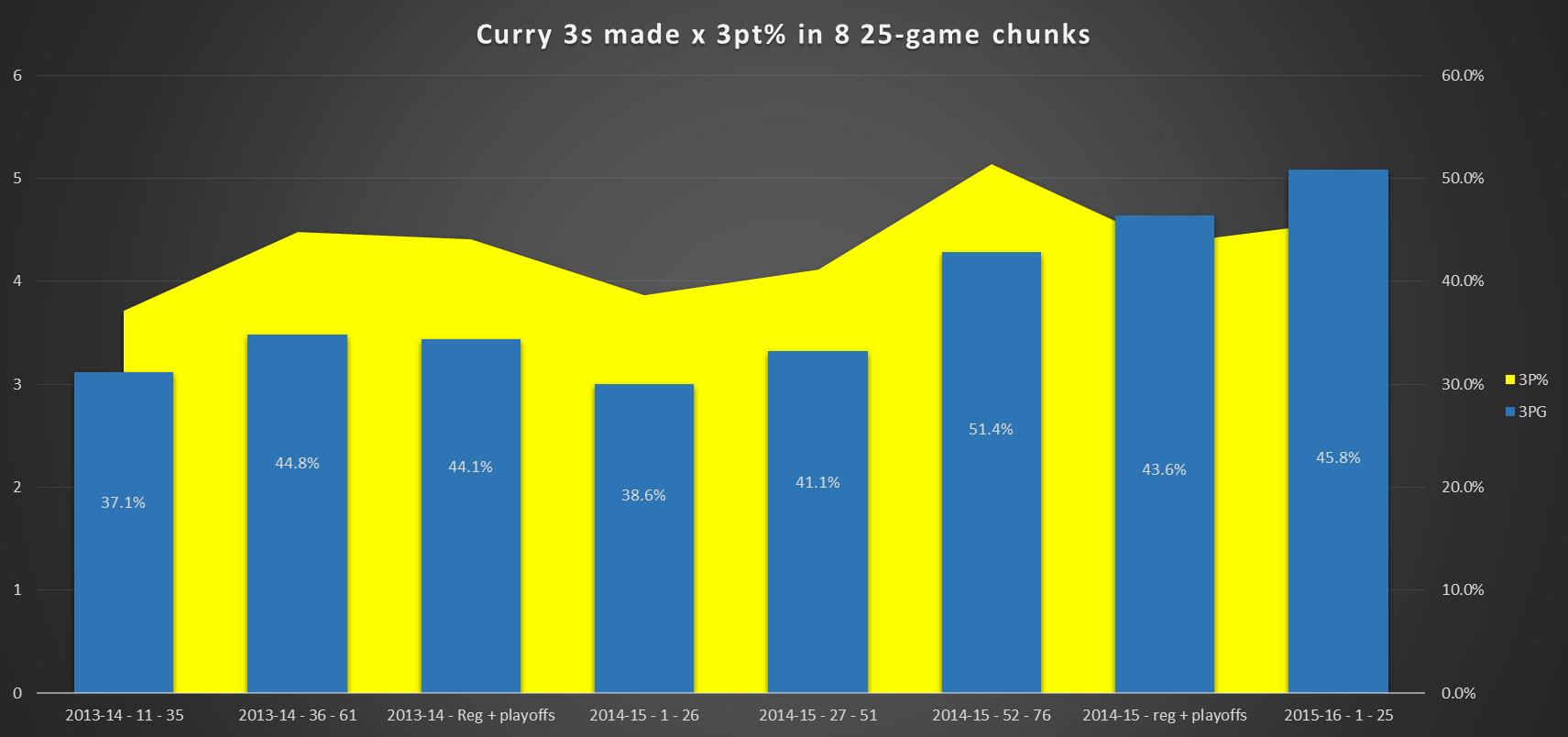
But I don’t feel satisfied just saying volume and efficiency have risen even if those things are true. There are notions and theories at play here that I feel compelled to explore. I went back to the start of 2013-14 (starting with game 11 of that season – the reasoning will become clearer) and broke out Steph’s ensuing 201 games into 25-game chunks that include regular season and playoffs. The patterns are intriguing in that we’re able to see sporadic trends during Mark Jackson’s final year with the team when Curry’s three chunks of 25 games saw his minutes fluctuate between an average of nearly 40 in games 11-35 down to just under 36 in games 36-61. When he was playing nearly 40mpg, his FG% and 3p% were the worst of this 8-set sample, as were his turnovers/game – nearly 5.

stats courtesy basketball-reference.com

stats courtesy basketball-reference.com

As Kerr came on in 2014-15, there’s an immediate shift in Curry’s minutes down to a much-more-manageable 32-34/night with a steady rise in his three-point accuracy and a slight dip in total points. During that first regular season under Kerr, he took less field goal attempts, averaged less assists, and turned the ball over than he did under Jackson the previous year. It’s necessary to call out that Kerr taking over as coach led to a lot more changes than Curry’s role in the Warriors offense, but for the sake of this post and your time, we’ll focus on how Curry responded.

Last year’s playoff run is where we get a preview of what’s to come for Curry. Where he shot around eight threes/game in the regular season, it spiked up to 10.6 in 21 playoff games and final four games of the regular season. His three-point percentage stayed right at his average of this 201-game sample size – 43.6% during playoffs/reg season vs. 43.5% overall.

12-16-15 - Steph 3s

It’s that rise in the three-ball volume that appears to have carried over to 2015-16. Beginning in the sixth chunk of 25 games – game 52 to 76 of 2014-15 – Curry experienced his most accurate stretch of three point shooting: 107 of 208 – a 51.4% clip which accounted for 54.1% of his total points. For context, his average percentage of points from the three over this entire sample was 39.4%. From that block of games forward, his volume of three-pointers attempted has only increased. Curry was a great shooter before this stretch, but let’s look at the previous 126 games (start of 2013-14 thru game 51 of last season) against the most recent 75 games (game 52 of 2014-15 to present):

  • 126 game stretch: 412 threes made on 1003 attempts, 3.3 threes/game, 41% accuracy, threes account for 41% total points
  • 75 game stretch: 350 threes made on 751 attempts, 4.6 threes/game, 46% accuracy, threes account for 50% total points
  • 25 game stretch in 2015-16: 127 threes made on 277 attempts, 5.1 threes/game, 46% accuracy, threes account for 47% total points

What we’re seeing now is like late-career Barry Bonds crushing all MLB walk records. In 2001, Bonds set the record with 177 walks, then bested it in 2002 by 21, and in 2004 put an exclamation point on his own theater of absurd by walking 232 times. This is Steph with threes – minus the weird head enlargement and freakish physical metamorphosis. Curry is taking a truly great skill (he already holds the top-two single season marks for threes made) and building upon it, but in a way that appears to be a collectively conscious extension of last season’s second half run. It’s not just that he’s taking and making more threes, but that his range is extending – or it was always there and his confidence and the team’s confidence in him taking deeper shots has grown (per stats.nba.com):

  • 2013-14: 5.1 3PAs/game from 25-29ft
  • 2014-15: 5.5 3PAs/game from 25-29ft
  • 2015-16: 7.2 3PAs/game from 25-29ft

He’s already hit as many threes from 30-34 feet (three) as he did all of last season (regular season and playoffs combined) and more than he did in 2013-14 (playoffs and reg. combined). The impact of extending his range out further isn’t lost on his two-point game (again, he’s shooting 58.4% on twos) or his teammates who experience a wider, more open floor. Harrison Barnes approves.

Whatever Golden State saw in last year’s playoffs has carried over into this new season. The volume, the freedom, the carte blanche to shoot from anywhere at any time is open. We’re seeing Curry’s Davidson days replicated at the highest level of basketball in the known universe (when NCAA opponents decided they’d rather lose than have Curry go off on them, they were essentially waving a white flag in the same way MLB pitchers did when they intentionally walked Bonds all those hundreds of times). But what’s most fascinating to me is how Golden State appears to have tapped into an optimal playing time balance for Curry and the rest of the team. As I mentioned earlier when comparing Steph to other 30-point scorers, we’ve never had another 30-point scorer play this few minutes. Last year Curry won the MVP with the fewest minutes ever for a winner at 32.7. This isn’t just happenstance, but occurs when your margin of victory is somewhere between 10-13 points/night and your lead at the end of the third is 20-30 so your starters can kick back and rest during the final period.

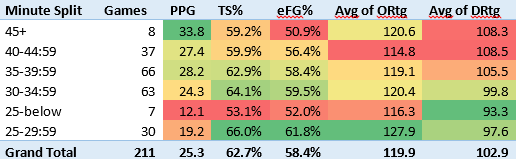
If we break out his efficiency and scoring output across five-minute splits, we can see a sweet spot in the 30-40 minute range. The sample below is from 2013-14 to present with playoffs included. It makes sense that in closer games where Curry struggles individually or the Warriors struggle collectively, Curry would play more minutes and see his efficiency dip and indeed his TS and eFG for games where he plays over 40 minutes are below averages in this sample set. What’s interesting though is that Curry’s output is greater in games where he plays 35-40 minutes than 40-45. For some players on that 30-ppg list, there’s a straight forward line between volume (minutes played and shot attempts) and points. For Curry, more doesn’t always equal more and Golden State appears to grasp that.

12-16-15 - steph splits

My suggestion that Golden State may have landed at an optimal spot in terms of Curry’s usage and minutes/game is the last area we’ll touch on. Last year they won 67 games in the regular season and went 16-5 in the post-season. This year, the playmaking responsibilities are increasingly falling in Draymond’s hands and the results are indisputable to-date. I’m curious about how far this envelope can be pushed though. We already see that Curry’s efficiency and even output in some cases takes a hit the more he plays, so pushing the envelope is finding ways to get more shots. It’s easy to look at what this team is doing and suggest that if ain’t broke, don’t break it, but they’ve made changes from last season with nothing but positive outcomes. Steph’s already stolen about two shots/game from Klay and two from somewhere else (David Lee?). Are there two more to go round? Is two more three-point attempts from Steph per game a better use of possessions than a shot each from Bogut and Draymond? Man, I don’t know and I’m not convinced it even matters, but while they’re here they may as well push it to the limit.

King Me at the end of November

It’s December now and the new season is nearly a quarter of the way done with the Golden State’s Warriors stealing the show then having their own show improbably stolen by power-mad Kobe Bryant enabled and emboldened by an out-of-touch cuckoo coach. Everything else except the Zinger is on the NBA periphery, except that it’s not. I take it all back except the part about Kobe; shit’s gone mad and he’s basking in the madness dropping fortune cookie knowledge in post-game pressers. Let’s peel back the layers of the headlines though and see what kind of historic non-headline-snatching are blessing this early season (all stats thru 11/30):

  1. Andre Drummond: 305 total rebounds and 105 offensive boards through his first 18 games. We haven’t seen this type of boarding destruction since Dennis Rodman back in 93-94. For context, Drummond has 70 more boards than his closest competitor, DeAndre Jordan and is snatching 25% of all rebounds and 36% of defensive rebounds.
  2. Hassan Whiteside: 75 blocks (4.7bpg) through 16 games. Sure, Whiteside’s prone to biting fakes and attempting to swat the ball into stands, but since 1985-86, just three other players have blocked more shots in their first 16 games: David Robinson, Dikembe Mutombo, and Mark Eaton.
  3. James Harden and Russell Westbrook: At least 85 turnovers thru 18 games. One is reckless, the other unfocused or complacent. Both are averaging at or near five turnovers/game becoming just the sixth and seventh players since 85-86 to do this. Most notable on the short list is a 23-year-old Charles Barkley. In 1986-87, the Round Mound of Barkley was averaging nearly six turnovers/game through his first 18. He was also averaging 24ppg, 14rpg, 6apg while shooting 63% from the field. This reads like a bigger, beefier, but more rampaging Westbrook.
  4. Steph Curry: 94 3s and 600 points thru 19 games. Every volume record associated with the three-point shot will be attached to Curry’s name sooner than later. Thru 19 undefeated games this season, he’s made 94 3s (nearly 5/game) which is 22 more than the next closest shooter in the same amount of games since 85-86: Antoine Walker with 72 in 2001-02. Steph’s also scored 600 points, becoming just the 22nd player to score 600 (31.5/game) this fast and the first since Allen Iverson in 2005-06. For historical context: MJ averaged 38.9 thru 19 in 86-87 and Wilt averaged 40 in 64-65.
  5. Draymond Green: 130 assists and 150 rebounds thru 19 games. I’ve watched a lot of Warriors basketball this season because I’m desperate to be there when they lose so I’m familiar with Draymond’s increasing role as a playmaking facilitator on this team, but I didn’t realize he was averaging over seven assists. The 130/150 has been done nine other times to open a season – nearly all of whom are Hall-of-Famers: LeBron (12-13 and 11-12), Jason Kidd (twice), Scottie Pippen, Larry Bird (twice), Fat Lever, and Magic Johnson.
  6. Kristaps Porzingis: 15 3s and 34 blocks in 18 games. Zinger’s the 11th player to record 15 and 34 since 85-86. Serge Ibaka did it last year and the previous list is a mix versatile post players and combo forwards: Wilson Chandler and Shawn Marion (twice), Rasheed Wallace and Raef LaFrentz (twice), Donyell Marshall and Lamar Odom and of course, Spencer Hawes. No one’s done it with the zest and fanfare of the Zinger though unless we’re considering underground GOP’s love affair with Hawes.
  7. Blake Griffin: 450 points, 150 rebounds, and 80 assists in 18 games. Blake’s game has developed into something borderline unstoppable and it’s showing in the stats he’s putting up thru 18 games. His PER is over four full points greater than his best season and he’s averaging a career-high in points. The 450-150-80 hasn’t been accomplished since Bron in 2012-13 and before that it was Kobe in 02-03 when he started the season with 28/8.5rpg/6.5apg. The Mailman, Barkley, and Bird (twice each for Larry and Charles) are the other admissions.
  8. Paul George: At least eight rebounds and three 3s/game thru 16 games. The increasing emphasis on the three-ball means we’ll continue to see the game evolve as bigger guys are encouraged to add distance to their arsenal. Per basketball-reference, prior to this season Paul George had appeared at power forward for about 2% of his total on-court time. In 2015-16, that number has swelled to 57%. That hasn’t stopped him from drifting outside and spreading the court where he’s hitting over three 3s/game on 45% shooting. Counting Curry and CJ Miles this season, three 3s/game has been reached 13 times since 85-86. Of those three point shooters, PG13 is the only one to ever average over eight rebounds/game, or seven, or six. His combination of rebounding and threes is something we’ve never come close to seeing.

a7043a68ce0b4c59c20298abb508021a

Nearly 20 games into the season, we’re finally free from the “small sample size” qualifier that comes attached to early season wonders. We’ll still see what’s likely to be regression to the mean like Dirk’s three-point percentage sliding from 53% to 46% over a five-game span. But the trends above are worth monitoring and at the end of each month I’ll check back in to see how these guys (and others) are progressing relative to history. Onward to the winter, you kings.

Robert Covington and the time Alvin Robertson recorded a bunch of steals

Do you remember that stretch of games from Alvin Robertson back in November of 1986? He was a third-year shooting guard for the Spurs out of the University of Arkansas already established as being a tough defender. Hell, he’d already been named to the All-Star team in his second season when he set the NBA record for steals-per-game with 3.7. 29 years ago, starting on November 15th, 1986, Robertson came out with seven steals against the Suns, then followed it up with five more games of six steals or more with a streak-high of ten steals against the Clippers on November 22nd.

In the ensuing 29 years, the longest streak of six steals or more that any player amassed was two games. It’s not easy to do. There’s a knack to steals that’s part anticipation, part gamble, part identifying the sucker at the table. I’ve seen Rajon Rondo and Chris Paul take risks that leave backline defenders painfully naked, caught between speeding point guards on the front and soon-to-be alley oop dunking giants on the back, but hey, it’s taking the risk for an easy bucket and being a thief doesn’t always equate with being a great defender, but getting six or more steals several games in a row means you’re doing at least something right.

So it came as a surprise when the Philadelphia 76ers and their 0-18 roster produced some kind of off-kilter heir to Alvin Robertson in this kid Robert Covington. Covington was born back in 1990, a good four years after Robertson was stalking NBA teams and taking the ball from them with unprejudiced kleptomania. And with all the Stocktons, Jordans, and Pauls that have hunted the ball over the years, it’s the 6’9” 24-year-old from Tennessee State that sniffing around at what hard ass Robertson reached all those years ago.

Put the basektballs away when the Alvins and Robert come over

Put the basektballs away when the Alvins and Robert come over

Unfortunately, the depth of NBA.com’s stats database doesn’t allow us to go back and scout out every one of those Robertson steals, but we can look at all of the Covington thefts over these past three games. Covington’s streak started less than a week ago on November, 25th with six steals against the Celtics. It was in a losing effort like all Philadelphia games this year, but his opportunistic instincts were on display. He was beaten by Jae Crowder on a screen, but used his long arms to poke the ball away from behind and force the TO. He capitalized on a full-court press, played help defense, stripped a defensive rebounder, and made himself a nuisance to the Celtics. Reviewing his six steals against Boston wasn’t overly impressive. He made decent plays, but I needed to see more.

Against Houston when Harden dropped 50 with nine TOs, Brett Brown got creative or desperate or something and slid Covington over to the five. In the end it didn’t make a difference, but again, the long SF/PF/C took full advantage of a Houston team (and Harden) that struggles nearly as bad as Philly does when it comes to taking care of the ball. He was directly responsible for at least four of Harden’s nine turnovers while also seizing upon young Clint Capela like the tiger on the savanna feasting on the naïve goat. Tiger Covington kicked some Rocket ass with 28 points and eight steals and broader defensive array than what I saw against Boston. Reading the passer’s eyes (in a couple cases Harden telegraphing passes) and identifying un-sure-handed opponents (Capela) allowed him to take advantage of their mistakes.

Finally, on the 29th of November, the streak continued in what was, based on the tape, his best effort yet. Instead of being the opportunistic poacher I saw against Boston and Houston, Covington swallowed defenders, poking and prodding at the ball with go-go gadget arms. He picked the pocket of sure-handed Mike Conley twice, stripped Jeff Green, and read passing lanes with eyes attached to a head that is on a constant swivel on defense. Six more steals against the Grizz, but he offset those with an ugly eight turnovers.

That’s six, eight, and six steals in consecutive games paired up with four, four, and eight turnovers for a steal-to-turnover rate of 1.3:1 (21 to 16) which is a suspect ratio for a wing.

Covington is no Alvin Robertson. Robertson averaged 2.7 steals/game for his career and we haven’t seen a guy average 2.7 steals/game for a season since CP3 in 2008-09. Covington, like the rest of these Sixers, is nigh impossible to get a true read on because the circumstances deviate so far from what we’re used to analyzing. I don’t have a clue how or what Covington becomes, but his current stretch in 2015-16 is, in its own compartmentalized way, impressive. In nine games he’s appeared in this season, he’s giving Philly 3.6 steals/night while pulling off a streak we haven’t seen in close to 30 years. On December 1st, the Sixers host the Lakers and all their on and off-court mega-circus act. I don’t have a clue what happens in this game, but it’s likely at least one of Philly’s current streaks will come to an end.