I was an angry basketball fan last night when OKC shat the bed once again in the fourth quarter. I was texting out blames to Russell, Kevin, Maynor and especially Scotty Brooks. It was inevitable and Dallas somehow knew it with all their experience and come-from-behind poise and it grated me; grated the skin right off into a nasty little pile on my coffee table.
On that note, I decided to say goodbye to the Thunder for the 2011 season:
Russell Westbrook: You were the most intriguing player in the playoffs this year and in terms of basketball culture, you’ve made the leap. We all knew who you were and anyone who watched OKC knew what you were about, but by the end of the whole thing, I just wanted to give you a hug and tell you it’ll all be alright:
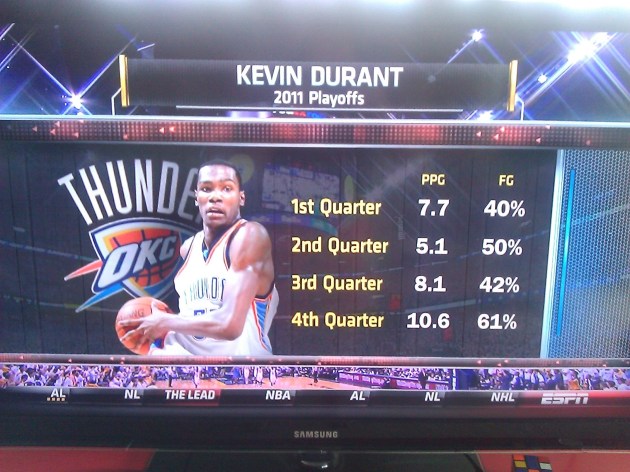
Kevin Durant: Was there a sadder scene than Durant at the game four post-game press conference? All gangly arms, legs; shoulders hunched forward and infinite sadness painted on his 22-year-old face with that damn backpack on asking, “What could I do?” We love you Kevin because it hurt so bad:
James Harden: Has Harden always been this good or is it a product of off-the-radar, covert development? Was OKC just playing possum for next year when they unleash this guy? Seeing him play point opposite Westbrook and Durant on the wings was watching living, breathing basketball genius—and then Scott Brooks snatched it away from us:
Nick Collison: I watched Collison play a few years in Seattle before the departure and was always impressed with his defense. He did the best job any single human could do against Zbo and Dirk and did it all by his damn Iowan self. This man is underappreciated.
Serge Ibaka: Don’t be scared, Serge. It’s all over now.
Kendrick Perkins: We all stood up and applauded the great Sam Presti after he made this trade; then the playoffs happened and we realized he was still hurt. Perkins was about as effective as a grocery cart with a brain would’ve been (as opposed to a grocery cart without a brain?) and was exposed by John Hollinger as being the biggest detriment to OKC’s success against Dallas. We know you weren’t healthy, but still, it was ugly.
Eric Maynor: You walked into my life as a warm, soft beacon on the horizon; something to cling to in a time of chaos and tumult. Then you betrayed me when you tried to slay Dirk on one play.
Scotty Brooks: Jeeeeee-sus. I used to be a Scott Brooks fan and maybe there’s still a place in my heart where he can redeem himself, but when OKC calls a timeout and I immediately text people “Bad Shot Alert!”, it’s a fucking problem. And any arguments about Brooks being just a second-year coach or coaching a simple game because his team is so young are ignoring the obvious: Brooks was out of his league. Maybe it’s time to hit up Phil Jackson for some of that peyote:
There are all kinds of change, but the most lasting and legitimate kind of change comes over time. It comes from things like experience, trial and error, practice, habit, development and often criticism. For all the excitement of this year’s playoffs, two changes stand out:
The first change has been gradual, subtle but frequently targeted for criticism. LeBron James is an easy target and always will be in the same way that MJ was ripped before he won titles and the way Kobe has been attacked before and after winning titles. Losing, the Decision, the Global Icon, the commercials, quitting accusations, rumors of uncoachability, ridiculous free agent demands and mountains of attacks and assaults in print and spoken word—it’s all been thrown at LeBron and no matter what happens in the next few weeks, it will continue to pour down on him. In the process of amassing hate from all corners of the basketball-watching and consuming public, LeBron went through the growing pains apparently required of NBA stars: incremental playoff progress followed by inevitable defeat by the league’s senior gatekeepers. In Cleveland, Bron lost to a veteran Pistons squad, Tim Duncan’s Spurs in a 4-0 Finals sweep, the KG-led Celtics (twice), and somehow to a hot-shooting Orlando Magic squad. After all those playoff losses and criticisms, he’s finally getting after it with the kind of intensity we’ve always associated with Kobe Bryant and Kevin Garnett. In the fourth quarter on Tuesday night, with the game on the line, he put the clamps on Derrick Rose. LeBron was the best player on both sides of the court and was rewarded for his efforts with a 3-1 series lead.
A few years ago LeBron commented, “I don’t think I have an instinct like Kobe, where I just want to kill everybody.” Homicide aside, we saw the comments and took note. Kobe busied himself with back-to-back titles and three straight finals appearances while LeBron continued to get bounced out of the Eastern Conference playoffs. It’d be beyond naiveté to ignore the southern migration and the Wade/Bosh upgrades. Bron is surrounded by the best #2 and 3 options in the league. With those two stars flanking him, he’s managed to improve his overall game. He’s been named to all-defensive teams in the past, but we haven’t seen anything like the lockdown job he put on Rose last night or the dive-for-the-ball intensity he showed in the late fourth. Maybe it’s the support of Wade and Bosh or maybe it’s the relief they provide, but this LeBron is different. He’s playing with an energy usually reserved for the lesser-talented players of the world and he somehow has an endless supply of it. His post-play and post-game celebrations are indicative of someone who’s giving a damn—whether his outburst are aimed at critics, opponents or history doesn’t matter much. Focus and commitment are questions of his northern past.
The other change born of these playoffs: the stoic evolution of Dirk Nowitzki—a few weeks shy of 33 years old. The Larry Bird comparisons are inaccurate, but Dirk’s likely been the MVP of these playoffs. He’s playing chess to the defenders’ checkers. He’s cancelling out the best defenders on every team and doing it with a style that’s foreign to the NBA game in more ways than just being a German import. He’s always been an efficient scorer and in his career the Mavs are 6-1 in playoff games where he scores over 40 points. Like LeBron, Dirk’s has his own basketball bouncing skeletons in the closet. It’s taken a long four years to cleanse himself of the stain laid on him by Stephen Jackson and the Warriors in the 2007 opening round playoff upset, but he’s returned to MVP form and then had the audacity to surpass it with something that appears to be a casual effort which isn’t to say he’s not trying, but that everything is somehow easier. Like James, any questions of Dirk’s toughness or heart have been silenced by his virtuosic performance in these playoffs.
With LeBron and Dirk, there’s been nothing disingenuous about their change. There’s no re-definition or worshiping false idols. They still carry the parts and pieces we’ve questioned over the years, but they’ve layered on so much more that we have to squint to see the old traces and even then, our eyesight’s still not strong enough.
I watched game three of the Eastern Conference Finals last night from the comforts and smoky hospitality of the Mandalay Bay Sports Book. Most games I watch are from the quiet and familiarity of my apartment and couch. Being surrounded by a hundred or so obnoxious gamblers watching a basketball game was refreshing. I’m usually chided for screaming at the TV, but here I was among the likeminded; united by a mix of basketball and money.
It was in that setting that I took in the gritty play of celebrities in South Beach. At a first thought, it’s not natural to associate defense and battling with the quartet of LeBron, Wade, Bosh and Derrick Rose. You see Bron and Wade specifically with their little cardigans and v-necks in the post-game press conferences, but fortunately fashion tastes don’t preclude on-court efforts. We knew it would be a defensive series so it’s no shock to see the 48-minute grind bleeding into every half court possession and leading to momentum-driving Miami fast breaks that cracked the Bulls backs just like they did Boston’s.
For a game and series that leans closer to the ethos of Joakim Noah, it was a surprise to see Chris Bosh spit in the collective faces of his critics. Noah was frustrated and out of rhythm. He committed fouls (questionable or not), stewed on the bench and failed to provide the right kind of energy that the Bulls expect and need from him. Bosh, by contrast, delivered on fades, jumpers, spins and dunks and while his Gasolian screams after fouls or dunks continue to feel artificial or at least misplaced (the screams are aimed more at the critics than his opponents), he was the Heat’s most productive and consistent player in game three. With Bosh as the go-to, any questions about the mythic tug of war between Bron and Wade are questions that didn’t exist on this Sunday.
Lost in Bosh’s Raptor throwback was the one of the better statistical games we’ve seen from Boozer in these playoffs. He went for 27 and 17, but failed to hit any field goals in a fourth quarter where the Bulls were outscored by eight.
The common theme this season between Bosh and Boozer has been their inabilities to fit in to which I can only imagine must be confusing. They’ve both been criticized for failing to replicate their previous successes which is unfair and rarely possible given the current circumstances. When they both arrived in full on Sunday night, it was Bosh who received the greater support while Boozer was left trying to carry Chicago in a role all-too-familiar to Rose.
For Bosh to make 34 points against the league’s best defense look so easy reconfirms the potential of this Miami team. His identity isn’t the same as it was in Toronto and it never will be again, but games like tonight are reminders of the versatility of his game and the value of a skilled seven footer—even if he is a little on the soft side. Boozer’s productivity opposite of Rose’s struggles last night reinforced a suspicion I have that Boozer and Rose suffer from compatibility issues. The injuries and lack of on-court time between the two (or three if you consider Noah’s injuries earlier this year) are well known, but until Rose and Boozer are able to co-exist as scorers, the Bulls will have trouble scoring enough points to win in this series.
The Heat, with its three elite scorers combined with Bron’s and Wade’s versatility, doesn’t share these same problems. Their problems consist of things like who stole Mike Miller’s basketball soul, how can they get his soul back and how can they keep Jamaal Magloire out of the arena.
It was somewhat painful to miss the OKC-Mavs game last night (game two), but my homey’s getting married, so I was on a flight. The flight had Wi-Fi, but apparently ESPN3.com doesn’t come on a plane too well and it ended up too choppy for my taste. So I missed the Durant smash on Haywood, Russell melting down, Dirk missing a free throw, Harden carrying the OKCs in the fourth and a bunch of other shit that didn’t make the Sportscenter recap I just saw four times in a row.
Remember back in December of 2009 when the Jazz made a salary dump and traded Matt Harpring’s contract and Maynor to OKC for someone named Peter Fehse? It was a good deal for OKC at the time and it I’m guessing it made sense for the Jazz too since Deron was monopolizing the point and was officially the face of the franchise for the foreseeable future. Jazz GM Kevin O’Connor on that trade:
“Trading Eric was a difficult decision. But, along with Matt’s contract, it greatly helps reduce our luxury tax responsibility. Fortunately, with Deron and a proven backup in Ronnie Price we feel that we have depth at that position.”
OKC GM Sam Presti had been high on Maynor in the 2009 draft and was willing to take on Harpring’s $6.5 million salary to get Maynor as a backup/insurance policy for Westbrook. After seeing the turn of events last night and seeing more than a few OKC games this year, I wonder if Maynor wasn’t more of a long-term insurance policy. For Presti, it was a low-risk reach for a prospect who’s being paid on the rookie scale for the next three seasons.
For the Salt Lake faithful, they have to be wondering what the fuck just happened. They went from legit Western Conference challengers to lottery team almost overnight. If you look at the 2009-10 team, it’s easy to place the blame for their fall on bad contracts. They had Wes Matthews and Maynor—both gone because Utah didn’t want to or couldn’t pay them (or pay Harpring in Maynor’s case). The Jazz were over the cap in the first place because they gave Andrei Kirilenko and Mehmet Okur huge contracts. It was either Boozer or Millsap and the Jazz went with Millsap. They couldn’t keep everyone because they bet the house on a few guys who struggle to start now—Okur and Kirilenko. The weaker-than-expected team they fielded this season led to Jerry Sloan’s abrupt resignation and the equally abrupt ending of the Deron Williams era in SLC. And now a team that had a couple of solid young point guards is being linked to drafting … yep … another young point guard in the 2011 draft.
Maybe they should reach out to OKC and see if Russell Westbrook’s available.
The title of this post is about the wonderful collective Lionel Hollins has created in Memphis. But it’s not just about Memphis because, more than ever, I’m unable to stay away from the cyclonic Russell Westbrook and, less intriguingly, the OKC Thunder.
Even in defeat, the Grizzlies put on a presentation to make basketball purists smile. Even though Zbo and Marc Gasol combined for nearly 50% of Memphis’s total 123 points, the team was selflessly expressive. For their stats, effort and abilities, the Memphis bigs get the their names in lights, but Shane Battier’s harassing defense, Mike Conley’s huge three to send the game into OT and Greivis Vasquez’s shot-put style deep three to put the game into a third OT proved anyone in a Grizz uniform (Haddadi?) can carry the flame of the moment. How a cast of NBA orphans that includes Zbo, Tony Allen, OJ Mayo, Sam Young, Mike Conley, etc. arrived at this style and accepted it is a feel-good story, NBA style.
Whether it was osmosis or never-ending note taking, recalling coaching strategies and tactics from memory or utilizing a network of NBA champion coaches, Memphis coach Lionel Hollins learned a few things from his time in the NBA: How to lead and coach. In one of the three overtimes, TNT cut away to the Grizzlies bench where Hollins was sitting quietly, nodding in approval while Shane Battier rattled off motivational encouragements worthy of Krzyzewski. In the world of basketball idealism, Coach K and Dr. Jack nodded along with Hollins—game recognize. That everyone else was buying in to Battier’s earnest words evidenced the cult of trust Hollins has created in a short time in Memphis.
Tracing Hollins’s basketball roots through the years, you can see the current Grizzlies predecessors in Dr. Jack Ramsay’s Blazer squads and it’s not a stretch to believe Hollins learned a few things from Chuck Daly in the few months he played for Daly in Detroit. Daly’s and Ramsay’s squads were inclusive, moving the ball and riding hot hands from night to night. Everyone contributed and was expected to. Coupling Hollins’s lineage with his up-front communication style (he was at the helm when Memphis let Iverson know he wouldn’t be treated different from any other player) and you have a coach who’s going to give everyone a chance (Haddadi, again) and not take any guff from his players.
The template for Marc G?
The cult of trust instills guys like Mike Conley and Greivis Vasquez with the confidence needed to bang home clutch threes when everyone’s expecting them to wilt in the bright, shining, face of the basketball-prince, Kevin Durant. It creates opportunities for Tony Allen to be reborn and OJ Mayo and Shane Battier to be welcomed back home not just with open arms, but with open roles on a winning basketball team.
Beyond all the good times in Memphis, down at the seedy end of the court, something strange and fun continues to happen: the all-to-public maturation of the relationship between Kevin Durant and Russell Westbrook. Whether it’s been mandated by Sam Presti up on high or if it’s just natural for Kevin Durant and Scott Brooks to do so, there’s an element of protectionism that surrounds Russell Westbrook. When Russell-related questions pop up in Durant’s interviews, he takes the high road and talks about his point guard warm, earthy tones. Keep saying the right things, Kevin, but we saw you getting exasperated the last two games. In the post-game presser, Scotty Brooks took the same sweet route when talking about Russell. Everything was peachy and kind and why not? The guy put up 40 including several on drives that could maybe be duplicated by Derrick Rose or Monta Ellis. And, most importantly for the Oklahomans, they left town with a series-equalizing victory.
Not everyone’s sucking lollipops and eating cotton candy though. How can they be when their point guard’s field goal attempts per game jump up almost 30% from the regular season to the post season? And how about his field goal percentage dropping from 44% to 40%? The same trends show up in his advanced stats. Russell’s Edge continues to be a twisted riddle. It seems appropriate and logical to compare him to Derrick Rose, but the bolder Russell becomes, the more I see him riding a fine, narrow, dangerous edge—Evel Knievel style. I don’t mean that just to add humor to his tales, but because the comparison is accurate and legitimate. Russell’s aware of the dangers of his freelancing (alienating Durant and/or putting OKC in a position to get knocked out of the playoffs), but it doesn’t slow down his improvisational drives or macho pull-up jumpers. The combination of ultra-confidence and the need to prove he can be Durant has crash and burn written all over it. Yet young Russell continues down that same path with fury and venom (anyone else notice that road rage element to his game?).
Lost in the ongoing Westbrook-Durant drama are the Oaklean efforts of Nick Collison, Kendrick Perkins and Nazr Mohammed. Every play in the paint and rebound up for grabs is being contested by desperate players on both sides. These small efforts on every play are making a good series great. I can’t not mention the bearded playmaking genius of James Harden. What secrets does his beard hold? I haven’t been this surprised about a player’s playmaking abilities since JR Smith diced up the Lakers in a losing series in 2009.
In the sense that styles make fights, basketball isn’t any different from boxing. OKC and Memphis are a perfect matchup and proved it on Monday night. The feel-good-Grizzlies with their labor party lineup (Comrade Gasol?) aren’t walking the path of righteousness any more than OKC with Westbrook trying to tip the superstar seesaw closer to his side. The contrasting styles and storylines, hungry fan bases and 63-minute instant classics are encompassing a wide range of this league’s great potential. Who knew we’d reach this potential somewhere between Oklahoma City and Memphis?
The beautiful truths below don’t change the fact that OKC is down 1-2. It’s easy to point the accusatory finger at Russell, but the blown lead in game three was a team effort.
It feels odd seeing two NBA juggernauts collapse in the span of a week, but that’s what’s happening. Last week it was the Spurs who were not unable to adapt. They did everything possible (swapped out values, souped up the system, cozied up with the three point line) to keep title hope floating, but the legs can’t always do what the mind demands of them. Now it’s the Lakers turn to take the painful escalator down, but what’s waiting for them at the lower levels is foggy and I assume it’s hot like a cool hell would be.
Expectations absolutely matter, but at the same time, predictions and prognostications don’t. We didn’t expect the Lakers to be down three games to none after Friday, yet here we sit. We could see the Spurs slide coming and we had time to digest it, play with the thoughts, accept it and move along to a Lakers vs. Celtics III or Lakers vs. Heat or something along those lines. This Lakers devastation (for them and their fans at least, devastation seems wholly appropriate) has been sudden even though it’s been in the making for over 1,300 games. This is a team that has been remarkably consistent over this most recent four-year span. They’ve lived in the Finals for the past three years and in three of the past four years, they’ve landed on the same 57-25 mark for the regular season. Statistically speaking, they’ve been a better team in 2010-11 than they were in 09-10.
Then Andrew Bynum was born. After his annual stint on the Lakers sideline with the standard issue Bynum-knee-injury, Andy resumed basketball activities with anger. He’s played better for longer in the past. We’re all familiar with the promise of this deer-legged 23-year-old who the younger Buss preferred to build the team around back in that tornado-ish start to the 2007 season when Kobe-to-Chicago was story du jour. While Bynum over Bryant was laughable in 2007, the hints of greatness are revealing themselves every time Bynum scowls, calls out his teammates or dunks without jumping. Whether Bynum’s tapping into some of that compulsive dark matter that fuels Kobe or just doing what many 23-year-olds do: Becoming Himself, we don’t know. Whatever the case, Bynum is developing which should be a great thing for the Lakers.
Here they sit in a 0-3 shithole, surrounded by their own foul odors in Dallas, Texas of all places. Who shot JR? Who the fuck stole the Lakers’ basketball brains is the more confounding mystery. A better, meaner, nastier Bynum, an improved bench, another year in the triangle for Artest—the Lakers aren’t favorites just because they still hold the crown. Beyond the stats, the players and the stories tell us the Lakers should beat the Mavs. This series hasn’t even been close though. The Mavs have been the better team every game and have deserved each of their three wins.
From Madrid to LA, everyone expected Pau Gasol to be his usual, steady, all-star-ish self. Over the past four seasons, he’s probably been the Lakers most consistent player and shown us that he’s capable of true, honest growth. For Pau, it was never a question of technical expertise. Perhaps it was too easy to slap a Euro label on him and call him soft. When Pau was bullied physically and mentally in the 2008 finals it reinforced the stereotype, but Gasol reinvented himself as a bearded Spaniard who screams, awkwardly initiates confrontation and is willing to do so while still maintaining the grace of technical mastery of game that has made him an all-star. Prior to this playoff matchup, the Lakers were 8-2 against the Mavs since Gasol joined the team in 2008. It’s never been about Pau vs. Dirk (who’s battled his own Euro stereotypes over the years) or Spain vs. Germany or anything even remotely along those lines. But in 2011, these graceful seven footers can be defined by their contrasting performances in this second round series. Dirk is acting as a conduit for greatness for this Mavs team. He’s the center of everything they’re doing whether he’s scoring the ball or attracting double teams that lead to hockey assists and it’s led to renewed appreciation of his game. Meanwhile, Gasol has been a case study in fatigue—likely mental and physical. Something indescribable and indefinable has finally caught up with Pau Gasol. Maybe it was stalking him all these years or maybe he contracted it like a sad disease striking when the Lakers required any and everything in his vast arsenal. You can’t read or listen to anything about the Lakers in this series without hearing “What’s wrong with Pau Gasol?” At the moment, that’s the unanswerable riddle.
By comparison, Kobe’s performance is easy to grasp. We’ve become accustomed to him living on the edge with acrobatic jump shots, triple pivots and old man shot fakes. He’s walked that line and teetered between success and failure, and mostly landed on the positive side. Only now it’s harder. It’s nothing but jump shots for 48 minutes, but that makes perfect sense. The guy has logged over 1,300 games and 48,000 minutes of basketball, consistently at the most meaningful levels of the sport—Christmas day games, games on national TV, playoff games, finals. Like his post peer Tim Duncan, it’s been inevitable. Kobe didn’t take two years off to refresh himself like MJ. Instead, he won titles and played 201 games (not counting USA basketball) over the previous two seasons. He’s still breathing fire and instilling fear in fans and hyperbolic commentators, but he’s not carrying the Lakers like he has. That the team is folding into the playoffs as Kobe’s game becomes less dynamic confirms the obvious (but still taken for granted) value of his on-the-court performances to this Lakers team. For all Kobe’s dramatic shots and game winners, the losses have been equally magnificent beginning with the Pistons demolition in 2004, the blown 3-1 lead against the Suns in 2006, the Celtics record-setting comeback in 2008 and finally the Mavs shock and awe campaign in 2011. When Kobe’s Lakers lose, it’s typically so definitive that it precludes a drastic change.
This isn’t a time for tears or eulogies though. If the end is near, there are a couple of obvious choices you can make: The first is to adapt. Adjust your lifestyle or habits to survive for as long as you possibly can. The other is to get settled into a recliner with a pack of cigarettes and a six-pack and stay committed to your values. For the Spurs, the decline was protracted enough that Pop could make survival-based adjustments. Phil hasn’t had that same luxury, but for all his Zen methods, you get the feeling he’s loyally married to his system. The old, rusty triangle worked long enough and well enough to leave Red Auerbach in the rear view of Phil’s gaudy accomplishments for all of eternity. And with Phil forcing the sun to set on his own watch, there won’t be any re-tooling or Pop-like adjustments. It’s sudden and confusing (mainly the Gasol piece of the puzzle), but Phil’s Lakers are finally on the precipice good-bye.
(Altnerate considerations: Kobe as player-coach, aside from Phil; what drastic changes will defeat bring?)
When I initially decided to say something about Russell Westbrook, it was mostly critical because I was mad and had been sending emails and text messages about Russell pulling up for contested jumpers in crunch time of close games. It happened most noticeably in game four against Denver when the OKC point put up thirty shots and missed 18. OKC ended up winning the series 4-1 so it wasn’t a nasty strike on Westbrook’s young résumé; just another example of his frustrating tendencies. And that’s why I sent all those angry texts and emails: Because three years into the league, playing opposite the league’s top scorer in Kevin Durant, Russell still felt the need to gun from the point spot.
I say “still” because I’ve been watching OKC closely since they left Seattle and what used to be a cute little hiccup in his first two seasons has developed into something stranger and more difficult to define. First and second year point guards aren’t supposed to be polished. They make mistakes like throwing errant passes, pushing the break too fast and charging over veteran defenders. They shoot poorly from the field and do the wrong things at the wrong time. Basketball heads nod and agree that they’ll get it at some point. If they don’t get it, they’ll eventually be replaced by someone who does. Now in his third year as a player who’s already won a gold medal at the 2010 World Basketball Championships, already named to the all-star team, is already considered elite at his position; we expect him to improve this singular part of his game.
Frustration leads to speculation, so I wondered what was motivating Russell to chuck up contested threes in close games when Kevin Durant was standing 15 feet away. Is he pulling a G-Money move to Durant’s Nino Brown? We all know how that turned out. Trying to prove to someone, anyone, that he could do the Durant? Is he trying to force his way out of the long shadow cast by Durant’s arms, legs and point-per-game average? Maybe it has nothing to do with Durant. Is he inept? Does he genuinely think it makes sense to pull up from 23 feet with Ty Lawson’s hand in his face when OKC is down 5 in Denver with under a minute left? Is he true a point guard?
Or is my frustration misplaced?
On any given day, Russell Westbrook is the third best point guard on the planet and on his bad days he’s still probably not much worse than fifth best. In terms of convention, he doesn’t fit the description. He doesn’t pass like his head is a giant eyeball seeing everything. He doesn’t lead like a general or a quarterback. He’s far from a calming presence on the floor (he’s led the league in total turnovers in two of his three seasons). He’s closer to a live wire whipping from baseline to baseline, bricking jumpers and collecting his own rebounds before defenders can even consider the boxout process. He’s never missed a game in three years which isn’t surprising even though he attacks offensive rebounds with bad intentions . By any statistical measure, he’s improved each year he’s been in the league.
Yet my text messages and emails are still met with mostly agreement. We agree: Russell Westbrook takes some dumbass shots at seriously inopportune times. We are a consensus, but through all my Russell Westbrook considerations, I can’t help but feel he might be onto something. The point guard he most resembles is Derrick Rose. Both PGs defy the position’s tradition by actively looking for their shots, but the difference is Rose doesn’t have Kevin Durant riding shotgun. He doesn’t have anything that even resembles Durant and as a result, every day in the United Center is Derrick Rose Day.
Which brings me to a place I didn’t think I didn’t think I’d arrive: Westbrook’s destiny and ceiling might be Derrick Rose’s 2010-11 season: MVP, best record in the league, all-star starter. He has the athleticism, a similar on-court mentality and damn near the exact same stats. If he truly believes he can do what Rose can do (he’s seen it up close at the World Championships), then he has a responsibility to himself to pursue it—potentially independent of Kevin Durant. Of course this goes against the grain of the selfless point guard who makes teammates better, but what’s an archetype to Russell Westbrook?
After all this, I’m no closer to understanding Russell Westbrook. I get it that he’s not a traditional point guard and I should adjust my expectations to him, not him adjusting his game to the expectations of his position. But until he’s got his own team or Durant’s sitting on the bench with six fouls or a boot on his foot, please Russell, do the right thing…whatever that is.
I’m not gonna lie. I didn’t dig into Ready to Die until after Life After Death had already been released. My hip hop journey started left and moved to the right, geographically passing over me in the process and so I was always catching up to the east coast. I was at the University of Iowa with a Case Logic book stuck full of CDs. Notorious was already dead, but when I threw on Ready to Die, it was like my Iowa City dorm room had been transformed into some grimy denizen in Brooklyn.
“Things Done Changed” is the introduction into the nightmares to come on Ready to Die, but here it’s a postscript for the Spurs. Biggie focused on the strapped youngsters changing the game, but he neglected to tell us about the old heads unable or unwilling to assimilate into the gun culture. The Grizzlies, with all their scrappiness, Brooklynese griminess, Tony Allens and Sam Youngs are the stickup kids:
…for the stupid motherfuckas wanna try to use kung fu/Instead of a Mac-10 he tried scrappin/slugs in his back and that’s what the fuck happens…
Yep, that’s what the fuck happens. From the Grizz bum rushing the Spurs in Memphis in game four to the Spurs sneaking by on a Gary Neal three in game five to the inevitability of Memphis stomping out the embers of hope in game six, the Spurs done changed. This isn’t anything new: teams age, superstars fade, Zbos come up and Ernie Johnson holds down the fort through it all. The incarnation of the Spurs that we know: the systematic offense (even you, Ginobili, with your behind the backs and violent head fakes, are systematic), constricting defense, the method, practiced and refined, perfectly improvised; this version is gone. It’s the same group of guys wearing the same jerseys and coming up with the same regular season results (61 wins and a number one seed in the west), but with different method.
The regular season is the key qualifier though. I always thought injuries and health would catch up with this iteration of the Spurs, but with the exception of Manu missing game one, the Spurs stayed as healthy as a team can after playing 80+ games and traveling across the United States for seven straight months. “Little motherfuckers with heat” may have pulled the final trigger, but they didn’t do the Spurs either.
Outside of San Antonio, the Spurs weren’t considered a strong option to win the title or even make the Finals. We know a fake when we see one and while you can’t fake your way to 61 wins in 82 games, you can fake being yourself. Time and circumstance forced Pop’s hand to come up with a new team out of old basketball players. And somehow he pulled it off with the second-most regular season wins in a 15-year career and the third-most in franchise history. The Spurs had slowly been trending toward this style over the past three or four years, but this season seemed more real and at times genuine because they were pulling it off so effectively. It’s almost harmonious for fans and analysts to see the Spurs in first place and be lulled into thinking they had returned for another voyage into the deep.
Then the playoffs started and the ruse was over. In terms of the Spurs postscript, the reverse-Biggie perspective, the Grizzlies have little to do with the Spurs’ aging wrinkles and saggy skin. If it wasn’t Memphis, it would’ve been Portland, Denver or OKC. Has a number one seed ever had so many poor potential matchups in the first round? The only two teams that matchup favorably for San Antonio are Dallas and New Orleans. This version of the Spurs relied on a magician’s bag of tricks: Manu’s leaning tow-on-the line two to keep hope alive in game five, his half-court shot in game six, his double behind-the-back dribbles—the same stuff he’s been doing for years. Only in the past, it was just one part of a larger ensemble. Manu went vintage in the 2011 playoffs, but it was a solo act. He stayed true to the game we’ve been watching for the past decade, but the rest of the club couldn’t keep up with his pace or rhythm. The Spurs fumbled In the fourth quarter of game six, dropping passes, miscommunicating on must-foul situations, were routinely beaten to loose balls and collapsed at the end with what felt like a sense of relief.
Change is inevitable, but doesn’t make it any less challenging or difficult to swallow. Today the future doesn’t matter in San Antonio any more than it does in Memphis. Both cities and fan-bases are stuck in the present for all the right reasons.





 Dancing With Noah