It’s December now and the new season is nearly a quarter of the way done with the Golden State’s Warriors stealing the show then having their own show improbably stolen by power-mad Kobe Bryant enabled and emboldened by an out-of-touch cuckoo coach. Everything else except the Zinger is on the NBA periphery, except that it’s not. I take it all back except the part about Kobe; shit’s gone mad and he’s basking in the madness dropping fortune cookie knowledge in post-game pressers. Let’s peel back the layers of the headlines though and see what kind of historic non-headline-snatching are blessing this early season (all stats thru 11/30):
Andre Drummond: 305 total rebounds and 105 offensive boards through his first 18 games. We haven’t seen this type of boarding destruction since Dennis Rodman back in 93-94. For context, Drummond has 70 more boards than his closest competitor, DeAndre Jordan and is snatching 25% of all rebounds and 36% of defensive rebounds.
James Harden and Russell Westbrook: At least 85 turnovers thru 18 games. One is reckless, the other unfocused or complacent. Both are averaging at or near five turnovers/game becoming just the sixth and seventh players since 85-86 to do this. Most notable on the short list is a 23-year-old Charles Barkley. In 1986-87, the Round Mound of Barkley was averaging nearly six turnovers/game through his first 18. He was also averaging 24ppg, 14rpg, 6apg while shooting 63% from the field. This reads like a bigger, beefier, but more rampaging Westbrook.
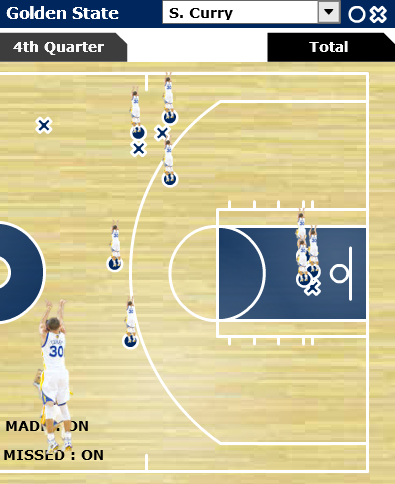
Steph Curry: 94 3s and 600 points thru 19 games. Every volume record associated with the three-point shot will be attached to Curry’s name sooner than later. Thru 19 undefeated games this season, he’s made 94 3s (nearly 5/game) which is 22 more than the next closest shooter in the same amount of games since 85-86: Antoine Walker with 72 in 2001-02. Steph’s also scored 600 points, becoming just the 22nd player to score 600 (31.5/game) this fast and the first since Allen Iverson in 2005-06. For historical context: MJ averaged 38.9 thru 19 in 86-87 and Wilt averaged 40 in 64-65.
Draymond Green: 130 assists and 150 rebounds thru 19 games. I’ve watched a lot of Warriors basketball this season because I’m desperate to be there when they lose so I’m familiar with Draymond’s increasing role as a playmaking facilitator on this team, but I didn’t realize he was averaging over seven assists. The 130/150 has been done nine other times to open a season – nearly all of whom are Hall-of-Famers: LeBron (12-13 and 11-12), Jason Kidd (twice), Scottie Pippen, Larry Bird (twice), Fat Lever, and Magic Johnson.
Blake Griffin: 450 points, 150 rebounds, and 80 assists in 18 games. Blake’s game has developed into something borderline unstoppable and it’s showing in the stats he’s putting up thru 18 games. His PER is over four full points greater than his best season and he’s averaging a career-high in points. The 450-150-80 hasn’t been accomplished since Bron in 2012-13 and before that it was Kobe in 02-03 when he started the season with 28/8.5rpg/6.5apg. The Mailman, Barkley, and Bird (twice each for Larry and Charles) are the other admissions.
Paul George: At least eight rebounds and three 3s/game thru 16 games. The increasing emphasis on the three-ball means we’ll continue to see the game evolve as bigger guys are encouraged to add distance to their arsenal. Per basketball-reference, prior to this season Paul George had appeared at power forward for about 2% of his total on-court time. In 2015-16, that number has swelled to 57%. That hasn’t stopped him from drifting outside and spreading the court where he’s hitting over three 3s/game on 45% shooting. Counting Curry and CJ Miles this season, three 3s/game has been reached 13 times since 85-86. Of those three point shooters, PG13 is the only one to ever average over eight rebounds/game, or seven, or six. His combination of rebounding and threes is something we’ve never come close to seeing.
Nearly 20 games into the season, we’re finally free from the “small sample size” qualifier that comes attached to early season wonders. We’ll still see what’s likely to be regression to the mean like Dirk’s three-point percentage sliding from 53% to 46% over a five-game span. But the trends above are worth monitoring and at the end of each month I’ll check back in to see how these guys (and others) are progressing relative to history. Onward to the winter, you kings.
Do you remember that stretch of games from Alvin Robertson back in November of 1986? He was a third-year shooting guard for the Spurs out of the University of Arkansas already established as being a tough defender. Hell, he’d already been named to the All-Star team in his second season when he set the NBA record for steals-per-game with 3.7. 29 years ago, starting on November 15th, 1986, Robertson came out with seven steals against the Suns, then followed it up with five more games of six steals or more with a streak-high of ten steals against the Clippers on November 22nd.
In the ensuing 29 years, the longest streak of six steals or more that any player amassed was two games. It’s not easy to do. There’s a knack to steals that’s part anticipation, part gamble, part identifying the sucker at the table. I’ve seen Rajon Rondo and Chris Paul take risks that leave backline defenders painfully naked, caught between speeding point guards on the front and soon-to-be alley oop dunking giants on the back, but hey, it’s taking the risk for an easy bucket and being a thief doesn’t always equate with being a great defender, but getting six or more steals several games in a row means you’re doing at least something right.
So it came as a surprise when the Philadelphia 76ers and their 0-18 roster produced some kind of off-kilter heir to Alvin Robertson in this kid Robert Covington. Covington was born back in 1990, a good four years after Robertson was stalking NBA teams and taking the ball from them with unprejudiced kleptomania. And with all the Stocktons, Jordans, and Pauls that have hunted the ball over the years, it’s the 6’9” 24-year-old from Tennessee State that sniffing around at what hard ass Robertson reached all those years ago.
Put the basektballs away when the Alvins and Robert come over
Unfortunately, the depth of NBA.com’s stats database doesn’t allow us to go back and scout out every one of those Robertson steals, but we can look at all of the Covington thefts over these past three games. Covington’s streak started less than a week ago on November, 25th with six steals against the Celtics. It was in a losing effort like all Philadelphia games this year, but his opportunistic instincts were on display. He was beaten by Jae Crowder on a screen, but used his long arms to poke the ball away from behind and force the TO. He capitalized on a full-court press, played help defense, stripped a defensive rebounder, and made himself a nuisance to the Celtics. Reviewing his six steals against Boston wasn’t overly impressive. He made decent plays, but I needed to see more.
Against Houston when Harden dropped 50 with nine TOs, Brett Brown got creative or desperate or something and slid Covington over to the five. In the end it didn’t make a difference, but again, the long SF/PF/C took full advantage of a Houston team (and Harden) that struggles nearly as bad as Philly does when it comes to taking care of the ball. He was directly responsible for at least four of Harden’s nine turnovers while also seizing upon young Clint Capela like the tiger on the savanna feasting on the naïve goat. Tiger Covington kicked some Rocket ass with 28 points and eight steals and broader defensive array than what I saw against Boston. Reading the passer’s eyes (in a couple cases Harden telegraphing passes) and identifying un-sure-handed opponents (Capela) allowed him to take advantage of their mistakes.
Finally, on the 29th of November, the streak continued in what was, based on the tape, his best effort yet. Instead of being the opportunistic poacher I saw against Boston and Houston, Covington swallowed defenders, poking and prodding at the ball with go-go gadget arms. He picked the pocket of sure-handed Mike Conley twice, stripped Jeff Green, and read passing lanes with eyes attached to a head that is on a constant swivel on defense. Six more steals against the Grizz, but he offset those with an ugly eight turnovers.
That’s six, eight, and six steals in consecutive games paired up with four, four, and eight turnovers for a steal-to-turnover rate of 1.3:1 (21 to 16) which is a suspect ratio for a wing.
Covington is no Alvin Robertson. Robertson averaged 2.7 steals/game for his career and we haven’t seen a guy average 2.7 steals/game for a season since CP3 in 2008-09. Covington, like the rest of these Sixers, is nigh impossible to get a true read on because the circumstances deviate so far from what we’re used to analyzing. I don’t have a clue how or what Covington becomes, but his current stretch in 2015-16 is, in its own compartmentalized way, impressive. In nine games he’s appeared in this season, he’s giving Philly 3.6 steals/night while pulling off a streak we haven’t seen in close to 30 years. On December 1st, the Sixers host the Lakers and all their on and off-court mega-circus act. I don’t have a clue what happens in this game, but it’s likely at least one of Philly’s current streaks will come to an end.
Black Friday, a time for some consumers to pit their deal-stalking prowess against the masses, a post-holiday competitive consuming dessert. For the NBA, a day to get back on track after one of the few league-wide off days. For some, strange cornucopias like chocolate drizzled on turkey manifested themselves on this Friday.
The criteria:
50 or more points
Nine or more turnovers
Two of my favorite storylines this year in the NBA sense of soap opera are Philadelphia and Houston. Black Friday was a chance to see these train wrecks on the same court navigating through their own personal debris in efforts to find some stable safety. But there can only ever be one winner in the NBA and for Houston (they won 116-114 at home knocking to Philly to 0-17 and extending their losing streak to 27 games) it took every particle of James Harden’s basketball being to achieve the victory. Harden hoisted the hodge podge Rockets on his back for the following line:
Harden, 11/27/15: 50pts on 12-28 from field, 6-12 from 3, 16-20 from the line, 9rebs, 8asts and 9 turnovers
This is right in line with the season he’s having where’s now averaging a career best 30 points/game alongside a career worst five turnovers/game. As I’ve written though, the only time the Rockets seem capable of competing is when James is dominating – efficiency be damned – and his inability to control the ball didn’t prevent a Rockets win. It does put him in some rare company though. As we see below, just two other players in the past 30 seasons have pieced together such uneven lines:
Allen Iverson, 4/12/97: 50pts on 17-32 shooting, 5-9 from 3, and nine TOs. He was just 21 at the time.
Hakeem Olajuwon, 4/19/90: 52pts on 21-34 shooting, 18rebs, 3stls, 3blks, 11 TOs while fouling out
Harden wasn’t the only big leaguer to struggle taking care of the ball on this evening. Up north in Oklahoma City, Mountain Dew pitchman Russell Westbrook bing bang bobbled his way into 11 turnovers in just 29 minutes of play (he fouled out) against the Pistons and former teammate Reggie Jackson. His TOs covered a broad swath of ball un-control:
Dribbled off his foot
Forced a pass
Charge
Bad pass
Bad pass
Stripped
Stepped out of bounds
Charge (bad call as Ilyasova pushed into Russ as he drove)
Dribbled off his foot
Unforced lost ball on drive
Charge (tried to draw contact jumping into defender)
The criteria:
11 or more turnovers
30 minutes or less
Unlike James and his friends Allen and Hakeem, Russ is all alone on this one. Since 1985-86, we’ve never had another guy turn the ball over this much in as limited playing time. It’s entirely possible that someone turned the ball over 12 times in 24 minutes of play, then proceeded to play another 10 minutes of TO-free basketball, but that’s not the criteria.
This is probably Russ’s worst game of the season. On top of the sloppy ball control, he shot 5-14 from the field and fouled out for just the ninth time in nearly 600 career games (playoffs and reg season). His already league-leading turnovers/game went from 4.9 to 5.2 in what’s suddenly become a race to the bottom between him and Harden to see who can turn the ball over most. Like Harden and the Rockets, OKC was still able to win and by double digits despite Russ’s off night. So instead of this being a costly headache, it’s the flipside consequence of a player that exceeds all speed limits and handling guidelines and occasionally goes off the rails as a result.
Not everyone can grace us with the ball protection and calm of a Chris Paul assist-to-turnover ratio. Harden and Westbrook are two of our most dynamic guards, centerpieces of a New NBA with an unstated philosophy that to make the perfect omelet, many, many eggs must be broken. On the same night, pro basketball wunderkind Stephen Curry dropped 41 points while turning the ball over six times and raising his career-worst turnovers/game up to 3.8. It’s like Tyler Durden told us in Fight Club, “even the Mona Lisa’s falling apart.”
In the midst of the decay of Kobe Bryant, Paul Pierce, and Kevin Garnett, Dirk Nowitzki has become the late 90s perimeter version of Tim Duncan: the elder statesman that ages, but evolves with something beyond grace, something both practical and creative. At age 37 and in his 18th season, Dirk isn’t so much reinventing his great game as re-purposing and fine tuning it.
Forever known as an all-time shooter, Dirk’s career averages are 51.4% eFG and 38.4% from three. Through 12 games in November of 2015-16, he’s scoffing at those numbers with a career-best 60.8% eFG and 53.3% from three. He’s taking less shots and getting to the line less than at any other point in his career, but at 37 the 9-5 surprise Mavs are happy to trade a bit of volume for unnatural efficiency.
Basketball-Reference stats as of 11.22
Bill Simmons of Bill Simmons fame created the 50-40-90 club as a statistical marker that takes into account quality shooting from three measures: FG% (50%), three-point accuracy (40%), and free throws (90%). Prior to this season, just eight players (including Dirk) had achieved the informal milestone: Kevin Durant, Steve Nash (four times), Jose Calderon, Steve Kerr, Reggie Miller, Mark Price, and Larry Bird. In early 2015-16, three players are trying to join that company: Utah’s Joe Ingles with his 13 minutes and three FGAs/game, Steph Curry and his transcendent season (51.5%, 44.1%, 93.8%), and a 37-year-old power forward named Dirk.
Where’s this coming from after a 2014-15 appeared to be the beginning of the inevitable downward slope of Nowitzki’s career? Last season his eFG and three-point shooting were both below career averages. The team as a whole struggled to find an identity after acquiring Rajon Rondo in December. Of their top-20 five-man lineups in 2014-15, Rondo appeared in just two of the top-ten based on point differential per 100 possessions. Four of the bottom-five lineups featured Rondo.
It’s not all about Rondo though as the Mavs made significant off-season changes including acquiring Deron Williams, Wes Matthews, and Zaza Pachulia (three of the top-four minutes/game players on the new roster). A healthy Ray Felton and Chandler Parsons are helping as well. To communicate the lack of continuity from last season, the guy who assisted most of Dirk’s baskets was Monta Ellis with 84 assists in 77 games in which Dirk appeared. He was just a hair over one assist-to-Dirk per game. In 2015-16, Deron Williams is already close to two assists/game to Dirk which is a decent indication Williams is adopting the Rick Carlisle offense in ways that Rondo didn’t and the Mavs are benefiting by getting the big man better looks.
Even though his three-point numbers are most staggering, it’s his work inside the arc that’s equally deadly. From three-to-16 feet, he’s getting over 35% of his total field goal attempts and from those spots he’s shooting either career-best (10-16ft) or near-best (3-10ft). These are remarkable stats of the Barry Bonds variety – as in, Hall-of-Fame player gets older and somehow keeps getting better, but Dirk’s head and neck haven’t grown in comical ways and in place of Balco it’s just his shooting coach Holger. Just your normal German tandem shot genius and savant pupil.
So while it’s easiest to compare Dirk to peers of his own age, comparing him to this season’s most dominant player does a better job of conveying how deadly he’s been. In terms of volume, Nowitzki at his finest couldn’t touch the Curry we’re seeing this year with his five threes made/game on nearly 12 attempts/night. Where a conversation can be had though is around accuracy. Anything that’s weighted towards threes rightly skews in Curry’s favor as he’s massacring our notions of what a volume three-point shooter looks like. For Dirk to be shooting 53% from deep while taking nearly four threes/game is unprecedented. No player in the league has ever hit two threes/game while shooting over 50%. With 68 games on deck, it’s entirely likely that a combination of opponent adjustments and wear and tear bring Dirk closer to his career averages, but at this snapshot in time he’s shot the ball as well as anyone in the league and done it at 37-years-old.
Michael Jordan, Kareem Abdul-Jabbar, Karl Malone have each had more prolific post-age 37 seasons than what Dirk’s doing this year. They shouldered great loads on good (or bad) teams, but with the exception of Kareem’s timelessness, Malone and Jordan rightly struggled to remain efficient as they aged. Nowitzki’s early season has the makings of a masterpiece. He doesn’t need to be compared to the senior division as he’s still good enough to compete seamlessly with world beaters ten years his junior. He’s truly a master of his craft in his execution and adaptation. His fadeaway and the high arc are romantically iconic. The sun’s going to set on him like it does all of us, but for now he’s traveling through space in a stasis of sorts where time doesn’t seem can’t seem to touch him.
Rainy Saturday nights in November against the lowly Brooklyn Nets. Quiet, tired Tuesday evenings when the wind is whipping outside and the Toronto Raptors are in town. We’re 12 games into the 2015-16 season and every game the Golden State Warriors play has become an event.
I don’t mean this in the Bill Simmons sense that that they’re so good they’re can’t miss TV though I also understand approach. I mean it in the Floyd Mayweather sense. (I considered titling this piece The Floyd Mayweatherization of the Golden State Warriors, but opted not to because the click baitishness of it all, but really this post is about a type of Mayweatherization.) I don’t know why people tuned into Floyd’s fights, just that the top-three buys for Pay-Per-View fights are owned by Mayweather. Most people either tune in to see him keep winning or hope tonight’s the night he finally loses. With his unblemished record and bombastic embrace of the villain role, he created an atmosphere where at his peak, each and every one of his fights became a mega event – though one can legitimately counter that his swan song against overmatched Andre Berto failed to meet the can’t-miss-TV status of his previous fights. And he’s managed to do it with unlikable, non-fan-friendly style.
Over a short three weeks, these Warriors have amplified the magnitude of their games from entertaining basketball games to high powered events. It’s not just that they’re 12-0 and threatening both the best opening record in NBA history (15-0) or that they’re a realistic possibility to reach 70 games. It’s that their margin of victory is over 15 points/game. They haven’t just adopted the NBA’s love of the three ball, but have mastered it through a blend of style and personnel. If that weren’t enough, the magnetic dichotomy of the best baby-faced player on the planet in Stephen Curry with the cockily confident/confidently cocky Draymond Green has offered up something for fans or non-fans of various stripes.
Much like a Floyd fight, the beginning of every game starts out with an iota of hopeful anticipation. For the Warrior supporter, a relaxed expectation that they will witness greatness yet again, further cementing a growing confidence of both fan and team. Where this begins to coincide with the Floyd fan is the zero in the loss tally. Over 82 games, perfection appears to be unattainable, but our species can’t help but rise and fall within the moment and as long as they’re 11-0, 12-0, 13-0, 14-0, the weight of each game will elevate. And if/when the Warriors finally lose and creep and climb through the winter and spring months, the emphasis will shift towards 70 wins and the weight will come back – probably soft and slow, like a small earthquake (hat tip Neil Diamond). For the Warrior opponent, the hopeful iotas are aimed at an opposite result – the Warrior loss. The non-fan views Warrior wins through the lens of the give-away. The Kings, the Nets, the Raptors had their chances and they gave it away. But they/we will tune in and hold on waiting for the knockout punch and pending desperate, satisfying catharsis.
And what of the connoisseur? The objective critic of Mayweather or Golden State is hard-pressed to find fault in the execution. The results speak for themselves. Championship rings, championship belts, flawless records. My Twitter timeline lights up with gushy excitement when the Warriors ride the improvised waves of basketball circumstances. Steph catches an intended receiver napping and finishes a righty layup in traffic. Floyd rolls his shoulders back, his opponent’s goal (a brutal headshot) less than an inch away but may as well be in Turkmenistan and he counters with a peppering jab to remind the hopeless that the goal, the purpose is and will remain unattainable. The analyzing fan and writers smile in appreciation.
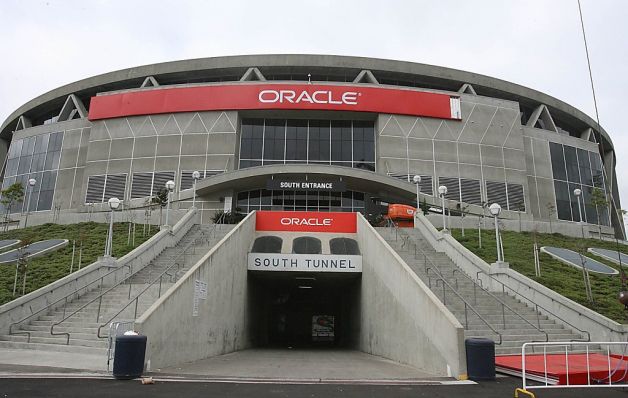
Even the space is part of the event. Oracle Arena tucked along a random highway in Oakland, a strange neighbor to industry, nothing close to a theater of dreams, but a house of worship nonetheless. Despite an ever-growing disparate fan base split between expensive courtside seats and less expensive upper-level seats, the attendees rise and fall in harmonious agreement. As I resided comfortably in my climate-controlled apartment watching the opening of Golden State-Toronto, I was inspired by the moment and the moment finally resonated (after the pre-game Ernie/Webber/Anthony chatter and the post-east coast games) when I recognized the fans. From the opening tip there was a palpability to the game and it started with the fans grasping the sense of the moment and raising their energy accordingly. Some have said that the real Warrior fans are being priced out by the fair weather Silicon Valley crowd and that may be the truest of the trues, but these past couple games where the undefeated start is at stake has produced May-level excitement from Warrior fans regardless of economic status.
This is peak Warriors. Steph Curry is at his other worldly best and Draymond Green is the clear cut second best player on the team. Andrew Bogut is leaner and bouncier. The team can play better, but they can’t be anymore 12-0 than they are 12-0 today. And as long as that zero sits in the loss column and as long as 70-73 wins is in place, every Golden State game will be an event in the Mayweather sense of things.
James Harden’s 2014-15 season ended with a splat. If you remember, Harden bumbled and stumbled his way into a 2-11 shooting night with a reckless 12 turnovers and a game score of one. Houston was bounced from the playoffs and Harden had the summer to vanquish whatever demons crept through his pores on that late May day.
That was nearly six months ago, plenty of time to recalibrate and find the touch that made Harden’s 2014-15 campaign one of Houstonian bliss. Ten games into the new season though and whatever oddities plagued Harden at the end of the playoffs have hardened into a crust. He’s a career 44% shooter from the field with a 51% mark at eFG (adjusted to account for threes being worth one more point than a normal field goal). Since his days as a 20-point scorer began, he averages just under four turnovers/game. Through ten games of the 2015-16 season, Harden’s efficiency has nosedived to 37% from the field with 4.9 turnovers/game.
Comparing Harden to players other than Harden doesn’t offer a much more favorable view. Since 1985-86, just six other players have managed 210 shot attempts with sub-40% from the field over their first ten games. Except for Kobe’s banged up/shot slinging 2014-15, each player below saw some degree of improvement from their early struggles to their end season stats. (As an aside, what in the hell happened in the Atlantic division in 2002-03 that three players began the season so ineptly inefficient?)
data courtesy of basketball-reference.com
It’s not that the list above is filled with bad company, rather it’s an ugly snapshot in time of otherwise talented players.
Much of Harden’s woes from the field can be traced to a combination of increased fascination with the three-ball and significantly decreased accuracy from that spot. His current approach to the three is enough to make Antoine Walker un-shimmy. After putting up between six to seven threes/game over the past three seasons, he’s jacking nearly ten/game in 2015. For context, prior to this season, no player in league history had ever averaged nine three-point attempts/game. Stephen Curry’s shooting 11.5/game this year, but he’s also making a whopping 45% of them. By contrast, Harden’s ten attempts/game are coming with a 24% efficiency. There’s no reason to suspect that his accuracy won’t creep back up to the 36-37% rate he’s maintained his entire career, but it’s also hard to envision him maintaining the current volume.
While Houston has plenty of issues that have contributed to a 4-6 record with a pair of three-game losing streaks (most notably a defense giving up 107.8ppg [27th out of 30th] with a DRtg of 108.9 [29th out of 30]), the chart below highlights the Rockets early-season dependence on Harden’s offensive efficiency for success. In wins, he has an eFG% of nearly 54 while in losses that number drops to under 32%. As a reminder, his career average is 51%.
There’s such a paradoxical element to Harden’s young 2015-16. He’s averaging a career-high in points at 28.4ppg bolstered by nearly 12 free throw attempts/night while sinking 86% of those attempts, but that’s countered by a career-low in ORtg (estimate of points created per 100 possessions). He’s getting more rebounds than at any point in his career, but that’s driven by him seeing more minutes than ever at small forward as Houston’s been forced to go small due to injuries. And CBS Sports’ Matt Moore pointed out that even those numbers come with caveats:
The NBA’s SportVU data has Harden logged for the second-most defensive rebound chances on the team, at 10.8 per game. He’s grabbing just 5.5, with only 1.4 contested. That is a horrendous rate, which is fine if he’s not being asked to do that, but with the Rockets going small, the guards have to rebound, and they’re not.
Speaking of said injuries, through ten games, Houston’s dilly dallied with five different starting lineups to accommodate the health of Dwight Howard and dings to Terrence Jones. Reserve guard Patrick Beverley has spent the season banged up and the assimilation of Ty Lawson appears to be confounding the entire populace of Houston – Lawson’s to-date performance as a Rocket makes Harden’s struggles feel like sunbeams and smart vacation. There’s a continuity issue here reflected in their streaky play (three-game losing streak followed by four straight wins then another three-game losing streak) and need for total domination by Harden to win. In wins he’s averaging 38ppg with a near-38% usage rate while losses 22ppg and 32% usage and a despicable 15% from three on 53 attempts.
We have three-plus seasons of video and statistical evidence that defines a true Harden identity. While he’s been historically bad over ten games, history tells us he’ll progress to the mean at some point and we’ve already seen it happen in a few Houston games this season. The question for coach Kevin McHale and Harden are more of a when than an if. But like Alexander’s mother tells him in the book which this post takes its name from: “Some games are like that. Even in Australia.”
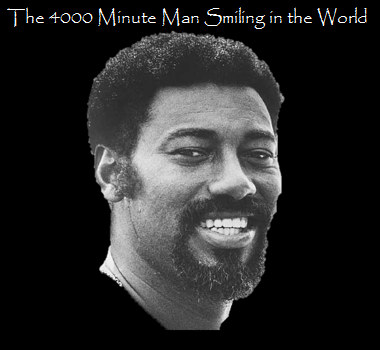
A while back I started researching the enormous amount of NBA minutes LeBron James has played in his decorated career. I’ll be exploring this in future work, but focusing on something different today: The 4,000 Minute Club because Dancing with Noah is interested in nothing if not interested in creating exclusive clubs for groups of large men that strut into statistical significance.
The 4,000 minute club is made up of any player that has appeared in 4,000 minutes or more combined across regular season and post-season for a single year. It’s a testament to some elite level of indispensability to your team, Cal Ripken-ish durability, and team success.
The 4k club is unique in that it’s possibly nearing extinction as you’ll see through the numbers below. While NBA Finals participants have the opportunity to appear in more total games than their NBA forebears due to playoff series expansion, things like sports science or common sense have resulted in minute reduction. A good, but isolated example of this is last year’s MVP Stephen Curry appearing in an MVP record-low 32.7 minutes/game. Golden State’s a unique example in that they’re able to blow out opponents without big minutes required of their top dog, but last season’s league leader in minutes played was James Harden who appeared in less than 3,000 minutes for the regular season – the fewest minutes played in a non-lockout season since 1958-59 when the NBA only played 72 games. These are microcosms of the broader downtrend in minutes played.
To arrive at a modern, contextual list of players, I separated the NBA/ABA into a pre-modern and modern era:
Pre-Modern: beginning of time to 1979-80
Modern: 1980-81 to present
The 4k threshold has been surpassed 55 times in NBA/ABA history with 36 of those seasons occurring in the pre-modern period when Wilt Chamberlain and Bill Russell stalked North America feasting on the blood and bones of knobby-kneed opponents. The top-10 of most combined regular and playoff minutes all occurred between 1961-62 and 1973-74 when pros wore low-top Chuck Taylor’s, shorts that would make John Stockton blush, and didn’t yet have the perks of chartered air travel or modern exercise science. The list below is made up of Wilt and Kareem, then four guys from the ABA which had an 84-game season.
Regardless of how it’s explained or rationalized, it’s difficult to wrap your head around Wilt the Stilt playing 48.5 minutes/game over the course of a 92-game season. He appeared in more than the available regulation minutes not for a game, a week, or a month, but an entire damn season. These super charged numbers are incomprehensible in the way Babe Ruth’s hitting and pitching stats are impossible, in the way Cy Young won over 500 games and threw nearly 750 complete games. They are so far beyond any current comprehension that they’re not comparable to the modern, post-Wilt game.
Instead, the modern breakout exists in a world closer to current standards of sanity and tolerability. Successful teams like the Spurs and Warriors have readjusted what is and isn’t acceptable with NBA player workloads while coaches like Tom Thibodeau are regularly admonished for throwing big minutes at players that who hobble on future arthritic joints.
The modern list is different and while it’s likely less of an achievement, it still speaks to something of the implicit meaning of the US Postal Service’s “rain, sleet or snow” motto that American’s love and cherish so much: We work hard.
18 players appear 19 times on the list of modern guys who have surpassed the 4k limit. They range in age from 22 to 34, in total games from 94 to 107, from MVPs to a lanky, lean Tayshaun Prince. 14 of the 19 occurrences made Finals appearances and every player on the list appeared in more than 40 minutes/game in the playoffs. Enough with demographics, take my hand and let’s explore this wonderful numerical forest.
The table above is sorted by total minutes and right at the top of this who’s who of NBA MVPs is “Thunder” Dan Majerle. Not exactly the two guard I would’ve expected to see at the top of the list, but when the Suns made the Finals in 1993, Majerle was an indispensable spoke. He appeared in all 106 games for Phoenix with 33.5% of his total 4,270 minutes played coming in the playoffs. His playoff MPG (44.6) represent the highest lift over regular season MPG with an increase of 5.6 minutes capped off by a 28-point performance on 6-8 from three in a 59-minute triple OT game in the Finals.
Only one player made this list without even advancing to the conference finals. Back in 2002-03, Allen Iverson appeared in all 94 of Philadelphia’s games, averaging a whopping 43 MPG. I don’t think anyone questions Iverson’s toughness, but for a player who weighed under 170lbs and averaged nine free throw attempts/game to play 43 minutes every night for 94 games is remarkable. Worth noting: The following season Iverson appeared in just 48 games.
Michael Jordan is the oldest player to reach 4k minutes and the only player in the modern era with two 4k seasons to his name. We’ll focus on his age-34 season when he appeared in 103 games averaging 39.3 MPG. While lacking the nightly minute madness of Iverson’s 2003 or Majerle’s beastly playoff run of 1993, MJ carried a massive load for 1998 Bulls. Scottie Pippen spent the season fighting injuries and the Bulls front office over contract issues and the result was a 34-year-old Jordan leading the league in usage while appearing in the most total minutes of his career. The combination of shouldering the load for this Bulls team and navigating the front office shenanigans of GM Jerry “Crumbs” Krause no doubt added to MJ’s decision to hang up the high tops following 1998.
We’ll wrap up the player-level analysis with the youngest guy on the list and the one who originally led me on this 4,000-minute quest: 22-year-old LeBron James in 2007. He was probably a year ahead of schedule carrying a team that just wasn’t that good all the way to the Finals. Playing 40 minutes/night in the regular season and nearly 45/night in the playoffs was the only way this team could compete and it wore down the young LeBron. After exceeding 55% true shooting in the regular season, he dipped below 52% for the playoffs.
The glut of minutes coupled with an average team and more creative defensive looks in the playoffs sucked the life out of Bron’s 2007. It’s telling that there’s only a single point guard (Gary Payton) on the list above. And with James so frequently playing that ball handling/offense-initiating role, it’s fair to wonder if that and a dose of Spursian common sense have resulted in just one 4k season for him.
The last time we saw a player cross the 4k barrier was 2008 with a 29-year-old Kobe Bryant. Given the aforementioned stats about Steph Curry and Harden last year coupled with theories that players are more susceptible to injury due to a multitude of factors (sleep deprivation, poorer diets, playing tons of basketball at younger ages, and poor weight training habits) and advances in sports medicine and biometric testing point to what should be a smarter, more cautious approach to managing player health and minutes, aka assets and investments. Though one could make the counter argument that advances in science may reveal new and better ways for athletes to protect their bodies and thus play even more minutes. The future is a damn abyss to which we’re all inevitably hurtling and nothing should be a surprise. But if teams follow the lead of two of our league’s most successful franchises, then we’ll no doubt see minutes trend downward and friends of the 4k club remaining a tidy, fraternal group of 17 (RIP, Moses Malone).
Once upon a time in the pre-presidential Obama days of the NBA, young Mr. Michael Jordan showed up for a game in Indianapolis against the Pacers and their funny two-guard, Reggie Miller. Jordan’s Bulls lost by four points, but it was due in no part to Jordan who crapped all over the Pacers for a sizzling 47 points, 11 rebounds, 13 assists, four steals and two blocks while shooting 57% from the field and 13-14 from the line. Egads!
Of course Michael Jordan, he of “commerce over conscience” infamy, is the modern-day NBA (defined as 1985-86 which is the first season basketball-reference offers certain box score stats) pioneer of the 43-13 club; aka 43-points and 13-assists, a truly dominant offensive game mixed of equal parts attack and distribution, but all attack.
So how’d we arrive here? James Harden delivered us to this moment on a Friday night in Sacramento in November with his vintage Hardenesque performance: 43 points on 23 shots with 16 FTAs and 13 assists. Harden was a rock or ogre or something irrepressible. And it was kind of fitting that in a league where all two guards are measured by their ability or inability to emulate his Airness, that the two-guard with the most un-MJish game would be the latest in a short line of NBA greats to repeat his feat from 1989.
James Harden considering Mars
Here’s the criteria:
43 points or more
13 assists or more
The inductees:
Michael Jordan, 26-years-old in 1989: 47pts, 11rebs, 13asts, 4stls
LeBron James, 25 in 2010: 43pts, 13rebs, 15asts, 4blks, 1-9 from 3
James Harden, 26 in 2015: 43pts, 13asts, 7 TOs
It’s an illustriously exclusive crowd Harden’s just joined, but fitting given the versatility of his game. Long a playmaker and dynamic scorer, the Beard is one of just 12 players in league history to average 27ppg and 7apg over the course of a single season. Where our eyelashes barely bat at the inclusion of MJ, Bird or LeBron, Kenny Anderson and Antoine Walker are more surprising. Anderson’s game was necessitated by an injury to Derrick Coleman while Walker’s was an outmatched team on the road where he caught fire.
Context for games like these matters. In Harden’s case, it was his sixth game of the year, the first three of which had all resulted in 20-point losses with last season’s MVP runner-up shooting a combined 12-54 (22%) from the field and 3-32 (9%) from three. His team has been ravaged by early injuries and the challenge of integrating speedy playmaker Ty Lawson into the attack. On this Friday night, there was no Dwight Howard, no Terrence Jones, Donatas Motiejunas, or Patrick Beverley. So against an undermanned (no DeMarcus Cousins) Kings team, Harden seized the reigns and torched the Kings. It was without peer as his best game of the new season with the Rockets largest margin of victory and his own highest usage and ORtg.
Which takes us to the final noteworthy relationship of the 43-13 club; the relationship between usage and Ortg. The 43-13 club means you’re accounting for no less than 60 of your team’s points. A player becomes the catalyzing engine driving the offensive attack from multiple planes much to the defense’s helplessness. I expected higher usage rates which isn’t to say the rates aren’t high, but below we see a consistent relationship: mid-30s usage, mid-130s Ortg – with a couple of truly unique outliers. Allen Iverson’s 44 and 15 on 16-22 shooting stands out as a model of harnessed efficiency which, given his career-long struggles with efficiency becomes the greatest outlier and a likely topic for a future edition.
Stats courtesy of the great Basketball-Reference.com.
On November 3rd, Andre Drummond, all of 22-years-old, notched the second 25-25 game of his career with 25 points on 12-17 shooting and 29 rebounds – a career high. In the process he joined Al Jefferson and Dwight Howard as the only three active players in the league with more than one 25-25 game. Guys like Shaq, Tim Duncan, Patrick Ewing only achieved the feat once in their storied careers, but at 22 Drummond’s already done it twice.
Hakeem Olajuwon sits on the modern 25-25 throne with five such games
One of Olajuwon’s games was a 32-point, 25-rebound, 10-block performance which I’ve previously written about and is one of the more dominant/lopsided individual stat lines I’ve come across.
The highest game score on the list is a 48.6 from Olajuwon on a night back in 1987 when he stuck it to the Sonics of Seattle for 49 points, 25 boards and six blocks. What the shit kind of night is that?
Kenneth Faried joined the club last year in a game in which he played just 30 minutes – the least minutes of anyone in the club.
And finally, the similarities between Dwight’s and Drummond’s appearances on this list.
By the time he was 21, Howard had his two 25-25s and I can only assume that most folks suspected these wouldn’t be the last two such games of his career. And given that he’s just turning 30 in a few weeks, it’s possible he tacks on a few more, but since his peak is well in the rearview, it’s unlikely.
25-25s aside, the young Dwight-young Drummond connection comes with intrigue not because of the similarities: they’re both powerfully built centers that use size, skill, and athleticism to dominate and they’ve both been coached by Stan Van Gundy; but the nearer they become statistically the better the future looks for Drummond.
At the end of Howard’s fourth season he was a two-time all-star with appearances on the NBA All-Defensive second team, All-NBA third team and All-NBA first team. He was highly decorated and more than prepared to take the torch as the league’s best big man. Drummond was named to the All-NBA Rookie second team back in the day and that’s it. Despite his size and athleticism and despite numbers that favorably compare to Dwight, he’s been unable to crack the code of the NBA’s off-season awards.
My friend and esteemed basketball writer and thinker Ian Levy just wrote a nice in-depth piece on the dissimilarities between these two that goes well beyond simplifications of them being large athletes that rebound and dunk. And where Dwight’s defense has long been Hall-of-Fame level (he’s the only player since the inception of the Defensive Player of the Year award in 1982-83 to win it three straight seasons), Andre’s merely a good defender. Though we’re looking at significantly different players, there are intersections and overlaps between their first three seasons. Below, in the most unscientific way possible, I’ve attempted to identify these intersections via my own made up statistic that includes traditional big man stats PPG, RPG, BPG combined with PER minus turnovers to arrive at an arbitrary stat for each of Andre and Dwight’s first three years in the league.
The above unscientific approach is interesting because it takes a variety of stats and makes a fat stat patty out of them which, when viewed in their entirety is strikingly similar in terms of progression and production. Additionally, through three seasons, both players were 21 and were just getting to know Van Gundy: he didn’t start coaching Howard until his fourth season and Drummond in his third. None of the above is presented to imply that Drummond = Dwight. Drummond is a much better offensive rebounder and plays more to his own strengths offensively which results in less turnovers. Young Dwight was the superior defender, (somehow) had a broader array of offensive moves, and was able to stay on the court for longer stretches without getting in foul trouble.
And yet, even with those copious variations, the statistical similarities are hard to overlook. If we shift forward with a similar eye and the little four-game sample we have of this season, it doesn’t take ultra-optimism to imagine a 2015-16 season out of Drummond. Dwight made significant leaps in his fourth year with improvements in scoring (ppg and FTA/game), rebounding (total boards and rebounding rate), and offensive and defensive impact (career bests in offensive and defensive win shares and offensive and defensive rating). Four games into 2015-16 is too few to plant any flags in Drummond making a similar leap, but with the paint cleared of former running mate Greg Monroe and a hand-crafted SVG roster that creates greater space for Drummond, the magic eight ball indicates sunny days for the big man. Or, if November 3rd’s ridiculous 25-29 game provides some kind of symbolic indicator of the future, then step to the side, lest you be dunk slammed on by the giant Andre Drummond.
We’re in November and the Golden State Warriors have played less than five percent of their total regular season games. The most recent, their fourth of the young year, was punctuated by a violent 119-69 Mike Tyson-over-Michael Spinks type victory over the Grizz – the same Grizz that took a 2-1 lead over GSW in the playoffs just six months ago. In the breezy 28 minutes he played, reigning MVP and pioneer of “new NBA” style basketball Steph Curry incinerated the Grizz for 30 points on 16 shots. Speaking in purely statistical terms, this was a below average game for Curry in 2015-16, but like I cautioned, we’ve got 78 games to go.
But in the young offering of the new season, Steph’s taking what was already a nuclear game and style replete with some kind of next world hand-eye coordination, progressively audacious handle, Doc Holliday trigger finger, and already all-time range and accuracy combination, and building on it.
In 2014-15, his first season under the guidance of Steve Kerr, Curry was a joy to behold, roughly achieving the same averages he had in 2013-14 (pts, rebounds, asts, 3s, stls, etc) while appearing in four less minutes per game. Comparing his 2014-15 to 2012-13 is even starker: he played six more minutes per game that year, but his per-game averages were lower as were his shooting percentages. His per-36 numbers from 2014-15 outshone what had already been all-star caliber numbers. Improvement is expected, but as we’ll see, the type of improvement is mostly unprecedented.
I’m going to paraphrase here and most likely screw this up, but there’s a four-quadrant concept that occurs in learning and task mastery:
You don’t know what you don’t know – you’re unconscious
You become aware of the things you don’t know – your consciousness develops so you can at least identify what you want to improve upon
You consciously begin to tackle those things of which you recently became aware
You unconsciously do the things you recently did in a conscious state
If last year’s MVP/NBA champion season was step #4 for Steph where execution became second nature like breathing and sneezing and laughing, then the four games we’ve seen of him in 15-16 are closer to that scene in The Matrix when Neo is all “What are you trying to tell me, I can dodge bullets?” and Morpheus responds, “No, Neo. I’m trying to tell you that when you’re ready, you won’t have to.”
Was there a point where Steph realized he didn’t have to metaphorically “dodge bullets,” that it would just happen instinctually? On opening night last week, his first quarter should’ve been an indication to all of us that instead of seeing the illusory images on the court, he was deep in some meta coding, interpreting his opponent’s futile defensive efforts as nothing more than unprejudiced attempts designed to deter him. In the first quarter alone he shot 9-13 (would’ve been 9-12 had he not heaved up a 40-footer as time expired) with 24 points. It was lightning, violence, blitzkrieg, all-out attack, a metaphor for war. It was, intentionally or not, a battle hymn that rang out across the TNT-powered sound waves through speakers and pixels into our feeble senses.
But it didn’t stop there and hasn’t stopped. We’re still hibernating in small sample size theater season, but something strange is afoot, like white walker afoot or when the levee breaks afoot. Through these piddly four games, Steph, this time under the substitute coaching of Luke “Son of Bill” Walton, is obliterating his own MVP-level stats and he’s somehow doing it with rarefied combination below:
Less minutes/game
More shots (more on this)
Increased efficiency (very little on this)
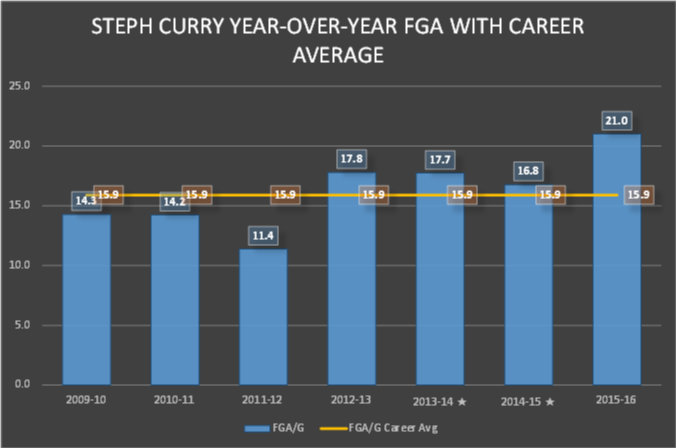
Because the Warriors can beat other playoff teams like the Grizz by 50 points on random Monday nights, there’s no need for Curry to play big minutes. This is our loss. In four games, all against playoff teams, GSW’s closest game was a 14-point victory. He’s averaging under 32 minutes/game. What we’re seeing though is that his slice of the offensive pie has grown in 2015-16. Where Curry’s career average for field goal attempts/game has sat right 16 attempts with a career high of just under 18 FGA back in 2012-13 in 38 minutes/game, Curry’s now cramming in 21 shots/game. He’s somehow getting up 32% more shots/game than his career average while appearing in the second lowest MPG of his career.
It doesn’t stop with field goals. As part of that 21 FGAs/game, Curry’s pushing an unprecedented nearly 11 3s/game. To put that into context, the most 3PAs a player has ever attempted on a per-game basis was Baron Davis back in 2004 when he put up 8.7/game. Curry’s clearly a prolific gunner himself and holds the top two single-season records for 3s made. His career high of 8.1 3Pas/game is good enough for sixth on the all-time list. But if we compare his current little four-game stretch to his career average of 6.5 3PAs/game, we see a ballsy bold leap of 64%. And if we’re truly interested in blowing our minds all over the walls in blue and gold Warrior-themed blood spatter in queer basketball-themed Rorschach patterns, then layer on the context that Curry’s spike in volume is being accompanied by a career best three-point accuracy (48.8%). He’s hitting five threes/game!
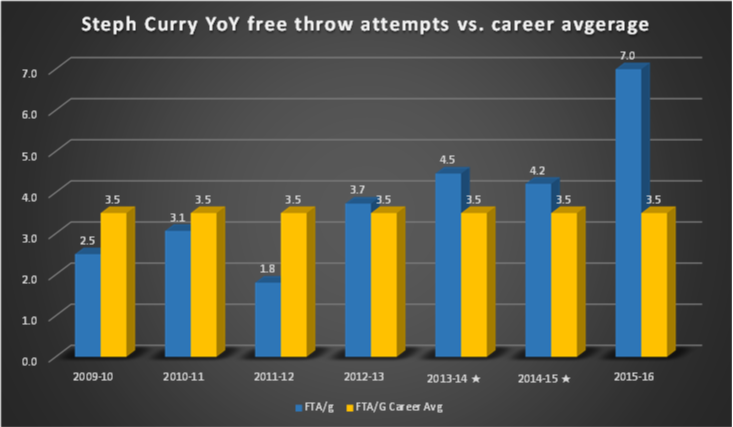
So Curry’s hovering around the perimeter, chucking record-setting threes and hitting them at paces typically reserved for guys who trade volume for efficiency. He’s taking advantage of spacing and passing and ball movement and all that good stuff. Yes to all of that, but for any notion that he’s merely perfecting the areas of already-existing strength while other aspects of his game stay flat or see small rises, he’s again a step ahead. For his career, Curry’s shooting a paltry 3.5 free throws/game. He’s third all-time in FT% just behind Steve Nash and Mark Price, so he’s getting the most bang for his free throw buck, but at 3.5 attempts/game with a career best of 4.5, he’s good at getting to the line for a point guard, but nothing special. In our shortened present season he’s somehow expanded his offensive range to include seven FTAs/game. For a guy that shoots over 90% from the line, seven FTAs/night is free points, a rhythmic bonus that builds on what’s already elite confidence. Where his increase in 3PA/game was a stunning 64%, his increase in FTA/game relative to his career average is nearly double at a 99% increase and the graph below more so than the others above clearly illustrates this spike.
While I’ve touched on Steph’s increased makes, I chose to focus on the attempts to show the early tidal change from last season. Maybe it’s having Walton at the helm instead of Kerr or maybe Klay Thompson has a bad back. Perhaps Kerr and company saw something in the numbers or on film, something like, “More Steph is better.” Regardless of the impetus for the jumps in volume, the return Golden State’s seeing on his increased offensive aggressiveness are eye popping and head shaking. Who averages 37ppg in under 32mpg for a team that beats all comers by double digits? It is unprecedented, I swear it is. It has to be.
We’re dealing with the smallest of sample sizes to the degree that every stat called out in this piece should have an asterisk next to it (“Hey man, it’s less than 5% of games, chill!”), but what we’re seeing even through these four games is borderline comical in the way that peak Pedro Martinez or Aroldis Champan were/are comical; we know what to expect and the opponent thinks they know what to expect and it doesn’t matter. The stats tell this truth as well as any verbose language or overused thesauri ever could. And sure sure, it’s probably unsustainable, but what if by some dint in the makeup of things, it is sustainable? If there’s even a shred of sustainability going on here, may god have mercy on all their basketball-playing souls because in this new NBA, the man shooting 50% on 11 3s/game is king.










 Dancing With Noah