We’re in November and the Golden State Warriors have played less than five percent of their total regular season games. The most recent, their fourth of the young year, was punctuated by a violent 119-69 Mike Tyson-over-Michael Spinks type victory over the Grizz – the same Grizz that took a 2-1 lead over GSW in the playoffs just six months ago. In the breezy 28 minutes he played, reigning MVP and pioneer of “new NBA” style basketball Steph Curry incinerated the Grizz for 30 points on 16 shots. Speaking in purely statistical terms, this was a below average game for Curry in 2015-16, but like I cautioned, we’ve got 78 games to go.
But in the young offering of the new season, Steph’s taking what was already a nuclear game and style replete with some kind of next world hand-eye coordination, progressively audacious handle, Doc Holliday trigger finger, and already all-time range and accuracy combination, and building on it.
In 2014-15, his first season under the guidance of Steve Kerr, Curry was a joy to behold, roughly achieving the same averages he had in 2013-14 (pts, rebounds, asts, 3s, stls, etc) while appearing in four less minutes per game. Comparing his 2014-15 to 2012-13 is even starker: he played six more minutes per game that year, but his per-game averages were lower as were his shooting percentages. His per-36 numbers from 2014-15 outshone what had already been all-star caliber numbers. Improvement is expected, but as we’ll see, the type of improvement is mostly unprecedented.
I’m going to paraphrase here and most likely screw this up, but there’s a four-quadrant concept that occurs in learning and task mastery:
You don’t know what you don’t know – you’re unconscious
You become aware of the things you don’t know – your consciousness develops so you can at least identify what you want to improve upon
You consciously begin to tackle those things of which you recently became aware
You unconsciously do the things you recently did in a conscious state
If last year’s MVP/NBA champion season was step #4 for Steph where execution became second nature like breathing and sneezing and laughing, then the four games we’ve seen of him in 15-16 are closer to that scene in The Matrix when Neo is all “What are you trying to tell me, I can dodge bullets?” and Morpheus responds, “No, Neo. I’m trying to tell you that when you’re ready, you won’t have to.”
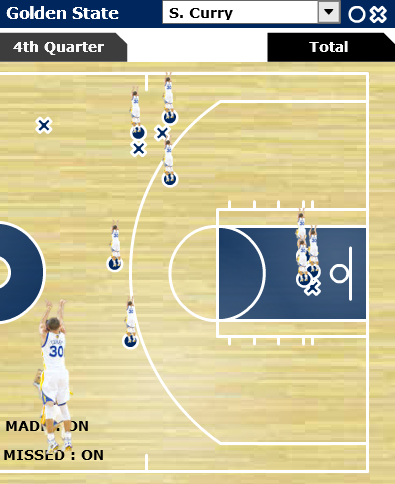
Was there a point where Steph realized he didn’t have to metaphorically “dodge bullets,” that it would just happen instinctually? On opening night last week, his first quarter should’ve been an indication to all of us that instead of seeing the illusory images on the court, he was deep in some meta coding, interpreting his opponent’s futile defensive efforts as nothing more than unprejudiced attempts designed to deter him. In the first quarter alone he shot 9-13 (would’ve been 9-12 had he not heaved up a 40-footer as time expired) with 24 points. It was lightning, violence, blitzkrieg, all-out attack, a metaphor for war. It was, intentionally or not, a battle hymn that rang out across the TNT-powered sound waves through speakers and pixels into our feeble senses.
But it didn’t stop there and hasn’t stopped. We’re still hibernating in small sample size theater season, but something strange is afoot, like white walker afoot or when the levee breaks afoot. Through these piddly four games, Steph, this time under the substitute coaching of Luke “Son of Bill” Walton, is obliterating his own MVP-level stats and he’s somehow doing it with rarefied combination below:
Less minutes/game
More shots (more on this)
Increased efficiency (very little on this)
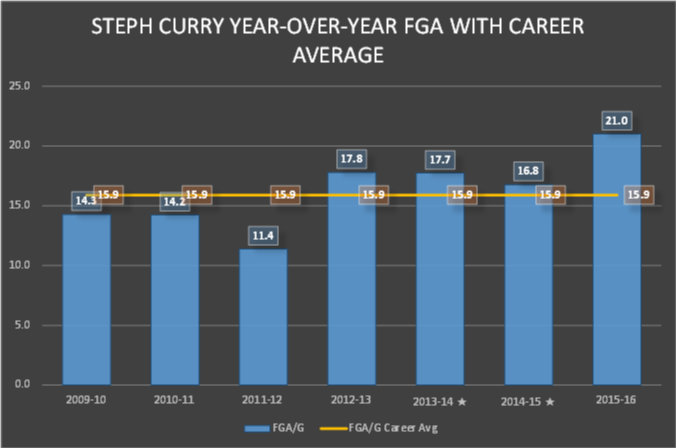
Because the Warriors can beat other playoff teams like the Grizz by 50 points on random Monday nights, there’s no need for Curry to play big minutes. This is our loss. In four games, all against playoff teams, GSW’s closest game was a 14-point victory. He’s averaging under 32 minutes/game. What we’re seeing though is that his slice of the offensive pie has grown in 2015-16. Where Curry’s career average for field goal attempts/game has sat right 16 attempts with a career high of just under 18 FGA back in 2012-13 in 38 minutes/game, Curry’s now cramming in 21 shots/game. He’s somehow getting up 32% more shots/game than his career average while appearing in the second lowest MPG of his career.
It doesn’t stop with field goals. As part of that 21 FGAs/game, Curry’s pushing an unprecedented nearly 11 3s/game. To put that into context, the most 3PAs a player has ever attempted on a per-game basis was Baron Davis back in 2004 when he put up 8.7/game. Curry’s clearly a prolific gunner himself and holds the top two single-season records for 3s made. His career high of 8.1 3Pas/game is good enough for sixth on the all-time list. But if we compare his current little four-game stretch to his career average of 6.5 3PAs/game, we see a ballsy bold leap of 64%. And if we’re truly interested in blowing our minds all over the walls in blue and gold Warrior-themed blood spatter in queer basketball-themed Rorschach patterns, then layer on the context that Curry’s spike in volume is being accompanied by a career best three-point accuracy (48.8%). He’s hitting five threes/game!
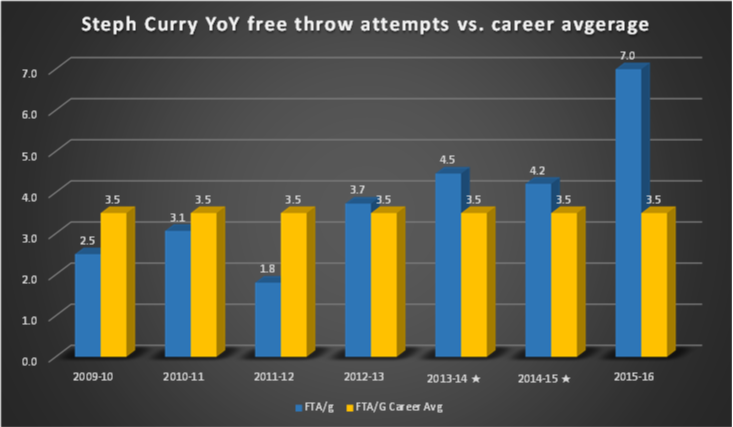
So Curry’s hovering around the perimeter, chucking record-setting threes and hitting them at paces typically reserved for guys who trade volume for efficiency. He’s taking advantage of spacing and passing and ball movement and all that good stuff. Yes to all of that, but for any notion that he’s merely perfecting the areas of already-existing strength while other aspects of his game stay flat or see small rises, he’s again a step ahead. For his career, Curry’s shooting a paltry 3.5 free throws/game. He’s third all-time in FT% just behind Steve Nash and Mark Price, so he’s getting the most bang for his free throw buck, but at 3.5 attempts/game with a career best of 4.5, he’s good at getting to the line for a point guard, but nothing special. In our shortened present season he’s somehow expanded his offensive range to include seven FTAs/game. For a guy that shoots over 90% from the line, seven FTAs/night is free points, a rhythmic bonus that builds on what’s already elite confidence. Where his increase in 3PA/game was a stunning 64%, his increase in FTA/game relative to his career average is nearly double at a 99% increase and the graph below more so than the others above clearly illustrates this spike.
While I’ve touched on Steph’s increased makes, I chose to focus on the attempts to show the early tidal change from last season. Maybe it’s having Walton at the helm instead of Kerr or maybe Klay Thompson has a bad back. Perhaps Kerr and company saw something in the numbers or on film, something like, “More Steph is better.” Regardless of the impetus for the jumps in volume, the return Golden State’s seeing on his increased offensive aggressiveness are eye popping and head shaking. Who averages 37ppg in under 32mpg for a team that beats all comers by double digits? It is unprecedented, I swear it is. It has to be.
We’re dealing with the smallest of sample sizes to the degree that every stat called out in this piece should have an asterisk next to it (“Hey man, it’s less than 5% of games, chill!”), but what we’re seeing even through these four games is borderline comical in the way that peak Pedro Martinez or Aroldis Champan were/are comical; we know what to expect and the opponent thinks they know what to expect and it doesn’t matter. The stats tell this truth as well as any verbose language or overused thesauri ever could. And sure sure, it’s probably unsustainable, but what if by some dint in the makeup of things, it is sustainable? If there’s even a shred of sustainability going on here, may god have mercy on all their basketball-playing souls because in this new NBA, the man shooting 50% on 11 3s/game is king.
After 2014-15, Anthony Davis’s pro hoop trajectory climbed into rare company. His traditional big man stats (points, rebounds, blocks) gained him admittance into a stratosphere known to few at the pro level: +24ppg, +10rpg, +2.5bpg. Only Shaquille O’Neal accomplished the same as a 21-year-old. For players 25 or younger, only Shaq, David Robinson, and Bob McAdoo pulled it off. If we expand the list to remove any age constraints, the list is still less than 30 total seasons and just eight players in league history. Anthony Davis won’t turn 23 until March of 2016 and yet, as some critics take aim at Michael Jordan’s career, I too have a prickle of concern in my gut about the durability of young Mr. Davis.
It’s not hyperbolic exaggeration to say Davis’s early career has the markings of an inevitable first-ballot Hall of Famer. His first three seasons have been that good. But somewhere in that mixing pot of historical greatness is the mildly concerning truth that Davis has yet to exceed 70 games in a single season. He’s never encountered the catastrophic injuries that wracked Greg Oden or Joel Embiid. Rather, he’s been sidelined by one little injury after another.
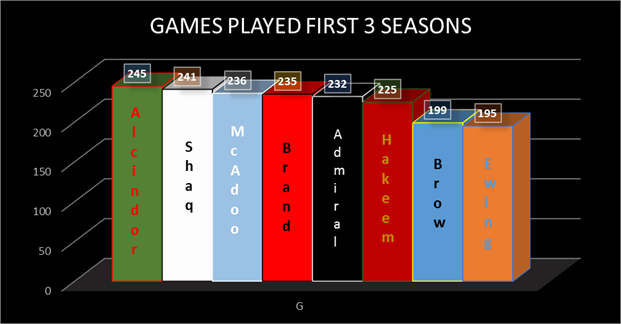
If we consider the players in the 24/10/2.5 club as some sort of bright and shiny baseline to compare against Davis from a purely durability view, we get the following breakout across each player’s first three seasons:
Anthony Davis and shiny baselines – stats courtesy of basketball-reference.com
It is certainly isn’t an apples to apples comparison, particularly since primary data linking the players (24/10/2.5) occurred for most guys at a different point in their careers. The other difference is player age though there’s not much we can do about that. Of the eight players on the list, David Robinson (26) was the oldest after three years while Davis (21) is the youngest. And given Davis’s lithe frame (particularly as a 19-year-old rookie), it’s fair to wonder if age and physical maturation have factored into his semi-fragility.
Olajuwon (knee injury in 1986) and Robinson (thumb surgery in 1992) both had 68-game seasons in their first three years, but Hakeem appeared in all 82 his first year while the Admiral hadn’t missed a game in nearly three full seasons. Ewing only appeared in 50 games as a rookie, then 63 his second season before finally finding health (82 games) via a significant reduction in minutes – less than four minutes played per game in his third season. Sticking with Ewing, the bulk of his 32 games missed as a rookie were the result of a shutdown in March after he re-aggravated a season-long knee injury.
As we look at Davis’s spate of missed games over his first three seasons, we’ll see the shutdown factor slightly skew his number of games played as well. Over his first two years in the league, Davis was shut down with three games to go as a rookie due to a sprained MCL and bone bruise, then five more as in year two due to back spasms. Those eight games combine for 17% of the total missed games in his career – small volume, but it’s fair to wonder whether he may have played through injury had the playoffs been a possibility.
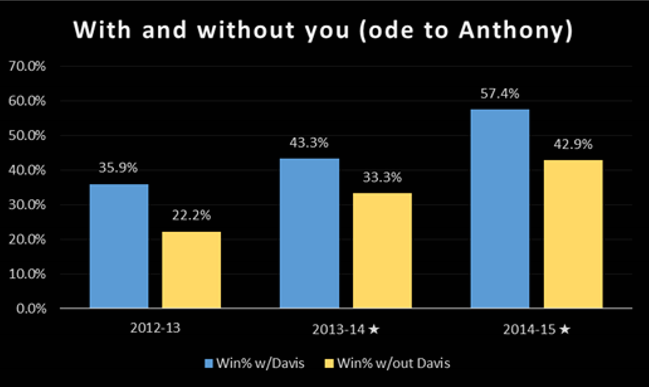
It shouldn’t come as a big surprise, but New Orleans is a significantly better team with Davis on the court. For his career, when Davis plays, the Pelicans’ winning percentage climbs nearly 14% — from ~32% to ~46%. While the team’s winning percentage has grown each season he’s been on the team (with or without Davis), the disparity between with and without Davis has never been greater than it was in 2014-15 when their winning percentage climbed 14.5% when Davis played. This shouldn’t shock anyone, but rather continue to highlight how critical a healthy Davis is to any New Orleans success.
Beyond just winning and losing, there’s the impact of continuity. How well did the Pelicans play in games following a Davis injury? Looking at his first two seasons, the games immediately following his injuries were miserable. There’s a lot of noise when drawing these attribution statements such as opponents, New Orleans personnel, and other injuries, but at its base level, the message is clear that New Orleans repeatedly struggled to re-integrate Davis into their schemes following injuries in years one and two:
2012-13 (rookie year): Davis missed 11 straight games from 11/20 – 12/8 and upon return, the team struggled losing 11 of 13 games (won 15% of games)
2012-13: Davis missed back-to-back games and upon his return, the team dropped seven of eight (13%)
2013-14: Davis missed seven straight and when he came back they lost 12 of 16 (25%)
Aside from being small sample sizes, the stretches above are directional indicators that New Orleans took time to rediscover their pre-Davis-injury winning rate. In each of those three stretches the team performed worse off than even without Davis in the lineup.
Year three revealed a different trend that should alleviate some of the uncertainty around the direction of the Pelicans:
2014-15: Davis misses three straight games and upon return, the Pelicans win four of five (80%)
2014-15: Davis misses five straight games, but when he returns the team wins five of seven (71%)
As the team and Davis have both evolved, New Orleans has improved; learning to live better without their star while simultaneously establishing a system stable enough to provide some level of continuity with or without him. Replacing former coach Monty Williams with veteran Alvin Gentry isn’t likely to disrupt too much as off-season changes left the team about as intact as any other in the league.
(As an aside, for all the teeth gnashing about how basketball is a team game, pro basketball with its radiant stars is hugely dependent on their in-game availability and ability to excel. Players like Davis that impact both offensively and defensively are capable of reshaping history singlehandedly.)
Finally, there are types of injuries. Davis hasn’t sustained a trademark injury like Steph Curry’s ankles, Derrick Rose’s knees or Steve Nash’s back. Since his rookie season, his injuries stretched from head to toe ranging from a concussion to a sprained toe. He’s sprained both shoulders, fractured his fifth metacarpal, experienced back spasms, sprained his MCL among various other dings picked up in nightly battle sessions. As someone without a background in sports health or injuries, it’s difficult for me to say if it’s a good or bad thing that Davis’s injuries are completely random instead of identifiable. I don’t know if it matters that his label is injury prone or just plagued with a bit of bad luck.
It doesn’t take intellectual curiosity to realize less Anthony Davis is bad for the Pelicans. But despite the obviousness of it, Davis has still missed 18, 15, and 14 games in each of his first three seasons as a pro basketball player and his team suffers mightily without him. The injuries are just random and fluky enough to think luck has played a role, but just recurrent enough to make me, you, and Dell Demps wonder. Winning 42% of their games without him is strong year-over-year improvement, but with Davis out for any extended period of time Pelican playoff dreams are crushed like a bag of Doritos in the mitts of Omer Asik. But maybe it’s all nothing more than a human impulse to search for the little blemish in perceived perfection. On the eve of a new season where someone somewhere is ready and willing to anoint Davis the next great thing, let’s bow our heads and clasp our hands and cry out to the Pagan gods of Walton and Ming that we’re dealing with another Ewing and not a Ralph Sampson.
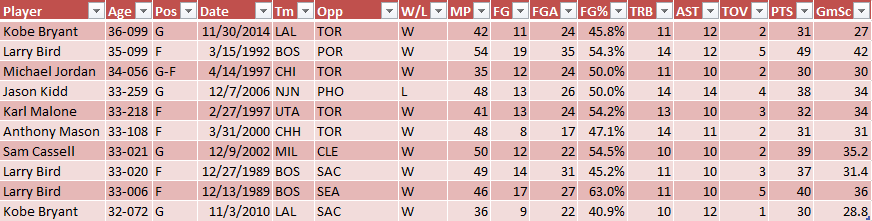
It’s another Monday morning which means the NBA Power Rankings are rolling out in a state of infinite arbitrariness, but deep down in the western corner of the country, Kobe-colored confetti is raining from the skies celebrating the Lakers fourth win in 17 games this year. We’re about 20% of the way through the 2014-15 season and the Lakers are probably near the bottom of the aforementioned power rankings, but we don’t care because this post is celebrating the weird accomplishment of Kobe last night. No, it’s not becoming the first player in NBA history with 30,000 points and 6,000 assists, although that’s mostly an incomprehensible achievement that speaks to the highly irregular elite play which he’s sustained for so long. But instead of looking at macro-Kobe, we’re going micro-Kobe and exploring his individual performance against power ranking darlings, the Toronto Raptors.
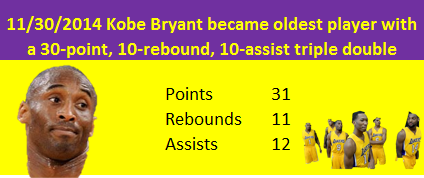
In 42 minutes, Kobe triple doubled with 31 points, grabbing 11 rebounds and repeatedly finding good looks for his teammates while tallying 12 assists – a Lakers individual high this season. If we want to get semi-nitty gritty, Bryant had just two turnovers and attempted only one three while putting up his highest game score of the season at 27. It was a gem of a throwback game from a player putting up one of the best individual seasons we’ve ever seen from a 36-year-old.
[It’s taking a thorough amount of self-restraint to not go full on research mode and dig into that Larry Bird game from 1992 when a 35-year-old Larry Legend executed a 49-point, 14-rebound, 12-assist game on Portland, but we’ll save that for a rainy day.]
In what otherwise feels like a lost season without meaning for LA’s first basketball franchise, Kobe and his MASH unit continue to find ways to make games interesting and add meaning through effort. Kobe’s me-first game and me-first personality have a polarizing effect on fans and people who don’t know diddly about basketball, but all the same, a 36-year-old Bryant is still revealing himself as a professional fully committed winning every night – even if those wins are coming at the most infrequent pace of his career. Sunday night while languishing at the bottom of power rankings, Kobe’s game came together and he willed the Lakers to a victory over a shorthanded, but superior Raptors team. It took a herculean effort from Kobe and quality performances from his mates, but in a season without spoils, even the scraps are easy to savor.
Up in Minnesota where winter is perpetual and ice ages are annual occurrences, the most intriguing pro athlete is banged and bandaged, unable to share his gift with the native Minnesotans who love him. It’s not future Governor and Minnesota Twin, Joe Mauer. Nor is it the switch-wielding Adrian Peterson of the Vikings. It’s not a hockey player either and if it was I wouldn’t know him. Ricard Rubio I Vives (said with the Spanish accent of an American, the words pop with flair and gusto), aka Ricky Rubio, is the most special of all Minnesota’s pro athletes. And after destroying his ankle on the night of November 7th, he’s shelved for no one knows how long as Minnesotans cope by listening to “Ain’t No Sunshine” by the late, great Bill Withers because if Elton John taught us anything it’s that sad songs say so much.
With the immaculate outlet passing of the wide-bottomed Kevin Love gone to the rosy environs of Cleveland, Rubio’s natural joy and effervescence has quickly become the guiding light of the young Wolves’ identity. In the four full games they played before the ligaments of his ankle shredded, Rubio infected his team with fun – laughing, smiling, sharing, competitive fun. They were 2-2 and showing the earliest signs of young definition. Always a great passer, Rubio was assisting even more with a career-best 55.5% assist rate and 11 assists-per-game in the four full games in which he appeared. His rebounding was up, his three-point attempts cut in half. Historically a sub-40% shooter on two-point field goals, he was up over 44%, but most interesting was his scoring on assisted plays. Prior to this season less than 18% of his two-point buckets came on assists, but this season it more than doubled up to nearly 37% which is significantly above the norms we see from point guards. In the tiniest of a sliver of sample sizes, Rubio’s prodigious talents were merging with patience and improved decision making and the entire team was benefiting.
But what does it mean to lose the jewel of the 10,000 Lakes, that bright and shining beacon of the great snow blanketed north? Aside from the young Wolves (seventh-youngest team in the league) going from one of the most exciting teams to watch with Rubio they’re suddenly like a canoe of fisherman floating through the frigid Great Lakes with frozen snotsicles hanging from noses, men without spears and without oars, hunting for game which they can’t find, lost in the chilling mercilessness of a brutal voyage. Minnesota is a winless basketball team without Ricky, his absence felt in nearly every aspect of the game, but most notably his infectious positivity which can keep a team sane through the leanest of times.
The Wolves are now shooting more threes, but making less, unable to find the easy shots which Rubio creates. They’re guided by a 19-year-old wing miscast as a point guard in uber-athlete Zach LaVine. Not surprisingly, turnovers are up and assists are down. ORtg and points-per-game are falling like sad snowflakes alongside dips in shooting percentages. Most telling is the hit to DRtg. With Rubio, the team had a 104.5 DRtg which is better than the league average, but without the maestro that number leaps to 121.6 which is worse than the Lakers’ miserable 117.8. To be fair, the two drivers of that spike are a couple of blowouts against New Orleans and Dallas, but with Rubio, those blowouts are maybe mere six-point losses with character building competitiveness.
Stats from Basketball-Reference.com
The timetable for Rubio’s return from this severe Grade three ankle sprain has been listed as 7-8 weeks which puts Minnesota at a Rubio-less disadvantage until sometime around Christmas or New Year’s. While 7-8 weeks can fly by in metaphorical blinking of eyes, that same time for a maturing team can seem like ages, particularly if the losses keep piling up like thick layers of ice. No one had great expectations for the Wolves this year, but missing out on 25 or more games of prime gelling opportunities is sickening and saddening for Wolves disciples and b-ball fans alike. So as much as Ricky is missed and we want him back as soon as physically possible, let’s hope he doesn’t rush and risk further injury. To paraphrase Mr. Withers, “ain’t no sunshine when Ricky’s gone, only darkness every day.”
Two nights ago, NBA preseason made a stop in Des Moines Iowa for the first time in 17 years. Denver vs. GSW was the matchup hyped as Harrison Barnes‘ homecoming of sorts. Despite two mostly ho-hum seasons as a pro, central Iowa loves itself some Harry B. Iowans turned out in huge numbers and overwhelmed the Wells Fargo arena staff (more on that in a bit) … If I recall, the last game here was between the KG/Marbury T-Wolves, and Ray Allen‘s Bucks. Fendo (Ed’s note: Fendo has little recollection of this) and I attended that game together. The only vivid memory I have is KG making some ridiculous facial expression for a child behind the bench taking photos. I remember nothing else about it. Three years earlier, Denver and GSW played here and I was entered into a contest (without my knowledge) to be a ball boy. I won and had an experience that was … unforgettable. Anyway, here are a few things I noticed the other night.
Security was wanding people on their way into the arena, which is annoying enough on its own but to make matters worse, they only had one dude with a wand for every set of DOUBLE doors. There were seriously hundreds (thousands?) of people at each of the three entrances waiting to get in. We waited 15 minutes and only missed three minutes of game. Some folks had to have missed nearly the entire 1st quarter or more. A man scanning tickets – who appeared to be in charge – had a look on his face like he wanted to vomit. He just knew a shit storm was coming his way … Never seen wands at WF Arena, or an NBA game. It appeared they were looking for guns and while I can’t be certain, I’m guessing the number of firearms they found was zero.
Wells Fargo Arena in Des Moines, where an NBA game was played recently
Every time I go to a game, I’m amazed at how thin these guys are. This was the closest I’ve sat, and man, they all look damn skinny. Even the dudes that look beefy on TV are lean.
Kenneth Faried‘s lucky if he’s 6’6″. I noticed him standing next to Arron Afflalo, and he couldn’t have been more than two inches taller. Faried closed out on a Klay Thompson shot (all net despite a good contest) and they jogged back together chatting it up. He’s shorter than Klay, but he’s everywhere on both ends which appears to make up a bit for his size. Plays like a guy that just loves to hoop. He’d be fun to have on your squad as a coach or teammate.
Barnes hasn’t improved. He showed no indication he’s added anything to his game.
Denver’s got an interesting mix of bigs. Mozgov’s got a nice looking stroke. He hit his FTs and buried a three from just off the top of the key. Jusuf Nurkic is huge. Each of his legs probably weighs at least 100 pounds. He needs to adapt to the speed of the NBA (got caught slow on some rotations and picked up dumb fouls) but he’s so big that once he gets it down, he could be one of the better interior defenders in the league. Pretty decent spring off the floor too. He worked hard to post up, but didn’t get as many touches as he should have. Denver Coach Brian Shaw really coached him up before he checked in and when he came off. I’d bet Shaw would love to get rid of Javale and wouldn’t feel too bad if he got hurt. There’s no way he likes that guy. He and Hickson didn’t play a single minute, but appeared to be enjoying themselves.
Nate Rob didn’t play either, but was into the game – except for during the Q1 break when he and Hickson spent a team huddle staring at, and discussing, the Iowa Energy (D-League team) dancers. They must have seen something they liked because they were laughing as they nodded in agreement and gave each other dap.
Golden State Coach Steve Kerr looks like he wants to run Andre Iguodala at PG with the 2nd unit. Had him out there handling the ball a lot with guys that won’t even make the team. Shaun Livingston did NOT look happy during timeouts. I don’t know if he was being held out for some reason, but his displeasure very well may have had to do with Iggy playing that role.
Kerr’s suit looked like it cost $10k. What’s a $10k suit look like? I can’t really describe it, but you just kind of know an expensive one when you see it.
Gary Harris is a small guy. He may not be taller than Steph Curry and has a young guy’s body (Curry’s got some definition to him nowadays). My first thought when I saw Harris was, “This guy might be too small to play SG.” And then he got the ball in transition and SMASHED on some poor GSW big man, plus the foul. It was the most impressive play of the night. He got open and hit some jumpers too. He’s fast and athletic and could be a nice player (both in real life and fantasy) this season if Denver loses a guard or two.
James Michael McAdoo had 20. He’s fighting an uphill battle to make GSW and has to kick himself daily for not coming out after his first year at UNC … Jason Kapono played for GSW late in the game and buried a three (or two). I didn’t know he was there until he got into the game. It was like that scene in Major League where Willie Mays Hayes wakes up in the parking lot and smokes those dudes in that race. “Get him a uniform.”
Aside from the metal detector debacle, it was great. Better ball than I expected from a preseason game, and very well attended. Des Moines and WF Arena should be pleased. They’ve got an application in for March Madness for ’16-’18 and drawing 10,000 for preseason NBA certainly doesn’t hurt that cause.
There are giants smaller than Jusuf Nurkic. At 6’11”, 280lbs, and having just turned 20, the massive Bosnian takes up space in ways that call to mind an Eastern European Jahidi White. He’s a rookie for the Nuggets, just drafted this past summer by the Bulls, but immediately traded to the Denver. It’s only pre-season so all this evidence we’re piling up is merely a miniscule sampling of a kid dipping a giant big toe in the paint of American pro basketball, but the early returns are cause for intrigue beyond the Mile High City.
Nurkic on left
Just ask Taj Gibson, the 6’9” all-world sixth man, ball of quick energy who’s held down the Bulls bench units since before Nurkic was even playing ball. Gibson was tasked with bodying up Nurkic in Monday night’s pre-season game and was soundly manhandled. In some ways it’s not surprising since Nurkic outweighs him by around 50 pounds, but if mass and weight were the only indicators of post-play success, then Luther Wright and Oliver Miller would’ve been enshrined in Springfield long ago. But there was Nurkic, a basketball beast in high tops, making seven of his nine shots, scoring 15 points in just 14 minutes on what SB Nation’s Denver Stiffs blog described as “very nifty post moves.” On the flip side, he also committed six fouls. If anything, I guess we know he was active.
Having seen snippets of Nurkic play in Denver’s pre-season opener against the Lakers, his feel for the game was evident even in a night where he shot a crummy 1-8. Laker reserve center Ed Davis looked like Billy Madison against a bunch of little kids as he repeatedly rejected Nurkic’s predictable interior attempts, but the big man still found ways to impact the game with nine rebounds, three assists and a blocked shot in 20 minutes.
It’s still too early to make declarations about a guy who projects to be the Nuggets’ third-string center, but his size, feel, and ability to improve game-over-game are positive indicators for the Denver faithful. We don’t love you just yet, Jusuf, but we’re happy to get to know you and see where it goes.
What a night. What a fucking night for the NBA, for the game of basketball, for Nate Robinson, Steph Curry and Manu Ginobili. What a night for Twitter and the screaming woman at the Spurs game. What didn’t happen? Game ones of the second round: Bulls @ Heat in the early game and Warriors @ Spurs in the later game.
The Heat were 11.5-point favorites and for good reason. Coming into tonight, Miami was 39-4 at home (counting playoffs) and was mostly healthy with the exception of Dwyane Wade’s nagging knee injury. We all know about the Bulls: Kirk Hinrich’s out with a calf injury, Luol Deng’s dealing with fallout from a spinal tap gone wrong and we’re all depleted from the media throwing Derrick Rose on repeat and forcing us to listen over and over. So the Bulls rolled out Nate Robinson, Marco Belinelli, Jimmy Butler, Joakim Noah and Carlos Boozer. They did everything. Every damn thing you could ask for from a group of rejects (Robinson and Belinelli), outcasts (Noah), overlooked (Butler) and scorned (Boozer) players.
Down the stretch of this game, with Noah compulsively hustling and diving, scowling at opponents and teammates alike with long tendrils of hair stuck to his sweaty face, the Bulls stared up at a slight fourth quarter deficit of four points; but if felt like a Miami’s game all the way. How many times this season have we seen the Heat cruise through three quarters against lesser-talented teams only to turn up the intensity late in the game and walk away with easy victories. And when Jimmy Butler, all 6’7” and 220lbs of chiseled Jimmy Butler, attempted to wrap up LeBron on a fast break, but was overpowered by Bron’s lefty layup, I was impressed and relaxed, thinking Miami was just closing out another victory against another helpless victim. But I was oh-so-fortunately wrong and had no idea what was about to happen. The Bulls hit three threes (two by Belinelli and one by Butler) in the final five minutes, they shot 9-10 from the line and they frustrated the defending champions into missing all five of their shots in the final 97-seconds of the game. Somehow, the Bulls went down to the hardly hostile American Airlines Arena and beat the Heat 93-86 including a 35-24 fourth quarter.
For all that happened (Nate Robinson) and didn’t happen (Miami scoring points—they had their lowest point total since an 86-67 victory over these same Bulls on 2/21), what stood out most to me was Dwyane Wade’s irrationally selfish decision, coming out of a timeout, to chuck up a contested three at the 1:07 mark of the 4th quarter with his team down two points. On so many levels this was a bad shot. Many of us have become accustomed to the “hero ball” or “toilet bowl” offense where we get Paul Pierce or Kobe or Melo pounding the air out of the ball followed by a contested three. We all know it’s a bad shot, but there’s a level of latitude for the players I just mentioned. And Wade’s earned plenty of latitude in his career as well, but not enough to pull the shit he pulled on Monday night. Miami couldn’t have possibly drawn up the Wade-from-the-top-of-the-key special, could they have? Let’s look at some Dwyane Wade stats:
Dwyane Wade shot 25.8% from three this season
He was 2-18 from three over his previous 33 games
Wade was one of the least accurate three-point shooters in the league; finishing just a few percentage points better than only three other players (Lamar Odom, Reggie Jackson and Kevin Love) who made at least 17-threes this season
No Threes Allowed
I’m elated for the Bulls. It feels good and I don’t want to take away from their resilient victory, but I can’t get over Wade’s three; just a baffling, baffling shot.
It took a while to get over that first game. There was a sense of low-level adrenaline running through my body after the Bulls withstood the Heat’s meager comeback attempts. But during the NBA playoffs, there’s no time for dwelling on the past. I opened my celebratory beers and was pleasantly surprised seeing the Warriors confident and comfortable on the Spurs home court. Up four at the half in the AT&T Center? Well yes, yes of course.
All hell broke loose in the third though. Steph Curry started raining fire from the skies like a light-skinned basketball-playing Zeus firing bolts into the round cylinder. The Spurs crowd cringed with every blow, flinched at every shot release. At one point, the camera showed Gregg Popovich standing still, his eyes closed, his head hung down, but far from out. He looked like he was attempting to visualize the solution to this problem and for a split second I imagined Popovich taking the law into his hands Tanya Harding style and whacking Curry’s knee with a baton of sorts. We both snapped out of it though and after a patented succession of Warriors mistakes to end the third quarter, the dust had settled and Curry’s third looked like this:
Minutes: 11 minutes, 56 seconds
FG/FGA: 9/12
3p/3pa: 4/6
Assists: 3
Turnovers: 0
Points: 22
Golden State 92, San Antonio 80 (end of third)
There was a sense, I think, in many of us who had been here before, who had sat through the Warriors’ near collapse on Thursday night in game six against the Nuggets, that trouble loomed ahead, that all the Curry-fueled momentum in the world wasn’t going to make this any easier. And it wasn’t. The Spurs used every ounce of savvy and veteran poise and whatever other cliché you want to dress them up with to outscore the Warriors 26-14 in the fourth quarter.
The Curry third quarter, the Spurs comeback; it all evolved or devolved into some kind of brilliant basketball game that etched itself deeper into our minds and stomachs, intertwining itself within the gray matter of our brains and the slimy coils of our intestines. Harrison Barnes, Draymond Green, Kent Bazemore, Andrew Bogut, Steph Curry, Jarrett Jack … a professionally-trained youth movement apparently oblivious to the fear that rides shotgun on their road to fate. On the opposite side, it was the familiar faces that have stalked the league so patiently with their secretive wisdom and insider humor: Pop, Tony Parker, Manu Ginobili, Tim Duncan and a strange cast of characters that plug into roles that feel tailor made: Boris Diaw, Kawhi Leonard, Danny Green. They came and they came and they came. The old men with their flu bugs and bald spots and interchangeable pieces; a group of calm Texans embodying the same ethos of the Bulls. And somehow, after being down 18 points in the third quarter, the Spurs won in double overtime. Do you believe in Boris Diaw corner threes or nights where Manu Ginobili shoots 5-20, but hits the one that really matters? Fuck man, I don’t know, but I saw it happen.
Some notable items from this insane game in San Antonio in May:
Golden State shot 14-24 (58%) from the free throw line
Golden State is a 79% free throw-shooting team on the regular season (good enough for fourth in the league)
Boris Diaw: The big Frenchman had a series of big plays that helped this Spurs team achieve victory:
He somehow became the only Spurs player able conceive of not leaving his feet to guard Steph Curry. At the 1:22 mark in the fourth quarter, with GSW up five, Curry attempted a little shake move and pull up on Diaw; likely underestimating his defender’s length and discipline. Diaw blocked the shot without leaving the ground.
He went to the line and hit a pair of FTs to bring the Spurs to within one late in the 4th.
Diaw set the screen to free up Danny Green for the OT-forcing three.
He was on the floor for all of both OTs, contributed rebounds, screens and a clutch three.
There were heroes on both teams. Ginobili, Parker and Curry were special tonight, but in the thick history making moments, Diaw’s hand never shook. He played intelligent, confident basketball and is a big reason the Spurs are up 1-0 in this series.
I’ll close this with a line from Jim Morrison that embodies unknowing excitement of tonight and hopefully the days to come: I don’t know what’s gonna happen man, but I wanna have my kicks before the whole shithouse goes up in flames…Alright!
Jason Collins came out of the closet – this is a beautiful thing and people who don’t realize that or see this as a non-story would be wise to take some time to listen to the struggles faced by anyone who’s ever had to hide a part of themselves for fear of being judged, blackballed, ignored or rejected. You don’t have to be thrilled about it, but this is one more person who’s making a massive leap into the world. Be happy for him.
The NBA’s Relocation Committee voted unanimously to deny the Kings request to move the franchise to Seattle. For whatever it might be worth, the NBA Relocation Committee is made up of: Clay Bennett (the NBA can’t not see this as a terribly ironic placement), Peter Holt (Spurs), James Dolan (Knicks), Herb Simon (Pacers), Larry Tanenbaum (Raptors), Glen Taylor (Timberwolves), Jeanie Buss (Lakers), Robert Sarver (Suns), Greg Miller (Jazz), Wyc Grousbeck (Celtics), Ted Leonsis (Wizards) and Micky Arison (Heat).
So here we sit with a day that will reverberate throughout the NBA’s near-term, and potentially long-term, future. I’ve lived in Seattle since 2004 and I attended around 10-15 games per season when the Sonics called Key Arena home. It’s a progressive city, one that promotes diversity and supports alternative lifestyles. You can find anything from thriving art and music scenes to reenactments of medieval battles. It’s a populace that takes full advantage of the gifts nature has bestowed upon it which include the Cascade Mountain range, Mount Rainier, Olympic National Park, the San Juan Islands, Lake Washington, Lake Union and a million other outdoor activities enjoyed by Pacific Northwesterners year-round.
This past summer I read Jim Bouton’s classic insider account of life in Major League Baseball: Ball Four. Bouton was a 30-year-old knuckleballer who pitched for the then expansion Seattle Pilots. In a nod to the city’s long-standing struggle with pro sports franchises, the Pilots lasted a single season in the Emerald City before relocating to Milwaukee and becoming the Brewers. It wasn’t until 1977 that the Mariners came into existence. Bouton spent the spring and summer of 1969 with the Pilots and I recall a small portion of the book touching on the lukewarm support from Seattleites. This is dating all the back in the late 60s. A forward-looking view shows the city’s often strained relationship with the pro franchises they simultaneously support:
In the mid-90s, the Mariners owners threatened to relocate the team if a new arena wasn’t built. In 1995, voters defeated a ballot to pay for a new stadium. Then the M’s made the playoffs and the state Legislature capitalized on the momentum to come up with an alternate funding plan which included a .5% tax on restaurants, taverns and bars and a 2% tax increase on rental cars. Disaster was averted and the M’s got the stadium they demanded. The balance came out to $340mill from the public in the form of tax increases and $75mill from the M’s owners.
In 1995, there was a proposal to issue county bonds to pay for a remodeling of the Kingdome (the Seattle Seahawks stadium at the time). The proposal was rejected (not surprising given the Mariners had just asked for public money as well). At the time, Seahawks owner Ken Behring did what comes so naturally to businessmen and sports franchise owners: He threatened to sell or move the team. Microsoft founder and billionaire, Paul Allen stepped in and committed to buy the team if a new stadium could be built. After some legal/political wrangling, there was a final public/private partnership that included the public contribution capped at $300million and Allen’s company First & Goal Inc. to contribute up to $130million.
On June 16th, 1994, construction began on what was then called Seattle Central Coliseum and would eventually be renamed as Key Arena. The city picked up $74.5mill while the Sonics covered ~$21mill. The intent of the makeover was to bring the then-32-year-old arena up to par with other NBA arenas.
And of course, the Sonics/Howard Schultz/Clay Bennett clusterfuck that resulted in the Sonics being sold to an out-of-town group on October 31st, 2006—so strangely appropriate that the deal was consummated on Halloween.
It’s no surprise that pro sports teams make threats and cities respond. In many cases, new arenas are necessary and the threats are nothing more than negotiation tactics that happen to play on the hearts and minds of local fanbases. But in my limited experience as an observer of these scenarios, it’s somewhat unique for a city to face three of these threats in just over a ten-year span. For a city that was already lukewarm on supporting pro teams with public funds, the Bennett/Stern false ultimatum was the straw that broke the camel’s back. For me personally, this was a watershed moment. I initially sided with the “Save Our Sonics” contingent and would cringe at the numerous editorials telling Stern and Bennett to pound sand. Over the next three years, I would reverse that stance.
Kevin Durant’s rookie year in 2007 was a disaster. The Sonics had been gutted in a way that reminded me of the plot from Major League where widow of the Cleveland Indians’ owner builds a crappy team with the purpose of moving to sunnier climes in Florida. The 2007 Sonics were in full blown rebuilding mode in a city they’d soon be saying goodbye to. They finished with the 2nd worst record in the league and ranked 28th out of 30 teams in attendance. The “save our Sonics” chants that would randomly ring out throughout the season were painfully pathetic; pathetic in the sense that it was a futile chant from a half-empty arena of half-enthused fans. As a regular ticket buyer, I would get promotional emails every few weeks offering lower bowl seats for $15. I’m talking 10 rows back at an NBA game—for $15! No one else was going to the games, so they damn near gave tickets away. Every Durant jumper or glimpse of success was lifeline of hope for Seattle fans that somehow, someway the team would remain here. There were lawsuits, talks of Steve Ballmer buying the team, dreams of investors who preferred Sonics jerseys to shining suits of armor. But it was all for naught and over time I accepted that the team would relocate. It certainly helped that from the time the Bennett group purchased the team up to the release of Sonicsgate: Requiem for a Team in 2009, evidence mounted revealing what most people suspected already: The Sonics had been purchased with the intent of relocating to OKC. After so many months of being lied to, the confirmation of these assumptions at least validated the anger. And with that in mind, please forgive the people of Seattle for not rallying with a Kings-like battle cry.
Watching Durant and Russell Westbrook thrive in OKC didn’t enflame the ill feelings I felt for Bennett or Schultz or Stern. Rather, it hardened me to the cold reality that sports are a business; a chillingly merciless business that, as a collective, isn’t concerned with fans beyond the amount of money they spend or demographics they fall into. This was the end of the child-like innocent fan that lived inside of me. Maybe being 26 or 27 is too old to come to that obvious conclusion, but it reshaped the way I watch and interact with sports and to some degree, I’m thankful for it.
Fast forward to 2013 when the owners of the Kings agreed to sell the franchise to Seattle-born billionaire Chris Hansen. The Seattle streets were covered in throwback Sonics hats, shirts and jerseys. Oskar’s, a local bar just a few blocks from Key Arena, owned by former Sonic icon Shawn Kemp, has been aglow in the potential return of the team. Sonics fans and Kings supporters have sniped at each other on blogs, Twitter and in comments sections. It was a petty, trite game being played; as if mutual love for basketball teams was reason enough to fight with a stranger. Meanwhile, the actual men in control of the situation (Stern, Hansen, Kevin Johnson, the Maloofs, the Kings new prospective ownership group) skated by with minimal criticism outside of Seattle and Sacramento. All of us sat and waited anxiously for the verdict of a 12-man jury; the aforementioned Relocation Committee. They voted unanimously to keep the Kings in Sacramento. For once they voted to eschew the money in favor of doing the right thing; of doing what they should’ve done six years ago when Clay Bennett purchased the Sonics. For once, this money grubbing association got it right. With any luck, the league’s setting a new precedent for itself; one that will see it work more closely with local politicians instead of divisively as we saw with the Sonics situation. (The Sacramento arena deal breaks out like this: the city takes on $258mill [primarily from parking fees and ticketing fees] while the investment group would account for $189mill and be responsible for all capital improvements.)
In the process of the vote, the NBA changed the rules of the game on the people of Seattle while simultaneously getting it right for the fans in Sacramento. For the people of Seattle who supported this team and league uninterruptedly for 40 straight years, this vote is grossly unfair. The league created an environment where inconsistency exists and it’s within that environment that they should have alienated a market, but sadly that won’t be the case. People will still invest time, money and emotion in getting pro basketball back to Seattle and I do respect their resilience; their ability to separate the anger from their passion.
As for Jason Collins … I’m happy for the man. I find it amazing that this is still a topic for discussion. Part of my amazement may stem from the fact that I’ve become an adult in ultra-liberal Seattle where terms like “social justice” and “white privilege” stay on the tips of tongues; where marijuana and gay marriage are both legal. I spent my Saturday night at the Seattle Poetry Grand Slam where young, creative, expressive, strong poets stood vulnerable on a stage and expressed themselves and, in some cases, their sexuality in front of a packed Seattle Town Hall. They expressed their struggles through beautiful emotive words with a raw, but harnessed energy, but their descriptions of their love didn’t escape my realm of knowing or comprehension. The pain and sadness of not being accepted rang through their voices and met the crowd who groaned in painful understanding. And I think about Jason Collins alone in locker rooms, on buses and planes, surrounded by homophobic slurs that stung; sometimes more than others. That loneliness is so unbelievably unfair. For this man to finally reach a level of comfort to expose himself on the largest stage in the world makes me want to hug him in acceptance and support.
After John Amaechi came out in 2007, I think there was a hope that his revelation would lead to more gay athletes following suit, but in terms of the major sports leagues, that hasn’t been the case. With gay marriage gaining nationwide support, the issue has again risen to the forefront of athletics where former Baltimore Ravens linebacker Brendon Ayanbadejo recently commented that four NFL players may come out on the same day as a way to relieve the pressure of going it alone. Whether or not Collins’s decision is based in large or small part on the current climate of improved gay rights awareness, his coming out is nothing but a positive and it feels good to see an NBA player leading the way and getting the overwhelming support he received today.
It’s a good day to celebrate the two-year anniversary of a blog and it’s a good day to honor what this game has brought me not just over the past two years, but the past 25 years of my life where basketballs have been bouncing, nets splashing, struggles struggling—be it labor wars, substance abuse, homophobia, media, marketing, or the actual on-court product. Basketball has provided me an outlet from the stresses of being a living human being in the 21st century and given me a lens through which to see the world unfold in a most a familiar context. I’m thankful for days like this when the league gets it right even if they’re jobbing my city in the process.
Encourage your local and federal representatives to fully vet your NBA owners
In a vacuum, I think all of us can agree that what Kobe Bryant’s doing in his 17th NBA season is mostly ridiculous. With a handful of games remaining this season, Bryant has amassed 1,456 games (playoffs and regular season) and spent 53,897 minutes on the court. To list off his accomplishments, both statistical and of the award variety, would be like reading through a ledger that includes every sin any of us committed. It would go on and on and we’d fall asleep out of monotonous exhaustion and boredom and then we’d wake up and the voice would still be droning on.
For me, and I assume, for many of us, one of the most impressive aspects of Kobe’s long, long run has been remarkable consistency of it. So many games and years later and the man is still performing at a level that exceeds his career averages (his career averages are admittedly tipped by his first three years in the league). His game is as identifiable as any player’s in the league. Just when we think he’s lost a step and is on the decline (2011 appeared this way), he bounces back with Orthonkine therapy and back-to-back 27ppg, +20PER seasons—at ages 33 and 34.
Being the lightning rod he is, Kobe’s accomplishments come hand-in-hand with overreaction from the pro-Kobe and con-Kobe camps which are both bolstered by millions of basketball fans who sit at computers or on smartphones pounding away at the keys and venting through Kobe-based superlative arguments. The objective or indifferent fans marvel at Kobe’s resilience and shot-making ability while shaking their heads at the head-scratchingly bad shots or lackluster defense that we’ve all grown accustomed to seeing.
But as I started this post, I’ll reiterate: In a vacuum … I’m not interested in opening up or hashing out or re-hashing debates that have no ending. After Kobe’s game yesterday, a 14-point loss to the Clippers that gave them a 4-0 sweep in the Battle for Los Angeles; a game in which Kobe played 47 minutes (Mike D’Antoni’s never been shy about running guys into the ground and most elite athletes need someone to force them to rest, so the Kobe/D’Antoni combination is mostly a poor match when it comes to the long-term consideration of Kobe’s physical health), I found myself asking: Who does this? Who plays 47 minutes at 34-years-old? Who’s 34 and putting up 25 points and 10 assists? So I did what I do, I had to answer this question for myself and the answer was interesting enough to share it with you:
I took Kobe’s season-to-date stats (as of 4/8/12) and plugged them into Basketball-Refrerence.com and took a look at how this season compares historically at a couple different levels. First off, I just focused on players who have averaged at least 38 minutes/game at age 34 or older. I don’t know what my hunch was going into this, but as I think more about it, it makes sense that only a few times in league history has circumstance demanded a player of this age pour so much of himself into the game and only so many times has the player actually been able to hold up to the rigorous demands of an NBA schedule for so many minutes every night:
It’s an interesting list. Of the 15 seasons included there, only three players went on to win titles (Jordan, Bill Russell and Wilt Chamberlain in 1972). With the exception of Lenny Wilkins’ Cavs in 1973 and Anthony Mason’s Bucks in 2002, each player did make the playoffs, although it’s worth noting that several teams were low-seeded playoff teams that needed every ounce of production available from their best players—similar to the Lakers dependency on Bryant this year.
To take it a step further in terms of production at age 34 or older with 38 minutes or more played each night, I layered in points, PER and Usage%. Only a single other player compares favorably to Kobe in these measures:
MJ edged Kobe in PER (25.2 vs. 22.7) and usage rates (33.7% vs. 31.8%), but in both cases, these teams relied on these shooting guards for so so much production. The results were drastically different and the purpose of this post isn’t to delve into that aspect of these post-34 seasons, but to explore the rarity of what an aging Kobe Bryant’s doing this season which is about as rarefied company as you can come across. As an aside, these explorations often reveal some unexpected random piece of information and in this case it’s Karl Malone’s 2001-02 season where he averaged 38mpg as 38-year-old power forward and had a usage rate of 28.8%. For perspective, that 28.8 would rank 8th overall this season and place him ahead of James Harden—and he was 38.
Someday we’ll say goodbye to Kobe, but it appears it’ll be a lot later than a whole gang of people thought…











 Dancing With Noah