It didn’t take long for the big red balloon of optimism to pop over the city of Chicago and rain down tears in the shapes of dripping red-hued question marks. All the finger pointing in the world (at Thibodeau, at the shortened season, at Derrick’s delicate 2012 body) won’t put Derrick’s ACL back together again, so let’s march on for a quick review of Saturday’s agonies and ecstasies:
Philly at Chicago, game one: The Bulls were their controlled, dominant selves with Rip Hamilton flashing and dashing off baseline screens and running Philly defenders ragged like it was 2004 all over again. If the Bulls, sans Rose, can somehow continue to score close to 100 points, this series won’t last long. They know how to behave with C.J. Watson at the helm and will continue to execute Thibodeau’s air tight game plans, but can Doug Collins’s squad find a way to step up their defense and put points on the board against a stubborn Bulls team? I don’t know, but I’m guessing Lavoy Allen is not the answer.
Random fact: Chicago was 22-0 when scoring 100 points or more this season.
New York at Miami, game one: 100 to 67? So much for the hype machine, Melo vs. Bron, Amar’e vs. Bosh, Shumpert vs. Wade (?) and New York’s three-point bombing bench. This was supposed to be the matchup we were all slobbering over, but instead game one had that dreamlike falling feeling, but we never woke up; or at least the Knicks didn’t wake up. Since no one really knows who the Knicks are (Knicks included), it’s impossible to imagine what we’ll get in the next three to six games, but my buddy Bug made a great, although mostly unrelated, point: Miami with Tyson Chandler instead of Chris Bosh would be a nightmare.
Random fact: Miami finished the regular season 18-0 when shooting over 50% as a team. Translation: LeBron and Dwyane: Don’t give into temptation, avoid the three.
Tragic ending: To Iman Shumpert’s season. Like Rose an hour or so before, the rookie who’d been somewhat prematurely anointed as one of the league’s top perimeter defenders (already?) tore his ACL as well.
Orlando at Indiana, game one: Here’s another one I caught on the highlight reel. The stories of this game: Danny Granger wet the bed, Roy Hibbert blocked nine shots (life’s a lot simpler when you get Big Baby instead of Dwight Howard) and Stan Van Gundy continues to build support in the ongoing Dwight vs. Stan feud.
Random fact: The Magic is 10-1 all-time when winning game one of a series.
Dallas at OKC, game one: The legend of Kevin Durant continues to grow. He got a true shooter’s bounce to win the game for OKC and send the bench and hometown fans in euphoria. Even though some of the names and faces have changed and James Harden’s beard takes up a little more mass, it felt like carryover from last year’s Western Conference Finals—minus Dirk being perpetually en fuego.
Rejected!: OKC led the league in blocks per game and their 8.2bpg is the fifth most per-game total in league history. They tallied eleven blocks on Saturday.
Sunday’s games added more piss and vinegar to the mix (we see you, Rajon). I’ll be back here tomorrow with another recap. And in the meantime, leave us all to ponder if anyone plays with a Marc Gasolian zeal for the game. It’s like he took all that energy his brother has channeled into primordial roars and re-directed it to positivity and an acknowledgement that he’s paid to play basketball for a living.
Sometimes we go through hiatuses and require a divine intervention, an intoxicating muse or maybe just a bizarre stat to snap us out of our doldrums.
So it was tonight when I was looking at the box score from the Mavs-Jazz game which ended in triple overtime with the Jazz getting a huge 123-121 win. Six players played over 50 minutes, the teams combined for 62 free throw attempts, five players scored over 20, Al Jefferson had 28 points and 26 rebounds, Dirk put up 40. The game was stuffed with numbers of all kinds, but what stood out the most was a pair of zeros side-by-side, attention grabbing emptiness: In 54 minutes and 4 seconds of play, Al Jefferson attempted zero free throws.
This is a man who grabbed five offensive rebounds and took nine shots in the paint. He spent time most contentious area of the court, but didn’t get to the line once. In all fairness, no one fouled out this. It wasn’t a foul fest or a game won or lost in the trenches. In terms of free throws attempted, the 62 combined free throw attempts were just a few more than the league’s FTA average per minute.
But the 0-0 in 54 minutes made me wonder who, if anyone had ever endured this kind of FTA allergy. And so I took a look at basketball-reference’s player game finder (dating back to 1985-86) and came up with the following, not-so-coveted list:
The Lakers-Nuggets game is just wrapping up and I’m seeing St. Patrick’s own Al Harrington drop 24 from a variety of spots on the court; a typical performance from a man who’s remarkably expanded his game to include the three-point shot.
Today, I salute Al Harrington for both his commitment to growing his game and the fact that he’s a member of the recently created 5,000-800 Club–that’s at least 5,000 rebounds and 800 threes made. What does all that mean? It means he walks with Hall of Famers (Kobe, Gary Payton, Dirk, Pierce) and belongs to a small fraternity of long-range shooting big men who exist in part to confoud video game developers (Tim Thomas, Cliff Robinson):
Blake Griffin‘s dunk last night brought up a spirited exchange about dunkers on an email thread at work, so I figured I’d share not just one of my favorite dunks, but my favorite post-dunk taunt/celebration/expression of all time:
We’ve got some great dunkers in the game these days, but either David Stern’s stamped out spontaneous expression or players are too hooked on scowling and staring to drop low and give a double point a’la SHAWN KEMP:
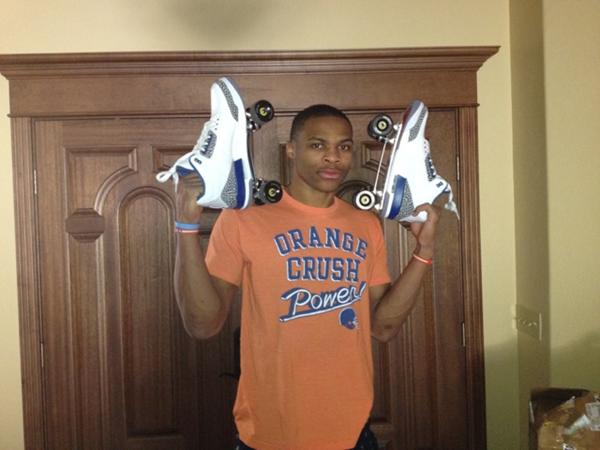
OKC did the right thing on Thursday when they gave avant-garde roller skater and sometimes NBA point guard, Russell Westbrook, a contract extension. While OKC played it cryptically and refused to disclose the terms of the deal, sources are calling it a 5-year, $80 million deal with no opt-out clause.
I kicked around the idea and got excited about it like it was some kind of realization unique to me, but I have my doubts. I mean, if Greg Anthony and those cats are talking about it, I’m far from original, but I figured since I thought of it independent of Greg Anthony, but possibly in dependence (would agreement be more appropriate, cahoots?) with Jim Buss (oh, the skin crawls just thinking I might agree with this Buss), it was worthy of a developed post here. And so I bring you the question: Is Andrew Bynum on par with Dwight Howard?
Before anyone goes all Stephen A. Smith on me and covers their keyboard with spittle or coffee or whatever’s in your mouth, I request the opportunity to define the terms of the question and answer.
I arrived at this question way back last week and would’ve asked it on the spot, but DeMarcus Cousins got the best of my limited attention span, so I had to wait until now. After serving his four-game suspension for flattening the smallest man in a Mavs uniform in last year’s playoffs (wrong place, wrong time, JJ), Andy B. returned to the court for the Lakers on New Year’s Eve and imposed his knees and arms all over the faces of the Denver Nuggets. Bynum is listed as a mere 7’0” tall, but I can’t help but second guess this listing as my TV projects the man to be mammothly large and possessed of limbs that stretch and stretch up beyond the heights of your everyday, average NBA seven-footer. It’s these same limbs that make anyone who watches Laker games cringe when he jumps or stretches for a loose ball for a couple reasons: First: His injury history precedes him (over his six-year career, he’s averaged 55 games/season … he misses, on average a third of his team’s games every season) and second: Those legs, as much as they’ve developed in terms of strength and balance, still conjure up images of Bambi or some other four-legged creature with legs that are far too structurally weak for the physique that sits atop. This haunting fear that Andy’s legs aren’t ready for his body may be a thing of the past, but old fears die slow … or they get medicated. Back to New Year’s Eve, the new introduction for Andrew Bynum, his first game being coached by new Laker Coach, Mike Brown. His first night out he shot 13-18 from the field, grabbed 13 rebounds and finished the game with 29 points. Welcome aboard, why yes, the Lakers have plenty of minutes available for a man who can do these things on a regular basis, but therein lies the variation between Dwight and Andy: Can Andy do it every night? Will he stop parking in handicapped spots and cramming his still-growing frame in Porsche 911s and just focus on his core—in the Billy Blanks sense, not the Jabbar sense.
Whatever Andy does off the court is just an expression of sorts, but it’s in part who he thinks he is, who he thinks people want him to be and who he thinks he should be. It’s all a juggling act and sometimes the groceries fall down and big, tall Andy Bynum, a world champion has to reach down in the grocery store and pick up his own vegetables when really, we’d all like to see him focused on the task at hand which is health and consistency as a Los Angeles Laker. So the first game was nice, but let’s see what followed and what we can see ahead, maybe to the future if they’ll even accept our probing inquisitions.
We don’t need the Hubbell telescope to see these stars, we have basketball -reference.com instead, an aggregator of all things black, white and numerical that have occurred in the NBA. Just know how to ask. Well, I asked and it turns out Andy’s first game against those Nuggets of Denver wasn’t no fluke (not no fluke I said). His performances on the young season:
18.8ppg
1.7bpg
3.3 TO/g
15.7rpg – that’s where it’s at
And over 50% from the field.
He’s less efficient than he has been in the past, but increased opportunities are going to lead to declines in efficiency.
Among the nights that made up the averages you see above was a masterful, fan-fueled evening at the Statples Center where Mr. B achieved his career-first 20-20 game. It was done against Houston on Wednesday night and it has to be noted that the Rockets’ front court isn’t quite mediocre. It’s not from a lack of effort. They tried for trades, but ran into David Stern’s heavy handed gavel. Don’t you think Pau Gasol for Houston would’ve made it more difficult for Andy to achieve 20-20 than Pau Gasol for Los Angeles? Houston couldn’t hold down the 7’2” Bynum and so it was on NBA TV, I believe, I began chewing the fat that not only are the Lakers maybe better with Bynum than Howard, but maybe Bynum’s just better than Dwight.
Better and different are words that walk a fine line and when they’re used together like that it’s usually to dispel a given notion or just to engage in a deeper dissection about Dwight Howard and Andrew Bynum.
On that same night when NBA TV was flashing graphics and stats like they’re tuned into the mainframe of NBA statistical databases and can present these informations with just a glance at huge HD screens, that’s when the topic came to Greg Anthony and his partners (Kenny? Webber? Both?). Anyhow, they big upped Andy’s accomplishment and then showed how many 20-20 games Dwight has had in his career (playoffs included): 39. Damn.
This disparity between 20-20 games really got me thinking and slicing the argument in different ways because as great as 20-20 is, you can hide a basket of fundamental flaws beneath the weight of those robust numbers that have the power to shape the ideas and contracts of American sports team owners which clearly isn’t our intent here because we’re just asking a few innocent questions.
Since I like boxing, I felt necessary to introduce the Tail of the Tape to this strange conversation that lost its way a while ago and continues to falter as we take our little steps forward.
Andy B
Dwight
Age
24
26
Height
7’2″
6’11”
Weight
285
240
Games
337
575
Playoffs
62
57
Minutes
over 9500
over 23k
Seasons
in 7th
in 8th
20-20 Games
1
39
Awards
2 Championships
Only family members and people who are paid by Dwight or the Orlando Magic should be forced to count his awards. The lists are redundant and bleed into the same award after 15 seconds.
If this were boxing, we’d all be enamored with the physical advantages held by the younger man. We’ be applauding lesser usage and predicting years of Dwight jumping up and down on pogo stick legs would eventually give out in a way that not even WD40 can resolve, but instead we’re looking at two very different basketball players who play the same position but do it so differently and do so for so many reasons.
Beyond the futuristic athleticism that was bestowed on Dwight by a combination of the Gods up on basketball Olympus and the genetic engineers over at Georgia Tech, the man has the Russellian/Rodmandian ability to dominate a game without having to shoot the ball. Whether he realizes it or not, this is a gift. He’s athletic enough to divert oppositions from painted areas out of fear that he’ll take their precious ball and give it to one of his own teammates if he so chooses. Or perhaps he’ll swat it away, into the hands of a paying customer, excited to be part of the game, amazed at the freakish shoulders of the man in front of him.
But beyond this rare gift is a counter-balance that seems contrived which makes it even worse. Dwight wants the ball. He wants to score it, dunk it, make passes to his friends so they too can feel what it’s like to be part of the big moment. It’s odd that this selfish part of his personality (however real it is) demands the ball for points. It’s really just an extension of his desire to be the center of attention and we all know scorers get the most attention. Dwight’s not a natural scorer though. Does he score and score efficiently? Yes, but for all his private workouts with Hakeem, his offense is still in development stages eight years into the league. And to make matters worse, I don’t think Dwight would give two spits about points if it didn’t mean more attention or if it didn’t mean he’d be more accepted by his peers. Dwight gets his fair share of plays drawn up these days, but he’s still at his best when he’s catching lobs or cleaning up the offensive glass. He uses his indomitable physical strength to outwork or outmaneuver the opposition, his presence alone opening up driving lanes and looks from beyond the arc for a supporting cast that’s been built to complement his skills—occupying the paint. Dwight shouldn’t be the focal point of an offense because it’s not best-suited for his game. If he were ever to come to this conclusion, he’d realize that imposing his will in the Russell fashion allows him to shape the outcome of games in ways that he only occasionally realizes. To be completely fair, Dwight’s only led his team in FGAs/game once his career—last season. His willingness to (mostly) accept the role Stan Van Gundy has carved out for him is commendable, but acceptance and embracing are different things altogether.
Then there’s big Andy who fits the traditional center character-type. He’s comfortable with his back to the basket, posting up and creating his own shots out of the post. His high shoulders and aforementioned long limbs allow him to get his shots off with ease and he’s developed a touch that the more-experienced Howard is still fine tuning. He’s able to reach over the opposition for rebounds without actually going over the back; a bizarre skill that few players possess. Removing injuries from the discussion, there’s an unknown that’s accompanied Bynum his entire career: Kobe Bryant. Bynum is paid like the superstar Jim Buss has always seen him as ($31million over next two seasons), but he’s never had the opportunity to explore the ceilings of his talents because he can’t stay on the court and even when he’s there, he’s the second or third option to Kobe and Gasol. This young season is the first time we’ve seen Bynum on the court for extended periods (34mpg is 4 more than his previous career high and his usage rate is 27% compared to his previous career-best of 20.8%) and the early returns are staggeringly better than anything we’ve ever seen from him. Plateaus aren’t part of the Bynum vocabulary today and until he levels off, the statistical possibilities and in-game impacts will be nothing but speculation.
In Andy’s 330+ game career, we’ve seen snippets of his 2011-12 performance, but it’s never been sustainable. Whether Gasol, Kobe or Phil Jackson impeded his progress, injuries got in the way or he just wasn’t ready for the increased role, he’s never been capable of persistent dominance. And it’d be an act of blind faith to believe the injuries are a thing of the past, but for the first time, it’s not a stretch to give Jim Buss the benefit of the doubt and acknowledge he may be onto something with this big kid. Does that mean Andrew Bynum is better than Dwight Howard? Absolutely not. I’m excited about Bynum going for 18 and 15 over a six-game stretch. Dwight’s been doing this regularly for well over 400 straight games and has the individual honors to prove it. Add in Howard’s commitment to fitness and reliability (he’s missed seven of a possible 583 games) and he’s one of the most consistent and productive players in the past 20 years whereas we’re still praying for an injury-free season from Andy.
Given Bynum’s age and the waves of potential flowing from his massive frame, we can at least hit the pause button on the “big man is dead” statements that have been so popular over the past few years. Andrew Bynum is giving hope to the great Pete Newell and seven footers around the world: You too can play with your back to the basket. He’s not on Dwight’s level yet and may never find that regularity, but in the infant stages of a new season, Bynum is injecting his name into conversations reserved for all-stars and future of famers. The immense ability coupled with the always-present questions about durability make Bynum’s career nerve racking. If I have anxieties and worry about Bynum’s injuries as a basketball fan, I can’t imagine the fears lying in the depths of the minds of Jim Buss or Mitch Kupchak. Bynum’s own feelings about his injuries remain a mystery.
A little Rudy Fernandez to the rookie Kenneth Faried while fellow rookie Jimmer Fredette looks on. Jimmer had to be wondering what kind of mumbo jumbo Rudy was pulling when he chucked this ball up over his head … and just as the final thought flows through ….
In other news … how about those Nuggets? For all the respect and accolades he gets, George Karl is still underrated. Stay tuned for more on the coach and his surprising (to me at least … c’mon, you didn’t see it coming) team.
In the midst of the late summer league circuit, I wrote a post about the passage of myths and legends; about how Youtube, camera phones and Twitter had cannibalized the “I saw Kevin Durant go for 50, no 60, wait wait it was definitely 66 points…” stories. There’s a light lament that gives way to honesty with the erosion of legend. But there’s another unknown that still lives on no matter how technologically advanced we become (unless we end up developing some kind of AI to assess a human’s capability and just play the game through simulations—don’t doubt it) and that’s unrealized potential. Injuries, drugs, alcohol, attitude … tragedy. All temptations and we’re all human so we’re all susceptible. Depending on who you are and what genes your parents passed onto you and where you grew up and when you grew up there; the likelihood of you meandering down one of the dark paths above changes accordingly. Most of us find a way to walk, stumble or crawl straight enough or just make sure our wanderings don’t get too far off the path to become trapped and scrape by for survival.
But… we all know someone or many someones who have gotten stuck and maybe you fucked up too and maybe it wasn’t your fault. Someone close to me struggles to stay straight every day and even though I know his chronology and I know what he’s been through, I’ll never know what his struggle feels like. He’s talented, intelligent, exuberant, equipped with talent to create beauty out of thin air and yet … he’s his own worst enemy.
So we’re almost 300 words in and you’re like, “My man, where’s the basketball?” It’s here, it’s relatable. It’s DeMarcus Cousins. It’s every scouting report dating back to him being a sophomore in high school questioning his consistency, commitment to conditioning, emotional maturity (by 2007, I think the high school basketball scouting industry issued a mandate that all Cousins scouting reports include a reference to emotional maturity), mentioning loafing, asking about his effort and on and on. For every negative or weakness that came attached to a Cousins scouting report, there were five more positives/strengths that usually amounted to “sky’s the limit if he can figure it out.” The question marks above leeched onto Cousins’ reputation and whatever they sucked out, they spewed into the basketball world to be inhaled by people who want to make money off Cousins and are willing to give him things in return. Some probably believe the Cousins question marks were validated this past Sunday when the Kings reported that the 21-year-old had requested a trade or they just see it as one more validation in a half-decade full of validations.
In true DeMarcus Cousins fashion, he denied having demanded a trade. And if you look back through the interviews and clippings that cover his basketball-playing career, Cousins has done a remarkably consistent job of deflecting blame and refusing to take accountability for his actions. Even small concessions have been tough to come by. After his sophomore season in 2007 he transferred from Erwin High School in Birmingham because he got into an altercation with a faculty member (Cousins is insistent it was self-defense and witness reports agree). From there, it was on to Clay-Chalkville High School, but he was deemed ineligible for some recruiting shenanigans and never played a game there. Next it was onto his final high school destination, LeFlore in Mobile. Along the way, from the suspension at Erwin to the ineligibility at Clay-Chalkville to the developing reputation for becoming easily frustrated if an opponent challenged him, Cousins and his mother, Monique, painted a picture of being the victim, referring to DeMarcus as being a “target” and “piece of meat” and insisting that his reputation for being a malcontent was completely out of context and unfair.
I’m not naïve enough to dispute that Cousins was a target for some people or he was treated like a piece of meat. And I can’t fault Monique for protecting her son any way she could—even if it meant three schools in three years and vehemently defending her son against portrayals inconsistent with her idea of the young man she raised. His coach at LeFlore, Otis Hughley, sided with mom and said, “On the court he may be tough, but off the court he’s scared of the dog. He’s not a wussy kid, but he’s a sweet kid. I don’t know anyone that’s met him that doesn’t like him.”
Unfortunately, there’s no guide to raising a basketball prodigy which is exactly what Cousins was. Since the internet has claimed and archived so many moments of his teenage life that should’ve remained private, we can look at his development through the lens of time and realize that Cousins’ questionable behavior—whether you call it outbursts, tantrums, passion, emotion, motor—was allowed to grow, develop and settle in as part of his personality. More than likely, this was done to protect the young man. From the few quotes out there, Cousins has mentioned that he was bullied in junior high school. His biological father wasn’t present either. He had a strong relationship with Hughley and when John Calipari coached him at Kentucky, he had this to say in June of 2010, just after Cousins was drafted by Sacramento, “I coached him like he was my son, and he needs that. In fact, he and my (13-year-old) son (Brad) would play video games and I’d say (to Cousins), ‘You guys are the same age.’ He’s one of those kids that needs to be hugged, loved. Don’t act like he’s a grown man. He’s a growing man.”
Filling in the portrait of DeMarcus as a young man, I kept making connections between the youth of Cousins and Shaquille O’Neal. Shaq’s step-father, “Sarge” (Philip Harrison) is likely the most-referenced person in his auto-biography (or maybe it just seems that way because of the repeated references to physical and mental abuse—another post, another day) and while I can’t even get close to condoning Sarge’s method, the more I read about Cousins, the more I felt he needed (and maybe still needs) someone to hold him accountable, someone who wouldn’t let him hold his head down when classmates called him a “waste of space,” someone to get in his ass when the shoulders slumped and the nostrils flared, someone who wouldn’t let him run away when the shit hit the fan—three high schools in three years, one year in college and just four games into his second NBA season when he was ready to run away again.
But he didn’t have that and nothing can be done to change the past. His time at Kentucky sounded like a positive, stable experience and even after he was drafted by the Kings, Cousins was saying he wished he would’ve stayed in school. Even in that structured environment, he was involved in a couple of on-court incidents against Louisville, Vanderbilt and rumors had him fighting fans in South Carolina. And in his first season with the Kings, a franchise that went out of its way to provide stability for Cousins by hiring his former high school coach, Otis Hughley, Cousins got in a postgame locker room fight with teammate Donte Greene. Elbows, forearms, heated exchange with teammates … these things happen in competitive environments, but what separates Cousins from the majority of pro and college athletes is that reputation, that “dark cloud” as Cousins refers to it, that he’s unable or unwilling to take any responsibility for. It’s beneficial for pro franchises to keep these incidents behind closed doors and it sounds like the Kings organization has kept a lot of DeMarcus’s issues on the hush hush. Coach Paul Westphal explained it like this: “Everything that happens on a team does not become known to the public. This is how it should be. However, when a player continually, aggressively, lets it be known that he is unwilling/unable to embrace traveling in the same direction as his team, it cannot be ignored indefinitely,” and told Cousins there would be “less protection” from the team in disclosing future issues.
The people who care about DeMarcus Cousins can see the fighting, arguments, pouting, knee-jerk denials (“I have not demanded or requested a trade.” – Bullshit.) and see beyond the punk or the brat. Just like we can all see people in our lives (friends, family, co-workers, the dude in the mirror) who are doing too little with too much talent, who struggle to buy into their own ability and create their own personal obstacle courses which they clumsily navigate. And when you see these people and especially if you find it happening to yourself, you want to reach out with the utmost urgency and shake this man or woman out of whatever funk that lies so deeply in their soul, but it’s not that easy. You talk it over with them and have the same conversations and the same solutions come up and they nod because they get it just like you do. Then the same behaviors crop back up, bad habits creep around the corner like the bad humor man delivering another sick joke. You sympathize and feel the pain and cut them a bit of slack because you love and care about this person, but at some point, maybe today, tomorrow or yesterday, you deliver your message with a little less meaning and it doesn’t mean you give up; it just means it’s on them to figure it out. For DeMarcus Cousins, there’s a world of basketball fans and media out there, sympathetic and unsympathetic (does it even matter?), watching closely, I mean up in his face, breath hot on the side of his 21-year-old stubble-covered cheek, watching and waiting. DeMarcus has already proven the ride’s going to be entertaining; regardless of the ending.
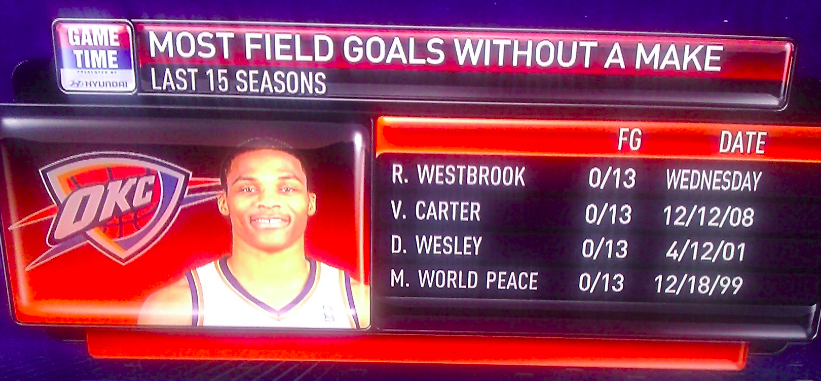
Wednesday night was a fun one. I was camped in my usual spot on the couch, NBA TV kicking out basketball magic alongside early-season ineptitude (we see you, Utah!) for multiple hours straight. I switched over to the Oklahoma City-Memphis game just after halftime and had the opportunity to see Dancing with Noah favorite; Russell Westbrook struggle through a historically poor shooting night (see image below—courtesy of NBA TV). So far through three games of the young 2011-12 season, Little Bigs is averaging six turnovers/game and shooting 31% from the field while taking 17 shots/game. The laws of averages tell us that Russ will return to his norms and I believe in those laws. I also believe in trends and reality.
Dating back to the playoffs last year (17 playoff games and three regular season games), Russ is shooting under 40% and averaging close to five turnovers per game. His win shares are as poor as they’ve been his entire career and last night we finally saw a little public spat between Westbrook and Saint Durant. Arguments don’t imply divorce. I argue with my fiancée and I’ve gotten in pissing contests with my friends and had heated disagreements with teammates, so fights alone don’t mean the Westbrook/Durant partnership can’t thrive and continue to blossom. In all the fights I’ve been in, I wanted to work through to a solution and find a compromise. The argument we saw last night was probably nothing more than a heat of the moment thing, but going back to the playoffs last year, I can’t help but wonder about Westbrook’s self-image and intent. Does he see himself as a sidekick or the leading man? Is it 50/50? Is he confused? Am I confused? Am I speculating about shit that doesn’t really exist? Have I asked all these questions in the past and am I repeating my own mistakes searching for answers to hypotheticals that exist only in these confines?
I meant this to just be a quick little blurb, but I’ve slipped into a mini black-hole of curiosity where Russell Westbrook reigns and shoots pull up jumpers on fast breaks and is fueled by a smoldering desire to prove to someone, anyone that he can do it on his own. The “it” is whatever he defines it as.
As long as OKC keeps winning and everyone (Durant, Russ, Scott Brooks, Sam Presti) keeps saying the right things, these sub-par performances and chemistry questions will remain open-ended parts of the drama that spruce up the narrative, but don’t factor into its ending. If/when those things change is when we’ll be able to attach substance to Russell’s saga. It’s been a bad start to 2011-12 for Russ, but it can only get better than the misery he ran into last night:
If you’ve read any of my team preview posts, you probably picked up on the theme of excited curiosity that surrounds the unknown. We all know what Derrick Rose and Dwight Howard and Samuel Dalembert are capable of doing, but we’re still learning about young players and guys who have switched uniforms.
With that that in mind, I was tickled last night as I sat on my couch, New Castle in hand, feet kicked up and landed the remote on the OKC @ Minnesota game. There was that Russell Westbrook whipping and snapping all over the court, a new haircut for Nick Collison, a DC battle between Beasely and Durant, and then the Spanish question mark Ricky Rubio. Yeah man, I was all skeptical about Rubio. Skeptical about his defense. Skeptical about his foot speed. Skeptical about the hype. I wasn’t quite hating on the kid, but I wasn’t supportive either and I can make a case that I wasn’t even fair in regards to his NBA potential.
I’m fully aware that 26 minutes and 18 seconds doesn’t count for much of a sample, but watching Rubio thread passes through the tiniest and tightest of lanes and openings had me stroking the stubble on my chin and nodding in agreement: Yes, that’s a man who can pass. The passes he made were hard enough to see let alone execute and he repeatedly threw these passes without making a single turnover. Ahhh … it was a breath of fresh air and for Minnesota fans, you people (whatchu mean, you people?!?! – it’s not even like that) should be rejoicing in the name of all that is round, leather and flies through a steel rim:




 Dancing With Noah