Sometimes we go through hiatuses and require a divine intervention, an intoxicating muse or maybe just a bizarre stat to snap us out of our doldrums.
So it was tonight when I was looking at the box score from the Mavs-Jazz game which ended in triple overtime with the Jazz getting a huge 123-121 win. Six players played over 50 minutes, the teams combined for 62 free throw attempts, five players scored over 20, Al Jefferson had 28 points and 26 rebounds, Dirk put up 40. The game was stuffed with numbers of all kinds, but what stood out the most was a pair of zeros side-by-side, attention grabbing emptiness: In 54 minutes and 4 seconds of play, Al Jefferson attempted zero free throws.
This is a man who grabbed five offensive rebounds and took nine shots in the paint. He spent time most contentious area of the court, but didn’t get to the line once. In all fairness, no one fouled out this. It wasn’t a foul fest or a game won or lost in the trenches. In terms of free throws attempted, the 62 combined free throw attempts were just a few more than the league’s FTA average per minute.
But the 0-0 in 54 minutes made me wonder who, if anyone had ever endured this kind of FTA allergy. And so I took a look at basketball-reference’s player game finder (dating back to 1985-86) and came up with the following, not-so-coveted list:
I know Ricky Rubio will come back to us in six to nine months like most victims of torn ACLs do, but it doesn’t ease the pain, the sense that we’re all being deprived of something or someone with rare abilities. Ricky Rubio is that someone and it sucks that he’s gone too soon, but when we get out of bed in the early morning hours and walk out the door, we put ourselves at grave risk every single day. Ricky was doing what he what loved when he tore the aforementioned ACL…just like so many blessed basketball players before him—and my fiancée when she tore her ACL on a trampoline last year.
So instead of sitting in a windowless room with the light of a single candle burning while Michael Jackson’s “Gone to Soon” fills the silence and I swallow Xanax to calm my worried mind, I decided to get tough and force myself to see a bright side of this situation. The truth is there is no bright side to Rubio tearing his ACL.
Oh, brother.
But there are other truths. Like this one: Today’s NBA is cram packed with men of average-to-just-above-average height (worth noting that the point guard position, based on the physical pre-requisites of the position, has a larger pool of humans to select from than all other positions combined) who play the point guard position extremely well. For my buck, none of them have that je ne se quoi that Rubio possesses, but what they may lack in some poetic Spanish essence, they make up for in burst and tenacity, abruptness and precision. As much as I want to stack rank these players (it feels so damn natural), I realize that rankings obfuscate the point and result in arguing and debates that have nothing to do with this celebratory acknowledgement that I wish Walt Whitman and Curtis Mayfield could collaborate on instead.
We’re in the midst of a point guard boon and even with the loss of one of its most joyfully entertaining members (it’s temporary!); it remains a group bound together by ability and time. To investigate the “why now?” is to embark on a Freakonomics journey that I’m not presently being paid enough to embark on. In place of said investigation, I’ve included an homage to the shabooya roll call, giving out respect and love to the architects who laid the blueprints for this position and the torch bearers who continue to shed light on its borders:
Bob Cousy: One handed, but he greased the wheels of the most successful machine we’ve seen.
Oscar Robertson: Elgin Baylor at the point. The Big O would’ve been big for a PG in today’s game. In the 1960s, he was pretty much a predecessor to LeBron.
Isiah Thomas: Lord lord lord, the original baby faced assassin. I hated his guts, but Zeke was the last great point guard (Rondo?) to lead his team to a title … 20+ years ago.
Unseen 80s buddy flick: Zeke and Billy's Wacky Summer
Magic Johnson: The greatest nickname for the greatest point guard of all time.
John Stockton: Slow and steady wins the race. Watching Stockton and hearing stories about him, you get the feeling he has a cockroach-like ability to survive any situation. If and when the nuclear holocaust happens, Stockton will be one of the few to survive and re-build our civilization.
Tim Hardaway: It was all about the UTEP Two-Step, but little Timmy was a founding member of RUN-TMC and was one of the original jitterbug point guards. If Rubio needs inspiration during his recovery process, he need look no further than Timmy who tore his ACL and bounced back to become one of the most dynamic points of the 90s.
Jason Kidd: Cut from the Magic mold, Kidd could’ve retired five years ago and still made the Hall on his first ballot. Still ticking away and winning a title in his late 30s, he makes me wonder what Magic could’ve accomplished if he hadn’t retired prematurely at 31—I’m 31 and I know I’ve still got some good hoops left in me.
Nate Archibald: I don’t know much about Nate except he preceded Hardaway at UTEP and led the league in scoring and assists. How you do that?
Steve Nash: When Nash was decked out in Santa Clara red, I never would’ve imagined he’d be a two-time MVP and retire as one of the greatest passers and consummate PGs in league history. Not knowing is what makes this game so lovable and addictive. Who’s going to fuck up your misguided misconceptions next?
Kevin Johnson: Fred Hoiberg’s already got the “Mayor” trademarked, but KJ acting as the savior for the NBA in Sacramento exceeds anything he accomplished in a Suns uniform… although Hakeem might disagree.
Mark Price: Bobby Cremins’s original point guard extraordinaire. Price has won free throw competitions in all 48 of the contiguous United States as well as Hawaii.
Stephon Marbury: Sticking with Georgia Tech, Marbury’s resume is debatable, but he was one of the original one and done players and is a poster child for the mid-90s malcontents. Hate if you must, but there’s a place in the point guard pantheon for Marbury; I just don’t know where it is.
Gary Payton: Yakety yak, Payton loved to talk smack. A 6’4” point with a post game, Payton is regarded with universal positivity. The northwest adores the man to this day and his NBA TV partnership with Chris Webber is as entertaining as his partnership with Shawn Kemp…albeit for completely different reasons.
Mark Jackson: It’s not fun to watch a man start backing another man down at the half court line, but Jackson made a career out of utilizing his superior size and apparent “old man” strength. The league changed the rules because of his constant abuse.
Chris Paul: In terms of pure point guard-ability, CP’s my preferred flavor for today’s game. He might be a dirty player, but he controls the timing and tempo of any game he’s in. The only drawback to his game is when he over point guards—that’s a term for point guards who are so insistent on getting teammates involved that they essentially remove themselves as scoring threats and allow the defense to play 5 on 4 basketball: *Over point guarding*.
Deron Williams: Hard to believe the Hawks passed (no pun) on Deron and CP3, but they did. Deron’s a fullback of a point guard at 6’3”, 200lbs+. He can score, pass, provide court generalship and plays Lex Luger to CP’s Ric Flair.
Rajon Rondo: People should be nicer to Rajon. He’s a point guard who can’t shoot worth a damn, but I don’t remember Mark Jackson or J-Kidd hitting too many jumpers either. Rondo’s an underappreciated innovator…with a ring.
Chauncey Billups: Is a he a Hall of Famer or isn’t he? Should he really be called “Mr. Big Shot?” These aren’t the questions to consider. Instead of questioning, let’s all appreciate Billups for being a power point guard whose value always exceeded the conventions of a box score.
In all seriousness.
Derrick Rose: An MVP at 22 and completely incorruptible by the LeBron-led “cool kids” clique. Rose is a point guard version of Kevin Durant—a young man wholly committed to the game of basketball. Let’s just hope his back is up for the task.
Russell Westbrook: The pressure he applies on the offensive end is unrelenting and suffocating. He plays point guard, but if he was two inches taller, he’d be a younger, more explosive D-Wade. As it stands, we’ll just have to accept him as the league’s most explosive point guard (sorry, Derrick).
Rod Strickland: He might have a serious problem with drinking and driving, but nonetheless Strick enjoyed a 16-year career as a pure point guard.
Kyrie Irving: His game doesn’t match his age at all and I’m probably the first who thinks someone should check his birth certificate, but my paranoia aside, Irving is taking the right steps towards a career of accomplishment and accolades. When you think Kyrie, think poise.
Mike Bibby: Maybe had the best mid-range game of any point guard here. And that’s all I’m going to say about that.
Dennis Johnson: He wasn’t the best passer on his own team and he left us far too soon, but DJ’s completion of “a steal by Bird!” is a signature moment of the 80s NBA.
Anfernee Hardaway: Injuries robbed Penny and robbed us of what appeared to be a HOF career in the making. What’s not to be won’t be and we’ll have to settle for memories of Butch McRae tossing lobs to Neon Boudeaux while Coach Pete Bell watches; anxiously waiting for the other foot to fall.
Ricky Rubio: It was love at first pass. I have a terrible memory, but like LeBron James’s debut several years ago, I can remember exactly where I was when I saw my first Rubio NBA highlights.
Baron Davis: When I was in college (early 2000s), I got in an argument with someone about the similarities between Baron’s game and Allen Iverson’s game. I disagreed Davis would ever be an Iversonian scorer then and I disagree now. Unfortunately, that’s my first thought when Baron’s name comes up. It’s not his fault, but he’s definitely to blame for regularly showing up out of shape.
Lenny Wilkens: I’ve only seen faded clips of Lenny playing ball, but his sideburns and coaching (most losses in NBA history) have embedded memories that can’t escape.
Doc Rivers: He’ll always been remembered more for coaching the Celtics to the title, but when I was six years old, Doc averaged a double double running point for the Hawks.
Mookie Blaylock: The original inspiration for Pearl Jam, M-m-m-m-m-m-Mookie played integral roles on mediocre teams. Does that make him mediocre? I say no.
No doubt, Omar picked up 3 assists on this one pass.
Omar Cook: Some people might scoff at Omar’s inclusion on this list, but just know that for the one year he played for St. Johns, Cook was a point guard prodigy who broke Mark Jackson’s single-game school assist record with 17—as a freshman. While I’m hesitant to question any of Cook’s decisions, he most likely could’ve benefited by staying at St. Johns for a few more years and fine-tuning his all-around game. Omar Cook, we won’t forget.
Walt Frazier: If you have League Pass or watch Knicks local broadcasts, then you’ve no doubt heard Clyde’s legendary vocabulary narrating their games. And then there’s his game seven Finals performance in 1970: 36 points, 19 assists and five steals.
Michael Adams: If a baseball player’s career stat-line followed the diminutive (5’10”) Michael Adams’s, someone would be pointing the accusatory PED finger at him, but since pro basketball players would never take PEDs, no one ever questions anything. Anyways, Adams was mostly known as a shoot first, shoot second, shoot third point guard with good, but far from great talents. He averaged 14.7ppg and 6.4apg for his career. And then there’s the blip on the radar that I remember all too well. In 1991, his 6th year in the league, Adams exploded (over 66 games) for 26.5ppg and 10.5apg.
Scott Skiles: 30 assists in a single game is good enough for me.
Derek Harper: Harper was his best playing alongside Rolando Blackman with the Mavs, but I remember him more for his redefined role as an enforcer of sorts on the 90s Knicks.
Norm Nixon: What do I know about Norm Nixon except he was pretty much forced out by Magic? Not too much.
Terry Porter: Porter was firing threes before it became the popular thing to do. He was never a speed/quickness-modeled point guard and I have my doubts that he’d be as successful in today’s game, but in the late 80s and early 90s, he was a key component of Rick Adelman’s Blazer squads.
Micheal Williams: Still holds the record for most consecutive free throws made at 97.
Micheal Ray Richardson: A victim of the 80s drug explosion. Everyone who saw him gushes about “Sugar,” but sadly isn’t that the case for most of the players who are either corrupted by drugs or tragedy? Despite my skepticism, there’s no arguing with Richardson’s stats: 15ppg, 2.6 steals/game, 7apg and 5.5rpg.
Brandon Jennings: The fact that Jennings probably isn’t a top-10 point guard is more reflective of the league’s depth at the position than it is an indictment of Jennings’s abilities. He’s Chris Rock skinny, but he’s got the stones of a leader.
Tony Parker: No one said you had to be a model citizen, friend or teammate to make the shabooya roll call for point guards and that’s a good thing for Parker. He’s been and done everything the Spurs ever asked from him and then some.
Fat Lever: One of the original triple double machines. Lever played for 80s version Mike D’Antoni in Denver’s Doug Moe and his stats reflect it. Over a four-year stretch in the late 80s, Lever put up 19ppg, 8.9rpg and 7.5apg.
Damon Stoudamire: Mighty Mouse won a rookie of the year award, shot over 3,000 threes and was pulled over with Rasheed Wallace for speeding and driving under the influence of reefer while driving from Seattle back to Portland after a game against the Sonics. Stoudamire’s also notable for statistically declining season over season as opposed to the natural bell curve we see with most players.
Kenny Anderson: Bobby Cremins strikes again. Kenny was a second overall pick and was supposed to be the next great NYC point guard. He never lived up to the lofty expectations, but he did marry Tami from the Real World.
Muggsy Bogues/Spud Webb: Both were great players who unfortunately can’t escape the association of being short men in a tall man’s game.
Nick Van Exel: My fond memories of Nick the Quick chucking ill-advised threes with that cock-eyed lefty release are accompanied by the hand-held Rodney King-quality video clip of Van Exel and some cronies of his stomping the shit out of some poor guy. Of course, I can’t find any reference to this on the internets, so I can only assume it’s a figment of my imagination (wink wink).
Ty Lawson/Jrue Holiday: A pair of speedy, talented, under-represented guys. Holiday and Lawson are perfect examples of the league’s depth at the position. They’re 21 (Holiday) and 24 (Lawson). The future is bright.
Andre Miller: The future might be bright for some, but we keep expecting the sun to start setting on others. Andre Miller refuses to recede into the horizon. He’s tough as pollution (ask Blake Griffin), knows his role and gets the job done every night. Is he underappreciated? Most likely, but even in his under-ratedness, he knows his role and plays it well.
John Wall: I feel bad for this kid who’s forced to play with mind benders like JaVale McGee, Andray Blatche, Nick Young and Jordan Crawford. Then I see him pull shit like that behind the back dunk he ripped off in the rookie/sophomore game and I’m like, “Hell no, I don’t feel bad for him.” I feel bad for us for not getting the chance to see what Wall’s all about. Until the Wizards finally bite the bullet and push the reset button all the way in, “How good is John Wall?” will continue to be asked on message boards and in cubicles.
Steve Francis: Is Steve Francis gay or isn’t he? I don’t think it matters, but typing his name into a search engine, the first few recommended searches include “Steve Francis gay.” Where does this it come from? I don’t have time to worry about it as I’ve already spent 2500+ words taking a trip down memory lane and present day boulevard to revisit point guards who have stepped on NBA courts in NBA jerseys over the past seven decades. Francis isn’t memorable because he was possibly gay. He’s memorable for doing things like driving for a game-winning dunk and disintegrating from NBA relevance overnight.
This was never meant to an all-encompassing list of NBA point guards (it was meant to be about Rubio), but rather players who, for one reason or another, stood out to me. If there was a question mark around a player’s position (Iverson, Jerry West, Steph Curry, the Jones boys from the Celtics), I left them off. Like Monica sang, “don’t take it personal.”
Tune in next week as I tie Hamed Haddadi and Omri Casspi into America’s foreign policy in the Middle East.
In a week when rumors ran rampant that the Celtics were “aggressively” looking to trade their enigmatically styled point guard, little Rajon Rondo responded by blowing the dust off his headband and putting Boston on his back in a Sunday matinee against the Knicks. Rondo went for 18 points, 17 rebounds and 20 assists in the overtime victory. That line is crazy even if came with a D’Antoni caveat.
To put Rondo’s statistical performance into context, I took a journey to Basketball-Reference.com’s Player Game Finder and found out that since 1985, only three other players have performed the improbable 3 x 15 (15 points, 15 rebounds, 15 assists in one game):
Rondo, more exclusive than secret societies.
**I didn’t see the tail end of ABC’s Knicks-Celtics broadcast today, so if they flashed some stat graphs referencing the numbers above, I can’t be accused of stat-jacking since I had no awareness of its existence.
Welcome one and all, man, woman and child to the first annual, Dancing with Noah all-star selection. Fans and coaches, writers and analysts, people I know and people you know; they’ve all had their say and now it’s our turn. We the people on this 14th day of February, 2012 wish to declare a new stash of all-stars free from the defined parameters of the National Basketball Association. Will there be carryover, overlap, blendings and snubs? We can only hope so.
This year’s team is made up of 12 players. Positions, team structure and conferences don’t matter much here. We’re not playing for gold medals or gold metals or home court advantage or even pride. If it’s a celebration, then let’s express ourselves in a mood of Dionysian delight and indulge in the players who captivate our attentions on the court and help our minds to believe in the impossible.
Kobe Bryant: Still the One. Not the “one” in the sense of Neo in the Matrix, but in the sense he’s still at the center of basketball world; consuming our loves and hates, sucking it all in like a swirling vacuum and becoming endearing with time. He’s tough, driven, motivated. Even the legions of anti-Kobe-ites have had their icy facades melted away by his commitment to and pursuit of excellence. Kobe Bryant embodies that blue collar, hardworking American ethic we tout so proudly in this country. Put that in your pipe and smoke it.
DeMarcus Cousins: It’s fitting that this child-like man is on the Kings. His game is resplendent with royalty and a lingering sense of being spoiled that probably accompanies the young and entitled. But despite the years of bad press and the mountains of evidence that his attitude is rotten to the core, his post-Westphal game has become the envy of big men worldwide. At 21, he already possesses a more well-rounded offensive game than Dwight or Bynum. His motor ticks, he cares and he can only get older (which is hopefully accompanied by more maturity).
Ricky Rubio: His passes are snazzy and functional at the same time. He already had a cult following that maybe gave up on him after a couple of bumbling seasons in Spain, but a chance to radiate in the greatest league in the world has been seized upon by this young man who was apparently born to play here (in Minnesota?). Like Cousins, he’s only 21 and already running shit in Minneapolis. He’s fourth in the league in assists and leads the league in steals. His on-the-ball defense needs a bit of work and his jumper does too, but holy shit, Rubio’s already nudged, elbowed, scratched and clawed his way into NBA legitimacy. A lot of us thought it was all premature and a lot us are happily watching his highlights thankful for being so embarrassingly incorrect.
Andrew Bynum: Welcome to World B. Healthy—for now at least. In a scant 24 games of youthful vitality, Andrew Bynum has given fans and basketball minds a respite from the all-too-familiar tale of sky’s the limit prodigy hobbled by the cruel fate of injury. Bynum’s story (far from complete) is one of patience and warmth. His health and the world class performance that accompanies it, is a ray of sunshine for the young Sam Bowies and Greg Odens of the world. Yes young man, you may be down and out and experiencing literal growing pains, but tomorrow can be yours. Just ask Drew.
JaVale McGee: If 2012 Andrew Bynum is unimpeded sunshine, then JaVale McGee is a full moon; equally captivating, but cooler and more confounding. Despite the Youtube clips of JaVale doing nonsensical things on the court, I don’t believe there’s a decision to do or not do. Impulse takes over and next thing we know, JaVale’s tossing up hook shots, pushing the break or saluting imaginary soldiers in the crowd after blocked shots. If Kobe, Michael and Larry have taught us you can take basketball too seriously, then McGee’s head in the clouds routine (that’s not a reference to one of his dunks) acts as a comedic reminder that basketball is just a game—sometimes played by children.
Brandon Jennings: I like Brandon Jennings. I was pleased when he gave the establishment the bird and spent what would’ve been his freshman NCAA season playing in Italy. I like that he skirted the traditional sneaker powers that be and signed an endorsement deal with a power-to-be in Under Amour. And even though it was never his choice, I’m satisfied he plays up in that great northern everyman’s town of Milwaukee. It’s not as crazy of juxtaposition as a young, politically and spiritually curious Lew Alcindor playing there in the early 70s, but Jennings has enough Hollywood in him to seem like an outsider while maintaining a strong enough sense of himself to be accepted by the locals.
Andrea Bargnani: Like Franz Kafka’s strange tale The Castle, Bargnani’s work in 2011-12 is incomplete (he’s appeared in 13 of 29 games). And also like The Castle, this particular season, however brief and interrupted, has been a pleasure to partake in. The former number one pick and player most-frequently-compared-to-Dirk was having a career best season across the board until a calf injury deprived us, Raptors fans and Silvio Berlusconi of seeing it through. The NBA might not have a place on its all-star team for a guy who’s appeared in less than half of his team’s games, but here at Dancing with Noah, we’re willing to waive these simple trivialities.
Josh Smith: He might not be paid like he’s the man in Atlanta, but since Al Horford went down with an injury, Josh Smith has functioned as the heart, soul and elbow grease of this sleep-inducing also-ran Hawks team. He rebounds, dunks, blocks shots, shoots less threes than he used to (keep working on it) and does it at 6’9” without complaint. His improved rebounding and re-commitment to defense indicate he’s finally ready to move on from that experimentation phase so many of us go through and accept the talents his creators bestowed on him. Do your thing, Josh. Just make sure you do it inside the three point line.
James Harden: How good is this guy? That’s not a rhetorical question. We’ve all see his dope game: the lefty threes, upright running style, deceptive athleticism, change of pace and surprising passing and playmaking, but do we have any real idea what the ceiling holds for Harden? He reminds me somewhat of a talented backup in the NFL trapped behind an all-pro incumbent. Is he Aaron Rodgers, Michael Turner, DeMarco Murray? For any player in the league who takes ten shots per game or less, James Harden scores the most at 16.6ppg. If he took 20 shots a night, would he score 32? Doubtful, but I don’t think we’ll find out any time soon. He’s under contract through 2014, so until then, don’t let your curiosity get the best of you.
LeBron James: Just because we’ve come to expect greatness from this great one, let’s not get all carried away and take it for granted. As a transplant of almost eight years, I still notice things in Seattle that just don’t exist in the Midwest. My daily walk to work used to take me down Madison St which crosses over I-5. Looking south on clear days, you can see over 14,000 majestic feet of Mount Rainier resting impassively in the distance. So many times I walked past this and instead of marveling at its natural power and beauty, I marveled at the other people walking by who never blinked in the direction of that mountain. This isn’t to say I have a keen appreciation for nature that others lack. It’s to say sometimes we get so caught up in what’s next; we forget to enjoy what’s now.
Greg Monroe: There is hope in Detroit and his name is Greg Monroe. Sadly, I haven’t seen the latest Georgetown big man nearly as much as I’d like since it’s so painful to watch his team play, but I know from what some friends tell me and what the stats and highlights say that Mr. Monroe is for real. He joins Cousins, Bynum, McGee and Nikola Pekovic as post-Shaq bigs who embrace the advantages their size offers. Just because his team is so awful, let’s not condemn the son (Monroe) for the mistakes of the father (Dumars).
Kevin Durant: I guess it shouldn’t be a shock that he’s getting better at 23, but rather that he was so good at 20, 21, 22. He’s rebounding and passing the ball better and shooting a career high FG%. His on-the-ball and team defense have both improved. His scoring is down, but the team’s winning more. He’s exhibited a willingness to sacrifice his own points to appease the needs of others (Harden and Westbrook are both averaging career highs in PPG). And most importantly, he’s has taken what appears to be his natural high road regarding the Westbrook situation that lingered from last year’s playoffs and carried over to the beginning of this season. He’s handled the situation perfectly from the get go and has most likely reinforced what was already a sturdy foundation in OKC.
We can’t have a team without coaches and this year’s co-DWN all-star coaches are Minnesota’s Rick Adelman and Philadelphia’s Doug Collins. They might be a couple of old chips off the old NBA block, but both combine a strong sense of in-game coaching with the ability to read the temperatures of their teams and adjust accordingly. For that, they have the great opportunity to coach this mish mash, hodge podge of world class talent against each other in imaginary scrimmages that I’ll daydream about on the bus tomorrow.
Friends, this concludes the 2012 Dancing with Noah all-star selections. I hope you’ve enjoyed reading it as much as I enjoyed writing it.
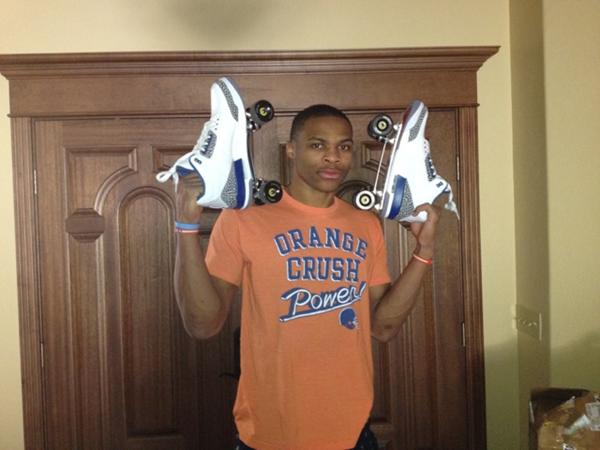
OKC did the right thing on Thursday when they gave avant-garde roller skater and sometimes NBA point guard, Russell Westbrook, a contract extension. While OKC played it cryptically and refused to disclose the terms of the deal, sources are calling it a 5-year, $80 million deal with no opt-out clause.
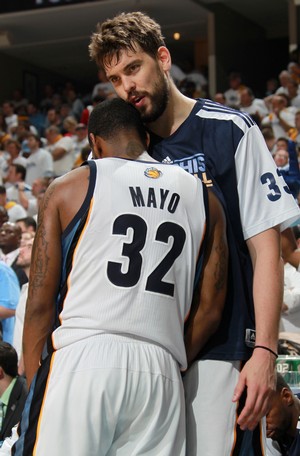
Once or twice before, I’ve mentioned my yet-to-be-published (or even started) Choose Your Own Adventure, NBA-style doorstop of a book based on trades or signings that didn’t quite happen (Chris Paul to Lakers is and will continue to be the Mount Everest of What-Ifs based on circumstance alone). Well, today is the first extension of that concept; what I’ll refer to as an Alternative Chapter. It’s nothing more than me channeling my imagination to come up with a (somewhat plausible) scenario for a team or player that strays away from reality. Today’s Alternative Chapter features the pride of Huntington, West Virginia, O.J. Mayo.
Mayo’s only in his fourth season in the NBA, but it feels like we’re all old friends because his name has been plastered across prep headlines since he was named to the all-state first-team in Kentucky … as an eighth grader.
At this point, I’ll stop and posit a theory about O.J. Mayo. Scouts, high school beat writers, opponents, fans and junkies (of the hoop variety) accelerated the Mayo hype-wagon in part (large, small, medium part?) because of his name. O.J. Mayo is not a name we easily forget. Oh-jay-may-oh (or you could say it like this). Say it enough and it will stick to your mind like bugs splattered across your windshield. Had he been named Jeff Ridges, the likelihood of his rapid rise through the prep rankings may have taken a longer, more traditional and healthy route. Instead, Mayo’s been ingrained in the basketball zeitgeist since 2002. Great exposure brings great expectations and that’s where the reality of Mayo has fallen short. This whole concept is applicable beyond the basketball court and should likely be addressed by Malcolm Gladwell if someone else hasn’t cracked the code already.
Onto the Alternative Chapter …
Every few weeks, O.J. Mayo’s name is mentioned in trade rumors … to the Bulls, to the Pacers, to the Nets. There’s the consoling, “Well someone wants me,” but after multiple failed trades, even a basketball vagabond like Mayo wonders, “Am I really wanted … by anyone?” These doubts are human (and potentially canine), but they make any of us feel unwanted and unloved. And since we the fans have been reading about the great O.J. Mayo for years already, maybe we’re tired of his undersized two-guardness, his catchy name, the constant trade rumors and the confusion of his game not living up to the hype (“I thought he was supposed to be better?”). Maybe we don’t want him either.
Fast forward to May 2012 when the sixth seed Grizzlies are bounced in game six against the Lakers in Memphis. After suffering a sprained ankle in game five, Tony Allen is forced to sit out the next game which means Mayo draws the start and gets the luxury of guarding Kobe Bryant. Between games five and six, reporters bait Mayo into a headline-making comment and he sadly takes the hook; cracking a joke about the time he “locked Kobe up” in a game of one-on-one. Not that Kobe needed more motivation for an elimination game, but he attacks Mayo inside and out, abusing the smaller guard without mercy. After Bryant scores 16 in the first quarter, Mayo’s confidence is shaken and it shows on offense where his performance brings up Starksian memories from the early 90s—just another small shooting guard lining up the sights for a soon-to-be-Hall of Famer. He shoots 1-14 from the field. His coach, Lionel Hollins ends his misery with two minutes left in the third quarter and benches Mayo in favor of the rangy Quincy Pondexter. Mayo exits to a cold chorus of boos from the hometown fans; his last time in a Grizzlies jersey.
The season over, a team option on his fifth year, Mayo gets out of Memphis as soon as he’s able. Bags packed, he ventures to the Caribbean for a couple weeks of quiet, uninterrupted reflection. His beard grows unkempt, his hair ‘fros out, unbrushed. Despite the images of a black Castaway, his mind is clear and upon return stateside, he meets with his agent Rob Pelinka. While the Grizzlies have rejected the team option, Pelinka excitedly rattles off teams that have contacted him regarding his client’s services. The refreshed Mayo cuts him off. He’s done, he says. Tired of the games and politics. Tired of the unfair expectations (“Don’t they know Kobe’s 6’7” … at least 6’7”!?!?”). He demands Pelinka look into Spanish opportunities (“I’ve already talked to Marc (Gasol) about it.”).
The first hint that Spain offered refuge
And that’s how O.J. Mayo came to join FCB Regal (aka, FC Barcelona) of the Spanish top division. He signed for one year to “get your confidence back” as Pelinka put it. Mayo didn’t disagree. He arrived in September and played for about a third of the money he would’ve made in the NBA. Sadly, Euro legend Pete Mickeal retired due to a degenerative knee condition, but close one man’s window and another man often hurls a basketball through it, then climbs in and that’s what Mayo did.
Like so many expats before him, Mayo was revived by a new culture and new people. The passion of the fans brought back nostalgia for the high school crowds he played to nearly a decade before and his game thrived. In his first season alone, Barcelona won the rare treble: the domestic Copa del Rey, the ACB Championship and the Euro League title. This wasn’t any indictment of the quality of Spanish league basketball; just the realization of O.J. Mayo’s potential.
The record books and tales of Mayo’s long stay in the Spanish league are much too long for the meager space allotted here. Just know that the acceptance and sense of inclusion that was so hard to come by in the Association was made readily available by his teammates and fans in Barcelona.
I spent part of my Tuesday night watching the Heat against Golden State. I was at home watching frustrated as Miami came down with a case of confusion in the fourth quarter. The road trip had been going so well through three quarters: Miami was ahead 84 to 72, GSW was missing Andris Biedrins and Steph Curry and would eventually lose Kwame Brown to a shoulder injury. The Heat were warring with their big three; yep Dwyane Wade had returned and done so in an assertive alpha style.
But as I watched that fourth quarter, I quickly realized what was happening in Oakland. The real fans, full of piss and vinegar and then some, were grasping onto each Warrior 4th quarter point like it was one more symbol to stack up against the establishment and the Miami hype machine. And the fans got in sync with the players, with Monta Ellis and David Lee, Brandon Rush and Dorell Wright and of course they saved their strongest exultations for the man who thrived off them most: Nate Robinson. Together they chopped down what was once a 17-point Miami lead, made something out of nothing, they re-wrote the media’s yet-to-be filed stories and changed the course of fates.
Along the road to disgraceful defeat, I witnessed a hardening and lack of focus among the Heat players. Dwyane had been out a few games and in his absence, LeBron James was his most confidently controlled self, consumed of no doubts, just pure efficiency for all the fans—sons, daughters, grandma’s and grandpa’s, all y’all. Then big, bad Wade showed up and all of sudden the script is flipped? I didn’t watch the game’s entirety, but I watched the last quarter and overtime with the angst of a person who’s not comfortable with disruption. And there was the disruption, calmly, expeditiously, politely. Wade wants it, LeBron wants to give it and the result was a lead whittled away by scraps of lucky points.
Near the end of regulation, there were numerous loose balls, bouncing balls, missed plays, missed catches and temper tantrums (that’s you, Udonis Haslem) by both teams. Even with GSW’s mistakes, Miami was insistent on allowing them back in. Credit is due to Dorell Wright and Nate Rob who both hit huge threes, but I had a flashback ….
It was a flashback to the 2011 NBA Finals when LeBron faded into the background, too flustered, confused or uncomfortable to let his big light shine. The man wanted to be invisible. He stood at the top of the perimeter and refused to attack. He passed to Wade or Haslem or Bosh, but would then drift out beyond three-point range.
Earlier on Tuesday, I had defended LeBron with words from the heart. It’s between the ears and once he figures it out, it’s over, I argued. What’s there to figure out? He had 26pts, 11rebs, 7asts, shot well from the field and I don’t give a shit because when it mattered he reverted to passive LeBron like a fly to the light, sucking him away from his rightful role. This was different from his days in Cleveland when he’d penetrate for the shot and pass it to open shooters if/when the defense collapsed. This was LeBron removing himself from the conversation and, in my meager analysis on Tuesday night, doing it because Dwyane Wade was around.
For what it’s worth, the stats provide an objective witness. LeBron’s quarter-by-quarter line:
Quarter
Min
FG
FGA
FT
FTA
Rebs
Asts
Stls
Tos
BS
Pts
1st
0:12:00
4
7
0
0
3
1
0
1
0
8
2nd
0:06:59
2
2
3
4
3
2
0
1
0
7
3rd
0:12:00
3
7
2
2
3
1
2
2
0
8
4th
0:06:34
0
0
1
2
0
0
0
0
0
1
I’m disappointed too.
Naturally, Golden State gritted out the win in overtime.
Where was that man with the world’s greatest game and what was he saving it for? I feel like he needs a combination of Ben Affleck’s character from Goodwill Hunting and Jamal Wallace from Finding Forrester. Between these two, there’s plenty of inspiration and realization to help a man even as complex as LeBron James figure things out. If they could crack Will Hunting’s code and get through the thick skull of a Sean Connery character, then the resolution to Bron’s mental issues are just a climactic scene away.
Aside from that rant, I’m still happy to walk out on my balcony and shout my prediction that the Miami Heat will be the 2012 NBA Champions. And that’s what makes it all the more frustrating, even in a Tuesday night road game in January, to see the game’s best extricate himself from the big moment. Miss a shot, throw the ball away, choke slam Nate Robinson … anything is better than the nothing I saw in Oakland.
I kicked around the idea and got excited about it like it was some kind of realization unique to me, but I have my doubts. I mean, if Greg Anthony and those cats are talking about it, I’m far from original, but I figured since I thought of it independent of Greg Anthony, but possibly in dependence (would agreement be more appropriate, cahoots?) with Jim Buss (oh, the skin crawls just thinking I might agree with this Buss), it was worthy of a developed post here. And so I bring you the question: Is Andrew Bynum on par with Dwight Howard?
Before anyone goes all Stephen A. Smith on me and covers their keyboard with spittle or coffee or whatever’s in your mouth, I request the opportunity to define the terms of the question and answer.
I arrived at this question way back last week and would’ve asked it on the spot, but DeMarcus Cousins got the best of my limited attention span, so I had to wait until now. After serving his four-game suspension for flattening the smallest man in a Mavs uniform in last year’s playoffs (wrong place, wrong time, JJ), Andy B. returned to the court for the Lakers on New Year’s Eve and imposed his knees and arms all over the faces of the Denver Nuggets. Bynum is listed as a mere 7’0” tall, but I can’t help but second guess this listing as my TV projects the man to be mammothly large and possessed of limbs that stretch and stretch up beyond the heights of your everyday, average NBA seven-footer. It’s these same limbs that make anyone who watches Laker games cringe when he jumps or stretches for a loose ball for a couple reasons: First: His injury history precedes him (over his six-year career, he’s averaged 55 games/season … he misses, on average a third of his team’s games every season) and second: Those legs, as much as they’ve developed in terms of strength and balance, still conjure up images of Bambi or some other four-legged creature with legs that are far too structurally weak for the physique that sits atop. This haunting fear that Andy’s legs aren’t ready for his body may be a thing of the past, but old fears die slow … or they get medicated. Back to New Year’s Eve, the new introduction for Andrew Bynum, his first game being coached by new Laker Coach, Mike Brown. His first night out he shot 13-18 from the field, grabbed 13 rebounds and finished the game with 29 points. Welcome aboard, why yes, the Lakers have plenty of minutes available for a man who can do these things on a regular basis, but therein lies the variation between Dwight and Andy: Can Andy do it every night? Will he stop parking in handicapped spots and cramming his still-growing frame in Porsche 911s and just focus on his core—in the Billy Blanks sense, not the Jabbar sense.
Whatever Andy does off the court is just an expression of sorts, but it’s in part who he thinks he is, who he thinks people want him to be and who he thinks he should be. It’s all a juggling act and sometimes the groceries fall down and big, tall Andy Bynum, a world champion has to reach down in the grocery store and pick up his own vegetables when really, we’d all like to see him focused on the task at hand which is health and consistency as a Los Angeles Laker. So the first game was nice, but let’s see what followed and what we can see ahead, maybe to the future if they’ll even accept our probing inquisitions.
We don’t need the Hubbell telescope to see these stars, we have basketball -reference.com instead, an aggregator of all things black, white and numerical that have occurred in the NBA. Just know how to ask. Well, I asked and it turns out Andy’s first game against those Nuggets of Denver wasn’t no fluke (not no fluke I said). His performances on the young season:
18.8ppg
1.7bpg
3.3 TO/g
15.7rpg – that’s where it’s at
And over 50% from the field.
He’s less efficient than he has been in the past, but increased opportunities are going to lead to declines in efficiency.
Among the nights that made up the averages you see above was a masterful, fan-fueled evening at the Statples Center where Mr. B achieved his career-first 20-20 game. It was done against Houston on Wednesday night and it has to be noted that the Rockets’ front court isn’t quite mediocre. It’s not from a lack of effort. They tried for trades, but ran into David Stern’s heavy handed gavel. Don’t you think Pau Gasol for Houston would’ve made it more difficult for Andy to achieve 20-20 than Pau Gasol for Los Angeles? Houston couldn’t hold down the 7’2” Bynum and so it was on NBA TV, I believe, I began chewing the fat that not only are the Lakers maybe better with Bynum than Howard, but maybe Bynum’s just better than Dwight.
Better and different are words that walk a fine line and when they’re used together like that it’s usually to dispel a given notion or just to engage in a deeper dissection about Dwight Howard and Andrew Bynum.
On that same night when NBA TV was flashing graphics and stats like they’re tuned into the mainframe of NBA statistical databases and can present these informations with just a glance at huge HD screens, that’s when the topic came to Greg Anthony and his partners (Kenny? Webber? Both?). Anyhow, they big upped Andy’s accomplishment and then showed how many 20-20 games Dwight has had in his career (playoffs included): 39. Damn.
This disparity between 20-20 games really got me thinking and slicing the argument in different ways because as great as 20-20 is, you can hide a basket of fundamental flaws beneath the weight of those robust numbers that have the power to shape the ideas and contracts of American sports team owners which clearly isn’t our intent here because we’re just asking a few innocent questions.
Since I like boxing, I felt necessary to introduce the Tail of the Tape to this strange conversation that lost its way a while ago and continues to falter as we take our little steps forward.
Andy B
Dwight
Age
24
26
Height
7’2″
6’11”
Weight
285
240
Games
337
575
Playoffs
62
57
Minutes
over 9500
over 23k
Seasons
in 7th
in 8th
20-20 Games
1
39
Awards
2 Championships
Only family members and people who are paid by Dwight or the Orlando Magic should be forced to count his awards. The lists are redundant and bleed into the same award after 15 seconds.
If this were boxing, we’d all be enamored with the physical advantages held by the younger man. We’ be applauding lesser usage and predicting years of Dwight jumping up and down on pogo stick legs would eventually give out in a way that not even WD40 can resolve, but instead we’re looking at two very different basketball players who play the same position but do it so differently and do so for so many reasons.
Beyond the futuristic athleticism that was bestowed on Dwight by a combination of the Gods up on basketball Olympus and the genetic engineers over at Georgia Tech, the man has the Russellian/Rodmandian ability to dominate a game without having to shoot the ball. Whether he realizes it or not, this is a gift. He’s athletic enough to divert oppositions from painted areas out of fear that he’ll take their precious ball and give it to one of his own teammates if he so chooses. Or perhaps he’ll swat it away, into the hands of a paying customer, excited to be part of the game, amazed at the freakish shoulders of the man in front of him.
But beyond this rare gift is a counter-balance that seems contrived which makes it even worse. Dwight wants the ball. He wants to score it, dunk it, make passes to his friends so they too can feel what it’s like to be part of the big moment. It’s odd that this selfish part of his personality (however real it is) demands the ball for points. It’s really just an extension of his desire to be the center of attention and we all know scorers get the most attention. Dwight’s not a natural scorer though. Does he score and score efficiently? Yes, but for all his private workouts with Hakeem, his offense is still in development stages eight years into the league. And to make matters worse, I don’t think Dwight would give two spits about points if it didn’t mean more attention or if it didn’t mean he’d be more accepted by his peers. Dwight gets his fair share of plays drawn up these days, but he’s still at his best when he’s catching lobs or cleaning up the offensive glass. He uses his indomitable physical strength to outwork or outmaneuver the opposition, his presence alone opening up driving lanes and looks from beyond the arc for a supporting cast that’s been built to complement his skills—occupying the paint. Dwight shouldn’t be the focal point of an offense because it’s not best-suited for his game. If he were ever to come to this conclusion, he’d realize that imposing his will in the Russell fashion allows him to shape the outcome of games in ways that he only occasionally realizes. To be completely fair, Dwight’s only led his team in FGAs/game once his career—last season. His willingness to (mostly) accept the role Stan Van Gundy has carved out for him is commendable, but acceptance and embracing are different things altogether.
Then there’s big Andy who fits the traditional center character-type. He’s comfortable with his back to the basket, posting up and creating his own shots out of the post. His high shoulders and aforementioned long limbs allow him to get his shots off with ease and he’s developed a touch that the more-experienced Howard is still fine tuning. He’s able to reach over the opposition for rebounds without actually going over the back; a bizarre skill that few players possess. Removing injuries from the discussion, there’s an unknown that’s accompanied Bynum his entire career: Kobe Bryant. Bynum is paid like the superstar Jim Buss has always seen him as ($31million over next two seasons), but he’s never had the opportunity to explore the ceilings of his talents because he can’t stay on the court and even when he’s there, he’s the second or third option to Kobe and Gasol. This young season is the first time we’ve seen Bynum on the court for extended periods (34mpg is 4 more than his previous career high and his usage rate is 27% compared to his previous career-best of 20.8%) and the early returns are staggeringly better than anything we’ve ever seen from him. Plateaus aren’t part of the Bynum vocabulary today and until he levels off, the statistical possibilities and in-game impacts will be nothing but speculation.
In Andy’s 330+ game career, we’ve seen snippets of his 2011-12 performance, but it’s never been sustainable. Whether Gasol, Kobe or Phil Jackson impeded his progress, injuries got in the way or he just wasn’t ready for the increased role, he’s never been capable of persistent dominance. And it’d be an act of blind faith to believe the injuries are a thing of the past, but for the first time, it’s not a stretch to give Jim Buss the benefit of the doubt and acknowledge he may be onto something with this big kid. Does that mean Andrew Bynum is better than Dwight Howard? Absolutely not. I’m excited about Bynum going for 18 and 15 over a six-game stretch. Dwight’s been doing this regularly for well over 400 straight games and has the individual honors to prove it. Add in Howard’s commitment to fitness and reliability (he’s missed seven of a possible 583 games) and he’s one of the most consistent and productive players in the past 20 years whereas we’re still praying for an injury-free season from Andy.
Given Bynum’s age and the waves of potential flowing from his massive frame, we can at least hit the pause button on the “big man is dead” statements that have been so popular over the past few years. Andrew Bynum is giving hope to the great Pete Newell and seven footers around the world: You too can play with your back to the basket. He’s not on Dwight’s level yet and may never find that regularity, but in the infant stages of a new season, Bynum is injecting his name into conversations reserved for all-stars and future of famers. The immense ability coupled with the always-present questions about durability make Bynum’s career nerve racking. If I have anxieties and worry about Bynum’s injuries as a basketball fan, I can’t imagine the fears lying in the depths of the minds of Jim Buss or Mitch Kupchak. Bynum’s own feelings about his injuries remain a mystery.
Excuse this departure from the team-by-team previews (which may or may not ever be completed) as I recently participated in a highly informal NBA round table. It was a cold Thursday night in Des Moines, Iowa when I rendezvoused at the local Buffalo Wild Wings with Bug, Milton and Rex. The primary reason for going was sixty-cent boneless wings and there were 7-10 different sporting events being shown on the 50” screens that surrounded us, but after dinner and a few beers it was time to break out the napkins, locate a pen and attempt to sloppily break down the then-pending NBA season.
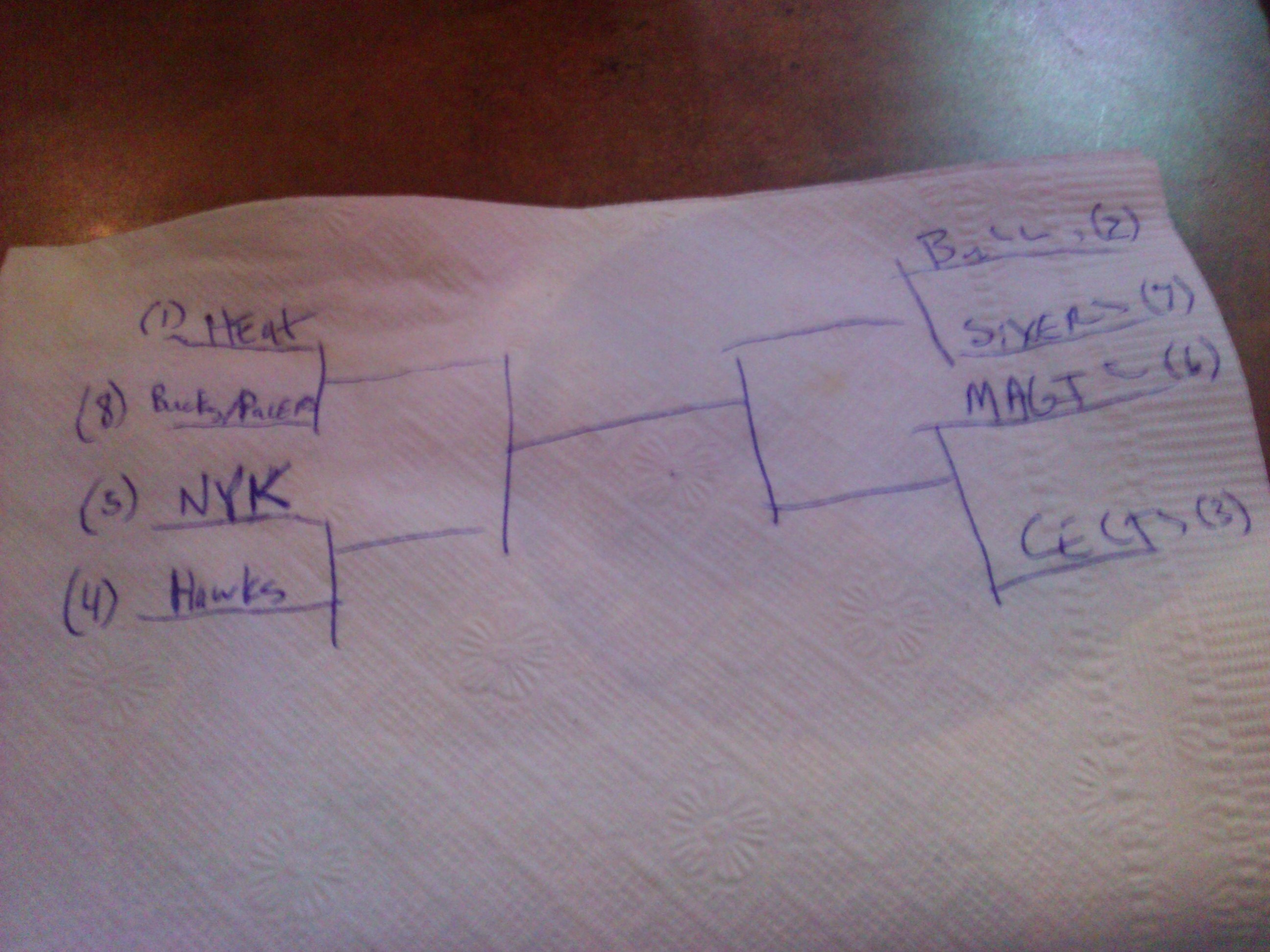
We didn’t start out with any goals in mind and didn’t end up achieving anything, so to that end, it was a success. The distractions were aplenty and mostly of the liquid variety, yet we were able to arrive at a loose consensus of the 16 teams we expect to make the playoffs and the order they’ll finish. We tackled the Eastern Conference first:
The main thing I recall from the Eastern Conference discussion was Milton’s distaste at the Knicks projected fifth seed. He despises D’Antoni’s perceived lack of commitment to defense and it showed in the venom he spewed forth and his insistence that Philly would finish ahead of NYK. Calmer heads prevailed. The other hot topic was Bucks vs. Pacers for the honor to be the sacrificial lambs to Gods of Miami. Grand ideas indeed.
As you can see by the napkin below, the Western Conference analysis deteriorated or evolved (really open to interpretation) in depth, but sacrificed quality with comparisons being drawn between injury-prone players like Devin Harris and Andrew Bynum and the comparative value to their teams. The biggest argument here was between the four and five seeds—Lakers or Mavs; which was really just a debate about who would get home court advantage. Also, Milton refused to attach his name to a Clippers number two and instead preferred the veteran Spurs for that spot.
If you’ve read any of my team preview posts, you probably picked up on the theme of excited curiosity that surrounds the unknown. We all know what Derrick Rose and Dwight Howard and Samuel Dalembert are capable of doing, but we’re still learning about young players and guys who have switched uniforms.
With that that in mind, I was tickled last night as I sat on my couch, New Castle in hand, feet kicked up and landed the remote on the OKC @ Minnesota game. There was that Russell Westbrook whipping and snapping all over the court, a new haircut for Nick Collison, a DC battle between Beasely and Durant, and then the Spanish question mark Ricky Rubio. Yeah man, I was all skeptical about Rubio. Skeptical about his defense. Skeptical about his foot speed. Skeptical about the hype. I wasn’t quite hating on the kid, but I wasn’t supportive either and I can make a case that I wasn’t even fair in regards to his NBA potential.
I’m fully aware that 26 minutes and 18 seconds doesn’t count for much of a sample, but watching Rubio thread passes through the tiniest and tightest of lanes and openings had me stroking the stubble on my chin and nodding in agreement: Yes, that’s a man who can pass. The passes he made were hard enough to see let alone execute and he repeatedly threw these passes without making a single turnover. Ahhh … it was a breath of fresh air and for Minnesota fans, you people (whatchu mean, you people?!?! – it’s not even like that) should be rejoicing in the name of all that is round, leather and flies through a steel rim:






 Dancing With Noah