Dancing With Noah

Just messing around, getting triple doubles

Tag Archives: NBA

4,000 Minutes (or the death of)

A while back I started researching the enormous amount of NBA minutes LeBron James has played in his decorated career. I’ll be exploring this in future work, but focusing on something different today: The 4,000 Minute Club because Dancing with Noah is interested in nothing if not interested in creating exclusive clubs for groups of large men that strut into statistical significance.

members-only

The 4,000 minute club is made up of any player that has appeared in 4,000 minutes or more combined across regular season and post-season for a single year. It’s a testament to some elite level of indispensability to your team, Cal Ripken-ish durability, and team success.

The 4k club is unique in that it’s possibly nearing extinction as you’ll see through the numbers below. While NBA Finals participants have the opportunity to appear in more total games than their NBA forebears due to playoff series expansion, things like sports science or common sense have resulted in minute reduction. A good, but isolated example of this is last year’s MVP Stephen Curry appearing in an MVP record-low 32.7 minutes/game. Golden State’s a unique example in that they’re able to blow out opponents without big minutes required of their top dog, but last season’s league leader in minutes played was James Harden who appeared in less than 3,000 minutes for the regular season – the fewest minutes played in a non-lockout season since 1958-59 when the NBA only played 72 games. These are microcosms of the broader downtrend in minutes played.

To arrive at a modern, contextual list of players, I separated the NBA/ABA into a pre-modern and modern era:

  • Pre-Modern: beginning of time to 1979-80
  • Modern: 1980-81 to present

The 4k threshold has been surpassed 55 times in NBA/ABA history with 36 of those seasons occurring in the pre-modern period when Wilt Chamberlain and Bill Russell stalked North America feasting on the blood and bones of knobby-kneed opponents. The top-10 of most combined regular and playoff minutes all occurred between 1961-62 and 1973-74 when pros wore low-top Chuck Taylor’s, shorts that would make John Stockton blush, and didn’t yet have the perks of chartered air travel or modern exercise science. The list below is made up of Wilt and Kareem, then four guys from the ABA which had an 84-game season.

11-12-15 - Wilt & ABA 4k minutes

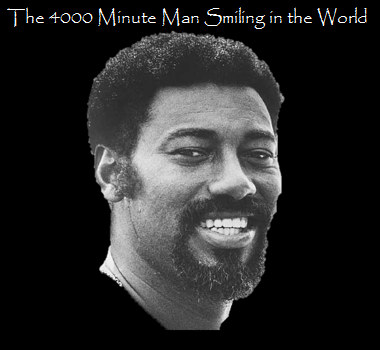
Regardless of how it’s explained or rationalized, it’s difficult to wrap your head around Wilt the Stilt playing 48.5 minutes/game over the course of a 92-game season. He appeared in more than the available regulation minutes not for a game, a week, or a month, but an entire damn season. These super charged numbers are incomprehensible in the way Babe Ruth’s hitting and pitching stats are impossible, in the way Cy Young won over 500 games and threw nearly 750 complete games. They are so far beyond any current comprehension that they’re not comparable to the modern, post-Wilt game.

11-12-15 - 4000 minute man

Instead, the modern breakout exists in a world closer to current standards of sanity and tolerability. Successful teams like the Spurs and Warriors have readjusted what is and isn’t acceptable with NBA player workloads while coaches like Tom Thibodeau are regularly admonished for throwing big minutes at players that who hobble on future arthritic joints.

The modern list is different and while it’s likely less of an achievement, it still speaks to something of the implicit meaning of the US Postal Service’s “rain, sleet or snow” motto that American’s love and cherish so much: We work hard.

18 players appear 19 times on the list of modern guys who have surpassed the 4k limit. They range in age from 22 to 34, in total games from 94 to 107, from MVPs to a lanky, lean Tayshaun Prince. 14 of the 19 occurrences made Finals appearances and every player on the list appeared in more than 40 minutes/game in the playoffs. Enough with demographics, take my hand and let’s explore this wonderful numerical forest.

11-12-15 - Modern 4k minutes

The table above is sorted by total minutes and right at the top of this who’s who of NBA MVPs is “Thunder” Dan Majerle. Not exactly the two guard I would’ve expected to see at the top of the list, but when the Suns made the Finals in 1993, Majerle was an indispensable spoke. He appeared in all 106 games for Phoenix with 33.5% of his total 4,270 minutes played coming in the playoffs. His playoff MPG (44.6) represent the highest lift over regular season MPG with an increase of 5.6 minutes capped off by a 28-point performance on 6-8 from three in a 59-minute triple OT game in the Finals.

Only one player made this list without even advancing to the conference finals. Back in 2002-03, Allen Iverson appeared in all 94 of Philadelphia’s games, averaging a whopping 43 MPG. I don’t think anyone questions Iverson’s toughness, but for a player who weighed under 170lbs and averaged nine free throw attempts/game to play 43 minutes every night for 94 games is remarkable. Worth noting: The following season Iverson appeared in just 48 games.

Michael Jordan is the oldest player to reach 4k minutes and the only player in the modern era with two 4k seasons to his name. We’ll focus on his age-34 season when he appeared in 103 games averaging 39.3 MPG. While lacking the nightly minute madness of Iverson’s 2003 or Majerle’s beastly playoff run of 1993, MJ carried a massive load for 1998 Bulls. Scottie Pippen spent the season fighting injuries and the Bulls front office over contract issues and the result was a 34-year-old Jordan leading the league in usage while appearing in the most total minutes of his career. The combination of shouldering the load for this Bulls team and navigating the front office shenanigans of GM Jerry “Crumbs” Krause no doubt added to MJ’s decision to hang up the high tops following 1998.

We’ll wrap up the player-level analysis with the youngest guy on the list and the one who originally led me on this 4,000-minute quest: 22-year-old LeBron James in 2007. He was probably a year ahead of schedule carrying a team that just wasn’t that good all the way to the Finals. Playing 40 minutes/night in the regular season and nearly 45/night in the playoffs was the only way this team could compete and it wore down the young LeBron. After exceeding 55% true shooting in the regular season, he dipped below 52% for the playoffs.

11-12-15 - Bron 2007

The glut of minutes coupled with an average team and more creative defensive looks in the playoffs sucked the life out of Bron’s 2007. It’s telling that there’s only a single point guard (Gary Payton) on the list above. And with James so frequently playing that ball handling/offense-initiating role, it’s fair to wonder if that and a dose of Spursian common sense have resulted in just one 4k season for him.

The last time we saw a player cross the 4k barrier was 2008 with a 29-year-old Kobe Bryant. Given the aforementioned stats about Steph Curry and Harden last year coupled with theories that players are more susceptible to injury due to a multitude of factors (sleep deprivation, poorer diets, playing tons of basketball at younger ages, and poor weight training habits) and advances in sports medicine and biometric testing point to what should be a smarter, more cautious approach to managing player health and minutes, aka assets and investments. Though one could make the counter argument that advances in science may reveal new and better ways for athletes to protect their bodies and thus play even more minutes. The future is a damn abyss to which we’re all inevitably hurtling and nothing should be a surprise. But if teams follow the lead of two of our league’s most successful franchises, then we’ll no doubt see minutes trend downward and friends of the 4k club remaining a tidy, fraternal group of 17 (RIP, Moses Malone).

James Harden and the 43-13 Club

Once upon a time in the pre-presidential Obama days of the NBA, young Mr. Michael Jordan showed up for a game in Indianapolis against the Pacers and their funny two-guard, Reggie Miller. Jordan’s Bulls lost by four points, but it was due in no part to Jordan who crapped all over the Pacers for a sizzling 47 points, 11 rebounds, 13 assists, four steals and two blocks while shooting 57% from the field and 13-14 from the line. Egads!

Of course Michael Jordan, he of “commerce over conscience” infamy, is the modern-day NBA (defined as 1985-86 which is the first season basketball-reference offers certain box score stats) pioneer of the 43-13 club; aka 43-points and 13-assists, a truly dominant offensive game mixed of equal parts attack and distribution, but all attack.

So how’d we arrive here? James Harden delivered us to this moment on a Friday night in Sacramento in November with his vintage Hardenesque performance: 43 points on 23 shots with 16 FTAs and 13 assists. Harden was a rock or ogre or something irrepressible. And it was kind of fitting that in a league where all two guards are measured by their ability or inability to emulate his Airness, that the two-guard with the most un-MJish game would be the latest in a short line of NBA greats to repeat his feat from 1989.

James Harden considering Mars

James Harden considering Mars

Here’s the criteria:

  • 43 points or more
  • 13 assists or more

The inductees:

  1. Michael Jordan, 26-years-old in 1989: 47pts, 11rebs, 13asts, 4stls
  2. Larry Bird, 33 in 1990: 43pts, 8rebs, 13asts
  3. Kenny Anderson, 23 in 1994: 45pts, 8rebs, 14asts, 4stls, 20-23 from FT
  4. Antoine Walker, 24 in 2001: 47pts, 5rebs, 13asts, 4stls, 9-14 from 3
  5. Tracy McGrady, 23 in 2003: 46pts, 10rebs, 13asts, 2blks
  6. Allen Iverson, 31 in 2007: 44pts on 16-22 shooting, 15asts
  7. Gilbert Arenas, 27 in 2009: 45pts, 13asts
  8. LeBron James, 25 in 2010: 43pts, 13rebs, 15asts, 4blks, 1-9 from 3
  9. James Harden, 26 in 2015: 43pts, 13asts, 7 TOs

It’s an illustriously exclusive crowd Harden’s just joined, but fitting given the versatility of his game. Long a playmaker and dynamic scorer, the Beard is one of just 12 players in league history to average 27ppg and 7apg over the course of a single season. Where our eyelashes barely bat at the inclusion of MJ, Bird or LeBron, Kenny Anderson and Antoine Walker are more surprising. Anderson’s game was necessitated by an injury to Derrick Coleman while Walker’s was an outmatched team on the road where he caught fire.

Context for games like these matters. In Harden’s case, it was his sixth game of the year, the first three of which had all resulted in 20-point losses with last season’s MVP runner-up shooting a combined 12-54 (22%) from the field and 3-32 (9%) from three. His team has been ravaged by early injuries and the challenge of integrating speedy playmaker Ty Lawson into the attack. On this Friday night, there was no Dwight Howard, no Terrence Jones, Donatas Motiejunas, or Patrick Beverley. So against an undermanned (no DeMarcus Cousins) Kings team, Harden seized the reigns and torched the Kings. It was without peer as his best game of the new season with the Rockets largest margin of victory and his own highest usage and ORtg.

Which takes us to the final noteworthy relationship of the 43-13 club; the relationship between usage and Ortg. The 43-13 club means you’re accounting for no less than 60 of your team’s points. A player becomes the catalyzing engine driving the offensive attack from multiple planes much to the defense’s helplessness. I expected higher usage rates which isn’t to say the rates aren’t high, but below we see a consistent relationship: mid-30s usage, mid-130s Ortg – with a couple of truly unique outliers. Allen Iverson’s 44 and 15 on 16-22 shooting stands out as a model of harnessed efficiency which, given his career-long struggles with efficiency becomes the greatest outlier and a likely topic for a future edition.

Stats courtesy of the great Basketball-Reference.com.

Stats courtesy of the great Basketball-Reference.com.

25-25 starring Young Drummond with supporting role from Young Dwight

On November 3rd, Andre Drummond, all of 22-years-old, notched the second 25-25 game of his career with 25 points on 12-17 shooting and 29 rebounds – a career high. In the process he joined Al Jefferson and Dwight Howard as the only three active players in the league with more than one 25-25 game. Guys like Shaq, Tim Duncan, Patrick Ewing only achieved the feat once in their storied careers, but at 22 Drummond’s already done it twice.

11-05-15 - Drummond in Detroit

As I looked over this list in all its randomness dating back to 1985-86 (which is worth noting because Wilt Chamberlain, that giant NBA version of Babe Ruth, had three seasons where he averaged 25-25 and went for 30 and 23 as a career average), a few things stuck out in their oddball numerical beauty:

  • Hakeem Olajuwon sits on the modern 25-25 throne with five such games
  • One of Olajuwon’s games was a 32-point, 25-rebound, 10-block performance which I’ve previously written about and is one of the more dominant/lopsided individual stat lines I’ve come across.
  • The highest game score on the list is a 48.6 from Olajuwon on a night back in 1987 when he stuck it to the Sonics of Seattle for 49 points, 25 boards and six blocks. What the shit kind of night is that?
  • Kenneth Faried joined the club last year in a game in which he played just 30 minutes – the least minutes of anyone in the club.
  • RIP Lorenzen Wright
  • And finally, the similarities between Dwight’s and Drummond’s appearances on this list.

By the time he was 21, Howard had his two 25-25s and I can only assume that most folks suspected these wouldn’t be the last two such games of his career. And given that he’s just turning 30 in a few weeks, it’s possible he tacks on a few more, but since his peak is well in the rearview, it’s unlikely.

25-25s aside, the young Dwight-young Drummond connection comes with intrigue not because of the similarities: they’re both powerfully built centers that use size, skill, and athleticism to dominate and they’ve both been coached by Stan Van Gundy; but the nearer they become statistically the better the future looks for Drummond.

At the end of Howard’s fourth season he was a two-time all-star with appearances on the NBA All-Defensive second team, All-NBA third team and All-NBA first team. He was highly decorated and more than prepared to take the torch as the league’s best big man. Drummond was named to the All-NBA Rookie second team back in the day and that’s it. Despite his size and athleticism and despite numbers that favorably compare to Dwight, he’s been unable to crack the code of the NBA’s off-season awards.

My friend and esteemed basketball writer and thinker Ian Levy just wrote a nice in-depth piece on the dissimilarities between these two that goes well beyond simplifications of them being large athletes that rebound and dunk. And where Dwight’s defense has long been Hall-of-Fame level (he’s the only player since the inception of the Defensive Player of the Year award in 1982-83 to win it three straight seasons), Andre’s merely a good defender. Though we’re looking at significantly different players, there are intersections and overlaps between their first three seasons. Below, in the most unscientific way possible, I’ve attempted to identify these intersections via my own made up statistic that includes traditional big man stats PPG, RPG, BPG combined with PER minus turnovers to arrive at an arbitrary stat for each of Andre and Dwight’s first three years in the league.

11-05-15 - Drummond vs. Dwight

The above unscientific approach is interesting because it takes a variety of stats and makes a fat stat patty out of them which, when viewed in their entirety is strikingly similar in terms of progression and production. Additionally, through three seasons, both players were 21 and were just getting to know Van Gundy: he didn’t start coaching Howard until his fourth season and Drummond in his third. None of the above is presented to imply that Drummond = Dwight. Drummond is a much better offensive rebounder and plays more to his own strengths offensively which results in less turnovers. Young Dwight was the superior defender, (somehow) had a broader array of offensive moves, and was able to stay on the court for longer stretches without getting in foul trouble.

And yet, even with those copious variations, the statistical similarities are hard to overlook. If we shift forward with a similar eye and the little four-game sample we have of this season, it doesn’t take ultra-optimism to imagine a 2015-16 season out of Drummond. Dwight made significant leaps in his fourth year with improvements in scoring (ppg and FTA/game), rebounding (total boards and rebounding rate), and offensive and defensive impact (career bests in offensive and defensive win shares and offensive and defensive rating). Four games into 2015-16 is too few to plant any flags in Drummond making a similar leap, but with the paint cleared of former running mate Greg Monroe and a hand-crafted SVG roster that creates greater space for Drummond, the magic eight ball indicates sunny days for the big man. Or, if November 3rd’s ridiculous 25-29 game provides some kind of symbolic indicator of the future, then step to the side, lest you be dunk slammed on by the giant Andre Drummond.

The Grandiosity of Steph Curry in Autumn

We’re in November and the Golden State Warriors have played less than five percent of their total regular season games. The most recent, their fourth of the young year, was punctuated by a violent 119-69 Mike Tyson-over-Michael Spinks type victory over the Grizz – the same Grizz that took a 2-1 lead over GSW in the playoffs just six months ago. In the breezy 28 minutes he played, reigning MVP and pioneer of “new NBA” style basketball Steph Curry incinerated the Grizz for 30 points on 16 shots. Speaking in purely statistical terms, this was a below average game for Curry in 2015-16, but like I cautioned, we’ve got 78 games to go.

But in the young offering of the new season, Steph’s taking what was already a nuclear game and style replete with some kind of next world hand-eye coordination, progressively audacious handle, Doc Holliday trigger finger, and already all-time range and accuracy combination, and building on it.

In 2014-15, his first season under the guidance of Steve Kerr, Curry was a joy to behold, roughly achieving the same averages he had in 2013-14 (pts, rebounds, asts, 3s, stls, etc) while appearing in four less minutes per game. Comparing his 2014-15 to 2012-13 is even starker: he played six more minutes per game that year, but his per-game averages were lower as were his shooting percentages. His per-36 numbers from 2014-15 outshone what had already been all-star caliber numbers. Improvement is expected, but as we’ll see, the type of improvement is mostly unprecedented.

I’m going to paraphrase here and most likely screw this up, but there’s a four-quadrant concept that occurs in learning and task mastery:

  1. You don’t know what you don’t know – you’re unconscious
  2. You become aware of the things you don’t know – your consciousness develops so you can at least identify what you want to improve upon
  3. You consciously begin to tackle those things of which you recently became aware
  4. You unconsciously do the things you recently did in a conscious state

If last year’s MVP/NBA champion season was step #4 for Steph where execution became second nature like breathing and sneezing and laughing, then the four games we’ve seen of him in 15-16 are closer to that scene in The Matrix when Neo is all “What are you trying to tell me, I can dodge bullets?” and Morpheus responds, “No, Neo. I’m trying to tell you that when you’re ready, you won’t have to.”

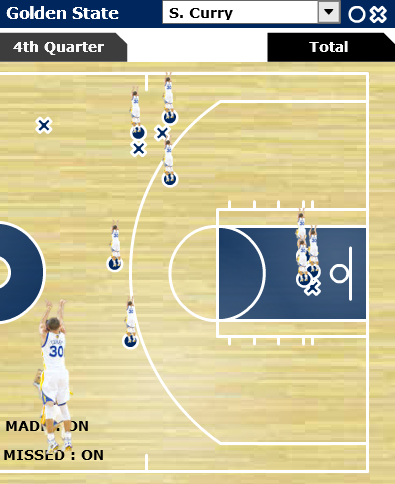
Was there a point where Steph realized he didn’t have to metaphorically “dodge bullets,” that it would just happen instinctually? On opening night last week, his first quarter should’ve been an indication to all of us that instead of seeing the illusory images on the court, he was deep in some meta coding, interpreting his opponent’s futile defensive efforts as nothing more than unprejudiced attempts designed to deter him. In the first quarter alone he shot 9-13 (would’ve been 9-12 had he not heaved up a 40-footer as time expired) with 24 points. It was lightning, violence, blitzkrieg, all-out attack, a metaphor for war. It was, intentionally or not, a battle hymn that rang out across the TNT-powered sound waves through speakers and pixels into our feeble senses.

11-03-15 - Steph shot chart game 1 updated

But it didn’t stop there and hasn’t stopped. We’re still hibernating in small sample size theater season, but something strange is afoot, like white walker afoot or when the levee breaks afoot. Through these piddly four games, Steph, this time under the substitute coaching of Luke “Son of Bill” Walton, is obliterating his own MVP-level stats and he’s somehow doing it with rarefied combination below:

  • Less minutes/game
  • More shots (more on this)
  • Increased efficiency (very little on this)

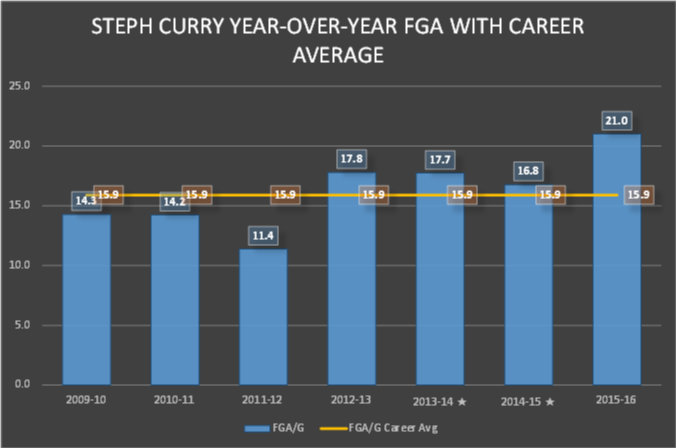
Because the Warriors can beat other playoff teams like the Grizz by 50 points on random Monday nights, there’s no need for Curry to play big minutes. This is our loss. In four games, all against playoff teams, GSW’s closest game was a 14-point victory. He’s averaging under 32 minutes/game. What we’re seeing though is that his slice of the offensive pie has grown in 2015-16. Where Curry’s career average for field goal attempts/game has sat right 16 attempts with a career high of just under 18 FGA back in 2012-13 in 38 minutes/game, Curry’s now cramming in 21 shots/game. He’s somehow getting up 32% more shots/game than his career average while appearing in the second lowest MPG of his career.

11-02-15 - Steph YoY FGA

It doesn’t stop with field goals. As part of that 21 FGAs/game, Curry’s pushing an unprecedented nearly 11 3s/game. To put that into context, the most 3PAs a player has ever attempted on a per-game basis was Baron Davis back in 2004 when he put up 8.7/game. Curry’s clearly a prolific gunner himself and holds the top two single-season records for 3s made. His career high of 8.1 3Pas/game is good enough for sixth on the all-time list. But if we compare his current little four-game stretch to his career average of 6.5 3PAs/game, we see a ballsy bold leap of 64%. And if we’re truly interested in blowing our minds all over the walls in blue and gold Warrior-themed blood spatter in queer basketball-themed Rorschach patterns, then layer on the context that Curry’s spike in volume is being accompanied by a career best three-point accuracy (48.8%). He’s hitting five threes/game!

11-02-15 - Steph YoY 3pa

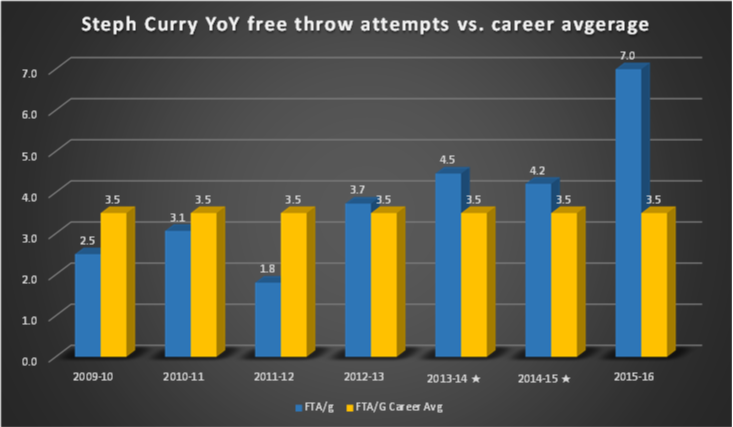
So Curry’s hovering around the perimeter, chucking record-setting threes and hitting them at paces typically reserved for guys who trade volume for efficiency. He’s taking advantage of spacing and passing and ball movement and all that good stuff. Yes to all of that, but for any notion that he’s merely perfecting the areas of already-existing strength while other aspects of his game stay flat or see small rises, he’s again a step ahead. For his career, Curry’s shooting a paltry 3.5 free throws/game. He’s third all-time in FT% just behind Steve Nash and Mark Price, so he’s getting the most bang for his free throw buck, but at 3.5 attempts/game with a career best of 4.5, he’s good at getting to the line for a point guard, but nothing special. In our shortened present season he’s somehow expanded his offensive range to include seven FTAs/game. For a guy that shoots over 90% from the line, seven FTAs/night is free points, a rhythmic bonus that builds on what’s already elite confidence. Where his increase in 3PA/game was a stunning 64%, his increase in FTA/game relative to his career average is nearly double at a 99% increase and the graph below more so than the others above clearly illustrates this spike.

11-02-15 - Steph YoY FTA

While I’ve touched on Steph’s increased makes, I chose to focus on the attempts to show the early tidal change from last season. Maybe it’s having Walton at the helm instead of Kerr or maybe Klay Thompson has a bad back. Perhaps Kerr and company saw something in the numbers or on film, something like, “More Steph is better.” Regardless of the impetus for the jumps in volume, the return Golden State’s seeing on his increased offensive aggressiveness are eye popping and head shaking. Who averages 37ppg in under 32mpg for a team that beats all comers by double digits? It is unprecedented, I swear it is. It has to be.

We’re dealing with the smallest of sample sizes to the degree that every stat called out in this piece should have an asterisk next to it (“Hey man, it’s less than 5% of games, chill!”), but what we’re seeing even through these four games is borderline comical in the way that peak Pedro Martinez or Aroldis Champan were/are comical; we know what to expect and the opponent thinks they know what to expect and it doesn’t matter. The stats tell this truth as well as any verbose language or overused thesauri ever could. And sure sure, it’s probably unsustainable, but what if by some dint in the makeup of things, it is sustainable? If there’s even a shred of sustainability going on here, may god have mercy on all their basketball-playing souls because in this new NBA, the man shooting 50% on 11 3s/game is king.

Melo greets Kristaps at the beginning of a great career

It’s a new season and that means a first edition of the Guess I’m Strange series wherein I track down some completely random oddball stat line like Ricky Rubio’s opening night 28-point, 14-assist, 1-turnover on 58% shooting and attempt to contextualize the feat form a historical perspective.

It seems fitting that on what is the real deal opening night of the 2015-16 season, our first admission to this longstanding (three years and counting – seems eternal in blog years) feature is from a rookie. But not just any run of the mill, taller-than-average NBA rookie, but a gangly 7’3” 20-year-old from the Baltic coastal country of Latvia, a country with a population a quarter the size of said rookie’s new home in New York City. Kristaps Porzingis, aka the Zinger, all swinging arms, legs, and elongated torso with an Ivan Drago-lite styled haircut arrived and made his debut in Milwaukee of all places; a brew-town in the upper Midwest that bears no resemblance to NYC which makes one wonder how in the hell young Kristaps is processing this all this Americana.

There are sayings about first impressions and maybe someone once tried to sell men’s cologne or deodorant based around the importance of first impressions and how you only get one chance to make one. Attempted truisms as such hold little weight at this blog, but since we’re talking about it, the first NBA action I saw this “precocious neophyte” (all praise due to Walt Frazier) partake in was having a loose ball rebound snatched away from his gangly paws by bearded and weathered semi-vet Greg Monroe. It was like some kind of flag bearing American brute stealing Latvian cupcakes from a skinny baby – a frightening thought for all of us, particularly the skinny baby thing.

First impressions be damned and flushed down toilets with water swirling both clockwise and counterclockwise. In the land of Lew Alcindor (keep in mind, in the Dancing with Noah mock draft, I compared Zinger’s string bean build to a young Alcindor), the lanky Latvian was determined and aggressive in seeking his own shots while donning the flowing New York Knick blue shorts and shirt which gave the appearance of rivers of copious fabric rolling on his lean frame.

The Zinger’s aggressiveness would soon be rewarded by the law; in this case NBA officials. In 24 minutes of play, he went to the line 12 times and made nine. When the final buzzer sounded, his line read 16 points, five rebounds, a plus/minus of plus-one and a Knicks road victory against a playoff team – and least importantly, a spot in DWN folklore for being statistically unique, statistically strange.

The criteria:

  • 12 or more free throw attempts
  • NBA debut

Once plugging the criteria into Basketball-reference.com’s wonderful game finder database, an astonishingly short list of matches were returned: four players (other than Zinger) since the 1963-64 season have taken 12 free throws in their NBA debuts:

  1. Billy McKinney: 10/15/78 – 12 FTAs, 23pts
  2. Isiah Thomas: 10/30/81 – 13 FTAs, 31pts
  3. David Robinson: 11/4/89 – 14 FTAs, 17rebs, 3blks, 23pts
  4. Lamar Odom: 11/2/99 – 15 FTAs, 44min, 12rebs, 2stls, 2blks, 30pts

Before we get into the illustrious company the Zinger keeps, how about that debut from Odom? At the time, he was only 19-years-old, making his NBA debut alongside a cast of quixotic characters with the Clippers that far exceeds the Zinger’s experience in weird New York. But to open a career with 30 and 12, 15 trips to the line in a whopping 44 minutes is the stuff greatness is built on. Beyond the Odom gem, how about David Robinson and Isiah Thomas? Please don’t hurt us, Zinger.

This is the ultimate in small sample size theater, but it’s theater nonetheless and the 7’3” debutant playing the four, facing up, getting his jumper at will in a way in Kevin Durant can relate to and of course, working his way to the charity stripe 12 times is beautiful, promising start. To paraphrase Ralph Waldo Emerson’s legendary letter to Walt Whitman in which he wrote, “I greet you at the beginning of a great career,” the Zinger similarly received great praise from the face of his own franchise as Melo said, “you couldn’t ask for more than that.”

81% of Anthony Davis looks like this

After 2014-15, Anthony Davis’s pro hoop trajectory climbed into rare company. His traditional big man stats (points, rebounds, blocks) gained him admittance into a stratosphere known to few at the pro level: +24ppg, +10rpg, +2.5bpg. Only Shaquille O’Neal accomplished the same as a 21-year-old. For players 25 or younger, only Shaq, David Robinson, and Bob McAdoo pulled it off. If we expand the list to remove any age constraints, the list is still less than 30 total seasons and just eight players in league history. Anthony Davis won’t turn 23 until March of 2016 and yet, as some critics take aim at Michael Jordan’s career, I too have a prickle of concern in my gut about the durability of young Mr. Davis.

It’s not hyperbolic exaggeration to say Davis’s early career has the markings of an inevitable first-ballot Hall of Famer. His first three seasons have been that good. But somewhere in that mixing pot of historical greatness is the mildly concerning truth that Davis has yet to exceed 70 games in a single season. He’s never encountered the catastrophic injuries that wracked Greg Oden or Joel Embiid. Rather, he’s been sidelined by one little injury after another.

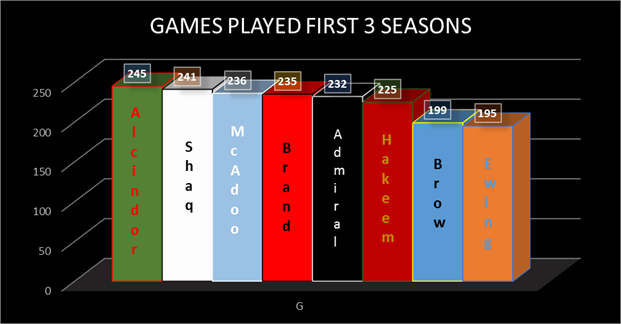
If we consider the players in the 24/10/2.5 club as some sort of bright and shiny baseline to compare against Davis from a purely durability view, we get the following breakout across each player’s first three seasons:

Anthony Davis and shiny baselines - stats courtesy of basketball-reference.com

Anthony Davis and shiny baselines – stats courtesy of basketball-reference.com


It is certainly isn’t an apples to apples comparison, particularly since primary data linking the players (24/10/2.5) occurred for most guys at a different point in their careers. The other difference is player age though there’s not much we can do about that. Of the eight players on the list, David Robinson (26) was the oldest after three years while Davis (21) is the youngest. And given Davis’s lithe frame (particularly as a 19-year-old rookie), it’s fair to wonder if age and physical maturation have factored into his semi-fragility.

Olajuwon (knee injury in 1986) and Robinson (thumb surgery in 1992) both had 68-game seasons in their first three years, but Hakeem appeared in all 82 his first year while the Admiral hadn’t missed a game in nearly three full seasons. Ewing only appeared in 50 games as a rookie, then 63 his second season before finally finding health (82 games) via a significant reduction in minutes – less than four minutes played per game in his third season. Sticking with Ewing, the bulk of his 32 games missed as a rookie were the result of a shutdown in March after he re-aggravated a season-long knee injury.

As we look at Davis’s spate of missed games over his first three seasons, we’ll see the shutdown factor slightly skew his number of games played as well. Over his first two years in the league, Davis was shut down with three games to go as a rookie due to a sprained MCL and bone bruise, then five more as in year two due to back spasms. Those eight games combine for 17% of the total missed games in his career – small volume, but it’s fair to wonder whether he may have played through injury had the playoffs been a possibility.

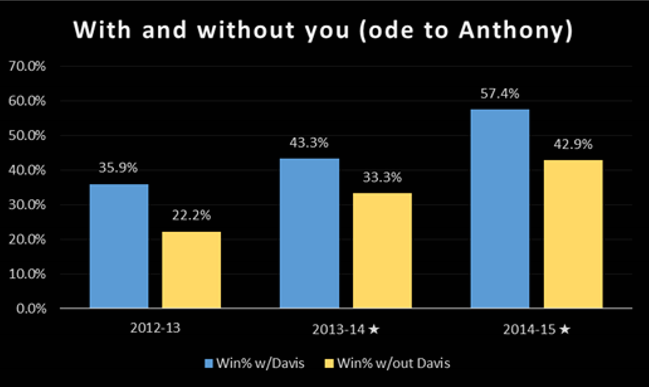
It shouldn’t come as a big surprise, but New Orleans is a significantly better team with Davis on the court. For his career, when Davis plays, the Pelicans’ winning percentage climbs nearly 14% — from ~32% to ~46%. While the team’s winning percentage has grown each season he’s been on the team (with or without Davis), the disparity between with and without Davis has never been greater than it was in 2014-15 when their winning percentage climbed 14.5% when Davis played. This shouldn’t shock anyone, but rather continue to highlight how critical a healthy Davis is to any New Orleans success.

10-26-15 - with or without anthony

Beyond just winning and losing, there’s the impact of continuity. How well did the Pelicans play in games following a Davis injury? Looking at his first two seasons, the games immediately following his injuries were miserable. There’s a lot of noise when drawing these attribution statements such as opponents, New Orleans personnel, and other injuries, but at its base level, the message is clear that New Orleans repeatedly struggled to re-integrate Davis into their schemes following injuries in years one and two:

  • 2012-13 (rookie year): Davis missed 11 straight games from 11/20 – 12/8 and upon return, the team struggled losing 11 of 13 games (won 15% of games)
  • 2012-13: Davis missed back-to-back games and upon his return, the team dropped seven of eight (13%)
  • 2013-14: Davis missed seven straight and when he came back they lost 12 of 16 (25%)

Aside from being small sample sizes, the stretches above are directional indicators that New Orleans took time to rediscover their pre-Davis-injury winning rate. In each of those three stretches the team performed worse off than even without Davis in the lineup.

Year three revealed a different trend that should alleviate some of the uncertainty around the direction of the Pelicans:

  • 2014-15: Davis misses three straight games and upon return, the Pelicans win four of five (80%)
  • 2014-15: Davis misses five straight games, but when he returns the team wins five of seven (71%)

As the team and Davis have both evolved, New Orleans has improved; learning to live better without their star while simultaneously establishing a system stable enough to provide some level of continuity with or without him. Replacing former coach Monty Williams with veteran Alvin Gentry isn’t likely to disrupt too much as off-season changes left the team about as intact as any other in the league.

(As an aside, for all the teeth gnashing about how basketball is a team game, pro basketball with its radiant stars is hugely dependent on their in-game availability and ability to excel. Players like Davis that impact both offensively and defensively are capable of reshaping history singlehandedly.)

Finally, there are types of injuries. Davis hasn’t sustained a trademark injury like Steph Curry’s ankles, Derrick Rose’s knees or Steve Nash’s back. Since his rookie season, his injuries stretched from head to toe ranging from a concussion to a sprained toe. He’s sprained both shoulders, fractured his fifth metacarpal, experienced back spasms, sprained his MCL among various other dings picked up in nightly battle sessions. As someone without a background in sports health or injuries, it’s difficult for me to say if it’s a good or bad thing that Davis’s injuries are completely random instead of identifiable. I don’t know if it matters that his label is injury prone or just plagued with a bit of bad luck.

It doesn’t take intellectual curiosity to realize less Anthony Davis is bad for the Pelicans. But despite the obviousness of it, Davis has still missed 18, 15, and 14 games in each of his first three seasons as a pro basketball player and his team suffers mightily without him. The injuries are just random and fluky enough to think luck has played a role, but just recurrent enough to make me, you, and Dell Demps wonder. Winning 42% of their games without him is strong year-over-year improvement, but with Davis out for any extended period of time Pelican playoff dreams are crushed like a bag of Doritos in the mitts of Omer Asik. But maybe it’s all nothing more than a human impulse to search for the little blemish in perceived perfection. On the eve of a new season where someone somewhere is ready and willing to anoint Davis the next great thing, let’s bow our heads and clasp our hands and cry out to the Pagan gods of Walton and Ming that we’re dealing with another Ewing and not a Ralph Sampson.

anthony

Summer League Scouting Grab Bag

young & smartMore so than the college game with its mini-three point line and suspect officiating, summer league offers a chance for a first look at some of the league’s best and youngest players playing what is mostly an NBA game – right down to the annoying cutaways to Secaucus for summer reviews. (Also, double OT is sudden death – to my knowledge, a wrinkle players will find nowhere else on the planet.)

After catching a couple games on a lazy post 4th of July afternoon, a handful of players stood out to me for various reasons and I wanted to share these first (and second) impressions for posterity:

Jahlil Okafor, Philadelphia:

  • I don’t know who informed me (Twitter or NBA TV), but people are calling him “Jaws.” I give the nickname a C-.
  • The big man from Duke is as-advertised with terrific footwork and hands.
  • He doesn’t lumber or labor up and down the floor despite weighing 270lbs or more. That being said, my buddy Bug accurately compared his physique to Jared Sullinger and that’s not a good thing.
  • He ran the floor and hit the boards with effort.
  • His sense of space around the hoop is advanced for kid that’s just 19.
  • This is completely personal, but there’s something vacant in his eyes and missing in his body language. Is he interested? Is he entitled? Bored? Is summer league just another opportunity for him to bully opponents like he’s done his entire life? Is he just an even keel dude? I don’t know, but I’d like to.
  • The combination of size and skill is already good enough put up 15+ points-per-game against pros.
  • Okafor has an advanced handle for his size, but maybe that’s to his detriment as he instinctually put the ball on the floor and occasionally tried to dribble out of double teams which may work in summer league but could be a costly habit against NBA regulars.
  • Insists on taking his man one-on-one or creating his own looks.
  • I wasn’t paying attention to him too much on defense so I can’t speak to the deluge of criticisms there.
  • Free throws are an adventure.
  • His massive hands are a great asset for ball control and rebounding.
  • Post spin move already on par with the best post players in the league.
  • Like watching a great wave roll in.

TJ McConnell, Philadelphia:

  • McConell’s the Arizona point guard that kind of looks like Aaron Craft, but doesn’t play like him.
  • As the conductor of the Philly offense he fed Okfaor, kept him locked in, pushed when the opportunity was available, and finished well around the rim.
  • I have no idea if/how his game translates against the deepest position in the league, but after seeing him for a game and a half, I was surprised and impressed.
  • Struggled to stay in front of Terry Rozier.
  • Already reads and executes well on the pick and roll.
  • Poised.

Marcus Smart, Boston:

  • #36 is the second year point guard for Boston with an Earl Campbell-esque build. In summer league with guys that can’t legally drink, but can smoke all the cigarettes they want, this is even more pronounced.
  • Ridiculously physical for the position, nothing has changed here.
  • Owned Jazz defenders with his strength, but used change of pace and timing to penetrate and draw fouls over and over.
  • Still showing signs of lacking mental toughness. Got caught on a screen from beefy Jazz big man Jack Cooley and wound up with a flagrant foul. He’s feisty and irritable which is a dangerous combination for a guy with his strength.
  • Shot miserably from the field (2-10 from three), but made up for it with great shooting from the line (12-13).
  • He’s a man against boys in this league.
  • Sat out Boston’s second game on Tuesday.

RJ Hunter, Boston:

  • It’s one game, but watched him repeatedly bounce off bigger, stronger bodies.

Dante Exum, Utah:

  • What a feel for the game.
  • This is not the skinny kid I saw a handful of times last year.
  • He’s put on some much-needed pounds since last season and it shows in improved balance and body control, particularly when getting into the paint and getting his shot.
  • Used strength and feel to get 10 free throw attempts. Of note: I think it was @Ben_Dowsett who hipped me to this on Twitter, but Exum only shot 32 free throws in all 82 games last year. Wow.
  • Even more so than Smart, he stood out as the best player on the floor. The fluidity, the grace, my word.

Jack Cooley, Utah:

  • Who is this beefy Luke Harangody clone?
  • Well, @deehaze24 enlightened me:
  • Former Notre Dame player from Glenview, IL, played in the D-League last year and had a 29-rebound game.
  • On Monday against Boston, he repeatedly used a combination of his wide body, strength, and craftiness to suck in rebounds. He ended up with 13 boards in 16 minutes – seven of those were offensive.
  • On the flip side, he picked up six fouls in those 16 minutes. Not certain, but I’m guessing some were the result of Smart breaking down the defense.

Orlando, Orlando:

  • Get a real arena or find a way to deliver a higher vantage point for the camera. Frank Kaminsky on the camera-side of the court looked like a balletic Gheorghe Muresan.
  • Salt Lake City is the superior viewing experience.

2015 Dancing with Noah … Unprofessional Mock Draft

This draft, more so than most drafts in recent memory (I can only recall last year’s draft with any ease, and also the 1984 draft which is more something I know about and the 2003 draft), has great thorough talent lying the top eight players. It’s a remarkably deep group percolating with all kinds of global basketball goodness. We’ve got hyphens (Karl-Anthony, Cauley-Stein, Hollis-Jefferson), Euros (Kristaps, Hezonja), mano a mano positional intrigue (Towns vs. Okafor, Mudiay vs. Russell, Hezonja vs. Justise), and a pair of storied franchises (Lakers and Knicks) that could throw the whole thing out a whack with their maverick decision making ways. There’s Morey and Hinkie, the fence swinger and extra long looking visionary.

What’s best as a fan though is that there’s excitement. Everything I listed above is tossed into a big ass draft mixing bowl and stirred up into prognosticatory basketball goodness. And Adam Silver and ESPN’s talking heads will serve it up to all of us over the course of three to four hours (or however long the draft is these days) on a random Thursday night in high summer.

Below is the second annual Dancing with Noah mock. It’s weird and unsophisticated, but sprinkled with tasty little surprises throughout. This wasn’t a one-man show. My friends Rex Tredway, Hamilton, Bug, and Maahs joined for the bulk of it. And a couple Twitter personalities repped their teams below so special thanks to Justin Faudree and Jacob Greenberg.

Now let’s draft ……..

1. Minnesota Timberwolves, Karl-Anthony Towns as drafted by Rex Tredway

It’s not a done deal yet, but Karl-Anthony Towns seems to be ahead by a nose in the two horse race to become the first to cross the stage on June 25th. The T-wolves have the luxury of deciding which big man to build the franchise around, but with this decision comes pressure. Flip Saunders has been touting Jahlil Okafor since well before his team secured a victory in the lottery, but the T-wolves’ front office seems set on Towns. Is Towns the best fit? Is he the best compliment to Nikola Pekovic in the frontcourt? Or is he just the safest pick? When you hold the first pick you dream of Lebron, Duncan, and Ewing, but what keeps you up at night is Joe Smith, Kwame Brown, and Greg Oden. Get some rest, Flip.

Tony Towns

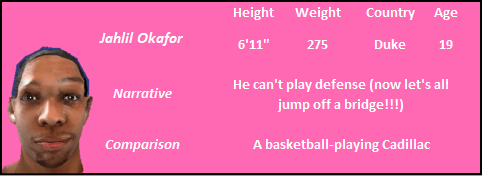
2. Los Angeles Lakers, Jahlil Okafor as drafted by Bug

It’s been 10 years since the Lakers struck gold with a quality big man in the draft when they selected the eclectic Andrew Bynum with the 10th pick in 2005. It didn’t last long, but they have two titles to show for it. With Jahlil Okafor the Lakers get back to their roots with a dominant low post force. Some like to critique his defensive presence and motor, but are the Lakers really going to roll with the Ed Davis/Robert Sacre/Jordan Hill poop sandwich for another season? Even Jim Buss can’t fuck this pick up.
jahlil okafor

3. Philadelphia 76ers, Emmanuel Mudiay as drafted by Hamilton

In the last two drafts the Sixers have acquired players who ended their collegiate seasons in travel gear. This time why not go with a guy who didn’t play college ball? Emmanuel Mudiay spent the year in China with the Guangdong Southern Tigers where he put up roughly 18, 6, 6. All I know about Chinese basketball is this happened, but I’m guessing Mudiay’s numbers were a bit inflated by the comp. In any case, he did travel a nation playing basketball for money and – what’s that? D’Angelo Russell did too? Oh … well, good on ya, D! But did you play with a 24 second shot clock? No? Okay, that seals the deal for Philly. Mudiay is the guy.

Emmanuel Mudiay

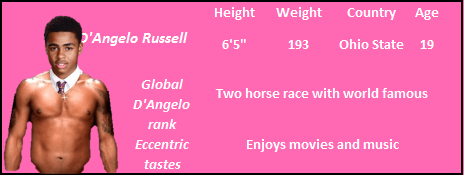
4. New York Knicks, D’Angelo Russell as drafted by Fendo

While the ghost of Isiah Thomas haunts the hallways of MSG, Phil Jackson’s chilling in Montana no doubt smoking peyote and tweeting three-point philosophies and Jimmy Dolan’s subconsciously scheming new and diabolical ways to break the hearts of loyal Knick fans. But even ghosts, hallucinogens, and incompetents aren’t enough to convince the Knickerbockers to pick Trey Lyles. The decision comes from above and when it reaches the ears of Derek Fisher, he’s giddier than he was that time Billy Hunter was ousted: D’Angelo Russell is the choice and maybe the best player in the entire draft. Only thing is, Phil, Dolan, Melo, and Isiah were bickering over the pick on an MSG conference line when it was mysteriously delivered to Adam Silver. Jonathan Abrams is hatching the oral history as we mock.
d'angelo r

5. Orlando Magic, Kristaps Porzingis as drafted by Maahs

After an amazing showing in Las Vegas against Antoine Tyler, Kristaps Porzingis rose towards the top of every team’s draft board. All joking aside there’s a lot to like about the 19-year-old Latvian prospect and his draft workout. “The Zinger” has the rare combination of mobility, shooting touch, and size (7’1″ with a 7’6″ wingspan to be exact) that has tantalized scouts for years. With a ceiling of a Dirk/Kirilenko/Schrempf and a floor of Tskitishvili/Vesely, Porzingis’ fate will be determined by his growth under Scott Skiles. Yikes. Hopefully Skiles and Co. have a plan in place to develop young Porzingis on and off the floor – different than Skiles’ usual plan of having his team hate the coach after three years.

kristaps

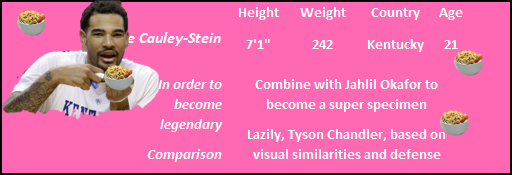
6. Sacramento Kings, Willie Cauley-Stein as drafted by Maahs

He’s the next Tyson Chandler, we know, we know. Every mocker has endlessly compared Willie Trill Cauley-Stein to Tyson Chandler, but WTCS’ ability to defend on the perimeter is what will eventually set him apart from Chandler. And while it took seven years for Tyson Chandler to become Tyson Chandler, WTCS will be able to make an immediate impact on the defensive end. Like most Kentucky guys in the draft (not named Harrison), he has some offensive skills that weren’t on display during last season’s undefeated run. Getting a Kentucky running mate and finally some front court help should provide for a less cantankerous version of Boogie in the 2015-16 season (assuming he’s still on the team and that’s even a possibility under Coach Karl).

cauley stein

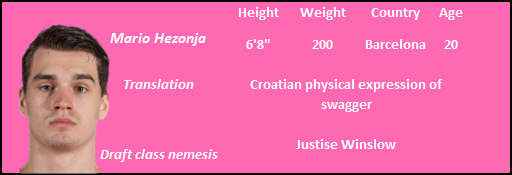
7. Denver Nuggets, Mario Hezonja as drafted by Fendo with input from Justin Faudree

I crept into the bowels of my Twitter contacts to speak with noted Europhile and Denver Nuggets guru, Justin Faudree. We weren’t able to go as deep into the conversation as I had hoped, but what became clear was Mario Hezonja’s uniqueness and the intertwining of his place in this draft relative to Justise Winslow. The Nuggets are filled with fresh new faces all eager to make a splash. Playing it safe (Winslow) isn’t winning the hearts and minds of the Nuggets faithful, but going in on a Croatian shooter/athlete with major Chase Budinger potential is the kind of balls to the wall move the people of Denver demand. Who needs defense when you’ve got the Rooster, Mario, and stay high Ty Lawson?

hezonja

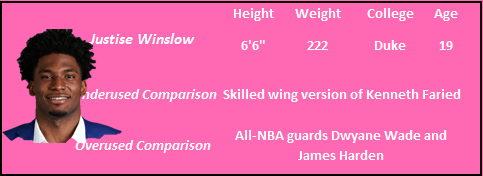
8. Detroit Pistons, Justise Winslow as drafted by Hamilton

You don’t hear Winslow’s name mentioned with Detroit at #8 too often because he’s not expected to be sitting there when Stan Van makes his choice. There’s not a team in the NBA that wouldn’t benefit from his defensive willingness and attack-the-basket mentality. As good as he was for Duke last year, he’s damn young and may just be scratching the surface of what he can become. The Harden comparisons are too easy (left handed, uses a Euro step on the drive, gets to the line) and totally neglect the possibility of him being an elite wing defender. The knocks on him are shooting ability and focus. Both those things can improve with time in the NBA and SVG won’t accept anything less.
justise winslow

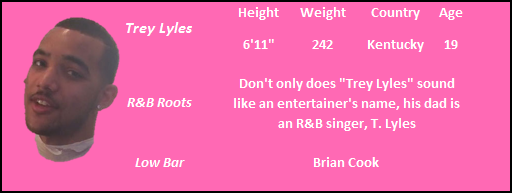
9. Charlotte Hornets, Trey Lyles as drafted by Bug

Jordan’s Hornets are on the clock, and there isn’t enough space allowable to mention all of the holes on this roster of ragamuffins. MJ was hoping for Cauley-Stein to fall to them to be their defensive anchor after Big Al skips town in a year (or sooner), but he is long gone. As Golden State showed with their championship run, versatility can be a major advantage. With that thought fresh in the minds of all NBA executives, the Hornets go with one of the most versatile players in the draft, Trey Lyles. Lyles came to Kentucky penciled in to play backup PF/C behind lottery picks Towns and Cauley-Stein, but injury forced him into action as a SF playing out of position. Lyles took the position change in stride, and steadily improved as the season progressed. At 6-10, 240, Lyles has the ability to play SF with a big lineup, or slide over center with a small ball lineup. Lyles isn’t great at any one skill, but he can do a bit of everything very well.

t lyles

10. Miami Heat, Stanley Johnson as drafted by Rex

There seem to be two schools of thought when it comes to drafting. You either select the “best” player: the guy at the top of your draft board. Or, you draft to fill a need: the guy who fits the best. If you’re the guy who can check both those boxes with one pick, well, you might be Pat Riley. With the selection of Stanley Johnson you get a wing with tremendous upside. An elite athlete who already plays solid D, which seems to be much harder to teach in today’s NBA then developing a 3-point shot (37% at Arizona) and also hits the boards (6.5 RPG). Aside from the upside of Johnson on the court they also draft their way into leverage over both Wade and Deng’s player options.

stan johnson

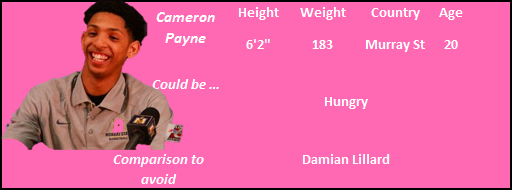
11. Indiana Pacers, Cameron Payne as drafted by Rex

Roy Hibbert is headed out the door and David West turns 35 this year so the Pacers have to take a big man right? A seven-footer from Texas? The pick has to be Myles Turner right? Not in this mock my friends. The Pacers have plenty of holes to fill on a roster that was completely exposed in a season largely without Paul George. A playmaking PG who averaged 20 and 6 could be just what the Pacers are looking for this upcoming season. I mean, they’ve talked about a more up-tempo style next year and is Rodney Stucky (if he re-signs) really the guy who you want running the show?

campayne

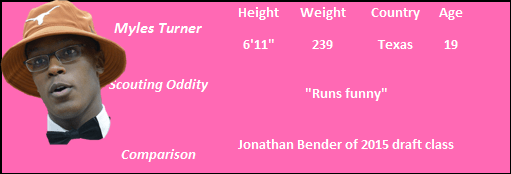
12. Utah Jazz, Myles Turner as drafted by Bug

Once the Jazz decided to ship Enes Kanter out of town, they drastically improved into one of the best defenses in the league down the stretch. Utah’s glaring need is an upgrade in the shooting department (Burks, Burke and Dante Exum shoot at an insanely terrible clip), but the departure of Kanter last season leaves them a bit thin on the front line. With this pick, the Jazz select Myles Turner out of Texas. The 6-11 Turner provides reinforcements for both needs. Don’t let Turner’s size and position fool you, he sported an 84% stroke from the charity stripe and is capable of knocking down the deep ball. The big payoff for Utah will be Turner’s defensive presence. Averaging 2.6 bpg in only 22mpg at Texas, the young big man will fit right in with the defensive tone established by Gobert and Favors late in the 2014-2015 season.
myles turner

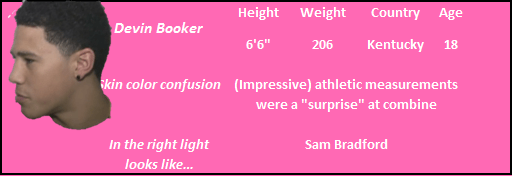
13. Phoenix Suns, Devin Booker as drafted by Hamilton

Devin Booker has a clear NBA level skill in his shot. Despite being picked after 3 of his UK teammates in this draft, there were several games during the 14-15 season in which he was their best player. Dude came up with timely 3s when his offensively-challenged team needed them. I clearly remember when his pops played for Mizzou and it makes me feel old as hell. But I digress. Like most NBA teams nowadays, the Suns want to spread the floor. This pick gets at that desire. Shooting ability isn’t just about making them – the threat is often enough to make an impact on games. Booker’s called light in the frame and below average athletically, but this is a make or miss league with a premium on the 3 pointer. When a guy can make ‘em like he does there’s a place for that late in the lottery.
devin booker

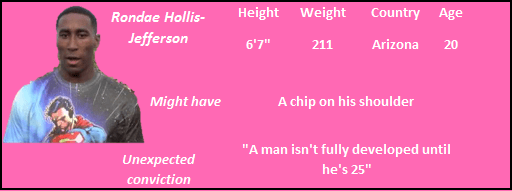
14. Oklahoma City Thunder, Rondae Hollis-Jefferson as drafted by Fendo

At this point the draft has drifted into some sort of quality-driven fourth tier of player and with a new coach in place, an elite team that was damned by injuries in 2015, and Sam Presti’s model that may or may not have plateaued, OKC’s in a queer spot. Who’s calling the shots and does it even matter? What do you give the team that already has everything? We guess depth and a future and by we I mean me, Billy D, and Presti. In our dreamy imaginary war room with me dialing in from Seattle and representing the spirit that allowed this franchise to come into existence, our selection is narrowed down to three: Cam Payne, Kelly Oubre, and Rondae Hollis-Jefferson. We agree Oubre’s ceiling is the highest, Payne is the best player today, and Hollis-Jefferson the most complementary player to the Thunder’s present day roster. Offense just isn’t a problem with this collection of talent and Presti’s keen on Donovan replicating the Kerr/Blatt first year successes. Fellow Seattleites shun me for canoodling with the OKC brass, but mock draft duty calls and I reject their jeers and criticisms. Give us the hyphen, the defense, the Hollis-Jefferson. [After the fact, it becomes clear to me that Cam Payne was already off the board for this pick. Thus I wasted imaginary conversation time stressing about whether he’d be a good fit or if he’d just end up putting OKC in a tight situation like Harden and Reggie Jackson. Presti should’ve told me.]
rondae hollis

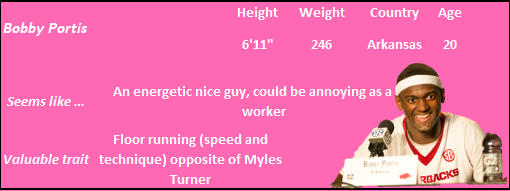
15. Atlanta Hawks, Bobby Portis as drafted by Maahs

After all the warm and fuzzy feelings of the regular season were gone, the injury bug and lack of depth ultimately doomed the Atlanta Hawks during the post season. With Paul Millsap and Demarre Carroll hitting free agency the Hawks are in desperate need of wing and post help. Portis, a lean 6’11”, provides immediate depth and his ability to hit the mid-range jumper will fit nicely into Coach Bud’s pace and space philosophy. With an offensive game similar to Chris Bosh, Portis will eventually be able extend is range to the 3 point line.

bobby portis

16. Boston Celtics, Kelly Oubre as drafted by Maahs

At 6’7” Oubre has the length, fluidity, athleticism, and look of your prototypical NBA small forward. A streaky shooter, Obure had a tendency to get lost on offense in his lone year at KU. And while he doesn’t yet excel at one specific thing, he projects to be at least a solid player in the league. Being a solid NBA player isn’t a bad thing, the Celtics current roster is full of them. Danny Ainge adds another high ceiling glue guy in the hopes of landing a max player or using them as future trade assets.

kelly oubre

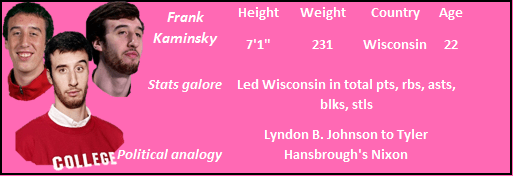
17. Milwaukee Bucks, Frank Kaminsky as drafted by Fendo

Frank the Tank or whatever they’re calling this mass of American-born Diaw-styled basketball goodness is the perfect fit in the rapidly developing cerebral nerve center of these Milwaukee Bucks. Coach Jason Kidd and GM John Hammond are high fiving in the Bucks war room as visions of Kaminsky occupying high posts and running weird pick & rolls with Giannis and Jabari and Khris dance in their heads. The League Pass darlings of 2015 look poised to carry the momentum forward in ways the Suns only wish they could’ve done the year before.
kaminsky

18. Houston Rockets, Jerian Grant as drafted by Hamilton

Houston rolled into the WCF with Jason Terry’s corpse starting at PG. There are few nights off in the NBA and even fewer at PG in the West. Whether the Rockets bring Jet back (they shouldn’t bother) they need younger legs behind Pat Beverley (assuming they retain his services). Jerian Grant’s the answer at #18. He’s got good size (6’4, 200), can shoot it, and played in an up-tempo offense at Notre Dame. That size coupled with defensive quickness gives him a shot to contribute in his first year. That’s what a team like Houston needs. As the son of former NBAer Harvey Grant and brother of Sixer SF Jerami, he knows what life in the league is all about. That matters too.

jerian grant

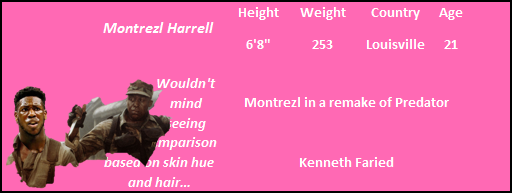
19. Washington Wizards, Montrezl Harrell as drafted by Bug

The Wiz have their backcourt locked down for the foreseeable future, but their frontline is a little long in the tooth. Nene, Gortat, and Humpries are all in their 30s now, and Nene will soon be a free agent. Washington came roaring out of the gates early in the season, but they hit a wall and one has to think that old legs was a factor. Although a bit undersized, Harrell is one of the strongest and most athletic players in this draft. He should provide some toughness on the frontline and bring a ton of energy to a team that seemed to fade down the stretch last season. Montrezl has an improving jumper and will need to continue improving in that area to make a name for himself, but there is always a spot in the league for an athletic big man that plays his ass off every night.

montrezl

20. Toronto Raptors, Sam Dekker as drafted by Bug

Masai Ujiri and crew were pleasantly surprised to have Sam Dekker fall in their laps at #20. Coming off of an electric tournament run, Dekker had scouts buzzing and being a lottery pick seemed to be a lock. The Raptors are in need of more production from both forward spots and Dekker is the top player left on their board. He gives the Raps some versatility with the ability to play both forward spots and even provide some mismatches at the four like he did at Wisconsin. Enough about Sam though…is anyone else rooting for his girlfriend to be in the green room with him?
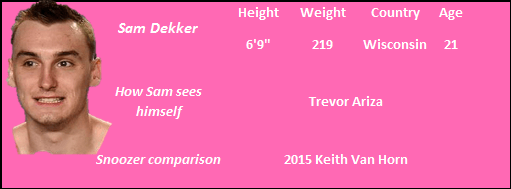
dekker

21. Dallas Mavs, RJ Hunter as drafted by Hamilton

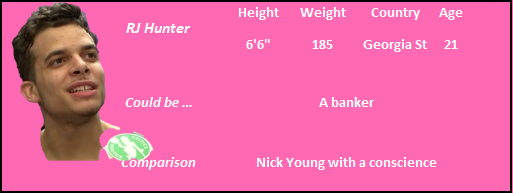
The Mavs (or Macs as the autocorrect on my phone prefers to call them) need a starting PG. They won’t find one here, but will be in the mix for every free agent like they are each summer. What they can find here is some shooting on the wing. Despite an odd release on his shot, at 6’5” RJ Hunter should be able to get clean looks and spread the floor when placed with the right (star) players – players Mark Cuban is certain to throw big money at in a post-Dirk world. Dallas will find itself in transition soon and having a specialist like Hunter under rookie contract during a retool makes sense from where I sit.

RJ Hunter

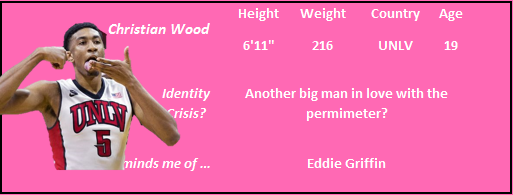
22. Chicago Bulls, Christian Wood as drafted by Bug

The Bulls hired Fred Hoiberg as their new coach to help open up the offense a bit and to unleash the Bulls deep talent. Unless a trade goes down, the Bulls don’t have many spots open in the rotation. There isn’t anyone left at this point in the draft that will contribute right away, so the Bulls decide to go with a developmental pick and take Christian Wood out of UNLV. Wood is high-energy forward that can run the floor like a gazelle. He also puts his length to good use on the defensive end where he averaged 2.6 blocks per game in his sophomore season for the Rebels. Wood has good mechanics on his jumper (73% FT) which has many GMs believing he can develop into a solid stretch four in the pros. The Bulls have the luxury of letting Wood develop his rail thin 6-10, 215 frame while he learns from watching Pau and Noah for his first couple years. He enrolled at UNLV at only 17-years of age, so Christian is one of the younger players in the draft at 19. Wood himself likens his game and skill set to Giannis Antekounmpo, and the Bulls are happy to allow him the opportunity to meet that potential.

christian wood

23. Portland Trailblazers, Justin Anderson as drafted by Hamilton

Portland has the worst luck when it comes to injuries. Or maybe they’re cursed. Who can tell for sure? You’re well aware of the injuries so it’d be a waste of my precious time to list them. If you’ve noticed a theme in my picks, it’s because there is one for the most part – wing players who can shoot. A basketball team can never have too many guys who can shoot from the outside. That’s never been truer than it is in today’s NBA. Portland has gotten squat from its bench in the last couple years which makes their injury situation impossible to mitigate. In Justin Anderson Portland gets everything it wants: a young athletic shooter capable on both ends who also missed games due to injury. A perfect fit indeed.
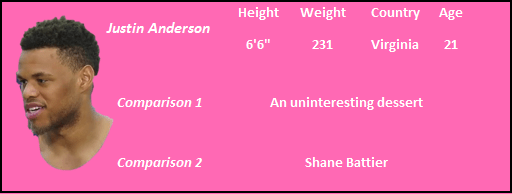
justin anderson

24. Cleveland Cavaliers, Rashad Vaughn as drafted by Fendo

Everything floating in LeBron’s powerful orbit screams NOW NOW NOW. But David Griffin (with the approval of D. Gilbert) has to at least acknowledge that a future exists, that tomorrow is right around the corner and what was NOW has become then. With that layman’s barstool philosophy driving him forward, he recognizes the need for someone who can be cultivated, developed, groomed into a legit pro. “Aim high, Griffin” is what he says as a stares intently into his own eyes in the mirror, sure to remind himself that, “You brought LeBron James back and now you’re drafting the next Bradley Beal. You’re the toast of Cleveland, Mr. Griffin.” Is it still a lie if it’s the truth in your reality?
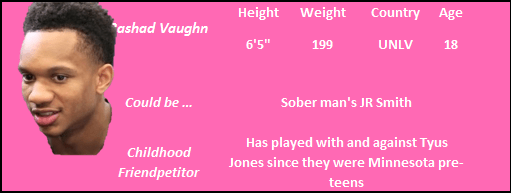
rashad vaughn

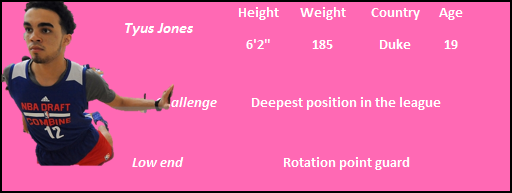
25. Memphis Grizzlies, Tyus Jones as drafted by Maahs

With some of the top wing players already gone, the Grizzlies select the best player on their board in Tyus Jones. Injuries to Mike Conley are mounting each year, and the Grizz could use depth at PG beyond the 1-2 punch that is Nick Calathes and Beno Udrih. What Jones lacks in size or athleticism he makes up with poise, leadership and clutch shooting. Joining a franchise that values “playing the right way” over wingspans (drink) and athleticism, Jones will do just fine.

tyus jones

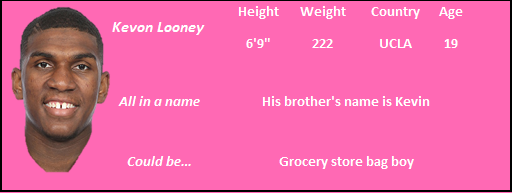
26. San Antonio Spurs, Kevon Looney as drafted by Maahs

With no viable Euro options on the board, the Spurs are forced to select a stateside player in the first round for the second consecutive year. A classic stretch four, with the ability to play some SF, Looney works hard on the glass and is a good decision maker on offense. Smart player, hard worker, good shooter…GO SPURS.

kevon looney

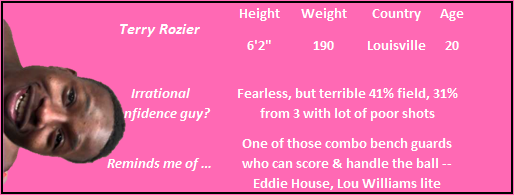
27. Los Angeles Lakers, Terry Rozier as drafted by Fendo

The Lakers have long treated the draft the way frivolous people treat lightly used, but still valuable goods — easily discardable. Meanwhile, thrifty NBA teams are using the draft the way savvy shoppers use garage sales and coupons. But these Lakers have been embarrassed into figuring out the new world of fiscal politics. But it’s weird because Kobe’s the last holdover to the good old days when the sex appeal of LA and the purple and gold was enough to finangle Pau Gasols and Chris Pauls (never forget). With a nod to their frivoulous past as Jerry Buss speaks sweet whispers into the thick El Segundo air, Mitch Kupchak and Jim Buss are inexplicably compelled to hand over the keys to #27 to the Mamba who promptly picks the kid most frequently labeled “fearless” in this draft: Terry Rozier. Never one to shy away from self-congratulations, Kobe makes his pick, then proceeds to tweet out a string of hardcore hashtags #ThisisNOW #LetitFly #CompetitionisEverything #LittleMamba #DwightisSoft #MambaMambaMambaMambaMamba…

terry rozier

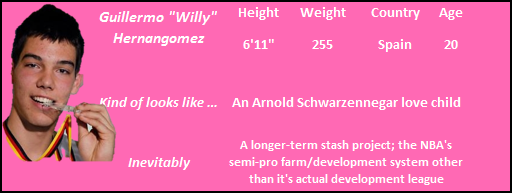
28. Boston Celtics, Guillermo “Willy” Hernangomez as drafted by Hamilton

Boston went with wing player in KU swingman Kelly Oubre earlier in this round. For this pick they’re going big and Euro. Guillermo Hernangomez might never come over to the NBA. If he does, he’ll be big and strong and Spanish. With multiple picks in the next two drafts Boston doesn’t have much risk in this pick and may be able to move his rights as part of a trade in the future. That, my friends, is value right there.

guillermo

29. Brooklyn Nets, Delon Wright as drafted by Bug

Still reeling from the KG/Paul Pierce trade that backfired, the beleaguered Nets are stuck in the shadows of luxury tax hell. Deron and Joe Johnson appear to be a shell of their former selves and the team depth is gutted from the over-inflated salaries of their fading stars. Based on Paul Pierce’s interview back in April, the Nets need an influx of players that give a damn. The best guard on Billy King’s (yes, he still has a GM job somehow) board is Delon Wright out of Utah. Delon is the younger brother of NBA veteran, Dorrell Wright, so he has an idea of what it takes to make it in the league. He was the engine behind the Utes surprising Sweet 16 run this past season. He has great size for a PG at 6-5, and he uses his length to cause havoc on the defensive end (2.1 spg). If Delon can get some more consistency with his outside jumper, he could end up being one of the steals in this draft.
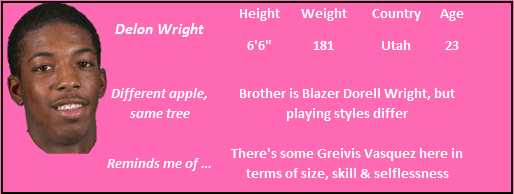
delon wright

30. Golden State Warriors, George de Paula as drafted by special guest Jacob Greenberg

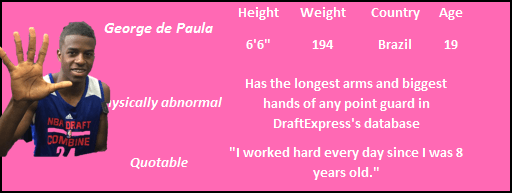
Unsurprisingly, the Warriors aren’t super attached to the 30th pick — what with winning the NBA championship and all — and most reports suggest that they’d happily give this pick away in a David Lee-centric trade in order to obtain some salary cap relief. But the Warriors have had some luck at #30 in recent years (Festus Ezeli went 30th in 2012), and other championship teams have found value at the end of the first round. If they do keep the pick, they may go with George de Paula, a 6’6” point guard out of Brazil. The last combo guard the Dubs drafted didn’t work out — rest in power, Nemanja Nedovic — and the Warriors already are pretty loaded at the guard spot. That said, the Warriors aren’t exactly thirsting for depth at the moment; he could go to the Santa Cruz Warriors to develop, or he could be stashed overseas until needed. And if Barbosa sticks around another year, those two could become the focal point of a potentially entertaining (and marketable) Brazilian cohort. But again, I’ll be very surprised if the Warriors have this pick (and David Lee; godspeed you loaf of Wonder Bread) by the end of the day on Thursday.

george de paula

The Turnover King

The turnover king, the turnover king,
Let’s not say long live the turnover king
He’s fallen in a heap of basketballs made of butter that don’t bounce but splat with buttery densities
His pockets picked clean like the dreams of a drunk passed out on the BART with destination of summer
The turnover king, you turnover king
Thirteen times you gave it away
Those 27 points that were nothing but average all year long
were unattainable,
A single point over half of average which is 14 total which is underwhelming when cities and states depend on you
Average was out of reach like the extra virgin olive oil-covered leather ball that betrayed you on a Wednesday night in May
Those seven assists you casually deliver with just a hair more than the effort I put into catching my morning bus or walking my morning dog
Were as fleeting as an acceptable assist-to-turnover ratio:
Yours was 1 to 2.1666666666667 tonight
(or something, could be there are too many or too few sixes)
But it doesn’t matter
The great turnover king, the turnover king
Exists in multispheres like this:
In my eye as a fan of trivial NBA history
In his eye as a human being trying to achieve something – such as a completed pass to a teammate
In the eyes of his opponents as a brown skinned equation that is a basketball version of the unsolvable, yet only if said equation collapsed on itself leaving mathematician
basketball opponents like, “Oh shit, the math did itself”
Historically bad is still historical you gnarled sweating
Turnover king
I swear to god if this was 1215 instead of 2015, probably the bards and songwriters would write about the turnover king with the amount of sadness on par with the amount of joy they write about the
Three point king or reverence with which they write about the regular king
Unnaturally bearded children would bury their heads in the bosoms of consoling mothers
While sober former players would chalk it up a bad game, shaking their heads shrugging massive suit-covered shoulders and reminisce on their own pimple covered failures in uglier-than-reality embellished memories
And in the sphere of emotional existence, do we not recall our scars as much if not more than our jubilations?
Oh you fucking immortal turnover king with all those errant passes and over dribbles
Are you mad man?
We know you’re not, you filthy turnover king
You just had a bad day like that time I stepped in dog shit with no shoes on before high school and nasty stuff in my toe nails and cuticles
Or that time I forgot my laptop even though my entire existence as a professional hinges to varying degrees around my laptop
Turnover king, I’ve never coughed up 13 turnovers, but I feel you
Or not, you know?
Dear turnover king, like that section in the US Weekly magazines my wife reads, I know you’re a star but you’re just like us – you have bad days
I know this because you had the worst fucking day possible short of a game-flushing timeout called when you didn’t have any timeouts like Chris Webber way back in the day
And I (and the people I know) have had shitty days
Oh sloppy turnover king, were you unfocused, distracted? Did you forget yourself?
I doubt it.
My friend thought you looked like Sidney Dean throwing that game in Watts with Billy Hoyle and who am I to argue even if I don’t agree
I don’t believe you threw the game but if you’d been wearing that Colnago cap with the bill flipped, then maybe
Suffice to say, not even turnover kings are immune to storylines and narrative
Someday turnover king, someday when you’re vanquishing the physical foes of the present, they’ll bring this up in the same way
Gatorade and Adidas and their chummy ad agencies with their truckloads of demographic audience data build storylines around bouncing back and overcoming failure
There’s no good that will come out of this, you gone fishing turnover king, but in our endless quest to attach meaning to every inconceivable
Mishap that befalls us, someone, perhaps you yourself, will invent the silver lining to create achievement out of failure
Like a technicolor flower sprouting out of the ugliness of a desolate wasteland
Whatever turnover king, just let’s take better care of that which we covet next time

A Fan’s Notes on Paul Pierce

As a kid in junior high and high school, I was a basketball fanatic. College, pros, high school, didn’t matter. Late summers and early falls were for consuming glossy-covered pre-season hoop publications like Athlon and Lindy’s, and less aesthetically attractive magazine covers like Sporting News and Sports Illustrated, I was source agnostic. Growing up in the not-so-fertile basketball world of Des Moines, Iowa, I was partial towards the hoop prospects my state produced and none had me as giddy as Raef LaFrentz. A 6’11” knee-knocked kid from some foreign outpost of school called MFL Monona-Marmac. The first I’d heard of Raef was in the Des Moines Register when he was named to the all-state team as a junior after averaging 36-points, 16-rebounds, and six blocks. His senior year was waylaid by a bout with mono, but seeing him at the State Tournament that year, I knew he’d be legit, unlike his fellow big man from the class of ’95, Iowa-commit Greg Helmers.

So it was that in 1996, I was riding a wave of anticipation when my parents picked up tickets to see LaFrentz’s Jayhawks in Ames, Iowa against Iowa State. After all, Kansas wasn’t just LaFrentz. There was Scot Pollard and Jerod Haase, Jacque Vaughn and Billy Thomas, and a talented freshman from Inglewood named Paul Pierce.

At the time I was a skinny fifteen year-old freshman with a full head of short brown hair and round glasses. During a grab ass game of gym class basketball I managed to break my arm and leg, a hideous and painful calamity of injuries that landed me in the hospital hopped up on drugs, constipated and completely incapable of attending of a college basketball game. My buddy Hamilton ended up with the tickets and took another high school buddy of ours, and meanwhile I was bed ridden and crippled, unable and uninterested in some basketball game.

Young Paul Pierce in a giant t-shirt


Back then Pierce was a curiosity. My affinity for the Jayhawks started with LaFrentz and ended with the team. The other guys were supporting characters, but characters nonetheless with their own stories on the periphery of my own basketball experience. For me Pierce maintained this role for much of his career before evolving into a hated villain when Kevin Garnett and Ray Allen arrived in Boston.
It’s weird, but before KG and Ray showed up, my most memorable Truth-related tale was his brush with death in a scary off-court stabbing in 2000. I was a college sophomore at the time and too busy being a 19-year-old idiot to fixate on the day-to-day comings and goings of the league, but even though the game was less of a priority, Pierce’s stabbing rose above the socio-academic cacophony. Looking back over the story, he “was stabbed 11 times in the face, neck, and back.” In some versions of the story the only reason he survived was the thick leather coat he wore at the time. Something about that always stuck with me and probably always will. He probably should’ve died, he probably should’ve been a tragic story in the wrong place at the wrong time, but instead this leather coat was his body armor and saved his life.

Then there was the oddball improbable chase for the finals with Antoine Walker and Coach Jim O’Brien in 2002. These Celtics won 49 games and had a 2-1 lead over the Jason Kidd/Kenyon Martin Nets in the conference finals before the Nets won three straight. Even though Boston lost, game three was another in a career of big Paul Pierce moments. The Celtics, down 19 points heading into the fourth, outscored New Jersey 41-16. Of course, the big game bonafides which were so clearly on display in 2015 against the Hawks had already begun taking shape: Pierce keyed that comeback by scoring 19 points in the final frame. And with a hint towards what would grow into a legendary swagger, after the game Pierce had this to say:

If I was on the other end of this, I would be hurting right now. I think this is a chance for us to gain momentum and take control of the series and not look back.

In a diluted, post-Jordan/pre-LeBron east, I thought the Pierce/Walker Celtics were maybe, possibly onto something following that conference finals appearance. It’s also possible my basketball analysis was rudimentary or confused. But whatever my shortcomings as a prognosticator, the ensuing five seasons were lean with Boston missing the playoffs twice and winning a total of seven playoff games in five years. With the Bron/Wade/Melo group emerging as torch bearers for a new generation, Pierce receded further away from the NBA’s mainstream superstardom. From 2002 until 2007, he continued his elite, if unspectacular role as an NBA all-star, but struggled to compete with the better players and storylines of his contemporaries like Kobe, Shaq, Duncan, KG, Dirk, Iverson, and Nash. He was likely overlooked and underappreciated, but fair or not, indicative of individual ability or not, the NBA has historically reserved its ink and camera time for winners, good guys, and players who score 81 points in a game. Pierce wasn’t as good as Kobe, didn’t win like Duncan, wasn’t a media darling like Nash, and didn’t have the culture-challenging chops of Iverson.

After all those years with Boston, the patience finally paid off in the summer of 2007 when Garnett and Allen joined the 30-year-old Pierce and second-year wunderkind Rajon Rondo. Pierce didn’t become a different person with his new team, but rather the cameras and mainstream just started paying closer attention and captured something of a Barkley-lite charisma. Great Celtic teams pull in the media like flies to shit and this was no different. Beyond the feel good story of these three first-ballot Hall-of-Famers finally rendezvousing, a narrative of villainy and bullying accompanied them. What made it all even more compelling was a reborn east with good teams and rivalry. The Celtics, with Pierce and KG as their joint mouthpiece, were front runners. Kendrick Perkins was perfectly cast as an enforcer, KG as the bully known for targeting European-born players and youngsters, and Pierce, the old school crusty veteran chomping at the bit to prove he was every bit the class of LeBron and Kobe.

I hated these Celtics. It wasn’t just because I’m a Laker fan. The best teams are often the easiest to dislike and these Celtics were no different. In retrospect, this was likely the best group in the league for a two-to-four year span and it’s surprising they only squeezed out a single title. Pierce had always been some sort of modern madcap iteration of Clyde Drexler and Charles Barkley, a great player outshined by better peers. Like Chuck and Clyde, his emergence onto center stage brought with it ample opportunity to re-assess his place in my fandom and whether it was easier to lump him into the unlikable whole that was the Celtics or maybe just the ridiculous, if overblown, wheelchair incident, I loathed this new Paul Pierce. But the wheelchair thing didn’t help and it was less about Pierce than the hero narrative the media or Mike Tirico attached to it. With Pierce going down and returning, the theater of the game and the Pierce narrative along with it grew out of control like an ugly media-created Frankenstein. On one hand, Tirico (or a Tirico-type) lionized the event. Meanwhile the public was right to troll it. The disparity between the two views was drastic and while my disdain should’ve been reserved for the media, Pierce was an easier target at whom I could direct my venoms.

From 2007 to 2011 or 2012, the Celtics were my least favorite team in the league. It’s more than likely a telling trait of my personality, but the players I loathe the most are the ones for whom I reserve much of my time. There’s a dark intimacy to embracing the characters you hate. In the same way I looked forward to Joffrey’s death in Game of Thrones, I relish the defeat of my least favorite teams in any sport. This deep loathing lives somewhere in my bones and in the pit of my guts and has been with me since the Pistons were walloping Michael Jordan back in the late 80s. What’s twisted about this relationship is the need for villain to be not just talented, but to be dominant. In order for any level of sustained sporting hatred to develop into anything worth remembering, the opponent needs to leave you salty, almost rub your face in all the things you can’t stand about them. At this point, the fan (me) can start seeing beyond actions and into intentions. Whether real or perceived, the fan who gets his or her money’s worth will have their suspicions validated by facial expressions imagined as arrogance, bumps misconstrued as flagrant shoves, injuries as fakery. I remember these teams and players as well as I remember my favorites over the years. Jordan’s Bulls aren’t Jordan’s Bulls without those Pistons, the Patrick Ewing Knicks, or even the Malone/Stockton Jazz. The Fab Five wasn’t as interesting without Duke as a contrasting foil – and I hated some Duke. For Pierce, with KG by his side, to attain this level after years of middling existence in my fan world is no small feat and for those four or five years he was at the top, I despised him.

But like everything else, nothing lasts forever and with the decline of the Celtics, the most beautiful part of fandom occurred for me: the great thaw. For most (all?) players I’ve despised, after a time, when they are no longer a threat to my team or my existence, the dark frost melts away from me and I can embrace the player with a sense of respect and appreciation. It’s almost sad to see an old foe no longer capable of eliciting the same anger in you, but unless you’re truly hardcore it’s simply not possible.

Before he was even traded to Brooklyn, Pierce was transitioning into this phase for me, but it was the most unfortunate part of the phase, the one where the former foe is an empty shell like Ewing in Seattle or Ewing in Orlando. In Brooklyn, it was boring with LeBron trouncing his old enemies in five games like an in-prime Larry Holmes pounding an outclassed Muhammad Ali into the canvas and that was that. It’s easy to forget and let memories go with a whimper or a fizzle, a something to a nothing without much reason to pause and reminisce.

Cue 2015 and the playoffs. Cue a throwback Paul Pierce, still rocking that pearish-shaped body, but now making appearances at the power forward spot in Randy Wittman’s offense. And suddenly Pierce wasn’t just an old man, but a queer specimen of the Hollywood variety. Our own Crash Davis as a colorfully crustified veteran oozing with savvy and audacity. He shot 52% from three over ten playoff games and that was while taking over six threes per game. As the Wiz scrapped and clawed through their series with Atlanta, a series they would lose in six games, it wasn’t Hawks Coach Mike Budenholzer or even game five hero Al Horford that would be deemed “winner of the series” (assuming such an award existed), but it was Pierce. With his game three buzzer beater for the win, his wide open game four miss, his game five clutch three that should’ve won, and his game six three that was late by the slightest of milliseconds, Pierce breathed life back into the character he’s always played, the character he’s always been and in the strangest of plot twists managed to temporarily snatch the spotlight from young bucks 10-15 years his junior. I watched all four of those final games and for the first time in my relationship with Pierce, I rooted for his slow-mo form to be perfect and on point, I sat at home trying to will his shots into the hoop and experience the other side of watching Paul Pierce.

It feels strange that my consciousness has known the human called Paul Pierce for nearly twenty years. The Pierce I missed out on in Ames back in 1996 is fundamentally the same person I hated for five years in Boston and the same guy I cheered for a week ago. Circumstance thrust him in and out of various roles and he’s the rare character fully capable of existing as hero or heel. With his one ring and incomplete splotchy facial hair, he’ll never be Kobe or Duncan, just an infinitely more colorful character who calls his own shots and hits them.