Once upon a time in the pre-presidential Obama days of the NBA, young Mr. Michael Jordan showed up for a game in Indianapolis against the Pacers and their funny two-guard, Reggie Miller. Jordan’s Bulls lost by four points, but it was due in no part to Jordan who crapped all over the Pacers for a sizzling 47 points, 11 rebounds, 13 assists, four steals and two blocks while shooting 57% from the field and 13-14 from the line. Egads!
Of course Michael Jordan, he of “commerce over conscience” infamy, is the modern-day NBA (defined as 1985-86 which is the first season basketball-reference offers certain box score stats) pioneer of the 43-13 club; aka 43-points and 13-assists, a truly dominant offensive game mixed of equal parts attack and distribution, but all attack.
So how’d we arrive here? James Harden delivered us to this moment on a Friday night in Sacramento in November with his vintage Hardenesque performance: 43 points on 23 shots with 16 FTAs and 13 assists. Harden was a rock or ogre or something irrepressible. And it was kind of fitting that in a league where all two guards are measured by their ability or inability to emulate his Airness, that the two-guard with the most un-MJish game would be the latest in a short line of NBA greats to repeat his feat from 1989.
James Harden considering Mars
Here’s the criteria:
43 points or more
13 assists or more
The inductees:
Michael Jordan, 26-years-old in 1989: 47pts, 11rebs, 13asts, 4stls
LeBron James, 25 in 2010: 43pts, 13rebs, 15asts, 4blks, 1-9 from 3
James Harden, 26 in 2015: 43pts, 13asts, 7 TOs
It’s an illustriously exclusive crowd Harden’s just joined, but fitting given the versatility of his game. Long a playmaker and dynamic scorer, the Beard is one of just 12 players in league history to average 27ppg and 7apg over the course of a single season. Where our eyelashes barely bat at the inclusion of MJ, Bird or LeBron, Kenny Anderson and Antoine Walker are more surprising. Anderson’s game was necessitated by an injury to Derrick Coleman while Walker’s was an outmatched team on the road where he caught fire.
Context for games like these matters. In Harden’s case, it was his sixth game of the year, the first three of which had all resulted in 20-point losses with last season’s MVP runner-up shooting a combined 12-54 (22%) from the field and 3-32 (9%) from three. His team has been ravaged by early injuries and the challenge of integrating speedy playmaker Ty Lawson into the attack. On this Friday night, there was no Dwight Howard, no Terrence Jones, Donatas Motiejunas, or Patrick Beverley. So against an undermanned (no DeMarcus Cousins) Kings team, Harden seized the reigns and torched the Kings. It was without peer as his best game of the new season with the Rockets largest margin of victory and his own highest usage and ORtg.
Which takes us to the final noteworthy relationship of the 43-13 club; the relationship between usage and Ortg. The 43-13 club means you’re accounting for no less than 60 of your team’s points. A player becomes the catalyzing engine driving the offensive attack from multiple planes much to the defense’s helplessness. I expected higher usage rates which isn’t to say the rates aren’t high, but below we see a consistent relationship: mid-30s usage, mid-130s Ortg – with a couple of truly unique outliers. Allen Iverson’s 44 and 15 on 16-22 shooting stands out as a model of harnessed efficiency which, given his career-long struggles with efficiency becomes the greatest outlier and a likely topic for a future edition.
Stats courtesy of the great Basketball-Reference.com.
After 2014-15, Anthony Davis’s pro hoop trajectory climbed into rare company. His traditional big man stats (points, rebounds, blocks) gained him admittance into a stratosphere known to few at the pro level: +24ppg, +10rpg, +2.5bpg. Only Shaquille O’Neal accomplished the same as a 21-year-old. For players 25 or younger, only Shaq, David Robinson, and Bob McAdoo pulled it off. If we expand the list to remove any age constraints, the list is still less than 30 total seasons and just eight players in league history. Anthony Davis won’t turn 23 until March of 2016 and yet, as some critics take aim at Michael Jordan’s career, I too have a prickle of concern in my gut about the durability of young Mr. Davis.
It’s not hyperbolic exaggeration to say Davis’s early career has the markings of an inevitable first-ballot Hall of Famer. His first three seasons have been that good. But somewhere in that mixing pot of historical greatness is the mildly concerning truth that Davis has yet to exceed 70 games in a single season. He’s never encountered the catastrophic injuries that wracked Greg Oden or Joel Embiid. Rather, he’s been sidelined by one little injury after another.
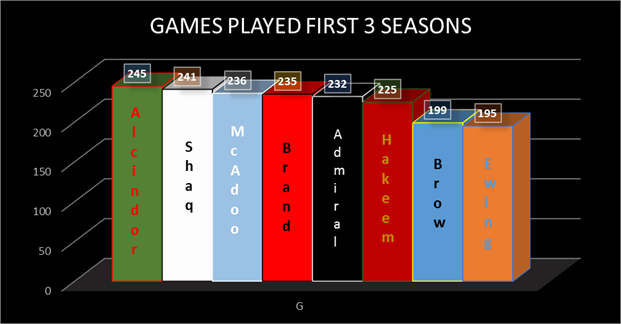
If we consider the players in the 24/10/2.5 club as some sort of bright and shiny baseline to compare against Davis from a purely durability view, we get the following breakout across each player’s first three seasons:
Anthony Davis and shiny baselines – stats courtesy of basketball-reference.com
It is certainly isn’t an apples to apples comparison, particularly since primary data linking the players (24/10/2.5) occurred for most guys at a different point in their careers. The other difference is player age though there’s not much we can do about that. Of the eight players on the list, David Robinson (26) was the oldest after three years while Davis (21) is the youngest. And given Davis’s lithe frame (particularly as a 19-year-old rookie), it’s fair to wonder if age and physical maturation have factored into his semi-fragility.
Olajuwon (knee injury in 1986) and Robinson (thumb surgery in 1992) both had 68-game seasons in their first three years, but Hakeem appeared in all 82 his first year while the Admiral hadn’t missed a game in nearly three full seasons. Ewing only appeared in 50 games as a rookie, then 63 his second season before finally finding health (82 games) via a significant reduction in minutes – less than four minutes played per game in his third season. Sticking with Ewing, the bulk of his 32 games missed as a rookie were the result of a shutdown in March after he re-aggravated a season-long knee injury.
As we look at Davis’s spate of missed games over his first three seasons, we’ll see the shutdown factor slightly skew his number of games played as well. Over his first two years in the league, Davis was shut down with three games to go as a rookie due to a sprained MCL and bone bruise, then five more as in year two due to back spasms. Those eight games combine for 17% of the total missed games in his career – small volume, but it’s fair to wonder whether he may have played through injury had the playoffs been a possibility.
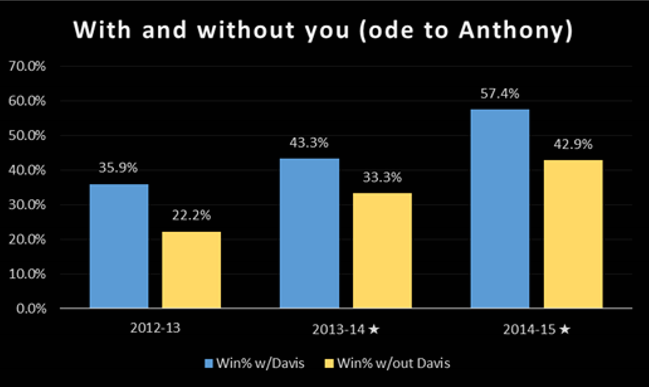
It shouldn’t come as a big surprise, but New Orleans is a significantly better team with Davis on the court. For his career, when Davis plays, the Pelicans’ winning percentage climbs nearly 14% — from ~32% to ~46%. While the team’s winning percentage has grown each season he’s been on the team (with or without Davis), the disparity between with and without Davis has never been greater than it was in 2014-15 when their winning percentage climbed 14.5% when Davis played. This shouldn’t shock anyone, but rather continue to highlight how critical a healthy Davis is to any New Orleans success.
Beyond just winning and losing, there’s the impact of continuity. How well did the Pelicans play in games following a Davis injury? Looking at his first two seasons, the games immediately following his injuries were miserable. There’s a lot of noise when drawing these attribution statements such as opponents, New Orleans personnel, and other injuries, but at its base level, the message is clear that New Orleans repeatedly struggled to re-integrate Davis into their schemes following injuries in years one and two:
2012-13 (rookie year): Davis missed 11 straight games from 11/20 – 12/8 and upon return, the team struggled losing 11 of 13 games (won 15% of games)
2012-13: Davis missed back-to-back games and upon his return, the team dropped seven of eight (13%)
2013-14: Davis missed seven straight and when he came back they lost 12 of 16 (25%)
Aside from being small sample sizes, the stretches above are directional indicators that New Orleans took time to rediscover their pre-Davis-injury winning rate. In each of those three stretches the team performed worse off than even without Davis in the lineup.
Year three revealed a different trend that should alleviate some of the uncertainty around the direction of the Pelicans:
2014-15: Davis misses three straight games and upon return, the Pelicans win four of five (80%)
2014-15: Davis misses five straight games, but when he returns the team wins five of seven (71%)
As the team and Davis have both evolved, New Orleans has improved; learning to live better without their star while simultaneously establishing a system stable enough to provide some level of continuity with or without him. Replacing former coach Monty Williams with veteran Alvin Gentry isn’t likely to disrupt too much as off-season changes left the team about as intact as any other in the league.
(As an aside, for all the teeth gnashing about how basketball is a team game, pro basketball with its radiant stars is hugely dependent on their in-game availability and ability to excel. Players like Davis that impact both offensively and defensively are capable of reshaping history singlehandedly.)
Finally, there are types of injuries. Davis hasn’t sustained a trademark injury like Steph Curry’s ankles, Derrick Rose’s knees or Steve Nash’s back. Since his rookie season, his injuries stretched from head to toe ranging from a concussion to a sprained toe. He’s sprained both shoulders, fractured his fifth metacarpal, experienced back spasms, sprained his MCL among various other dings picked up in nightly battle sessions. As someone without a background in sports health or injuries, it’s difficult for me to say if it’s a good or bad thing that Davis’s injuries are completely random instead of identifiable. I don’t know if it matters that his label is injury prone or just plagued with a bit of bad luck.
It doesn’t take intellectual curiosity to realize less Anthony Davis is bad for the Pelicans. But despite the obviousness of it, Davis has still missed 18, 15, and 14 games in each of his first three seasons as a pro basketball player and his team suffers mightily without him. The injuries are just random and fluky enough to think luck has played a role, but just recurrent enough to make me, you, and Dell Demps wonder. Winning 42% of their games without him is strong year-over-year improvement, but with Davis out for any extended period of time Pelican playoff dreams are crushed like a bag of Doritos in the mitts of Omer Asik. But maybe it’s all nothing more than a human impulse to search for the little blemish in perceived perfection. On the eve of a new season where someone somewhere is ready and willing to anoint Davis the next great thing, let’s bow our heads and clasp our hands and cry out to the Pagan gods of Walton and Ming that we’re dealing with another Ewing and not a Ralph Sampson.
What a night. What a fucking night for the NBA, for the game of basketball, for Nate Robinson, Steph Curry and Manu Ginobili. What a night for Twitter and the screaming woman at the Spurs game. What didn’t happen? Game ones of the second round: Bulls @ Heat in the early game and Warriors @ Spurs in the later game.
The Heat were 11.5-point favorites and for good reason. Coming into tonight, Miami was 39-4 at home (counting playoffs) and was mostly healthy with the exception of Dwyane Wade’s nagging knee injury. We all know about the Bulls: Kirk Hinrich’s out with a calf injury, Luol Deng’s dealing with fallout from a spinal tap gone wrong and we’re all depleted from the media throwing Derrick Rose on repeat and forcing us to listen over and over. So the Bulls rolled out Nate Robinson, Marco Belinelli, Jimmy Butler, Joakim Noah and Carlos Boozer. They did everything. Every damn thing you could ask for from a group of rejects (Robinson and Belinelli), outcasts (Noah), overlooked (Butler) and scorned (Boozer) players.
Down the stretch of this game, with Noah compulsively hustling and diving, scowling at opponents and teammates alike with long tendrils of hair stuck to his sweaty face, the Bulls stared up at a slight fourth quarter deficit of four points; but if felt like a Miami’s game all the way. How many times this season have we seen the Heat cruise through three quarters against lesser-talented teams only to turn up the intensity late in the game and walk away with easy victories. And when Jimmy Butler, all 6’7” and 220lbs of chiseled Jimmy Butler, attempted to wrap up LeBron on a fast break, but was overpowered by Bron’s lefty layup, I was impressed and relaxed, thinking Miami was just closing out another victory against another helpless victim. But I was oh-so-fortunately wrong and had no idea what was about to happen. The Bulls hit three threes (two by Belinelli and one by Butler) in the final five minutes, they shot 9-10 from the line and they frustrated the defending champions into missing all five of their shots in the final 97-seconds of the game. Somehow, the Bulls went down to the hardly hostile American Airlines Arena and beat the Heat 93-86 including a 35-24 fourth quarter.
For all that happened (Nate Robinson) and didn’t happen (Miami scoring points—they had their lowest point total since an 86-67 victory over these same Bulls on 2/21), what stood out most to me was Dwyane Wade’s irrationally selfish decision, coming out of a timeout, to chuck up a contested three at the 1:07 mark of the 4th quarter with his team down two points. On so many levels this was a bad shot. Many of us have become accustomed to the “hero ball” or “toilet bowl” offense where we get Paul Pierce or Kobe or Melo pounding the air out of the ball followed by a contested three. We all know it’s a bad shot, but there’s a level of latitude for the players I just mentioned. And Wade’s earned plenty of latitude in his career as well, but not enough to pull the shit he pulled on Monday night. Miami couldn’t have possibly drawn up the Wade-from-the-top-of-the-key special, could they have? Let’s look at some Dwyane Wade stats:
Dwyane Wade shot 25.8% from three this season
He was 2-18 from three over his previous 33 games
Wade was one of the least accurate three-point shooters in the league; finishing just a few percentage points better than only three other players (Lamar Odom, Reggie Jackson and Kevin Love) who made at least 17-threes this season
No Threes Allowed
I’m elated for the Bulls. It feels good and I don’t want to take away from their resilient victory, but I can’t get over Wade’s three; just a baffling, baffling shot.
It took a while to get over that first game. There was a sense of low-level adrenaline running through my body after the Bulls withstood the Heat’s meager comeback attempts. But during the NBA playoffs, there’s no time for dwelling on the past. I opened my celebratory beers and was pleasantly surprised seeing the Warriors confident and comfortable on the Spurs home court. Up four at the half in the AT&T Center? Well yes, yes of course.
All hell broke loose in the third though. Steph Curry started raining fire from the skies like a light-skinned basketball-playing Zeus firing bolts into the round cylinder. The Spurs crowd cringed with every blow, flinched at every shot release. At one point, the camera showed Gregg Popovich standing still, his eyes closed, his head hung down, but far from out. He looked like he was attempting to visualize the solution to this problem and for a split second I imagined Popovich taking the law into his hands Tanya Harding style and whacking Curry’s knee with a baton of sorts. We both snapped out of it though and after a patented succession of Warriors mistakes to end the third quarter, the dust had settled and Curry’s third looked like this:
Minutes: 11 minutes, 56 seconds
FG/FGA: 9/12
3p/3pa: 4/6
Assists: 3
Turnovers: 0
Points: 22
Golden State 92, San Antonio 80 (end of third)
There was a sense, I think, in many of us who had been here before, who had sat through the Warriors’ near collapse on Thursday night in game six against the Nuggets, that trouble loomed ahead, that all the Curry-fueled momentum in the world wasn’t going to make this any easier. And it wasn’t. The Spurs used every ounce of savvy and veteran poise and whatever other cliché you want to dress them up with to outscore the Warriors 26-14 in the fourth quarter.
The Curry third quarter, the Spurs comeback; it all evolved or devolved into some kind of brilliant basketball game that etched itself deeper into our minds and stomachs, intertwining itself within the gray matter of our brains and the slimy coils of our intestines. Harrison Barnes, Draymond Green, Kent Bazemore, Andrew Bogut, Steph Curry, Jarrett Jack … a professionally-trained youth movement apparently oblivious to the fear that rides shotgun on their road to fate. On the opposite side, it was the familiar faces that have stalked the league so patiently with their secretive wisdom and insider humor: Pop, Tony Parker, Manu Ginobili, Tim Duncan and a strange cast of characters that plug into roles that feel tailor made: Boris Diaw, Kawhi Leonard, Danny Green. They came and they came and they came. The old men with their flu bugs and bald spots and interchangeable pieces; a group of calm Texans embodying the same ethos of the Bulls. And somehow, after being down 18 points in the third quarter, the Spurs won in double overtime. Do you believe in Boris Diaw corner threes or nights where Manu Ginobili shoots 5-20, but hits the one that really matters? Fuck man, I don’t know, but I saw it happen.
Some notable items from this insane game in San Antonio in May:
Golden State shot 14-24 (58%) from the free throw line
Golden State is a 79% free throw-shooting team on the regular season (good enough for fourth in the league)
Boris Diaw: The big Frenchman had a series of big plays that helped this Spurs team achieve victory:
He somehow became the only Spurs player able conceive of not leaving his feet to guard Steph Curry. At the 1:22 mark in the fourth quarter, with GSW up five, Curry attempted a little shake move and pull up on Diaw; likely underestimating his defender’s length and discipline. Diaw blocked the shot without leaving the ground.
He went to the line and hit a pair of FTs to bring the Spurs to within one late in the 4th.
Diaw set the screen to free up Danny Green for the OT-forcing three.
He was on the floor for all of both OTs, contributed rebounds, screens and a clutch three.
There were heroes on both teams. Ginobili, Parker and Curry were special tonight, but in the thick history making moments, Diaw’s hand never shook. He played intelligent, confident basketball and is a big reason the Spurs are up 1-0 in this series.
I’ll close this with a line from Jim Morrison that embodies unknowing excitement of tonight and hopefully the days to come: I don’t know what’s gonna happen man, but I wanna have my kicks before the whole shithouse goes up in flames…Alright!
That line put him in the company of some of league’s best and most dominant big men of the past 30 years:
It’s no surprise to see Shaq, Dwight, Hakeem or Charles Barkley on this list. Lorenzen Wright and Joe Barry Carroll are more of the Reggie Evans variety, but Wright played 44 minutes and Carroll (aka Joe Barely Cares) played 55 minutes so it’s a bit more of a volume play. Evans played just 32 minutes (the only guy on the list under 40 minutes) and is also the oldest player at nearly 33 years. He grabbed just under 35% of the total possible rebounds while he was on the court. By comparison, Evans leads the league in this stat at 24.9%.
This is where these little weekend posts typically end. I’ll throw a youtube clip on the end of it and put it out into the world for consumption, but not this time. If you look back up at the table above and find #4 on the list: Hakeem Olajuwon’s 32-point, 25-rebound, 20-free throw attempt, 10-block performance against a hapless Magic squad on a chilly Sunday night back in December of 1989. I was nine years old at the time and most likely completely oblivious to The Dream’s ridiculous performance what with my age and the fact that Christmas was a week away.
This game sent me on a bit of search today; a search to have some context and understanding around Olajuwon’s game. The quest took me from the Houston Chronicle’s archives to the Orlando Sentinel’s archives to USA Today’s archives, then the SI Vault, onto reviews of newspaper database sites and finally to what felt like the grail of news of resources: NewsLibrary.com which has an easy-to-use/search database of hundreds of millions of articles and stories. Throughout this search, I was continually appalled by the lack of quality, the lack of results and terrible usability on some of the aforementioned sites. Most notably, the Houston Chronicle and USA Today have truly pathetic archive sections that either don’t work as intended or are impossible to find.
Media critiques aside, what Olajuwon accomplished in Orlando that night hasn’t been done by another player in the league in the 28 years covered by Basketball-reference’s box score database. In digging through the stories and recaps of the game, it’s plain to see the Magic were overmatched from the get go. This was Orlando’s inaugural season in the league and their roster reflected it with a group of pro basketball rejects; unwanted and unloved by the rest of the league’s General Managers. The team featured Scott Skiles, rookie Nick Anderson, Reggie Theus and other guys you likely haven’t heard of unless you’re around my age (32) or older. On the night Olajuwon crushed them, they started Mark Acres at center and Sidney Green at power forward. Missing from the lineup was their scoring leader and rugged PF, Terry Catledge. So it was Acres, Green and rotation guy Jeff Turner (owner of a 6ppg career scoring average). To compare the post mismatch in today’s terms, it’d be like sending Mark Madsen, Shelden Williams and Reggie Evans to war against well … no one in today’s game compares to the 1989 Olajuwon, so just imagine those three guys I just mentioned trying to stop the Dream.
I don’t mean to put down Turner, Acres and Green, but rather to show how outmatched the Magic were. The Orlando Sentinel’s write-up (written by Barry Cooper) praised the bench group (which Turner was a part of) for their hustle while spelling out the facts simply: “…Acres played hard against him (Olajuwon), but most of the rebounds Olajuwon grabbed were nearly uncontested.” As for Green who started in place of the ailing Catledge, “perhaps the Magic’s best post-up defender, didn’t take a shot and had only two rebounds in 10 minutes.”
Here’s the box score where we see Olajuwon had a ridiculous D-Rating of 72 for the game. It was his second triple double of the season and the fifth of his career. The 25 rebounds tied his career-high at that point and the 20 free throw attempts set a new career-high. In calling out that Olajuwon hit just 12 of his 20 FTAs, Houston Chronicle writer Eddie Sefko interestingly wrote “But for a change, not everybody jumped on Olajuwon’s back.” Given that he averaged over 24 points while leading the league in rebounding at 14rpg and blocks at 4.6bpg, played 39mpg while appearing in all 82 Rockets games; it’s intriguing that Sefko mentions this and reminds me of the Olajuwon section in Bill Simmons’s Book of Basketball where he references some of the less desirable traits of Olajuwon’s. While Sefko’s message is partly referring to his poor free throw shooting, you can piece together something of a love/hate relationship that existed between Houston fans and Olajuwon during this period.
The Chronicle’s recap also includes a quote from Orlando coach Matt Guokos that was left out of the Sentinel’s home town recap: “The discouraging aspect of going to the basket and getting shot after shot blocked kind of got to us.” Imagine the psychological impact of Olajuwon patrolling the paint that night. Your leading post scorer is out for the game, you’re an expansion team that was thrown together with spare parts. It’s almost Christmas and the excitement of being part of a new franchise has worn away and the reality that you’re playing against the best center in the league is wholly evident. You try to get in the paint for high percentage shots, but every time you turn a corner or beat a defender, there’s Olajuwon, crouched in his defensive position, but he’s a predator, he’s the hunter. He waits and times his jumps perfectly. Sure, he blocks 10 of your shots, but how many does he alter? How many times do you second guess penetrating? And at the end your coach finally admits what you and your exhausted teammates had been feeling all night long: It’s discouraging. He was just too good.
Olajuwon himself acknowledged the mismatch: “In a game like this, they really don’t have a legitimate center in the middle, so we have to take advantage of that.”
The Rockets underachieved in this game and it led to Olajuwon playing big minutes (43) out necessity more than anything else. Despite winning by 15, Houston was up just one point heading into the fourth quarter. By that point, the Magic were done driving into the paint and settled for jumpers which Olajuwon presumably tracked down on his way to the 25 boards. It was the perfect setting for Akeem to have a big game and he took full advantage.
My journey into the rabbit hole of box scores and recaps today is just an extension of the box score readings I used to do when I was a kid. I’d find the Sports section in the Des Moines Register, flip to the back to see the box scores and look for the explosions, the inconsistencies, the triple doubles, the 50-point outbursts and find some sense of satisfaction in the deviations. So many years later and years removed from reading box scores and getting dark ink smudges on my fingertips and thumbs, I’m still intrigued by the abnormal accomplishment and appreciate it for being one of the few things in sports that’s still so unpredictable; just like it’s unpredictable that a Reggie Evans 24-rebound, 15-free throw attempt on a Friday night in March in 2013 would lead me to contemplating Akeem Olajuwon’s relationship with Houston fans in the winter of 1989.
Twin Tower days prior to Olajuwon’s obliteration of Orlando
Trends and their meanings and sources are always insightful in sports, but I’m just as interested and sucked into the completely random stat line or statistitical accomplishment like the one that occurred on Friday night in the whipping the Spurs applied to the Kings. After dropping a stunner to the Suns in overtime a few nights before, the Spurs took out their frustrations on the Kings in the form of a 130-104 victory where San Antonio shot just over 60% from the field and scored 130 points on just 84 shots.
It was this environment of cleanliness and efficiency that Tony Parker went down with an ankle injury forcing Manu Ginobili into playmaking duties where Ginobili set a career-high with 15 assists and did it while spending less than 23 minutes on the court. That makes him one of just three players to achieve this random act of prolificacy over the past 28 seasons and of the accomplishment Manu had this to say: ”Yeah, it just happened…” For that, I guess Manu’s strange:
Alright, today’s post is a consolidation of madnesses from Sunday and Monday; and make no mistake it has been mad; at least someone’s mad. We’ve witnessed referee’s being loosely assaulted, Caron Butler breaking his hand, an impossible 27-point comeback and Amar’s Stoudemire punching out a pane of glass and in the process shredding his hand. If you’re not getting kicked out of games or getting hurt, you’re not doing your part.
Utah at San Antonio, game one, Spurs won 106-91, lead 1-0: Tony Parker did that Tony Parker thing he does where he uses speed and timing to invade the opposition’s defense at will. That the Spurs now play to his strengths instead of Duncan’s is impressive and a credit to all parties involved. The Jazz took one of four games against the Spurs in the regular season and will be fortunate to do better in the playoffs.
Random fact: Gordon Hayward attempted a career-high twelve free throws in game one and hit all twelve.
Denver at Lakers, game one, Lakers won 103-88, lead 1-0: Andrew Bynum is big, tall, long, talented, occasionally immature and more. To the Nuggets, he was the boogeyman in the paint, a giant protecting his lair. Ten blocks in the playoffs? Tied Hakeem Olajuwon and Mark Eaton for most blocks in playoff game history? Yep, that’s Andy. While Dwight’s temporarily crippled by a herniated disc, Bynum looks like an invincible force doing battle with children.
Boston at Atlanta, game one, Hawks won 83-74, lead 1-0: It was yet another battle in years’ worth of battles for these two franchises. The Hawks overcame a historically dismal shooting performance from Joe Johnson (see random fact below) to control this game and hang on for the win. The story that ruled the day was Rajon Rondo’s little chest bump into the ref. The timing and reaction were both overboard and could result in Boston dropping into a 0-2 hole. With Ray Allen’s health in question, the momentum Boston had built in March and April is vanishing in acts of immaturity and inevitability.
Random fact: Joe Johnson joined three other players in playoff history in three-point shooting ignominy with his 0-9 performance. His fellow culprits: John Starks, Rashard Lewis and Derrick Rose.
Clippers at Memphis, game one, Clippers won 99-98, lead 1-0: Watching this game was like watching a movie where you expect one thing to happen, but then the director/writer throws a knuckleball that leaves you disoriented and questioning the events of the previous two hours. Did it add up? Was it believable? Did I enjoy being befuddled or did the director just play a joke on me? There wasn’t a script to Sunday night’s game unless the big director in the sky is a Nick Young fan. What happens from here is anyone’s guess, but I can confidently say the Memphis Collective (players, coaches, fans, employees) looked helplessly nauseous in that fourth quarter.
Random fact(s): Reggie Evans’s 13 rebounds in 21 minutes put him in rare company with five other prolific playoff rebounders who’ve grabbed at least 13 boards in 21 minutes or less: Danny Schayes (14 in 21), Kurt Rambis (14 in 21), Scot Pollard (14 in 21), Jeff Foster (13 in 21), Maurice Lucas (14 in 19).
New York at Miami, game two, Heat won 104-94, lead 2-0: Once again, anger steals the headlines. Amar’e Stoudemire didn’t take too well to the Knicks’ second straight loss in Miami and took it out on a pane of glass covering a fire extinguisher. David Aldridge proceeded to take the event far too seriously, treating it more like Stoudemire had severed his femoral artery and was at risk of bleeding out instead of addressing it for the loss of control that it was. All this really does it take away the focus from what was another strong Miami performance and further reinforced the fact that the Knicks are simply overmatched the way blind Chinese dissidents are powerless against their government … oh, wait.
Random fact: Miami Heat nicknames: Mike Miller is “Slim,” Juwan Howard is “Nooky,” James Jones is “Jhoops” (which is actually pronounced “Joops” as the “h” is silent)
Orlando at Indiana, game two, Pacers won 93-78, tied 1-1: This game is being relegated to the NBA TV slot which essentially makes it the least interesting series in the playoffs. Ratings considerations aside, Monday night’s game was the familiar storyline of a tale of two halves. After falling behind by two at the half and being firmly bullied, the Pacers responded appropriately with a 30-13 third quarter. I wish things were different, but I struggle to find intrigue in this series.
Random fact: The Pacers are 33-2 on the season when leading after three quarters.
Dallas at OKC, game two, OKC won 102-99, up 2-0: Combined score after two games 201 – 197. The Mavs have had their chances, but unlike last season when they couldn’t miss in crunch time, Dirk and Jason Terry have come up short two games in a row and are dangerously close to seeing their title defense end early. Being pushed to the brink is nothing new for this Dallas crew, but in small spaces of their group consciousness, questions are being asked. Notable observations:
I’m not a Brendan Haywood fan, but the more I see him, the more I feel Shaq was justified in referring to him as “Brenda.”
Does Billy Hunter watch NBA games and if so, does he openly cheer against Derek Fisher? If the answer to either of those questions is yes, last night had to be particularly bitter for him.
Random fact: Miniscule sample size for sure, but through two playoff games, Kevin Durant is shooting 34% from the field compared to 52% for Russell Westbrook.
And that concludes three days of playoff basketball. We’ve had anger, controversy, pain and loss. Negativity is the overwhelming theme and I look forward to exploring the more affirmative aspects of these games in the coming days.
It didn’t take long for the big red balloon of optimism to pop over the city of Chicago and rain down tears in the shapes of dripping red-hued question marks. All the finger pointing in the world (at Thibodeau, at the shortened season, at Derrick’s delicate 2012 body) won’t put Derrick’s ACL back together again, so let’s march on for a quick review of Saturday’s agonies and ecstasies:
Philly at Chicago, game one: The Bulls were their controlled, dominant selves with Rip Hamilton flashing and dashing off baseline screens and running Philly defenders ragged like it was 2004 all over again. If the Bulls, sans Rose, can somehow continue to score close to 100 points, this series won’t last long. They know how to behave with C.J. Watson at the helm and will continue to execute Thibodeau’s air tight game plans, but can Doug Collins’s squad find a way to step up their defense and put points on the board against a stubborn Bulls team? I don’t know, but I’m guessing Lavoy Allen is not the answer.
Random fact: Chicago was 22-0 when scoring 100 points or more this season.
New York at Miami, game one: 100 to 67? So much for the hype machine, Melo vs. Bron, Amar’e vs. Bosh, Shumpert vs. Wade (?) and New York’s three-point bombing bench. This was supposed to be the matchup we were all slobbering over, but instead game one had that dreamlike falling feeling, but we never woke up; or at least the Knicks didn’t wake up. Since no one really knows who the Knicks are (Knicks included), it’s impossible to imagine what we’ll get in the next three to six games, but my buddy Bug made a great, although mostly unrelated, point: Miami with Tyson Chandler instead of Chris Bosh would be a nightmare.
Random fact: Miami finished the regular season 18-0 when shooting over 50% as a team. Translation: LeBron and Dwyane: Don’t give into temptation, avoid the three.
Tragic ending: To Iman Shumpert’s season. Like Rose an hour or so before, the rookie who’d been somewhat prematurely anointed as one of the league’s top perimeter defenders (already?) tore his ACL as well.
Orlando at Indiana, game one: Here’s another one I caught on the highlight reel. The stories of this game: Danny Granger wet the bed, Roy Hibbert blocked nine shots (life’s a lot simpler when you get Big Baby instead of Dwight Howard) and Stan Van Gundy continues to build support in the ongoing Dwight vs. Stan feud.
Random fact: The Magic is 10-1 all-time when winning game one of a series.
Dallas at OKC, game one: The legend of Kevin Durant continues to grow. He got a true shooter’s bounce to win the game for OKC and send the bench and hometown fans in euphoria. Even though some of the names and faces have changed and James Harden’s beard takes up a little more mass, it felt like carryover from last year’s Western Conference Finals—minus Dirk being perpetually en fuego.
Rejected!: OKC led the league in blocks per game and their 8.2bpg is the fifth most per-game total in league history. They tallied eleven blocks on Saturday.
Sunday’s games added more piss and vinegar to the mix (we see you, Rajon). I’ll be back here tomorrow with another recap. And in the meantime, leave us all to ponder if anyone plays with a Marc Gasolian zeal for the game. It’s like he took all that energy his brother has channeled into primordial roars and re-directed it to positivity and an acknowledgement that he’s paid to play basketball for a living.
The first post I ever wrote here was about the indefensible mugging the Spurs were receiving at the hands of a young, hungry, relentless Memphis Grizzlies team. After finishing the regular season with the West’s best record, the thousands of minutes and hundreds of games spanned over more than a decade worth of pro basketball had caught up with the great Tim Duncan and his associates. Now heading into another season at age 35, how should we feel about the present version of this all-time forward/center and the men who have flanked him in battle all these years?
As a sport consuming culture, we’ve become accustomed to watching our heroes transition from immortality (21pts, 20rebs, 10asts and 8blks—in a game six Finals clinching win) to flesh and bones mortals (6pts, 7rebs—against the Grizzlies in the playoffs last year—on his birthday!) on a gradual, measured decline with little reminders of previous greatness coming with less and less frequency. There’s nothing to be sad about here unless we fail to recall the past individual and team glories and with the ever-living online archive, this shouldn’t be a problem. Growing old and decaying is part of the deal; we just watch our athletes play out this sequence on the digitized, highly defined stages of ABC, TNT and ESPN while we experience our own in relative privacy.
What the fuck does any of this have to do with the San Antonio Spurs besides the fact that Tim Duncan has inevitably aged? (speaking of inevitably aging, if there was one player to make a deal with the devil or maybe one of the devil’s representatives, who would it be? I know the easy answer is Kobe, but I wouldn’t be surprised if it was Durant or Dwight… for completely different reasons—another post for another day) The Spurs as a collective have aged. Manu Ginobili is suddenly 34, Tony Parker 29, Antonio McDyess (if he returns) 37, DeJuan Blair’s knees alone are over 40. The youth movement that began with George Hill and ended with George Hill has been swapped out for an even younger player who has hands big enough to palm three basketballs at once … while texting with the other hand at the same time! Kawhi Leonard’s hands are freakishly large, but he’s more than a set of huge mitts. He’ll likely challenge Richard Jefferson for playing time at the three. So there’s at least an eye to the future, but in San Antonio, it’s difficult to catch a clear view of the horizon over the receding shoulders of an exiting Duncan.
Among the living legends roaming the streets of San Antonio is the most ancient of all: Gregg Popovich, the Garry Kasparovof NBA coaches. The fact his name has two ‘Gs’ only adds to the mystique. Pop’s success with an aging roster playing an updated style is indicative of his powers both as a visionary and a manager. 2011 proved the old wizard still had the magic; he just didn’t have the tools. What does 2012 have in store?
What’s so different about the Spurs’ decline and that of the Suns? I asked myself this while I was walking home earlier and while the differences were numerous, the Suns had romance and dreams on their side while the Spurs were coldly analytical and capable of merely living out their dreams. Mike D’Antoni’s constant middle finger pointed in the direction of convention and the Lakers won the Suns fans far beyond Arizona’s borders. The Spurs were real, practical and boring as hell to the average basketball fan. They played defense and made mid-range bank shots and gave quality minutes to the Matt Bonners and Bruce Bowens of the pro basketball world. The only Spur who designed outside the lines was and still is Manu and even his rejection of conventional American-style basketball somewhat seemed to fit in with the Spurs. Controlled improvisation? Practiced spontaneity? Who could be so confident as to say? There were and are drastic differences between these two clubs and in the end it mostly had to do with what could’ve happened versus what did happen.
If you want immortality, set a record. The flesh tears and bones break. Immortality is for numbers and ideas. The Spurs have done a masterful job with this group and extended the shelf life and entertainment value further than it probably should’ve gone, but I’m unsure, uncertain what happens next or what needs to happen next. There’s the simple answer: It’s a business. Then there’s the reality of it: We’re humans, the Spurs front office is filled with humans and its arena is filled with humans who’ve adopted Duncan and Friends like travelers on a shared road with a shared destination. I don’t know what will happen, but I’d be happy to supply the booze and pull up a chair for a chat with Popovich and RC Buford and hear their honest, unspun, unfiltered, unabbreviated, unabridged thoughts on the future of these San Antonio Spurs.







 Dancing With Noah