Dancing With Noah

Just messing around, getting triple doubles

Category Archives: Western Conference

The Dunking on of Brandon Knight by the Giant DeAndre Jordan

The Chorus

The Chorus (all player cutouts were pulled from the original photo found here: http://ow.ly/i/1F3Lo)

The chorus from left to right:

  •          Eric Bledsoe wearing a black suit, his view almost blocked by a teammate. His expression is one of in-the-moment processing mashed up with the first hints that something smells awful.
  •          Ryan Hollins: Hands on head, shock and surprise. Perhaps one of the more excitable players in the league already; this moment will likely be the highlight of his season—even if the Clips win a title.
  •          Trey Thompkins: Fairly certain this is Thompkins and Thompkins has seen the light. He looks like a man seeing the gates of Heaven open before his eyes and he can’t believe he’s worthy of being there.
  •          Jamal Crawford: Arms extended above his head in a classic NBA Dunk Contest pose that simultaneously communicates his rating of a 10 and the ending of the contest (or in this case, the game).
  •          Blake Griffin: A dunker extraordinaire in his own right, Griffin jumped off the bench and can be seen looking to his right where he promptly ran although his destination was undetermined. He eventually had to be restrained by coach Vinny Del Negro.
  •          Maalik Wayns: Just signed to a 10-day contract a couple days ago, Wayns’ reaction was natural, unbridled.
  •          Willie Green: It was almost like Green was being swept away in the reverberations of the dunk and collision. The face stretched with the mouth agape in a stretched out “OOOOOOHHHHHHHHHH” is clearly one of the more natural reactions to aerial collisions that occur with this force.
  •          Joe Resendez: Had to do a big of digging to identify Mr. Resendez who acts as the assistant athletic trainer and strength and conditioning coach. He kind of looks like Ben Stiller, but that doesn’t matter much. We expect our coaches and staff members to stay mostly buttoned up, but Resendez looks caught up in the moment. His teeth are clenched, his face masked in aggression. He’s enjoying Brandon Knight’s pain.
  •          Marc Iavaroni: The half of his face that we can see looks a little like a young Brent Musburger. Of all the faces we’ve seen so far, Iavaroni’s is the first that shows an actual concern for Knight.
The Witnesses

The Witnesses

The witnesses from left to right:

  •          Caron Butler: It’s hard to gauge his reaction at this point. On the video clip, we can see him making faces, but in this fresh, post-dunk moment, he seems to be contemplatively pitying Knight.
  •          Charlie Villanueva: Perhaps the most telling reaction of all the players. Villanueva’s is one that expresses to us not just the ill fate of his teammate, but that Knight’s embarrassment is symbolic of Detroit’s night: Far away from home in your opponent’s house without a friend in sight. Not only are you and your mates thrashed by 32 points, but your opponent is humiliating you and enjoying a celebration at your expense. This is a terrible moment for Detroit’s morale.
  •          Lamar Odom: In the video, you can catch Odom yelling enthusiastically, but at this point he seems more interested in the bench’s reaction. He was drifting away from the play after setting a screen on Villanueva and was the player on the court furthest from the epicenter of the carnage.
  •          Greg Monroe: Possibly my favorite reaction. He’s frozen; caught between his natural urge to react similar to the Clippers bench. You can see his lips prepping for the “OOOOOOOHHHHHHHH,” but his self-control is strong enough to maintain his composure. So he stands and stares, paralyzed between his urges and his self-control.
  •          Chris Paul: The archetypal table setter, Paul tossed the lob that led to the thunderous smash and celebrated appropriately.
The Officiant

The Officiant

The Officiant:

  •          Bennett Salvatore: Salvatore is serious, committed to professionalism and has spent decades witnessing up close the athletic feats of NBA players. That being said, there’s a sense of surprise and hints of entertainment hiding in those creases and behind the eyes.
The Combatants

The Combatants

The Combatants, from left to right:

  •          DeAndre Jordan: The destroyer incarnate. A story on NBA.com suggested there’s a 76-pound difference between the 6’11” Jordan (he looks more like 7’0”+) and the 6’3” Knight. In today’s NBA, Jordan’s reaction was completely within the boundaries we’re used to. He had this to say about his dunk: “I didn’t see Brandon until I caught the ball … After that it was just a wrap. Usually, when I get that dunk nobody is right there, but this is the first time somebody tried to block it.”
  •          Brandon Knight: Handling things well:
The Victim

The Victim

And if you’ve made it this far, here’s the dunk in all its glorious violence:

How Reggie Evans referred me to Akeem Olajuwon on December 17th, 1989

Last week I wrote a brief piece on Manu Ginobili’s 15 assists in 23 minutes of play. And previous explorations of statistical oddities have included Al Jefferson playing +50 minutes and attempting zero free throws, Isaiah Thomas scoring 27 points in under 16 minutes and Rajon Rondo’s 3×15 triple double. Through the research of these anomalies, I always learn a little something like Bob Cousy never shot over 40% from the field for his entire career (it was a Jamal Crawford stat that led me there). Last night I was digging through box scores looking for stories I had missed during the evening and despite Deron Williams’s immaculate night from three (11-16 from deep) and Kobe’s much-needed heroics, the oddball line of the night went to the University of Iowa’s own Reggie Evans who got to the line 16 times and grabbed 24 rebounds.

That line put him in the company of some of league’s best and most dominant big men of the past 30 years:

Reggie's company - 03-09-13

It’s no surprise to see Shaq, Dwight, Hakeem or Charles Barkley on this list. Lorenzen Wright and Joe Barry Carroll are more of the Reggie Evans variety, but Wright played 44 minutes and Carroll (aka Joe Barely Cares) played 55 minutes so it’s a bit more of a volume play. Evans played just 32 minutes (the only guy on the list under 40 minutes) and is also the oldest player at nearly 33 years. He grabbed just under 35% of the total possible rebounds while he was on the court. By comparison, Evans leads the league in this stat at 24.9%.

This is where these little weekend posts typically end. I’ll throw a youtube clip on the end of it and put it out into the world for consumption, but not this time. If you look back up at the table above and find #4 on the list: Hakeem Olajuwon’s 32-point, 25-rebound, 20-free throw attempt, 10-block performance against a hapless Magic squad on a chilly Sunday night back in December of 1989. I was nine years old at the time and most likely completely oblivious to The Dream’s ridiculous performance what with my age and the fact that Christmas was a week away.

This game sent me on a bit of search today; a search to have some context and understanding around Olajuwon’s game. The quest took me from the Houston Chronicle’s archives to the Orlando Sentinel’s archives to USA Today’s archives, then the SI Vault, onto reviews of newspaper database sites and finally to what felt like the grail of news of resources: NewsLibrary.com which has an easy-to-use/search database of hundreds of millions of articles and stories. Throughout this search, I was continually appalled by the lack of quality, the lack of results and terrible usability on some of the aforementioned sites. Most notably, the Houston Chronicle and USA Today have truly pathetic archive sections that either don’t work as intended or are impossible to find.

Media critiques aside, what Olajuwon accomplished in Orlando that night hasn’t been done by another player in the league in the 28 years covered by Basketball-reference’s box score database. In digging through the stories and recaps of the game, it’s plain to see the Magic were overmatched from the get go. This was Orlando’s inaugural season in the league and their roster reflected it with a group of pro basketball rejects; unwanted and unloved by the rest of the league’s General Managers. The team featured Scott Skiles, rookie Nick Anderson, Reggie Theus and other guys you likely haven’t heard of unless you’re around my age (32) or older. On the night Olajuwon crushed them, they started Mark Acres at center and Sidney Green at power forward. Missing from the lineup was their scoring leader and rugged PF, Terry Catledge. So it was Acres, Green and rotation guy Jeff Turner (owner of a 6ppg career scoring average). To compare the post mismatch in today’s terms, it’d be like sending Mark Madsen, Shelden Williams and Reggie Evans to war against well … no one in today’s game compares to the 1989 Olajuwon, so just imagine those three guys I just mentioned trying to stop the Dream.

I don’t mean to put down Turner, Acres and Green, but rather to show how outmatched the Magic were. The Orlando Sentinel’s write-up (written by Barry Cooper) praised the bench group (which Turner was a part of) for their hustle while spelling out the facts simply: “…Acres played hard against him (Olajuwon), but most of the rebounds Olajuwon grabbed were nearly uncontested.” As for Green who started in place of the ailing Catledge, “perhaps the Magic’s best post-up defender, didn’t take a shot and had only two rebounds in 10 minutes.”

Here’s the box score where we see Olajuwon had a ridiculous D-Rating of 72 for the game. It was his second triple double of the season and the fifth of his career. The 25 rebounds tied his career-high at that point and the 20 free throw attempts set a new career-high. In calling out that Olajuwon hit just 12 of his 20 FTAs, Houston Chronicle writer Eddie Sefko interestingly wrote “But for a change, not everybody jumped on Olajuwon’s back.” Given that he averaged over 24 points while leading the league in rebounding at 14rpg and blocks at 4.6bpg, played 39mpg while appearing in all 82 Rockets games; it’s intriguing that Sefko mentions this and reminds me of the Olajuwon section in Bill Simmons’s Book of Basketball where he references some of the less desirable traits of Olajuwon’s. While Sefko’s message is partly referring to his poor free throw shooting, you can piece together something of a love/hate relationship that existed between Houston fans and Olajuwon during this period.

The Chronicle’s recap also includes a quote from Orlando coach Matt Guokos that was left out of the Sentinel’s home town recap: “The discouraging aspect of going to the basket and getting shot after shot blocked kind of got to us.” Imagine the psychological impact of Olajuwon patrolling the paint that night. Your leading post scorer is out for the game, you’re an expansion team that was thrown together with spare parts. It’s almost Christmas and the excitement of being part of a new franchise has worn away and the reality that you’re playing against the best center in the league is wholly evident. You try to get in the paint for high percentage shots, but every time you turn a corner or beat a defender, there’s Olajuwon, crouched in his defensive position, but he’s a predator, he’s the hunter. He waits and times his jumps perfectly. Sure, he blocks 10 of your shots, but how many does he alter? How many times do you second guess penetrating? And at the end your coach finally admits what you and your exhausted teammates had been feeling all night long: It’s discouraging. He was just too good.

Olajuwon himself acknowledged the mismatch: “In a game like this, they really don’t have a legitimate center in the middle, so we have to take advantage of that.”

The Rockets underachieved in this game and it led to Olajuwon playing big minutes (43) out necessity more than anything else. Despite winning by 15, Houston was up just one point heading into the fourth quarter. By that point, the Magic were done driving into the paint and settled for jumpers which Olajuwon presumably tracked down on his way to the 25 boards. It was the perfect setting for Akeem to have a big game and he took full advantage.

My journey into the rabbit hole of box scores and recaps today is just an extension of the box score readings I used to do when I was a kid. I’d find the Sports section in the Des Moines Register, flip to the back to see the box scores and look for the explosions, the inconsistencies, the triple doubles, the 50-point outbursts and find some sense of satisfaction in the deviations. So many years later and years removed from reading box scores and getting dark ink smudges on my fingertips and thumbs, I’m still intrigued by the abnormal accomplishment and appreciate it for being one of the few things in sports that’s still so unpredictable; just like it’s unpredictable that a Reggie Evans 24-rebound, 15-free throw attempt on a Friday night in March in 2013 would lead me to contemplating Akeem Olajuwon’s relationship with Houston fans in the winter of 1989.

Twin Tower days prior to Olajuwon's obliteration of Orlando

Twin Tower days prior to Olajuwon’s obliteration of Orlando

Guess Manu’s Strange

Trends and their meanings and sources are always insightful in sports, but I’m just as interested and sucked into the completely random stat line or statistitical accomplishment like the one that occurred on Friday night in the whipping the Spurs applied to the Kings. After dropping a stunner to the Suns in overtime a few nights before, the Spurs took out their frustrations on the Kings in the form of a 130-104 victory where San Antonio shot just over 60% from the field and scored 130 points on just 84 shots.

It was this environment of cleanliness and efficiency that Tony Parker went down with an ankle injury forcing Manu Ginobili into playmaking duties where Ginobili set a career-high with 15 assists and did it while spending less than 23 minutes on the court. That makes him one of just three players to achieve this random act of prolificacy over the past 28 seasons and of the accomplishment Manu had this to say: ”Yeah, it just happened…” For that, I guess Manu’s strange:

Manu dimes - 03-02-13

Jarrett Jack: Author of Indispensability

It wasn’t always about Jarrett Jack, but for now at least it will be about him; this burly, hard-headed (in appearance) man with his brick wall frame, compact like a boxer’s, eyes locked in what appears to be a perpetual squint—in anger or humor—eyes given by mom or dad, eyes passed through the gene pool generations ago perhaps, a head that looks almost too big for its body; always cleanly shaven as if he calmly stands in front of the mirror before games and at halftime, straight razor in-hand, head covered with thick white shaving cream, slicing the hairs away from that immense rock-like brown dome with the same precision he’d cut open an adversary’s throat; a face and appearance (particularly in scowl mode) that draws comparisons to emcee Sticky Fingaz and could land him a spot in the aforementioned’s aggression-fueled hip hop group from the 90s, Onyx, with their furious black baldness, black hoodies, black pants, black boots. This is about Jack, who’s traveled the jet streams of the NBA; from and to teams I couldn’t even recall off the top of my head (completely blanked out on the long lost Pacers days). A journey begun back at Georgia Tech with BJ Elder and Paul Hewitt and moved on to Portland and Indiana and Toronto and New Orleans and now Oakland. Always steady, but never anyone’s first choice. Passed over in favor of Jose Calderon, traded for Jerryd Bayless not once, but twice, a multi-time trade casualty …

Typically in the background

Typically in the background

When I see Jack in 2012 playing with Steph Curry (as a replacement of sorts for Monta Ellis) I see indispensability and luxury. In terms of pure ability, it doesn’t matter how he compares to Monta, but in terms of the Golden State Warriors, he’s a flawless fit, pragmatic and versatile, complementary and embraceable. He’s glue, Velcro, a viscous player that appears in 83 games in an 82-game season, oblivious to any limitations. He’s the kind of dude every team needs even though they’re quick to send him on his way. Call him a liberator in that he can relieve Curry of his playmaking duties.

2012 isn’t the Year of Jarrett Jack, it’s just another in a career of underappreciated years. What’s so profound about Jack is that there’s nothing profound about him. He does what he’s called on to do and in a league of specialists and superstars, he’s easily taken for granted—just like the PJ Browns and James Poseys of the world. I’ve been thinking about this all season and now I’m expressing it in full, or maybe just in part because I’m fairly certain Jack will provide plenty more reasons to write and think and consider his uniquely simple place as a backup guard in a league gone mad with awards, titles (of the individual variety) and over-analysis.

(and no, this hasn’t turned into a Golden State Warriors fan blog)

16 Minutes or Less

I arrived home last night (12/14/12) after an evening of wrestling with tallboys of Rainier and eating massive slices of New York style pizza and promptly did what I often do: Scoured NBA box scores in search of anything out-of-the-ordinary. This exercise is typically futile which is why it’s out-of-the-ordinary, but on this Friday night, I noticed something in the Kings-Thunder box score that caught my eye:

Isaiah Thomas box score - 12-14-12.jpg

In the box score above, I highlighted the most intriguing stat of the night: Isaiah Thomas scored 26 points … in 16 minutes. This is no small feat; it’s prolific. It’s Reggie Miller prolific, Kobe Bryant prolific. I was curious to see if/when this had previously occurred and cross-referenced Basketball-Reference’s Player Game Finder which shows individual game data from 1985-86 to present. After plugging in the criteria (26 points in 16 minutes or less), I was pleased to get the following message:

No results

All of this leads to a few quick observations:

  • If Isaiah Thomas earned the starting spot last year and the team isn’t winning with Aaron Brooks running point … and IT’s stats are better across the board, why is Brooks still starting?
  • As a follow-up question to the first point, is it possible that the same reason Thomas dropped to the bottom of the draft in 2011 (his height—5’9”) is the same reason Kings coach Keith Smart insists on starting Brooks (6’0”)?
  • I can honestly say I didn’t see any of the game last night. And with that admission, there’s a good chance IT entered after the game was already out of hand and just gunned for the 16 minutes (15 minutes, 42 seconds to be precise) he was on the floor.
  • That’s a lot of points in a short amount of time whether you’re playing with grade schoolers or in a JV game or in summer league, but against pros who are paid millions to prevent you from scoring? It’s a hell of an accomplishment.

So for your efforts on Friday, December 14th, 2012, I award you, Isaiah Thomas, the first ever Dancing with Noah Extraordinary Performer of the Night (EPN) award. The opposite of this award would be given to Keith Smart for his complete inability to logically choose which players should be on the court and how much time said players should spend on the court.

What is this thing, hope? alternately: Drowning in our own hubris

Back in September, the odds makers in Vegas or Jersey City or Macau or wherever it is they reside set the odds of a Lakers championship at 9-4. For the sake of comparison, the defending champion Miami Heat also had 9-4 odds; which makes the Heat and the Lakers the odds-on-favorite to win the NBA crown … as of September. As I sat down to write this, the Lakers were 9-12 and a full two games outside of playoffs in the Western Conference. They were in the middle of a strange slap fight in Cleveland against the Cavs—a team that no doubt scraps and scrapes, but in terms of today’s talent, they’re many rungs lower than the Lakers on any imaginary talent ladder.

But for multiple reasons, I enjoy watching this Lakers team and it’s not because of any hatred I harbor for Kobe or the Lakers because I don’t hate the Lakers or Kobe. It’s not even the smoldering dislike I have for Dwight Howard—which I do have. It’s because there’s something beautiful in the struggle and I don’t mean beautiful struggle the way disenfranchised people struggle to find justice and equality in a prejudiced world. I mean it in the sense that there’s an awesome collection of talent on this Lakers team and, to some debatable degree, they’re trying to learn how to successfully coexist with each other. And in that struggle, I find them more intriguing than the team that won over 70% of their games the past five seasons because there are so many strange things going on with this team and their least interesting player is somehow Metta World Peace. And since I think lists are kind of gimmicky, but my brain moves in bullet points, I decided to lay out my feelings and views on the 2012-13 Lakers, an old team that could be hopeless or hopeful … or both:

  • The Lakers as imagined by a European soccer owner: The Lakers have always loved to make a big splash and collect talent and in that regard, they’re similar to those mega-spending Euro soccer clubs that build football foundations on cash and bricks of gold and hope that’s enough for success. Sometimes it works like Manchester City’s EPL title last year, but other times it ends up like Chelsea or Real Madrid—a pair of accomplished clubs that seem to be influx for perpetuity. Chelsea’s been through eight managers since 2008 and Real Madrid’s backups could compete for a UEFA crown on their own. It’s talent for days, but what’s that matter when it’s assembled without any sense of compatibility, cohesion, personality or style? Sound familiar?

    Lakers fans and their strange celebratory customs.

    Lakers fans and their strange celebratory customs.

  • Will Steve Nash even help this team? Mike D’Antoni loves to run the pick and roll, but how’s that going to work with Dwight and Kobe out there? How’s Nash feeling sitting on the bench and witnessing this avalanche of ineptitude? He looks sharp, has a nice new Tom Cruise-approved LA haircut and can be counted on to be a good soldier, but on the insides of the walls of his mind, in places we can’t penetrate; it’s likely a tumor filled with doubt and regret is growing.
  • Speaking of Steve Nash … how great is the Phoenix training staff? Anyone who follows the NBA is aware of the Suns’ magical powers of resuscitation and now we have the final proof, the absolute truth: Steve Nash and Grant Hill. Each of these aging (by NBA standards) players experienced mostly clean bills of health during their stays in Phoenix, but now that they’ve relocated to opposite ends of the Staples Center, they’ve appeared in a combined two of 42 games this season. Phoenix, we salute you.
  • How bad does it hurt to let your team down? Hack-a-Shaq has evolved into a hack-a-Dwight and Howard has predictably failed at the free throw line where he’s shooting a career-worst 48%. Too much pressure in LA? Too much pressure having to look Kobe in the eye after you miss another freebie? Eh, I’m not too concerned that Dwight’s missing these shots, but I’m curious about the psychological impact it has on him. Shaq couldn’t shoot throws to save his life and Wilt Chamberlain was worse than Shaq and Dwight. Each of these dominant giants has masked any insecurity they may have with blinding and deafening personas that divert and distract from pain, but somewhere deep in those psyches, behind the conquests, jokes and accomplishments lays shame and embarrassment at having stand in front of the world, naked and vulnerable, and be judged.
  • I alluded to this a bit in the second paragraph above, but part of the reason I want to keep watching this team is because something is going to happen. If the Lakers keep up like this, then the finger pointing, the blame game, the inability to trust … all of it is going to get to worse and while I don’t wish harm or anguish on these guys, it makes for an entertaining season and future and after all, sports exist for entertainment. The other reason, the preferable reason (depending on your allegiances) is the belief that the Lakers will figure things out, that Nash will come back, Pau will thrive in D’Antoni’s system, Dwight will get his legs and his back healthy and dominate defensively and of course Kobe will have the opportunity to explore the non-scoring facets of his game. This is the hope, but we have to find out if our basketball prayers (for better or worse) are answered.
  • Is this the longest winter of Mike D’Antoni’s life? That’s kind of tongue in cheek since the experiences life delivers us far exceed the game of basketball, but in professional terms, this has to be painful. And it leads to another question: Can Mike D’Antoni coach at this level? While the Seven Seconds Suns were delightfully pleasing to the eye and the box score, D’Antoni hasn’t proven capable of improving or innovating from that original style. Many fans and analysts saw his apparent disregard of defense as a cardinal sin he could never overcome and sadly he’s done nothing to prove otherwise. Instead, he’s bounced across the country in high profile jobs with his maverick mustache, laid back approach and lukewarm results. I have to give him leeway with this Lakers team that was strangely constructed and the short timeframe he’s had to turn things around, but if the struggles continue, Mike D’s head’s going to be on the chop block (figuratively speaking … I hope).
  • Phil Jackson can coach. It’s a natural segue from the previous questions about D’Antoni. I’m not saying the Lakers should’ve caved to the allegedly ridiculous demands made by the Zen Master, but to all the fans and anti-Phillipians out there who love to accuse Phil of riding the coattails of Jordan and Kobe, look at the nightly confusion that is the today’s Lakers and tell me that shit would fly with Phil sitting on the bench in that crazy special-made chair he had.
  • Was a curse attached to this trade and if so, did Rob Hennigan cast the spell? When I first read about the Dwight-Bynum-Iguodala trade this summer, I was least impressed with Orlando’s inability to get back any worthwhile assets (except for Aaron Afflalo, we all appreciate his contributions). But in the true, humbling nature of the universe, everyone in this deal appears to be struggling with their new acquisitions—except Orlando. Andrew Bynum’s combination of knee injuries and hairstyles has resulted in Moses Malone reconsidering his retirement (“for the good of Philadelphia,” he says). I thought Iguodala would blend in brilliantly in George Karl’s intense defensive approach to the game, but instead he’s playing about as poorly as he ever has as a pro. We’ve already discussed a few of the Lakers woes above. And that leaves Orlando; limping along at 8-12, but doing two things extremely well: Playing hard and playing together. And they’re facing some of the same challenges as the Lakers—new coach and new teammates. It’s a relative comparison since the Lakers are living below lofty expectations while the Magic are playing above the lowest expectations (they tied Charlotte with the worst odds to win the title: 1,000 to 1).
  • Dwightmare revisited? Of the possible dastardly outcomes of a Lakers collapse, the potential for a return of the Dwightmare is most concerning. Nothing gets the media’s attention like a juicy, sensational rumor; especially one that involves one of the league’s best players and signature franchises. And if the Lakers continue the current backslide, only time will stand between us and a litany of quotes from “unnamed sources.”

There’s a reason the sports books in Las Vegas are still accepting sports bets and haven’t gone out of business yet: They know more than we do. And they missed this early-season Lakers conflagration by a country mile and then some … just like the rest of us did. To say there’s anything certain attached to this Lakers team (other than them playing 82 games this season) is to actively participate in self-deception. So when your friends or your favorite bloggers or handicappers approach you with their foolproof theories and analysis of why this Lakers team will either sink into the abyss or triumph over the uncertainty of the day, kindly remind them, like the universe occasionally has to remind us, that we’re all walking through the darkness of today toward the light at the end of the tunnel of a tomorrow we’ll never reach.

Original photo by Richard P. Fennimore

Original photo by Richard P. Fennimore

Late Nights with Steph

Don’t get it twisted, this isn’t my foray into a new genre of basketball erotica and I am wearing (sweat) pants while I write this. It’s about me accepting the aesthetic of Stephen Curry’s game: a sweet, sensual convergence of college fundamentals with the boldness of Marvin Gaye on his classic I Want You.

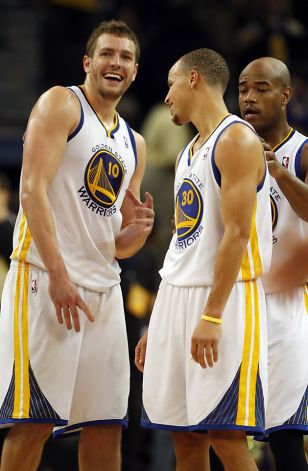
I live on the west coast, so I get the great pleasure of watching west coast teams play at a reasonable time—at least reasonable based on my 32-year-old/married standards. The straight up west coast options we have: Lakers, Clippers, Kings, Blazers, Suns and Warriors. The Lakers are a comedy of errors, a team without a collective identity even though they have players with well-defined identities. The Kings have really disappointed; particularly because of their decision not to re-sign Terrence Williams. I don’t care for the Blazers, but I do like some Nicolas Batum and Young Mr. Damian Lillard is pure joy—regardless of how you feel about point guards. The Suns are another laughable comedy routine on a nightly basis. Shannon Brown as your get buckets guy? It takes a rare NBA roster architect to devise that scenario. Then there are the Clippers and the Warriors, a couple of teams that are entertaining for entirely different reasons. The Clippers are potential-in-the-process-of-being-realized and this kind of maturation is so magnetic because we’re eagerly anticipating their ongoing improvement. Once the ceiling is reached, we can get bored because we’re simple people with short spans of attention living in a world full of attention grabbing experts. As a group, the Clippers are more fun than Golden State and yes, Chris Paul is the PG archetype, but there’s nothing human about Paul single-handedly demoralizing and discouraging defenses or Jamal Crawford heat checks or Blake Griffin or even Los Angeles for that matter. But up in Oakland? Oh, up north it doesn’t get much more human than Bogutian tragedy, the erosion of Andris Biedrins’ confidence, Brandon Rush’s torn ACL, David Lee’s around-the-basket intuitiveness (it’s still underrated) or Steph Curry’s nightly flirtations with basketball death, a dreaded Grant Hill career arc.

The crowd in Oakland pleads a great case for watching the Warriors, but Lee’s interior aptitude and the development of Harrison Barnes are entertaining too. The primary reason to watch, the main event … that’s Curry.  There’s a reason he’s still the (baby) face of the Warriors despite missing nearly 25% of his team’s games through his first three seasons (of course, part of that reason is that they were never able to find a trade partner willing to take on those papier-mâché ankles). They’re still going to war every night with Curry as their lead guard because the kid (he’s still just 24) is disruptively good and can get better.

I’m not positive if the NCAA’s and ESPN’s and Dick Vitale’s infatuations with Curry during his Davidson days soured me on him or if I was too distracted following the explosions of Monta Ellis (fiery spectacle one night, snap pops the next), but I only studied Curry from afar for his first few years. His ankle(s—was it both?) turned last season into one long, depressing sputter. And if it was frustrating for fans, imagine how Curry felt riding that physical and emotional roller coaster: special shoes, protective boots, ice bags on ice bags in ice baths, multiple doctors, fear that something’s wrong, that maybe it’s somehow his fault … failure; letting down your teammates, fans, the people who pay you huge checks to be on the court performing. So when he rolled his ankle (again!) in the pre-season, I think there was a part of me that lightly erased Curry from the NBA panorama. He wasn’t a ghost yet, but he was fading.

This is a terribly unfair thing to do, particularly given the steadily impressive performances of Curry’s first two seasons in the league which compare better than favorably with Derrick Rose’s and Russell Westbrook’s:

Advanced stats on top, per game on bottom

Advanced stats on top, per game on bottom

Not too many people put Curry in the same echelon as Rose and Westbrook and there are a couple of obvious reasons why:

  • The Third Season: While Curry spent his third season on crutches, in walking boots and enduring a bombardment of tests on his ankle(s), Westbrook and Rose made a motherfucking leap in theirs. Remember how similar these three guys were through their first two seasons? The third seasons created a massive chasm:
Per game stats

Per game stats

  • Playoff Appearances: Rose was a black NBA version of Rocky Balboa as a rookie when he led the 8th seed Bulls to a memorable seven-game series against the defending champion Boston Celtics in the opening round. Westbrook made a name more violently for his volatility—eruptions of athleticism versus decision making follies and the unique ability to forget Kevin Durant was on his team (and in the damn game!). Where Russell made the playoffs three of four years and has Rose has advanced to the postseason every year, the ill-fated Curry is still awaiting his first appearance.

I didn’t set out to write a story about how Steph Curry does or doesn’t compare favorably to two of the best young point guards in the game, it just organically occurred this way and I’m happy with that. Beyond the inconclusive stats we have above, the Curry I’ve seen this year is a smooth ball handler with great court awareness, passing ability and a hyper fast shot release. His handle is so much better than I realized, but it looks like he’s still figuring out how to fully utilize this skill. You see Rose and Westbrook combine their ball handling with raw speed and quickness: Rose more lateral quickness with the ball in-hand and Westbrook more straight ahead speed. Steph’s handle is so often used on the perimeter to keep defenders at bay instead of attacking with it. If and when he improves that part of his game, he’ll be able to create more space and get to the rim more frequently than he already does which would make him close to indefensible. Of course, the more he penetrates, I feel like the odds of rolling an ankle increase (is that true?).

So while the rest of you east coast and Midwest fans are sleeping away the nights or blowing rails just to stay up for the west coast games, your brothers and sisters on the left are settling in on couches and recliners from San Diego to Blaine with beers and green teas while our spouses and partners and roommates flit in and out, oblivious to our fascinations with a guy named Steph…and even more oblivious the fingers we have discretely crossed under a pillow or blanket, vainly hoping those tender ankles hold up.

Conquistadors in California, alternately: Channeling Emotion into Effectiveness: A Contrast of Blake Griffin and DeMarcus Cousins

Two of the league’s youngest, shiniest, brightest and most volatile stars are residing in the same Sunshine State and we all get the luxury of watching these mountains of agility, power and skill square off four times this season. I’m not talking about Dwight Howard (not that bright), Pau Gasol (not that young), Andrew Bogut (not that volatile) or DeAndre Jordan (just not enough). Blake Griffin and DeMarcus Cousins are captivating for what they’ve done in two short years and maybe even more for what they haven’t done; which is reach their stratospheric potentials.

Last night, Monday night, these two giants competed; not against each other, but for my attention. Big Cuz did his thing in Sacramento and went bananas during a third quarter stretch where he seemed to galvanize himself, his team and fans. His emotion rises in pitches and can be tracked by events: A blocked shot on the defensive end leads to Cousins making a face, a scowl that takes place while the 22-year-old barrels down the court, sprinting to get to the offensive end where his excitement almost results in turnovers, but instead it’s a hustle play, a jumper that extends the Kings’ lead and it’s followed by more sprinting and obvious satisfaction. There are sequences like this throughout the game: Cousins makes a layup, gets a steal on the other end and never missing a play, he gets a dunk going back the other way. He’s uplifted, raised to the rafters by a combination of his own energy (barely harnessed) and the sounds of the crowd urging him on, lifting him higher.

Down I-5 in Los Angeles, I focused of my attention on the Cavs-Clips game, Chris Paul vs. Kyrie Irving; which somehow turned into the Dion Waiters show. Point guard and ball handling clinics aside, I kept an eye on Blake Griffin; one of the league’s most recent poster boys. His face is more recognizable than Arian Foster’s, maybe better known than Mitt Romney among the 25-and-under set. And tonight he’s just OK. He catches lobs from CP3 that have a similar impact on the crowd as Cousins’ antics. The big difference is where Cousins wears his heart on his sleeve, unable to contain even the faintest emotion; wearing the worst poker face in the NBA, Blake is cool, expectant, nonchalant. In a deadpan tone, “I ferociously dunked on that man’s face, put him on a poster, got seven million views on YouTube, so what? It’s what I do.” And the crowd reveres him for it—it’s LA, it’s Hollywood, it’s cold, emotionless, unfeeling, sunglasses at midnight—swaggalicious! But it’s not enough tonight, the 20 points, the dunks, the improved post game, the passes, the increased defensive activity; it’s not enough and he ends the game with the poorest plus/minus of any Clippers player. The stat’s not all-indicative or all-encompassing, but it does tell us that the Clips were outscored when Blake was on the court tonight. The above isn’t to say that Griffin is emotionless. Rather, his furies are selective; taken out on rims and refs. A man can’t dunk with the aggression of Griffin without having something built up, pent up, bottled up…waiting to explode.

Griffin’s an embraceable face, a marketable style, a chiseled athlete that Subway and Kia throw wads of cash at in attempts to lure him into promoting their products. He’s rugged and competitive; he’s the perfect athlete to place on a pedestal. But DeMarcus? Last season he demanded a trade and (in a roundabout way) got his coach fired. To casual fans, he’s known as much for his outbursts and tantrums as he is for his dominant play and potential. To the unknowing, he’s the enfant terrible. How much of is this fueled by anger compared to immature indiscretion is impossible to know, but it’s fair to assume both parts sources drive Cousins’ madness.

And of course these two young innocents have exchanged words and occasional elbows on the court. After a physical game last season, Cousins called Griffin an “actor” and said the NBA “babies” him. Griffin responded with some jokes and questioned Cousins’ reputation. It was a nice tit for tat that can link players together through the media while driving them apart as people and potential teammates (all-star games, Olympics).

Despite Griffin developing somewhat of a reputation as being one of the league’s golden children (especially from a marketing and advertising perspective), he’s simultaneously becoming known for his flopping and posturing. He’s prone to the extended stare after a big play, the glare after a hard foul; he can be seen as a tough guy who doesn’t back it up. If you’re a Clippers or Griffin fan, you see him getting under the skin of his opponents, helping his team win while maintaining his cool. His cool is part of his being, part of his on-court persona and skill set. Given his effort and physicality, it’s hard to make a case that his cool results in any on-court detachment. This is where the primary break with DeMarcus occurs. Where Griffin’s immaturity and petulance are merely annoying for fans and opponents, Demarcus’s antics and eruptions are distracting for him and his teammates. He’s battling the refs, battling opponents, battling coaches and worst of all, fighting himself.

At risk of delving into a wormhole of sociological speculation, I’ll only briefly touch on the drastic life differences these two young men endured growing up. Griffin was raised in a two-parent home in Oklahoma; one where he was homeschooled until eighth grade and played for his father in high school. Alternately, Cousins grew up in a single-family household, attended multiple high schools in Alabama and steadfastly refused to take any responsibility for his behavior. A fully fleshed-out essay could easily be built around the differences in their childhoods and the challenges they face today as a result, but other than this brief review, I’d rather stick to the men we’re dealing with today, not yesterday.

Literally speaking of yesterday, I watched Griffin and questioned whether or not he’d actually developed over his first couple seasons. While Cousins’ statistical arrow is pointed straight up, Griffin’s stats have been slightly, but steadily, dipping down. Looking at it from a purely statistical standpoint or even watching the games, you can see Griffin’s impact isn’t what it was when he was a rookie. Meanwhile, Cousins has become the heart, soul, tears and pulse of this Kings team. Instead of looking at this as Griffin already reaching his ceiling, it’s not as simple as that. Both players are filling a void on their respective teams. In Los Angeles, Chris Paul has revised the climate from the Blake Show to a CP3-led, guard-initiated attack. It begins and ends with Paul; an on-the-court general; one of the league’s most intense competitors who’s willing do whatever (ask Julius Hodge) it takes to win. The team (Blake included) has followed his lead. Griffin’s learned to play off of his PG, drifting towards the basket on CP’s defense-collapsing drives, hitting the offensive boards on CP misses or kick out misses, he takes advantage of slower fours by hitting what’s become an improved mid-range jumper. In Sacramento, as Tyreke Evans has either plateaued or regressed, Cousins has taken on the role of catalyst. When Paul Westphal was fired last season, it was evident there was a Westphal-Cousins conflict and new coach Keith Smart was wise to tap into the mercurial big man’s psyche and give him the confidence and latitude to succeed—which he clearly did last year: 4th overall in rebounds/game, only center to finish in the top-20 in steals/game, 3rd in TRB%, led all centers in usage rate. Cousins arrived with heavy footsteps and swinging limbs, announcing his arrival to anyone in earshot or sight.

None of this is to say one player is better than the other, but rather each player’s giving his team exactly what they need. CP3 might be the Clips’ version of Jean-Luc Picard, but Blake is the swag, the electricity, the vitality. And Cousins fulfills both of those roles in Sacramento…because that’s what he has to be for them to have any chance of success. These kids leave everything on the court every time they play. They play, they care, they’re upsettable, excitable, irritable, irrationally talented. And for all their differences (vertical vs. horizontal, NoCal vs. SoCal, one-parent vs. two-parent, stability vs. volatility), they have just as much in common, although both would probably puke if they had to admit it.

Tale of the Tape

How did we get here? (aka, a Lakers Chronicle)

The saga, the nightmare, the Dwightmare, the annoying story that mercilessly dominated NBA headlines for over a year, the Jason Voorhees of NBA rumors … it’s finally over; for now at least. The deal was consummated a week ago. Dwight Howard ends up in Los Angeles, Andre Iguodala in Denver, Andrew Bynum in Philly and Orlando gets a whole lot of spokes, but no axels. Us? We get much-deserved respite.

But all this hype and distraction got me wondering: How did we get here? And to answer that question, I went back to Wednesday, June 26th, 1996.  I was nothing but 15-years-old, likely surviving a hot Midwest summer in Des Moines. Impossible-to-predict twists and decisions led me from that summer day to a couch in Seattle where I sit writing this now. Equally strange turns have led to the Lakers building a squad that on June 26th, 1996 was impossible to imagine:

Kobe Bryant: After witnessing Kobe chew up Laker vets Michael Cooper and Larry Drew, Lakers GM Jerry West went all in (by “all in,” I’m referring to his effort not Vlade Divac; who he traded to get Kobe’s rights) to get the young Jedi master. The rest is basketball history. Like any 16-year relationship, there have been bumps along the road and breakup talk (do you even love me anymore?), but even if the spark burned out long ago, the marriage still makes too much sense. And so it is that Kobe has spent the duration of his 16 years with the same team and the majority of that time as the face of franchise. His journey to the current incarnation of the Lakers is less interesting than the rest of his teammates. The most interesting aspect of Kobe-to-the-Lakers is how agent Arn Tellem and Jerry West strong-armed the rest of the league out of drafting him—looking at you John Calipari.

Steve Nash: Two picks after Charlotte scooped up Kobe for Los Angeles, the Suns drafted a Canadian point guard who developed a knack for clutch play at Santa Clara University. The rookie Nash was not the swashbuckling, age-defying Canadian icon we know him as today. It took him several years, a visionary coach and a return to his second home in Phoenix to become the Nash so many people have fallen in love with: shaggy-haired, fearless competitor, ultimate giver and sympathetic superstar. Whether it’s the media, his opponents or fans, it seems like we all love Steve Nash. His resistance to bailing from a fading Suns franchise did nothing but endear him to us: “He’s so loyal!” Nash is no Jesus, but if he turned water to wine, I think people would just look at each other and say things like, “Well, it is Steve Nash,” then nod and move on to Anderson Cooper and dinner plans. Religious comparisons aside; after the Lakers-Suns battles of yore, the Lakers seem like the last team Nash would want anything to do with. But then, like thieves in the night, the Lakers, Suns owner Robert Sarver and Nash himself came to an agreement that had something to do with family and the pursuit of immortality. I don’t know if oaths were made or signatures signed in blood, but all of a sudden the two most-decorated members from the decorated class of ’96 were teaming up for what appears to be a final run at glory (potential book title there).

Dwight Howard: This guy. I’ve always had personal issues with how Dwight handles himself and it’s obvious that it’s my issue and not his. But this giant goofball, this part-time impersonator, this wannabe Shaq, this bane of Twitter’s existence somehow ended up on the Lakers last week. Dwight was just ten-years-old when Kobe joined the Lakers; a burgeoning athlete, he was just starting out on a path that would lead to him joining forces with Kobe and Steve Nash 16 years later. In the interim, he’s grown from that little boy with hoop dreams to a massive physical specimen; capable of lifting cars, dunking on 12-foot-hoops and a potpourri of other feats of athleticism and strength. When he finally became the Dwight we know today (this occurred at some point during his stay in Orlando), he revealed himself to be a playful joker who craves attention and pleasing people around him. This might be speculation, but over the past year where’s continually elbowed and sound-bit his way into the spotlight, we’ve learned a lot about the NBA’s best big man and it’s not all good. He made it clear he didn’t want to be in Orlando, then rescinded and professed loyalty, then demanded departure again. His love-affair with Brooklyn bordered on juvenile (“It’s my Brooklyn and I want it now!”) and exposed Dwight’s inability to understand NBA salary cap rules. It was always Brooklyn or bust for the big man and now that he’s landed on bust, it’ll be interesting to see how he settles in to his new town with his new friends. Kobe and Nash are a long way from Jameer Nelson and Jason Richardson.

Antawn Jamison: Oh sweet Antawn. When I think about Antawn Jamison, I picture those thick eyebrows lying above dark focused eyes, a head that was made to be cleanly shaven and game that consists of equal parts talent and equal parts hard hat mentality. I recall his Tar Heel partnership with the young Vince Carter and how he came out of nowhere (although this is mostly impossible given that he was on UNC’s squad) and dominated the ACC when it was the best college basketball conference in the world. As a productive non-superstar, he’s enjoyed (hopefully) being a sought-after commodity—the last piece on teams looking to get over the hump. And now he’s settling into what could be the final act of his oak solid career as the 6th Man on the Los Angeles Lakers. Back in ’96 when Kobe and Nash were being drafted, it was obvious he would end up in the league one day; it’s just tough to have envisioned him in this role at this time with these guys.

Metta World Peace, aka Ron Artest: Ron Ron was just 16-years-old when Kobe arrived in Lakerland. Based on the interviews he’s given and the backstory we know, he was conceivably roaming around Queensbridge ducking and dodging the scenes straight out of Mobb Deep and Nas. He made it out though and has had the most colorful voyage of all the current Lakers: Name changes, suspensions, therapists, elbows, brawls, rap albums and so much more shit that most of us probably can’t digest. That MWP made it to the Lakers actually seems more like a foot note than its own chapter in what’s just another pit stop on the unorthodox road of his biography.

Pau Gasol: Kobe’s longest-standing sidekick (unless you consider Mitch Kupchak as a Kobe-sidekick); Pau has been something of a whipping boy since he arrived in Los Angeles back in 2008. Whether it was KG and Perkins in the Finals or Kobe’s overused ice cold stares of disgust after Gasol failed (yet again!) to read Kobe’s mind; someone’s always got beef with Gasol’s heart and soul. It doesn’t matter that he was traded for his brother and a future murderer (allegedly). What matters is that Gasol is, and always has been, underappreciated. His name was kicked around in trade rumors like a deflated soccer ball and he was even traded to Houston in that bizarre Chris Paul deal (we still remember, Stern). But now that Bynum’s gone, it looks like Gasol can finally get the restful sleep and peaceful life he deserves.

I’ve always thought it begins and ends with Kobe, but Dwight changes all that. The future only ends darkly and you have to wonder how smoothly any Dwight Howard ascendance happens. Will Kobe pass the torch along with a smile and a sixth ring or will a triumvirate of Jim Buss, Mike Brown and Dwight pry it out of his arthritic fingers while simultaneously kicking him to foreign shores to wrap up his basketballing career? Or will the misery of all miseries come crashing down around us in waves of Dwight Howard free agent rumors? Pray for us all …

Day Three: What these Hands hath Wrought

Alright, today’s post is a consolidation of madnesses from Sunday and Monday; and make no mistake it has been mad; at least someone’s mad. We’ve witnessed referee’s being loosely assaulted, Caron Butler breaking his hand, an impossible 27-point comeback and Amar’s Stoudemire punching out a pane of glass and in the process shredding his hand. If you’re not getting kicked out of games or getting hurt, you’re not doing your part.

Utah at San Antonio, game one, Spurs won 106-91, lead 1-0: Tony Parker did that Tony Parker thing he does where he uses speed and timing to invade the opposition’s defense at will. That the Spurs now play to his strengths instead of Duncan’s is impressive and a credit to all parties involved. The Jazz took one of four games against the Spurs in the regular season and will be fortunate to do better in the playoffs.

Random fact: Gordon Hayward attempted a career-high twelve free throws in game one and hit all twelve.

Denver at Lakers, game one, Lakers won 103-88, lead 1-0: Andrew Bynum is big, tall, long, talented, occasionally immature and more. To the Nuggets, he was the boogeyman in the paint, a giant protecting his lair. Ten blocks in the playoffs? Tied Hakeem Olajuwon and Mark Eaton for most blocks in playoff game history? Yep, that’s Andy. While Dwight’s temporarily crippled by a herniated disc, Bynum looks like an invincible force doing battle with children.

Random fact*: Devin Ebanks is actually Trevor Ariza.

Boston at Atlanta, game one, Hawks won 83-74, lead 1-0: It was yet another battle in years’ worth of battles for these two franchises. The Hawks overcame a historically dismal shooting performance from Joe Johnson (see random fact below) to control this game and hang on for the win. The story that ruled the day was Rajon Rondo’s little chest bump into the ref. The timing and reaction were both overboard and could result in Boston dropping into a 0-2 hole. With Ray Allen’s health in question, the momentum Boston had built in March and April is vanishing in acts of immaturity and inevitability.

Random fact: Joe Johnson joined three other players in playoff history in three-point shooting ignominy with his 0-9 performance. His fellow culprits: John Starks, Rashard Lewis and Derrick Rose.

Clippers at Memphis, game one, Clippers won 99-98, lead 1-0: Watching this game was like watching a movie where you expect one thing to happen, but then the director/writer throws a knuckleball that leaves you disoriented and questioning the events of the previous two hours. Did it add up? Was it believable? Did I enjoy being befuddled or did the director just play a joke on me? There wasn’t a script to Sunday night’s game unless the big director in the sky is a Nick Young fan. What happens from here is anyone’s guess, but I can confidently say the Memphis Collective (players, coaches, fans, employees) looked helplessly nauseous in that fourth quarter.

Random fact(s): Reggie Evans’s 13 rebounds in 21 minutes put him in rare company with five other prolific playoff rebounders who’ve grabbed at least 13 boards in 21 minutes or less: Danny Schayes (14 in 21), Kurt Rambis (14 in 21), Scot Pollard (14 in 21), Jeff Foster (13 in 21), Maurice Lucas (14 in 19).

New York at Miami, game two, Heat won 104-94, lead 2-0: Once again, anger steals the headlines. Amar’e Stoudemire didn’t take too well to the Knicks’ second straight loss in Miami and took it out on a pane of glass covering a fire extinguisher. David Aldridge proceeded to take the event far too seriously, treating it more like Stoudemire had severed his femoral artery and was at risk of bleeding out instead of addressing it for the loss of control that it was. All this really does it take away the focus from what was another strong Miami performance and further reinforced the fact that the Knicks are simply overmatched the way blind Chinese dissidents are powerless against their government … oh, wait.

Random fact: Miami Heat nicknames: Mike Miller is “Slim,” Juwan Howard is “Nooky,” James Jones is “Jhoops” (which is actually pronounced “Joops” as the “h” is silent)

Orlando at Indiana, game two, Pacers won 93-78, tied 1-1: This game is being relegated to the NBA TV slot which essentially makes it the least interesting series in the playoffs. Ratings considerations aside, Monday night’s game was the familiar storyline of a tale of two halves. After falling behind by two at the half and being firmly bullied, the Pacers responded appropriately with a 30-13 third quarter. I wish things were different, but I struggle to find intrigue in this series.

Random fact: The Pacers are 33-2 on the season when leading after three quarters.

Dallas at OKC, game two, OKC won 102-99, up 2-0: Combined score after two games 201 – 197. The Mavs have had their chances, but unlike last season when they couldn’t miss in crunch time, Dirk and Jason Terry have come up short two games in a row and are dangerously close to seeing their title defense end early. Being pushed to the brink is nothing new for this Dallas crew, but in small spaces of their group consciousness, questions are being asked. Notable observations:

  • I’m not a Brendan Haywood fan, but the more I see him, the more I feel Shaq was justified in referring to him as “Brenda.”
  • Does Billy Hunter watch NBA games and if so, does he openly cheer against Derek Fisher? If the answer to either of those questions is yes, last night had to be particularly bitter for him.

Random fact: Miniscule sample size for sure, but through two playoff games, Kevin Durant is shooting 34% from the field compared to 52% for Russell Westbrook.

And that concludes three days of playoff basketball. We’ve had anger, controversy, pain and loss. Negativity is the overwhelming theme and I look forward to exploring the more affirmative aspects of these games in the coming days.